Creatio Review 2026
Low-code CRM platform offering Sales and Marketing modules with workflow automation and process management capabilities.
Key Takeaways
- Agentic platform combining CRM and no-code: Creatio merges traditional CRM (sales, marketing, service) with AI agents and no-code workflow automation in a single platform -- you're not bolting AI onto an old CRM, you're building workflows and agents together from the ground up.
- Recognized by Gartner and Forrester: Only Leader in the 2024 Forrester Wave for Low-Code Platforms for Citizen Developers, and a Leader in Gartner's 2025 Magic Quadrant for B2B Marketing Automation for five consecutive years. Also a Visionary in Gartner's 2025 Sales Force Automation MQ.
- Pricing starts at $15/user/month per module: Sales, Marketing, and Service modules are each $15/user/month individually. Enterprise edition bundles everything at $105/user/month. Platform-only access is $55/user/month.
- Built for enterprise scale: Clients like Howdens deployed for 7,000 users across 800 locations in 12 weeks. BSN Sports runs end-to-end CRM for 2,600 users with just three admins.
- Strong on automation, light on AI content optimization: Creatio excels at workflow automation and process management but doesn't offer AI-driven content creation or optimization tools for external visibility (like SEO or AI search ranking).
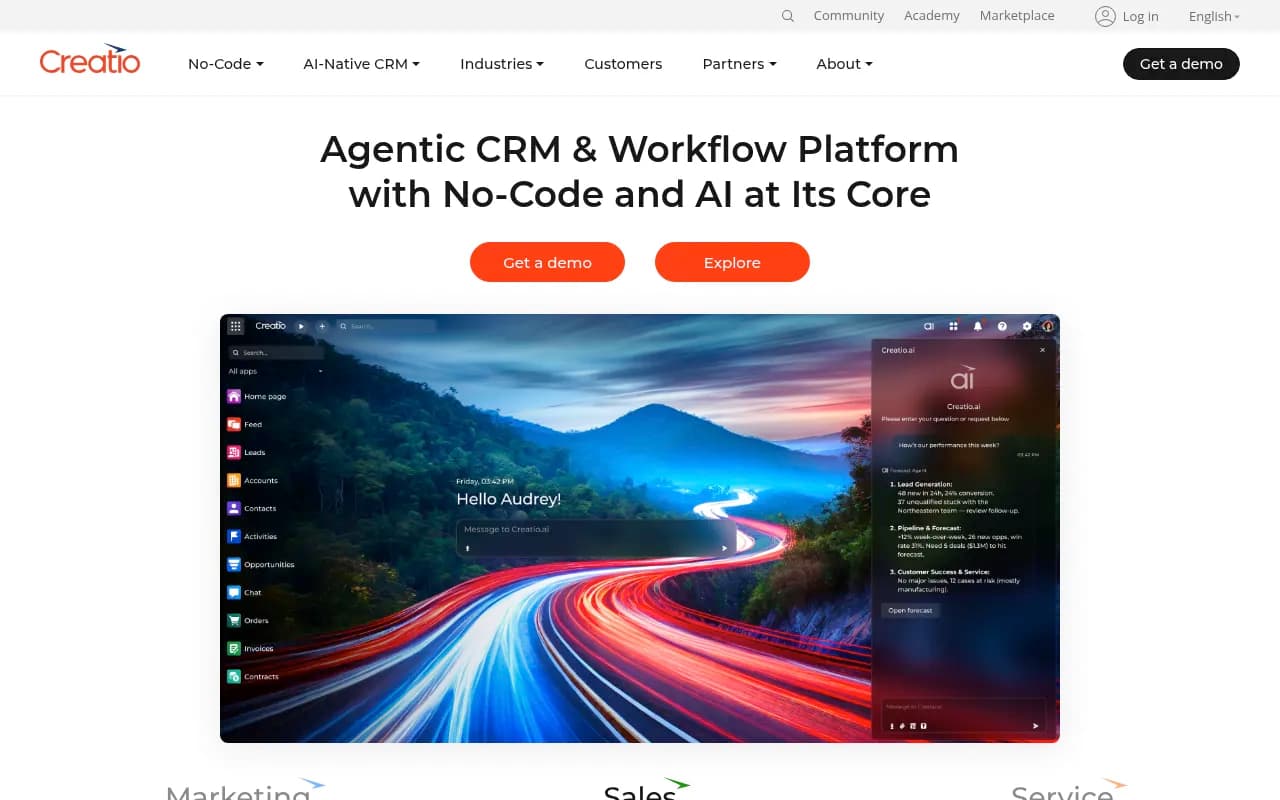
Creatio is a no-code CRM and workflow automation platform that positions itself as an "agentic" system -- meaning it combines traditional CRM modules (sales, marketing, service) with AI agents that can autonomously handle tasks like lead qualification, case routing, and meeting prep. Founded as bpm'online in 2014 and rebranded to Creatio in 2018, the company is based in Boston with development centers in Eastern Europe. It's used by over 10,000 organizations globally, including AMD, Nasdaq, MetLife, Colgate, and the City of Boston.
The core pitch: double your team's productivity without hiring more people. Creatio claims marketing teams can achieve twice the impact with the same budget, sales teams can double productivity with no extra headcount, and service teams can resolve twice as many cases twice as fast. These are bold claims, but they're backed by case studies -- BSN Sports increased average order size by 60%, Purplebricks grew leads by 35% and conversion by 50%, and Howdens deployed an enterprise solution for 7,000 users in just 12 weeks.
What makes Creatio different from Salesforce or HubSpot
Most CRMs are databases with workflows tacked on. Creatio is the opposite -- it's a workflow automation platform with CRM modules built on top. The underlying architecture is a no-code/low-code application platform (Creatio Studio) that lets you build custom apps, AI agents, and automated processes using visual designers and natural language prompts. You're not customizing a CRM -- you're building workflows that happen to include CRM data.
This matters because traditional CRMs force you into their data model and UI. Want to add a custom approval flow? You're writing Apex code in Salesforce or hiring a developer. In Creatio, you drag and drop process steps in a visual designer or describe what you want in plain English and the AI generates the workflow. The platform then deploys it as a native app.
The AI agent layer is newer (2024-2025 rollout) but already integrated. You can build agents that autonomously qualify leads, prepare meeting briefs, route service cases, or update records based on triggers. These aren't chatbots -- they're background workers that execute multi-step processes without human intervention. For example, a lead qualification agent can score inbound leads, enrich data from third-party sources, assign to the right rep, and schedule a follow-up call, all before a human touches it.
Core modules: Sales, Marketing, Service
Sales Creatio: Full sales force automation with lead and opportunity management, account and contact records, forecasting, and pipeline tracking. The standout feature is guided selling -- reps follow predefined workflows for each deal stage, with automated next-step recommendations and required actions. This reduces ramp time for new hires and keeps deals moving. Mobile app included. Integrates with Outlook, Gmail, and calendar systems for email tracking and meeting sync.
Marketing Creatio: B2B marketing automation with campaign management, lead scoring, email marketing, event management, and multi-channel nurture tracks. The visual campaign designer lets you build drip sequences, A/B tests, and trigger-based workflows without code. Lead scoring is rule-based (not AI-driven) but flexible -- you define point values for actions like email opens, form fills, or page visits. Includes landing page builder and form designer. Integrates with Google Ads, Facebook Ads, and webinar platforms.
Service Creatio: Case management, knowledge base, SLA tracking, and omnichannel support (email, chat, phone, social). The case routing engine uses rules and AI to assign tickets to the right agent based on skills, workload, and priority. Self-service portal lets customers submit cases and search the knowledge base. Includes satisfaction surveys and CSAT tracking. Integrates with telephony systems and chat widgets.
Each module can be purchased standalone at $15/user/month or bundled. The Enterprise edition ($105/user/month) includes all three modules plus advanced features like multi-brand support, custom roles, and API access.
Creatio Studio: The no-code engine
This is where Creatio separates from traditional CRMs. Studio is a full application development environment with three main tools:
- Process Designer: Visual workflow builder with drag-and-drop elements (tasks, gateways, timers, integrations). You map out business processes as flowcharts, then Creatio executes them. Supports parallel branches, conditional logic, and loops. Common use cases: approval workflows, lead routing, onboarding sequences, compliance checks.
- Page Designer: Build custom UI screens and forms without code. Drag fields, buttons, and widgets onto a canvas, set visibility rules and validation logic, then publish. Pages can be embedded in the CRM modules or deployed as standalone apps.
- Data Designer: Define custom objects (tables) and relationships. You're not limited to standard CRM entities -- create objects for projects, assets, contracts, whatever your business needs. Set field types, validation rules, and access permissions.
The AI layer (new in 2024) adds natural language generation. Describe a workflow in plain English ("When a lead fills out the contact form, score them, enrich with Clearbit data, assign to the right rep based on territory, and send a Slack notification") and Creatio generates the process flow. You can then refine it visually. This is genuinely useful for non-technical users -- you don't need to know how to structure a workflow, just what you want it to do.
AI agents: Autonomous task execution
Creatio's AI agents are background workers that execute multi-step processes autonomously. They're not chatbots or copilots -- they don't interact with users directly. Instead, they monitor triggers (new lead, case escalation, deal stage change) and take action based on predefined logic.
Example agents:
- Lead qualification agent: Scores inbound leads, enriches data from third-party sources, assigns to the right rep, schedules follow-up.
- Meeting prep agent: Pulls account history, recent interactions, open opportunities, and generates a briefing doc before a sales call.
- Case routing agent: Analyzes case content, checks agent availability and skills, assigns to the best match, escalates if SLA is at risk.
- Data hygiene agent: Finds duplicate records, merges them, flags incomplete data, updates fields from external sources.
You build agents using the same visual designer as workflows. Define the trigger, add steps (API calls, data lookups, conditional logic), set the output. Agents run in the background and log their actions for audit trails.
The AI model powering agents is not disclosed (likely OpenAI or a similar LLM) but it's embedded natively -- you don't need to connect your own API keys or manage infrastructure. Creatio handles the orchestration.
Integrations and ecosystem
Creatio integrates with 700+ apps via pre-built connectors and a REST API. Key integrations:
- Email and calendar: Outlook, Gmail, Exchange, Office 365. Two-way sync for emails, meetings, and contacts.
- Marketing: Google Ads, Facebook Ads, LinkedIn Ads, Mailchimp, Constant Contact, Zoom, GoToWebinar.
- Telephony: Twilio, RingCentral, Aircall, Five9. Click-to-call, call logging, and recording.
- Data enrichment: Clearbit, ZoomInfo, LinkedIn Sales Navigator.
- Collaboration: Slack, Microsoft Teams, Jira, Asana.
- ERP and finance: SAP, Oracle, NetSuite, QuickBooks.
The Creatio Marketplace offers 700+ pre-built apps and connectors built by partners and the community. These range from industry-specific modules (insurance claims, loan origination) to utility tools (document generation, e-signature, SMS).
API access is included in the Enterprise edition. The REST API supports CRUD operations on all objects, workflow triggers, and data queries. Webhooks available for real-time event notifications. SDKs for .NET and JavaScript.
Who is Creatio for
Creatio targets mid-market and enterprise B2B companies (100-10,000 employees) in industries with complex sales cycles and heavy process requirements. Strongest in:
- Financial services: Banks, credit unions, insurance companies. Creatio has pre-built workflows for loan origination, claims processing, and compliance.
- Manufacturing and distribution: CPG, industrial equipment, wholesale. Use cases include dealer management, order processing, and warranty tracking.
- Professional services: Consulting, legal, accounting. Project-based workflows, resource management, and client onboarding.
- Public sector: Government agencies, nonprofits. Grant management, constituent services, and compliance tracking.
The platform is overkill for small businesses (under 50 employees) or teams that just need basic contact management. It's also not ideal for B2C companies with high-volume, low-touch sales -- the workflow automation is built for complex, multi-step processes, not transactional sales.
Typical buyer: VP of Sales Operations, CRM Administrator, or IT Director looking to replace Salesforce, Microsoft Dynamics, or SugarCRM. They're frustrated with customization costs, long implementation times, or rigid workflows. Creatio appeals because it promises faster deployment, lower TCO, and more flexibility.
Deployment and implementation
Creatio offers cloud (SaaS) and on-premise deployment. Cloud is the default and recommended option -- hosted on AWS with data centers in the US, EU, and Asia-Pacific. On-premise is available for enterprises with strict data residency or security requirements.
Implementation typically takes 8-16 weeks for a full CRM rollout with custom workflows. Creatio provides implementation services (starting at $15,000) or you can work with one of 700+ certified partners. The partner network is strong in Europe and North America but thinner in Asia and Latin America.
The platform includes a built-in academy with training courses, certification programs, and a community forum. Documentation is thorough but dense -- expect a learning curve for admins building complex workflows.
Pricing and value
Creatio's pricing is modular:
- Sales, Marketing, or Service module: $15/user/month each (billed annually). Buy one, two, or all three.
- Platform access (Studio only): $55/user/month. For users who only need to build apps and workflows, not access CRM modules.
- Enterprise edition: $105/user/month. Includes all three CRM modules, Studio, advanced features (multi-brand, custom roles, API access), and priority support.
All plans include unlimited records, storage, and workflows. No per-contact or per-email pricing like HubSpot or Marketo. AI agent usage is included in the platform fee (no per-agent or per-execution charges as of early 2026).
Compared to Salesforce (starts at $25/user/month for basic CRM, $165/user/month for Sales Cloud with automation), Creatio is cheaper upfront. But Salesforce has a larger app ecosystem and more third-party integrations. Compared to HubSpot (free CRM, $800/month for Marketing Hub Professional), Creatio is more expensive but offers deeper workflow automation and no contact-based pricing.
The value proposition is strongest for companies that need heavy customization. Salesforce customization can cost $50,000-$200,000 for a mid-sized deployment. Creatio's no-code approach lets you build the same workflows in-house for a fraction of the cost.
Strengths
- True no-code workflow automation: The visual process designer is genuinely usable by non-developers. You can build complex, multi-step workflows without writing code.
- Unified platform: CRM, workflow automation, and AI agents in one system. No need to stitch together Salesforce + Zapier + custom scripts.
- Fast deployment: Case studies show 12-16 week implementations for enterprise-scale rollouts. Salesforce projects often take 6-12 months.
- Modular pricing: Pay only for the modules you need. No forced bundles or per-contact fees.
- Strong analyst recognition: Leader in Forrester's Low-Code Wave, Leader in Gartner's Marketing Automation MQ, Visionary in Sales Force Automation MQ. This is rare -- most platforms are strong in one category, not three.
Limitations
- Smaller ecosystem than Salesforce: 700+ marketplace apps vs. Salesforce's 3,000+ AppExchange listings. Fewer niche integrations and industry-specific solutions.
- Learning curve for admins: The no-code tools are powerful but not simple. Building complex workflows requires training and practice. Expect 2-4 weeks for a new admin to become productive.
- AI agents are new: The agentic features launched in 2024 and are still maturing. Documentation is thin and best practices are still emerging. Early adopters report trial-and-error in agent design.
- Limited AI content capabilities: Creatio's AI focuses on workflow automation and task execution. It doesn't offer AI-driven content generation, SEO optimization, or tools to improve visibility in AI search engines like ChatGPT or Perplexity. For companies looking to optimize their content for AI search results or track brand mentions in LLMs, a platform like Promptwatch would be a better fit.
- Weaker in B2C: The platform is built for complex B2B processes. If you're running high-volume, transactional sales (e-commerce, retail, consumer apps), tools like HubSpot or Salesforce Commerce Cloud are better suited.
Bottom line
Creatio is the right choice for mid-market and enterprise B2B companies that need deep workflow automation and don't want to hire a Salesforce consulting firm. It's particularly strong in financial services, manufacturing, and professional services where processes are complex and customization is non-negotiable. The no-code approach delivers real value -- you can build and deploy workflows in days instead of months, and the modular pricing keeps costs predictable. The AI agent layer is promising but still early -- expect to experiment and iterate. If you're a small business or need a simple CRM, look elsewhere. But if you're replacing Salesforce or Dynamics and tired of customization costs, Creatio is worth a demo.
Tags:
Similar and alternative tools to Creatio