Key takeaways
- Yolando positions itself as an end-to-end GEO/AEO solution, but several strong alternatives exist depending on your budget, team size, and whether you need monitoring, content generation, or both.
- Most platforms in this space are monitoring-only dashboards. Only a handful help you act on what you find.
- Promptwatch is the only platform rated a "Leader" across all categories in a 2026 comparison of 12 GEO tools, and the only one that closes the full loop from gap analysis to content generation to traffic attribution.
- Profound leads for enterprise analytics depth. Peec AI is the simplest option for smaller teams. Otterly.AI and Airefs are the most affordable entry points.
- If you're an agency, Cairrot is worth a look for its pricing model. If you need workflow automation alongside GEO, AirOps is in a category of its own.
The AI search landscape has moved fast. ChatGPT, Perplexity, Google AI Overviews, and a dozen other generative engines now answer questions directly, and if your brand isn't being cited in those answers, you're effectively invisible to a growing chunk of your potential audience. Yotpo research from early 2026 found that ChatGPT e-commerce traffic converts at a 31% higher rate than traditional organic search. Paid click-through rates on queries with AI Overviews have dropped 68%. The stakes are real.
Yolando entered this space as an end-to-end AEO and GEO platform, covering monitoring, content strategy, and optimization in one place. It's a solid tool. But it's not the right fit for everyone, and the category has gotten genuinely competitive. This guide breaks down the best alternatives, what each one actually does well, and where each falls short.
Why people look for Yolando alternatives
Yolando's pitch is the complete workflow: discover which AI prompts matter, track your brand's visibility across LLMs, and optimize your content accordingly. That's a compelling story. But a few things push teams to look elsewhere:
- Pricing can be hard to justify for smaller teams or single-site operators who only need monitoring.
- Some users want deeper analytics than Yolando provides, particularly around prompt volume data and competitor breakdowns.
- Agencies managing multiple clients often need more flexible seat and site limits.
- Teams that already have a content workflow want a tracker that integrates cleanly rather than a platform that tries to own everything.
None of these are dealbreakers for everyone, but they explain why the alternatives below each have a real audience.
The best Yolando alternatives in 2026
Promptwatch — best overall for teams that want to act, not just monitor
Promptwatch is the most complete platform in this category right now. It monitors 10 AI models (ChatGPT, Perplexity, Claude, Gemini, Grok, DeepSeek, Copilot, Meta AI, Google AI Overviews, and Google AI Mode), but what separates it from most competitors is what happens after monitoring.
The Answer Gap Analysis shows you exactly which prompts competitors rank for that you don't. The built-in AI writing agent then generates articles, listicles, and comparisons grounded in real citation data from 880M+ citations analyzed. You're not getting generic content — you're getting pages engineered to get cited by specific AI models. Then page-level tracking shows whether those pages are actually getting picked up, and traffic attribution (via code snippet, GSC integration, or server log analysis) connects visibility to revenue.
That full loop — find gaps, create content, track results — is what most platforms skip. Promptwatch also includes AI crawler logs showing which pages ChatGPT, Claude, and Perplexity are actually reading on your site, Reddit and YouTube citation tracking, ChatGPT Shopping monitoring, and prompt volume and difficulty scoring.
Used by 6,700+ brands and agencies including Booking.com and Center Parcs. Pricing starts at $99/month.

Profound — best for enterprise analytics depth
Profound is the go-to for teams that live in dashboards. Its reporting is genuinely deep: prompt-level visibility breakdowns, share-of-voice comparisons, and detailed competitor analysis. It's popular with larger marketing teams and agencies that need to present AI visibility data to stakeholders.
The limitation is that Profound is primarily a monitoring and analytics platform. It doesn't generate content or help you fix the gaps it finds. You'll need a separate content workflow to act on the insights. For teams that already have that workflow, it's excellent. For teams that don't, it adds friction.
Peec AI — best for simplicity and multi-language tracking
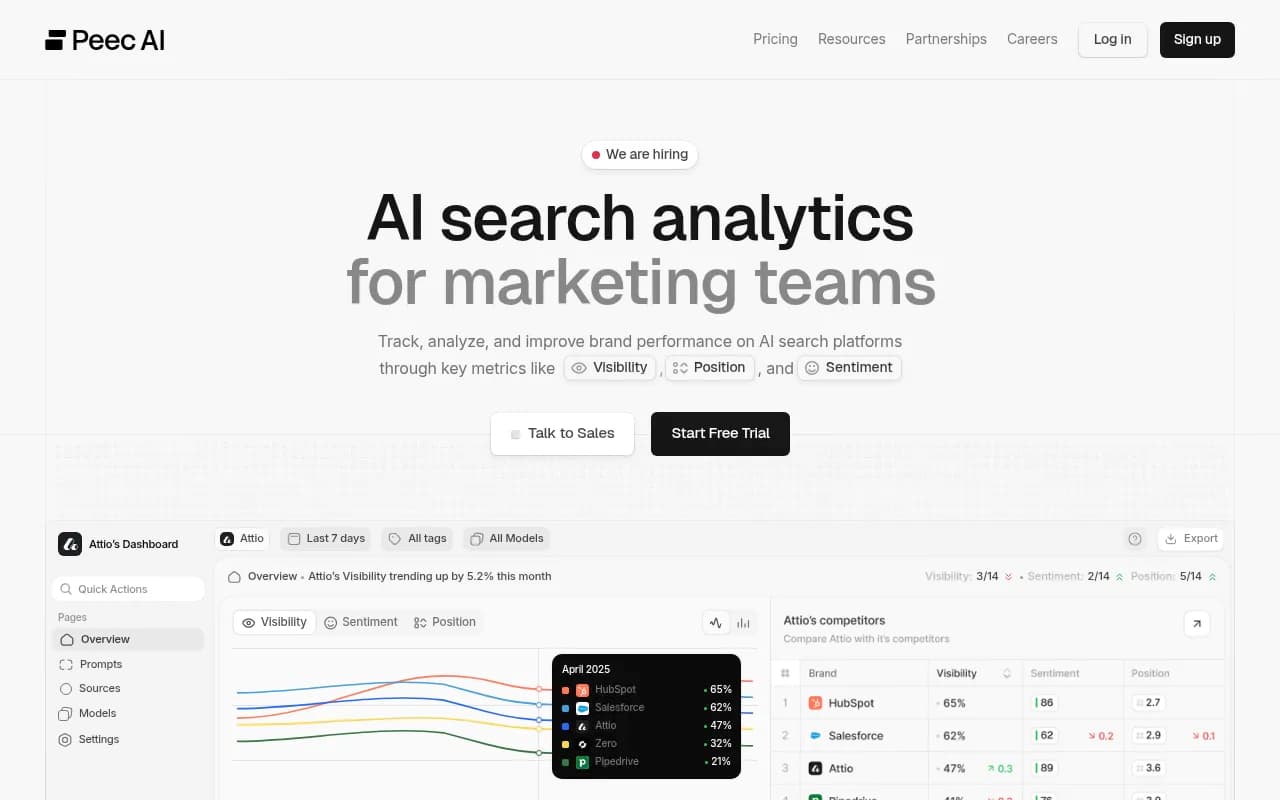
Peec AI is built for smaller teams and international brands. The interface is clean, setup is fast, and it supports monitoring across multiple languages and regions without the complexity of enterprise platforms. If you're a mid-sized brand that needs to track AI visibility in French, German, or Spanish markets, Peec AI handles that well.
It doesn't have the depth of Profound or the action capabilities of Promptwatch, but it doesn't pretend to. It's a focused monitoring tool at a price point that makes sense for SMBs.
Otterly.AI — best budget entry point
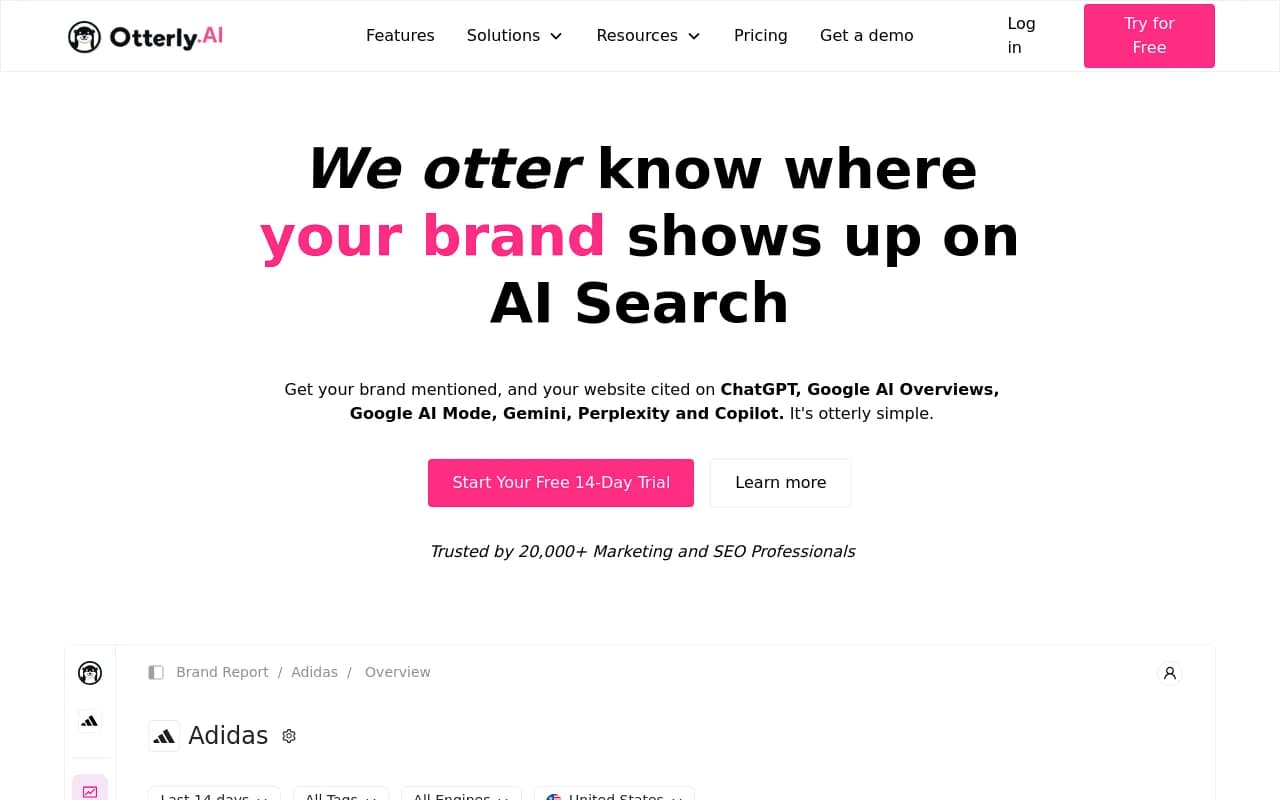
Otterly.AI is the most accessible option in the category. It tracks brand mentions across major AI models and gives you a basic visibility score. For teams that are just getting started with AEO/GEO and want to understand the landscape before committing to a more expensive platform, it's a reasonable starting point.
The ceiling is low, though. No content generation, no crawler logs, no traffic attribution. It's a monitoring dashboard and nothing more. Fine for early exploration, limiting once you want to actually improve your visibility.
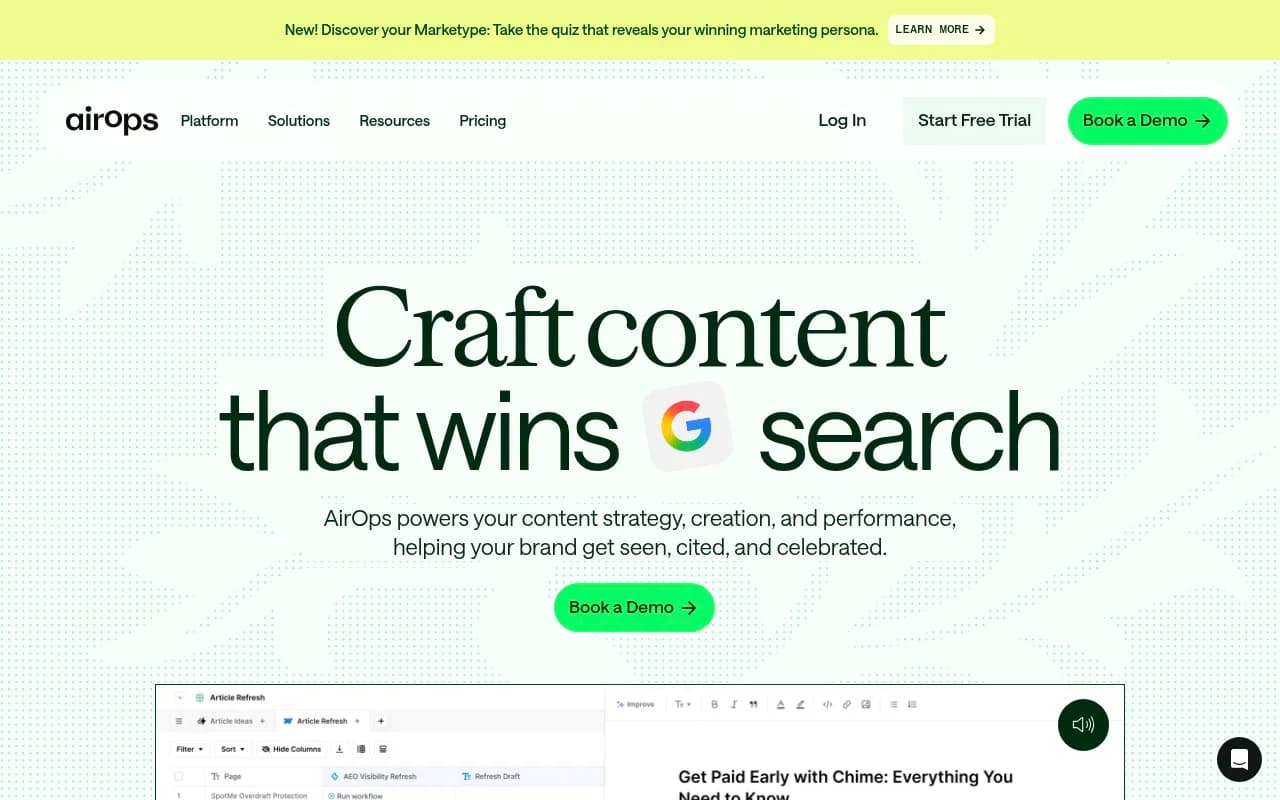
AirOps — best for teams that want GEO baked into content workflows
AirOps takes a different angle. Rather than being a pure tracking platform, it's an AI workflow automation tool that includes GEO capabilities. You can build content pipelines that automatically generate, optimize, and publish content with AI visibility in mind.
If your team already runs content at scale and wants to bake GEO into that process rather than bolt on a separate tracking tool, AirOps is worth serious consideration. It's less useful if you need detailed monitoring dashboards or competitor benchmarking.
Scrunch AI — best for influencer and social citation tracking
Scrunch AI monitors how AI assistants like ChatGPT and Claude cite your brand, but it has a particular strength in tracking social and influencer content that feeds into AI recommendations. If your brand's AI visibility is heavily influenced by Reddit threads, YouTube reviews, or influencer content, Scrunch surfaces that in a way most platforms don't.
Airefs — best affordable all-rounder
Airefs positions itself as an affordable alternative to the more expensive platforms. It covers the core monitoring use cases, tracks citations across major LLMs, and includes some basic optimization guidance. It won't replace Promptwatch or Profound for teams that need depth, but it's a solid mid-tier option.
Cairrot — best for agencies on tight margins
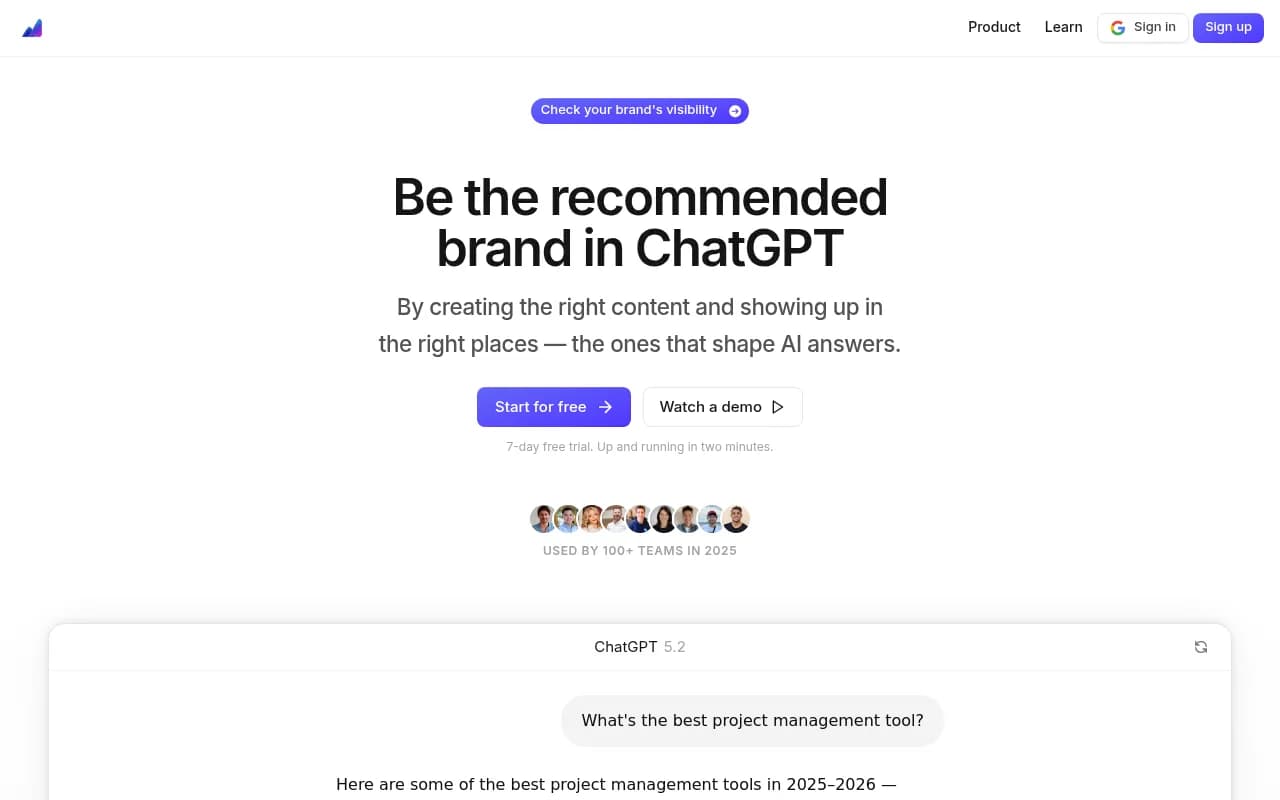
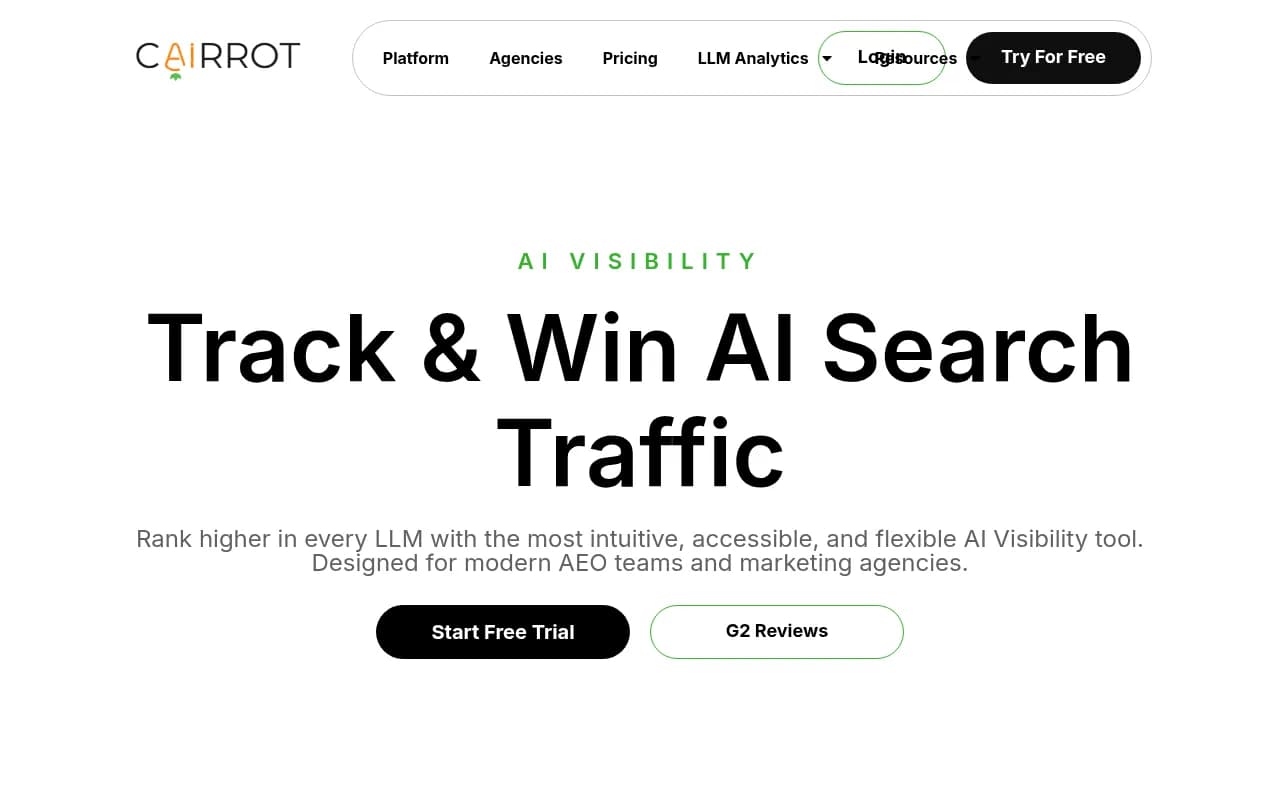
Cairrot is built specifically for agencies managing multiple clients in the AEO space. Its pricing model is designed around the agency profitability problem: you need to deliver AI visibility reporting without the per-client costs eating your margins. Flexible seat structures and white-label reporting make it practical for agency use cases.
Goodie AI — best for enterprise GEO with full platform ambitions
Goodie AI positions itself as a comprehensive GEO platform combining monitoring, optimization, attribution, and content intelligence. It's aimed at enterprise teams and competes directly with Profound and Promptwatch at the top end of the market.
Writesonic — best if you want GEO features inside a writing tool
Writesonic started as an AI writing platform and has added GEO tracking and optimization features. If your team already uses Writesonic for content creation, the GEO layer integrates naturally. If you're starting fresh and GEO is the primary need, the dedicated platforms above will serve you better.
Feature comparison table
| Platform | AI models monitored | Content generation | Crawler logs | Traffic attribution | Prompt volume data | Best for |
|---|---|---|---|---|---|---|
| Promptwatch | 10 | Yes (built-in AI writer) | Yes | Yes (GSC, snippet, logs) | Yes | Teams that want the full loop |
| Yolando | Multiple | Yes | Limited | Limited | Limited | End-to-end GEO workflow |
| Profound | Multiple | No | No | No | Yes | Enterprise analytics |
| Peec AI | Multiple | No | No | No | Basic | SMBs, multi-language |
| Otterly.AI | Multiple | No | No | No | No | Budget monitoring |
| AirOps | Multiple | Yes (workflow-based) | No | No | No | Content workflow automation |
| Scrunch AI | Multiple | No | No | No | No | Social/influencer citation tracking |
| Airefs | Multiple | Basic | No | No | Basic | Affordable all-rounder |
| Cairrot | 5+ | No | No | No | No | Agencies |
| Goodie AI | Multiple | Yes | Limited | Yes | Limited | Enterprise GEO |
| Writesonic | Multiple | Yes | No | No | Basic | Content-first teams |
How to choose the right platform
The honest answer is that the right tool depends on where you are in the GEO journey.
If you're just starting out and want to understand what AI visibility even means for your brand, Otterly.AI or Airefs will get you oriented without a big financial commitment.
If you're a growing brand or agency that needs to actually improve visibility, not just measure it, the monitoring-only tools will frustrate you quickly. You'll spend time looking at dashboards that tell you you're invisible without telling you how to fix it. That's where Promptwatch's content gap analysis and built-in writing agent change the equation.
If you're an enterprise with a dedicated analytics team and an existing content operation, Profound's depth might be exactly what you need, with your content team handling the execution side separately.
If you're an agency, Cairrot's pricing model is worth a serious look before committing to a platform built for single brands.
One thing worth saying directly: the category is still young, and several platforms that launched in 2024 and 2025 are still figuring out their product direction. The tools that have the clearest roadmap and the most real-world usage data behind them are the ones most likely to keep pace with how fast AI search is evolving. Promptwatch's 1.1 billion citations processed and 6,700+ active brands give it a data advantage that newer entrants can't replicate quickly.
What to look for beyond the feature list
A few things that don't always show up in comparison tables but matter a lot in practice:
How fresh is the data? AI search changes fast. A platform that updates visibility data weekly is much less useful than one that tracks in near real-time.
Which AI models are covered? Some platforms focus heavily on ChatGPT and Google AI Overviews while ignoring Perplexity, Claude, Grok, and DeepSeek. If your audience uses multiple AI tools, you need coverage across all of them.
Can you track at the page level? Brand-level visibility scores are useful for executive reporting. Page-level tracking is what actually tells you which content is working and which isn't.
Does it explain why you're not being cited? The most useful platforms don't just show you a visibility score — they show you what's missing from your content that AI models need to confidently cite you.
Is there a path from insight to action? This is the big one. A dashboard that shows you gaps is only valuable if you can do something about it. The platforms that help you close the loop between "we're invisible for this prompt" and "here's the content that fixes it" are the ones worth paying for.
Final take
Yolando is a legitimate platform with a clear vision for end-to-end GEO. But the alternatives above cover the full range of use cases, budgets, and team types. The monitoring-only tools are fine for orientation. The platforms that help you act on what you find are the ones that will actually move your AI visibility numbers.
If you want one recommendation: Promptwatch is the most complete option in the category right now. It's the only platform that takes you from finding gaps to generating content to tracking whether that content is getting cited, all in one place. For teams that are serious about AI search visibility in 2026, that closed loop is what matters.