Key takeaways
- LLMrefs is a solid starting point for AI visibility tracking, but its keyword-first approach, 50-keyword cap on Pro, and lack of sentiment analysis push many teams to look elsewhere.
- The best alternatives go beyond monitoring -- they show you the actual AI responses, analyze brand sentiment, and help you create content that gets cited.
- Promptwatch is the only platform in this space rated as a "Leader" across all GEO categories, combining gap analysis, AI content generation, and crawler logs in one place.
- Budget-friendly options like Otterly.AI and Airefs work well for smaller teams; enterprise teams should look at Profound or Evertune.
- The right tool depends on whether you need monitoring only, or a full optimization loop from gap discovery to content creation to traffic attribution.
LLMrefs made a smart bet early. When most SEOs were still debating whether AI search was real, LLMrefs built a keyword-based tracking interface that felt familiar -- almost like Google Search Console, but for ChatGPT and Perplexity. That familiarity helped a lot of teams get started with AI visibility tracking without having to rethink everything.
But "familiar" has limits. The platform's keyword abstraction means you see visibility scores, not the actual AI responses. There's no sentiment analysis, so you can't tell if ChatGPT is recommending you or quietly steering users toward a competitor. And the pricing jumps fast: 1 keyword on the free plan, 50 on Pro at $79/month, then custom enterprise pricing with no public rates.
If you've hit those walls, this guide covers the best LLMrefs alternatives in 2026 -- what each one does well, where it falls short, and which type of team it suits best.
What to look for in an LLMrefs alternative
Before jumping to the list, it's worth being clear about what "better" actually means here, because these tools vary a lot in what they prioritize.
The core question is: do you need monitoring, or optimization? Monitoring tools tell you where you're visible. Optimization tools help you get more visible. Most of the market is still monitoring-only. A smaller set of platforms -- and this is the more valuable category -- close the loop by helping you act on what you find.
Beyond that, look for:
- Full AI responses, not just aggregated scores
- Sentiment analysis (positive, neutral, negative brand mentions)
- Prompt-level tracking rather than keyword abstraction
- Coverage across multiple LLMs (ChatGPT, Perplexity, Claude, Gemini, Grok, etc.)
- Content gap analysis that shows what topics you're missing
- Reasonable pricing transparency
The best LLMrefs alternatives in 2026
1. Promptwatch -- best for full-cycle AI visibility optimization
Promptwatch is the most complete platform in this space. Where LLMrefs shows you a visibility score, Promptwatch shows you the actual AI responses, which pages are being cited, how often, and by which models. Then it goes further: the Answer Gap Analysis identifies prompts where competitors are visible but you're not, and the built-in AI writing agent generates content specifically engineered to get cited by ChatGPT, Claude, Perplexity, and others.
That combination -- find the gap, create the content, track the improvement -- is what separates it from the monitoring-only tools. Most competitors stop at step one.
Promptwatch also includes AI crawler logs (real-time visibility into when ChatGPT, Claude, and Perplexity crawl your site), prompt volume and difficulty scoring, Reddit and YouTube citation tracking, ChatGPT Shopping monitoring, and competitor heatmaps. It covers 10 AI models and supports multi-language, multi-region monitoring.
Pricing starts at $99/month for the Essential plan (1 site, 50 prompts, 5 articles). Professional is $249/month (2 sites, 150 prompts, 15 articles, crawler logs). Business is $579/month (5 sites, 350 prompts, 30 articles). A free trial is available.

Best for: Marketing and SEO teams that want to move beyond tracking and actually improve their AI visibility. Agencies managing multiple clients.
2. Otterly.AI -- best budget-friendly option
Otterly.AI is one of the most accessible entry points in the AI visibility space. It tracks brand mentions and citations across major AI models, shows you the actual responses (not just scores), and includes basic sentiment analysis. The interface is clean and the pricing is genuinely affordable at $29/month to start.
The tradeoff is depth. Otterly.AI is a monitoring tool -- it tells you what's happening but doesn't help you change it. There's no content generation, no gap analysis, and no crawler logs. For a solo marketer or small team that just needs visibility data without a big budget, it works well. For teams that want to act on that data, you'll hit the ceiling quickly.

Best for: Small teams and individuals who need basic AI visibility tracking without a large budget.
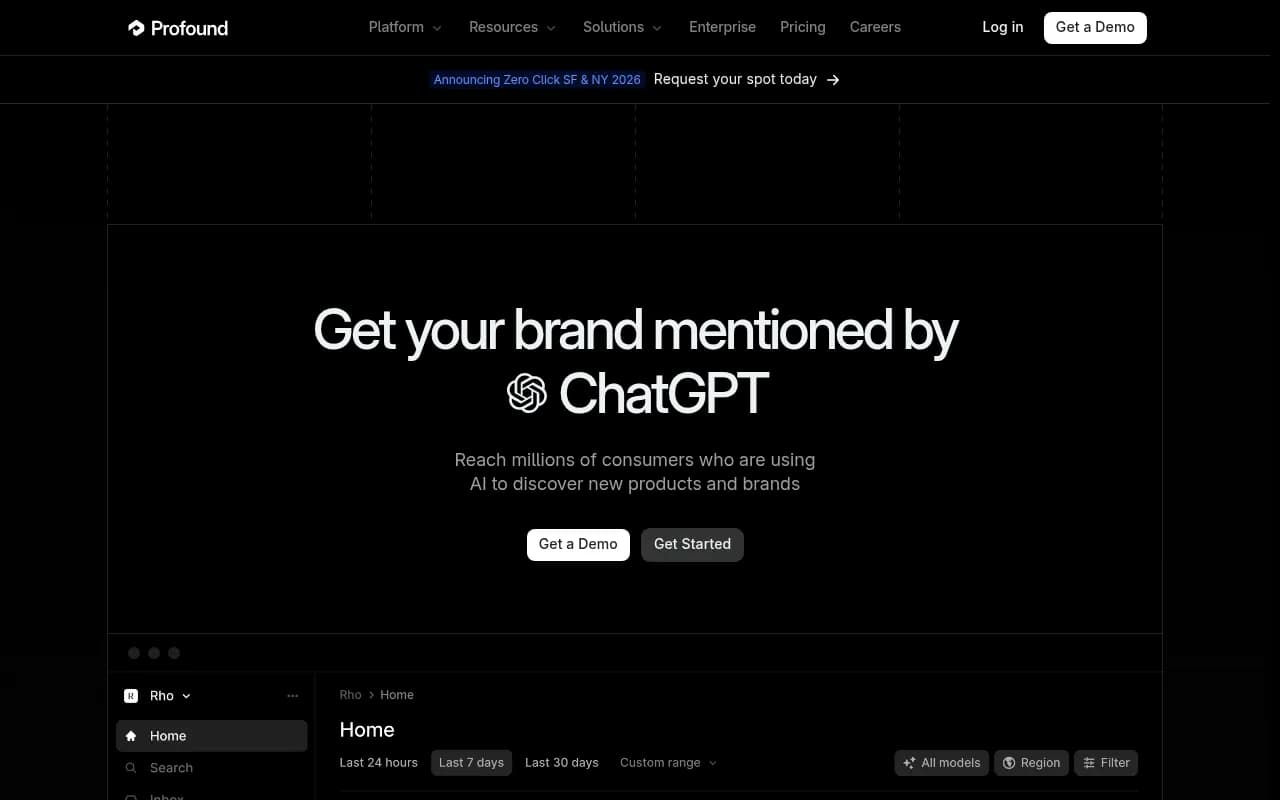
3. Profound -- best for enterprise monitoring
Profound is a well-built enterprise platform with strong prompt tracking, competitive benchmarking, and solid coverage across major LLMs. It's one of the more established names in this space and has been featured in Zapier's roundup of the best AI visibility tools.
The main friction is price -- Profound starts at $499/month, which puts it out of reach for most small and mid-sized teams. It's also primarily a monitoring and analytics platform; content generation and optimization aren't core features. If your organization has the budget and needs deep enterprise-grade reporting, Profound is worth evaluating. If you're looking for a tool that helps you fix visibility gaps, not just measure them, there are better options.
Best for: Enterprise marketing and strategy teams with larger budgets who need detailed LLM monitoring and reporting.
4. Scrunch AI -- best for mid-market teams wanting full responses
Scrunch AI sits in an interesting middle ground. It tracks brand visibility across AI platforms, shows full AI responses, and includes sentiment analysis. The pricing at $300/month is steep for smaller teams but reasonable for mid-market companies that need more than Otterly.AI but can't justify Profound's rates.
One thing Scrunch does well is response transparency -- you can see exactly what an AI model said about your brand, not just whether it mentioned you. That context matters a lot for reputation management. Like most tools in this space, content generation isn't a feature, so you're still on your own when it comes to acting on what you find.
Best for: Mid-market brands that prioritize seeing full AI responses and sentiment data.
5. Athena HQ -- best for teams with variable tracking needs
Athena HQ uses a credit-based model rather than fixed prompt limits, which gives teams more flexibility if their tracking needs vary month to month. It covers a solid range of AI models and includes sentiment analysis and full response visibility.
The starting price of $295/month is on the higher end for what's essentially a monitoring platform. And like most competitors in this category, it doesn't include content generation or gap analysis tools. The credit model can also make budgeting unpredictable if your prompt volume spikes.
Best for: Teams that need flexible tracking volumes and don't want to be locked into fixed prompt limits.
6. Peec AI -- best for multi-language tracking
Peec AI is a Berlin-based platform that focuses specifically on brand representation across ChatGPT, Perplexity, and Google AI Overviews. Its standout feature is multi-language support, which makes it one of the better options for brands operating across European markets or in non-English languages.
The platform includes smart suggestions for improving visibility, which gives it a slight edge over pure monitoring tools. It doesn't go as far as full content generation, but the directional guidance is useful. Pricing is mid-range and more transparent than some competitors.

Best for: International brands that need AI visibility tracking in multiple languages.
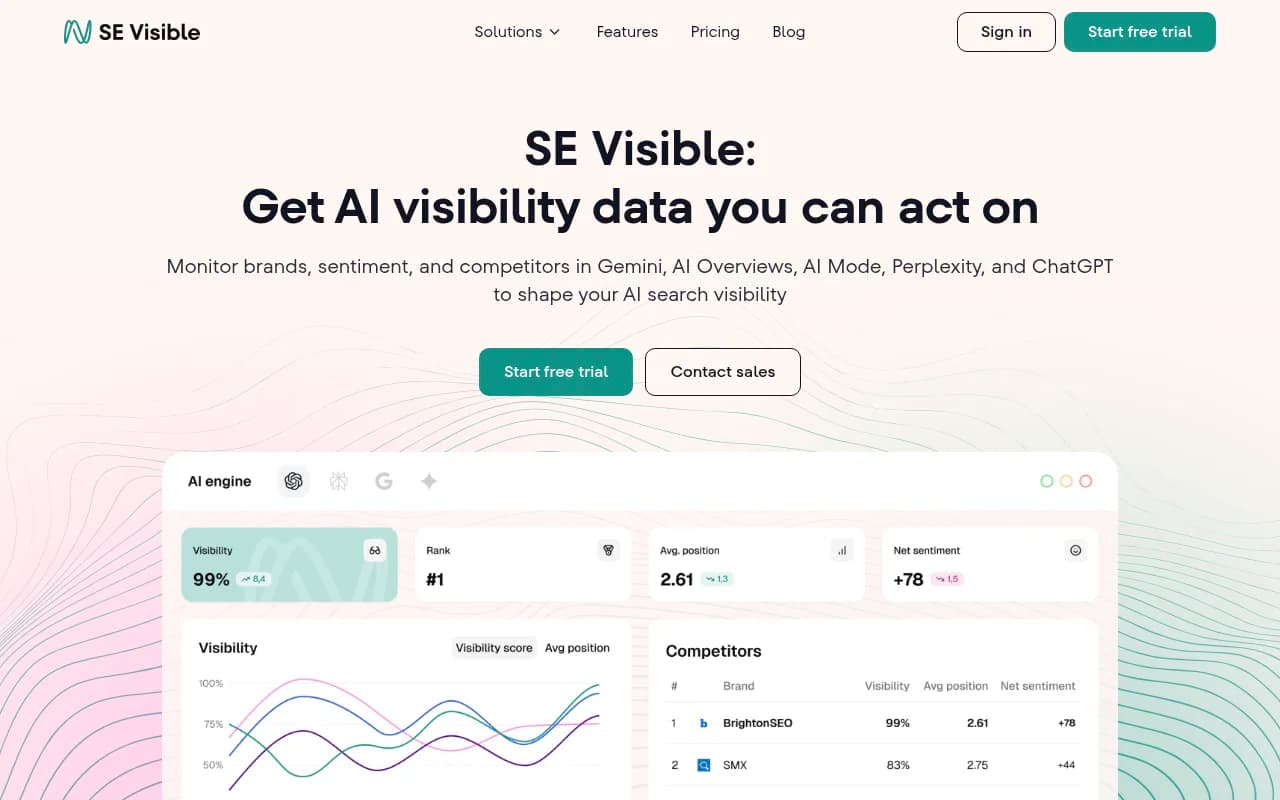
7. SE Ranking / SE Visible -- best for teams already using SE Ranking
SE Ranking has built AI visibility tracking directly into its existing SEO platform through a product called SE Visible. If you're already paying for SE Ranking's rank tracking and site audit tools, this is a natural extension -- you get brand visibility and sentiment tracking across AI search engines without adding another vendor.
The integration is the main selling point. As a standalone AI visibility tool, it's not as deep as dedicated platforms. But for teams that want to consolidate their SEO and GEO data in one place, it's a practical choice.
Best for: Existing SE Ranking users who want to add AI visibility tracking without switching platforms.
8. Airefs -- best affordable option for agencies
Airefs is a newer entrant that positions itself as an affordable AI search monitoring tool. It covers the core use case -- tracking brand mentions across major LLMs -- at a price point that works for agencies managing multiple clients on tight margins.
It's light on advanced features like content generation or crawler logs, but for agencies that need basic visibility data across a portfolio of clients, the pricing makes it worth considering.
Best for: Agencies that need cost-effective AI visibility tracking across multiple client accounts.
9. LLM Pulse -- best prompt-based alternative to LLMrefs
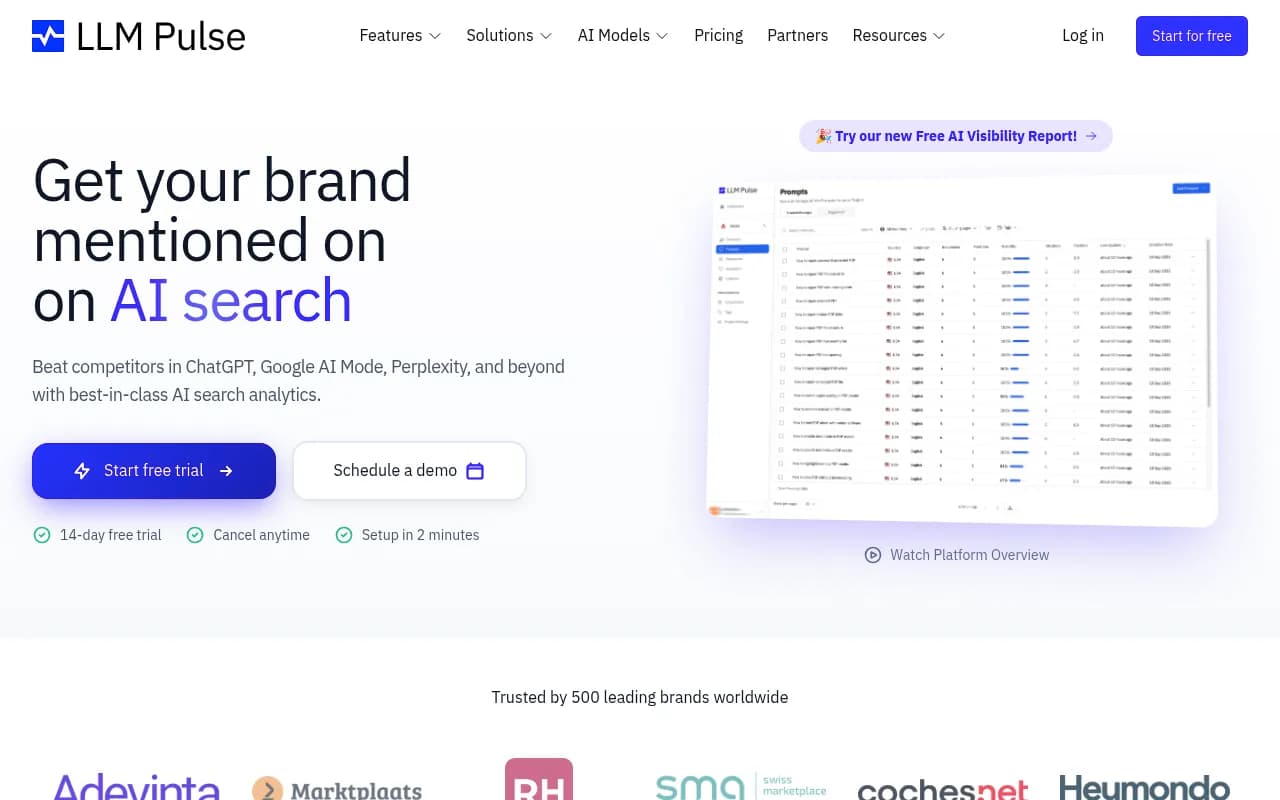
LLM Pulse is specifically designed as a prompt-based alternative to LLMrefs' keyword approach. Starting at €49/month, it tracks brand visibility using actual prompts rather than keyword abstractions, shows full AI responses, includes sentiment analysis, and covers Google AI Mode. That's a meaningful feature set at a competitive price.
For teams that liked LLMrefs' simplicity but want more transparency into what AI models are actually saying, LLM Pulse is a natural next step.
Best for: Teams migrating from LLMrefs who want prompt-level tracking and full response visibility without a big price jump.
10. Semrush (AI Toolkit) -- best for existing Semrush users
Semrush added AI visibility tracking through its AI Toolkit, making it an option for the large number of teams already using Semrush for traditional SEO. The integration means you can see AI visibility data alongside keyword rankings, backlinks, and site audits in one dashboard.
The limitations are real, though. Semrush uses fixed prompts rather than custom ones, which limits how precisely you can track your specific use cases. There's no AI traffic attribution, and the AI Toolkit is an add-on rather than a core feature. It's a reasonable starting point if you're already in the Semrush ecosystem, but dedicated AI visibility platforms go deeper.
Best for: Teams already paying for Semrush who want a basic introduction to AI visibility tracking.
Side-by-side comparison
| Tool | Starting price | Tracking approach | Sentiment analysis | Full AI responses | Content generation | Crawler logs |
|---|---|---|---|---|---|---|
| Promptwatch | $99/mo | Prompts | Yes | Yes | Yes (built-in AI agent) | Yes |
| LLMrefs | $79/mo | Keywords | No | Aggregated scores | No | No |
| LLM Pulse | €49/mo | Prompts | Yes | Yes | No | No |
| Otterly.AI | $29/mo | Prompts | Yes | Yes | No | No |
| Semrush AI Toolkit | $99/mo | Fixed prompts | Yes | Limited | No | No |
| Scrunch AI | $300/mo | Prompts | Yes | Yes | No | No |
| Athena HQ | $295/mo | Credits | Yes | Yes | No | No |
| Profound | $499/mo | Prompts | Yes | Yes | No | No |
| Peec AI | Mid-range | Prompts | Yes | Yes | No | No |
| Airefs | Low | Prompts | Basic | Yes | No | No |
Monitoring vs. optimization: the real dividing line
Most of the tools above are monitoring platforms. They answer the question "where am I visible?" That's genuinely useful, especially when you're starting out. But it leaves you with data and no clear path to improvement.
The more valuable question is "what do I need to do to become more visible?" That requires knowing which prompts competitors rank for that you don't, what content you're missing, and how to create content that AI models will actually cite. That's a different kind of tool.
Right now, Promptwatch is the only platform that closes this loop end-to-end: gap analysis to find what's missing, an AI writing agent to create content grounded in citation data, and page-level tracking to measure the results. Most competitors -- including the ones on this list -- stop at the monitoring step.
That's not a knock on monitoring tools. If you're early in your AI visibility journey, starting with a tool like Otterly.AI or LLM Pulse makes sense. But if you're at the stage where you have data and need to act on it, the monitoring-only approach will frustrate you.
Which tool should you choose?
Here's a simple way to think about it:
- You're just getting started and have a small budget: Otterly.AI ($29/mo) or LLM Pulse (€49/mo) give you prompt-level tracking and full responses without a big commitment.
- You're migrating from LLMrefs and want more transparency: LLM Pulse is the most direct upgrade -- same price range, better feature set.
- You're already using Semrush or SE Ranking: Use their built-in AI tracking as a starting point before committing to a dedicated platform.
- You need enterprise-grade reporting and have the budget: Profound or Evertune are worth evaluating.
- You want to actually improve your AI visibility, not just measure it: Promptwatch is the only tool that combines gap analysis, content generation, and tracking in one platform. The $99/month Essential plan is a reasonable starting point for most teams.
The AI search landscape is moving fast. Brands that figure out the optimization loop -- not just the monitoring part -- will have a real advantage over competitors who are still staring at dashboards.