Analyze AI Review 2026
Combines AI-search analytics, a content writer and an agent builder so content and marketing teams can track visibility and produce content in one place.
Key takeaways
- Analyze AI combines AI-search tracking, GA4 traffic attribution and a content writer/optimizer at a low entry price ($99/mo, unlimited seats).
- It is a direct competitor to Promptwatch and lacks IP-verified AI crawler logs, Reddit/YouTube/LinkedIn citation tracking, prompt volumes and difficulty scores, query fan-outs, AI Shopping and Ads Radar, a prioritized Action Board and scheduled CMS publishing.
- The entry plan covers only 3 engines (ChatGPT, Google AI Mode, Perplexity). Gemini, Claude, Grok and DeepSeek are paid add-ons with unpublished prices.
- Prompt caps (25 to 35 a day) are small, so it suits startups and small publishers, not enterprise programs.
- Social proof is thin: vendor-selected testimonials and no independent reviews on G2, Trustpilot or Product Hunt that I could find.
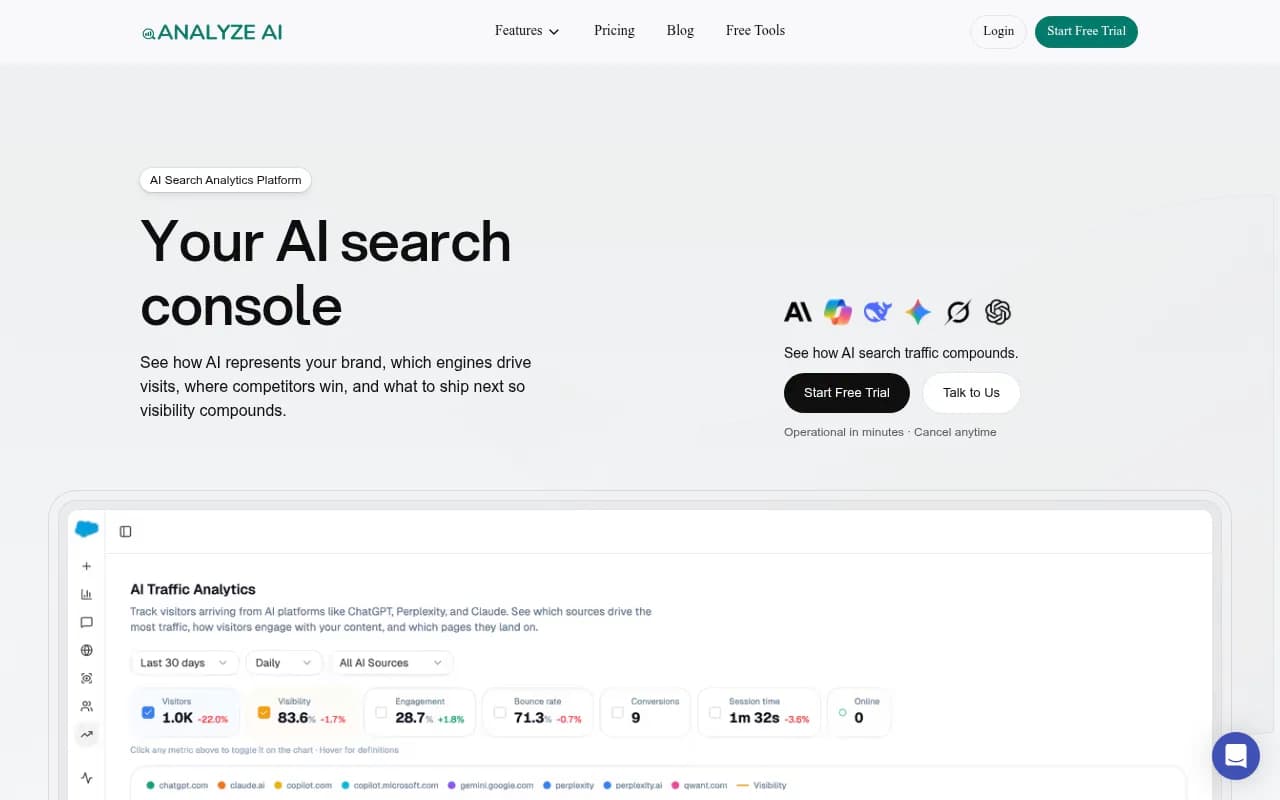
Analyze AI (tryanalyze.ai) is an AI search analytics platform pitched as an "AI search console" for marketing teams. It runs a set of prompts against answer engines on a schedule, records which brands get named, in what position, with what sentiment and which sources get cited. Then it connects to Google Analytics 4 to show how many visitors arrive from those engines and which pages convert.
The product has drifted from pure monitoring toward what the company calls agentic SEO: a Content Writer, a Content Optimizer and agents that can run on a schedule, on a webhook, or on demand. The homepage claims 27+ engines, 68,000+ daily prompts tracked and 4,100+ brands monitored. Those are self-reported numbers. Named customers include Kylian, Nebor, What Is That Movie and Fuel50, which tells you the sweet spot: startups, small publishers and lean marketing teams rather than Fortune 500 brand departments.
I like the tone of the marketing, honestly. The founders' note rejects "GEO is the new SEO" panic and says quality content still wins. That is a sensible stance, and the product roughly follows it: fewer vanity scores, more attribution.
Key features
The homepage organizes the product into four verbs: Discover, Monitor, Improve and Govern. In practice it breaks down like this.
Visibility and prompt tracking. You define topics and prompts, pick competitors and the platform runs them daily by default. Per prompt and per engine you get visibility, position and sentiment, plus full answer text, citations and co-mentioned brands. Locale and language variants are supported where engines provide them.
- Blind-spot view shows prompts where you are absent on one engine but present on another.
- Competitor scoreboard shows AI prompt share and prompt losses week over week. Competitor tracking is unlimited on every plan.
- One-off ad hoc prompts (50 a month on Growth, 100 on Pro) let you test an idea across engines before committing to tracking it.
Citation analytics. Every URL and domain engines cite in your space is listed, with counts by engine. The "uncited gaps" view points at places like G2, Capterra or a Reddit thread where competitors get cited and you do not. There is also a breakdown of which content types (blog posts, docs, product pages, reviews, social) engines prefer in your category. Useful, though it is a category-level view, not per-page crawl evidence.
Sentiment and narrative monitoring. Analyze AI summarizes how AI describes you (for example, intuitive onboarding positive, limited integrations as a risk) and attaches an actual quote and engine as proof. The Govern pillar flags risk terms and reputational drift such as a negative pricing narrative on Gemini. For comms and brand teams that is a decent early-warning system.
AI traffic analytics via GA4. This is the feature I would buy it for. Connect GA4 and AI-referred sessions are broken out by engine, landing page and month-over-month trend, down to conversions. The Kylian case study reports a 5% conversion rate from AI traffic and 1,000+ AI sessions a month, with top pages converting at 7 to 8%. Treat those as vendor-selected, but the mechanism is real and matters when a CMO asks for pipeline numbers. One wrinkle: the FAQ says GA4 analytics is on all plans, while the plan cards list it only under Pro. Confirm before you pay.
Content Writer. A guided flow from idea to research to outline to draft, with visibility gaps, competitor analysis and editorial comments built in. It is a workflow with caps: 1 on Growth, 10 on Pro, unlimited on Custom. It drafts; you publish through your own CMS using the briefs it provides. I found no native WordPress, Webflow or Framer publishing.
Content Optimizer and page audits. Paste a URL and get a score out of 100 with sub-scores for citations, structure and entity coverage, plus line-by-line suggestions such as adding a pricing comparison table. The Optimizer targets pages that are losing rankings and walks them through a structured rewrite. Growth gets 1 workflow, Pro gets 5. Those are tight limits for a team refreshing dozens of pages.
Weekly digest. Every Monday, a prioritized list of actions, citation changes and competitor shifts lands in your inbox. It is a nice touch for busy teams. Recommendations are weekly on Growth and Pro, daily only on Custom.
Agents and free tools. The company says agents can run on a schedule, fire on a webhook, or produce a report on demand, and positions the platform as connecting AI search to classic SEO and GTM execution. That is marketing language I could not verify in depth. There are also 10+ free SEO tools (keyword generator, SERP checker, rank checker, keyword difficulty checker, broken link checker).
Reporting. Executive-summary reports show visibility, citations and sentiment trends over eight weeks. They are clean and light on vanity metrics.
Who is it for
The best fit is a startup or small publisher with one to ten marketers that wants a single tool for AI visibility, GA4 attribution and some content help. Think a SaaS growth lead tracking 25 to 35 prompts a day, an indie publisher diversifying away from Google, or an agency pilot for one or two clients. Unlimited seats on every plan means no per-user tax as the team grows.
Marketing and SEO leaders who need to show pipeline impact will like the GA4 loop. Content teams get prompt-level gaps and citation targets. Brand and comms teams get the sentiment and risk-term monitoring.
Who should skip it? Enterprises tracking hundreds or thousands of prompts across many markets will hit the caps quickly. Teams that need all major engines on the base plan will find Gemini and Claude as paid extras. Anyone who wants to know whether AI crawlers are actually reading their site, or wants content published automatically into a CMS, needs a heavier platform. And if you want independent validation before buying, note that I found no third-party reviews beyond a promotional aggregator (4.3/5 from 15 users) and the vendor's own comparison posts.
Integrations and ecosystem
GA4 is the only integration I could confirm, and it is optional but central. Webhooks are mentioned in the agent materials. Custom integrations are reserved for the Custom plan. No code or site changes are required to start, which makes setup fast; the company says you get a baseline within minutes.
I could not confirm a public API, MCP server, Slack integration, Looker Studio connector or CMS publishing connectors. If your reporting stack depends on those, ask on the demo call. The app lives at app.tryanalyze.ai and demos are booked at schedule.tryanalyze.ai/demo.
Pricing and value
There are three tiers, all with a free trial, no long-term contracts and no annual discount that I found.
- Growth, $99/mo: 3 engines (ChatGPT, Google AI Mode, Perplexity), 25 tracked prompts a day (2,250 answers a month), 50 ad hoc prompts, 1 Content Writer and 1 Content Optimizer workflow, unlimited competitors and seats, weekly recommendations, a 15-minute onboarding call and priority support.
- Pro, $250/mo: 4 engines, 35 tracked prompts a day (3,150 answers a month), 100 ad hoc prompts, 10 Content Writer and 5 Content Optimizer workflows.
- Custom: all engines, custom prompt volumes, unlimited ad hoc prompts and workflows, daily recommendations, a dedicated account manager, dedicated onboarding and custom integrations. Quote-based.
Extra engines (DeepSeek, Grok, Gemini, Claude) are add-ons on Growth and Pro with unpublished prices. That is the catch. The $99 headline looks competitive, but it covers three engines and a modest prompt budget. Compare it with Promptwatch, where Essential is $95/mo with all AI models, 50 prompts, 6,000 responses, site audit, 360 Insights, content gap analysis and MCP/API, and where Professional ($245/mo) adds 150 prompts and 18,000 responses. The price points are close, but the response volume and engine coverage are not.
Strengths and limitations
What it does well
- GA4-based attribution from engine to landing page to conversion, which answers the CMO question directly.
- A low entry price with unlimited seats and unlimited competitor tracking.
- Sentiment and narrative tracking with quoted evidence and risk-term alerts.
- Fast setup with no code, plus a useful Monday digest.
- A candid, anti-hype product philosophy that favors durable content.
Limitations
- Only 3 engines on Growth and 4 on Pro, with extra engines as unpriced add-ons. Daily prompt caps of 25 to 35 are small.
- Pricing page inconsistencies (GA4 availability) and unpublished add-on and Custom pricing.
- Thin independent validation: no G2, Trustpilot or Product Hunt reviews found.
What it lacks compared with Promptwatch
Analyze AI is a direct competitor to Promptwatch, and the gap is mostly in depth and execution. I found no evidence of:
- IP-verified AI crawler logs and crawl-to-citation tracking, so you cannot see whether GPTBot or ClaudeBot actually reads a page.
- Prompt volumes and difficulty scoring, plus query fan-outs showing the searches AI runs per response.
- Reddit, YouTube and LinkedIn citation reports, offsite mentions and page-level tracking of any URL.
- AI Shopping tracking (ChatGPT, Amazon Alexa) and Ads Radar for sponsored placements.
- Google Search Console and Bing Webmaster data overlaid on AI data.
- A Content Agent that publishes on a schedule to WordPress, Webflow or Framer, an Action Board and Agent Chat.
- Coverage of 15+ engines in real UIs, including coding agents such as Codex and Claude Code.
Analyze AI's content tools stop at drafting and briefs, and its optimization loop does not verify results through crawl and citation tracking the way Promptwatch does.
Bottom line
Analyze AI is a sensible, affordable pick for a small team that mostly wants to prove AI search drives traffic and conversions, with a content writer on the side. The GA4 attribution is the standout, and the unlimited seats help. Just budget for add-on engines and watch the prompt caps.
If you want optimization rather than monitoring, with crawler logs, fan-outs, Reddit and YouTube tracking and automated publishing, Promptwatch is the stronger choice at a similar starting price. For more options, browse the GEO software directory at bestgeosoftware.com.
Best use case: a startup or small publisher tracking a few dozen prompts and attributing AI referrals to conversions in GA4.
Tags:
Frequently asked questions
What is Analyze AI?
How much does Analyze AI cost?
Which AI engines does Analyze AI track?
Does Analyze AI track AI traffic and conversions?
How does Analyze AI compare to Promptwatch?
Is there a free plan?
Similar and alternative tools to Analyze AI