Key takeaways
- If you want the best pure content optimization with real-time SERP scoring, Surfer SEO is the most direct GrowthBar competitor and generally more powerful for on-page optimization.
- For teams that care about content quality over speed, Clearscope has the most reliable keyword grading system and is worth the higher price.
- Frase is the best budget option if you need research + writing in one place, especially at the $39/mo Solo tier.
- Byword is the right pick if you need to produce SEO articles at scale with minimal manual effort — it's built for volume.
- Jasper makes sense for larger marketing teams running multi-channel campaigns, not just blog content.
- If your concern is visibility in AI search engines (ChatGPT, Perplexity, Claude) rather than Google rankings, that's a different problem — tools like Promptwatch are built specifically for that.
GrowthBar has built a decent following among bloggers and small content teams who want a simple, affordable way to write SEO-optimized posts faster. The pitch is straightforward: enter a keyword, get an AI-generated outline, click to write the post, and follow the on-page recommendations. For someone who just needs to produce blog content without a steep learning curve, it works.
But people start looking for alternatives for a few predictable reasons. The article limits feel tight at lower tiers. The keyword research is functional but not deep — you won't replace a dedicated SEO tool with it. The AI writing quality is decent but not exceptional, and the optimization scoring isn't as granular as what you get from Surfer or Clearscope. Some users also find the interface a bit dated compared to newer tools that have shipped significant product updates in the past year.
There's also a broader shift happening in 2026: "ranking on Google" is no longer the only game in town. A growing chunk of search traffic now flows through AI engines — ChatGPT, Perplexity, Gemini, Claude. GrowthBar doesn't address that at all. If that's a concern for your business, you'll need to look beyond traditional SEO content tools entirely.
Here's an honest look at the best alternatives, depending on what you actually need.
Promptwatch

GrowthBar and Promptwatch solve different problems, so this comparison only makes sense in a specific context: if you're creating content specifically to get cited by AI search engines, not just to rank on Google.
GrowthBar optimizes for Google's ranking signals — keyword density, heading structure, word count relative to competitors. Promptwatch tracks and optimizes for visibility in ChatGPT, Claude, Perplexity, Gemini, and seven other AI models. These are genuinely different goals, and the tools reflect that.
Where Promptwatch goes beyond being a monitoring dashboard is its Answer Gap Analysis, which shows you exactly which prompts your competitors are being cited for but you aren't. That tells you what content to create. Then there's a built-in AI writing agent that generates articles grounded in real citation data from 880M+ citations analyzed — not generic SEO filler, but content structured to get picked up by AI models. You can then track whether those new pages actually start getting cited, and connect that to traffic via GSC integration or server log analysis.
It also has features that have no equivalent in GrowthBar: AI crawler logs (see when ChatGPT or Perplexity crawls your site and which pages they read), Reddit and YouTube citation tracking, ChatGPT Shopping monitoring, and prompt volume/difficulty scoring.
Pricing starts at $99/mo (Essential: 1 site, 50 prompts, 5 articles), $249/mo (Professional), $579/mo (Business). That's more expensive than GrowthBar's entry point, but it's doing something fundamentally different.
Best for: Brands and marketing teams who want to understand and improve their visibility in AI search engines, not just Google. If you're asking "why isn't ChatGPT recommending us?" this is the tool to answer that.
Surfer SEO
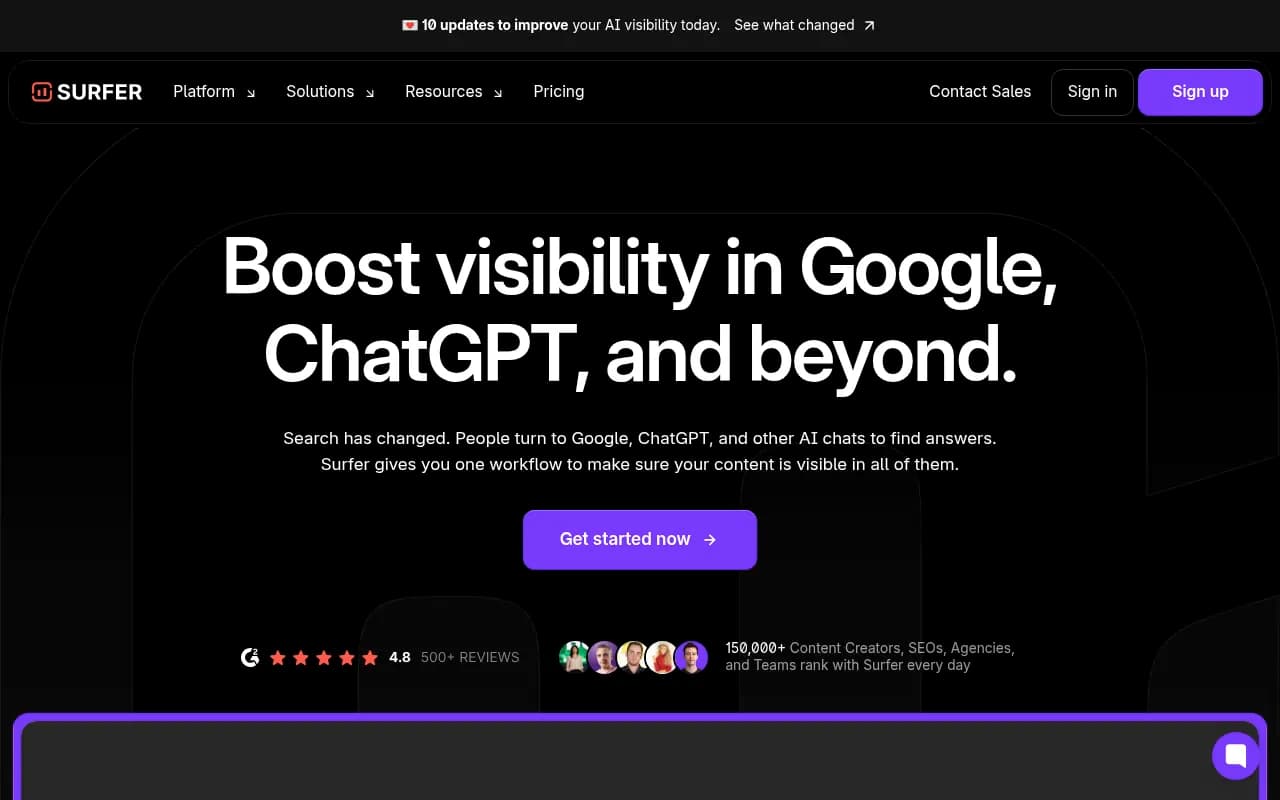
Surfer is probably the most direct GrowthBar competitor for teams focused on Google SEO content. Both tools analyze top-ranking pages and give you optimization recommendations while you write. But Surfer goes considerably deeper.
The Content Score in Surfer is more granular than GrowthBar's recommendations. It analyzes NLP terms, heading structure, word count, paragraph density, and keyword usage across the top 20 SERP results — and it updates in real time as you write. GrowthBar's optimization guidance is simpler and more prescriptive, which is fine for beginners but limiting for experienced SEOs who want to understand the "why" behind recommendations.
Surfer's Topical Map feature is something GrowthBar doesn't have at all. It maps out the full cluster of content you'd need to build authority around a topic, not just a single article. For teams building out content programs rather than one-off posts, that's genuinely useful.
On AI writing, both tools use GPT-based generation. Surfer's AI articles are reasonably good but still need editing — same as GrowthBar. Neither tool produces publish-ready copy without human review.
Surfer has also been expanding into AI search visibility, with features aimed at helping content rank in AI overviews and chatbot responses. It's not as deep as dedicated GEO tools, but it's a sign of where the product is heading.
Pricing: $99/mo (Essential, 30 articles), $219/mo (Scale), $399/mo (Max, 300 articles, 30 AI articles). Annual billing saves 20%. That's more expensive than GrowthBar's $36/mo entry point, but you're getting a more capable optimization engine.
Best for: SEO professionals and content teams who want serious on-page optimization data and are willing to pay more for it. If GrowthBar's scoring feels too surface-level, Surfer is the natural upgrade.
Clearscope

Clearscope takes a different philosophy than GrowthBar. It's less focused on AI writing and more focused on content grading — giving writers a clear, reliable score for how comprehensively a piece covers a topic.
The keyword grading system is genuinely excellent. Clearscope pulls NLP-based term recommendations from top-ranking content and grades your article in real time. Writers who use it tend to trust the scores because they correlate well with actual ranking performance. GrowthBar's optimization recommendations are more basic by comparison.
Where Clearscope falls short relative to GrowthBar is AI writing. Clearscope has added AI drafting features, but it's not the core product. If you need AI to write the first draft quickly, GrowthBar or Surfer are better fits. Clearscope is more of a "write it yourself, then optimize it" tool.
Clearscope has also been expanding into AI search visibility tracking — monitoring how your content performs in ChatGPT and Gemini responses. It's a newer feature set and not as deep as dedicated platforms, but it's a meaningful addition.
The pricing is a real consideration. At $189/mo for the Essentials plan, Clearscope is significantly more expensive than GrowthBar. You're paying for the quality and reliability of the optimization data, and most teams who use Clearscope say it's worth it — but it's not a casual purchase.
Best for: Content teams where quality and accuracy matter more than speed. Editors, in-house SEO teams at mid-size companies, and anyone who's been burned by low-quality AI content and wants a tool that helps them write better rather than faster.
Frase
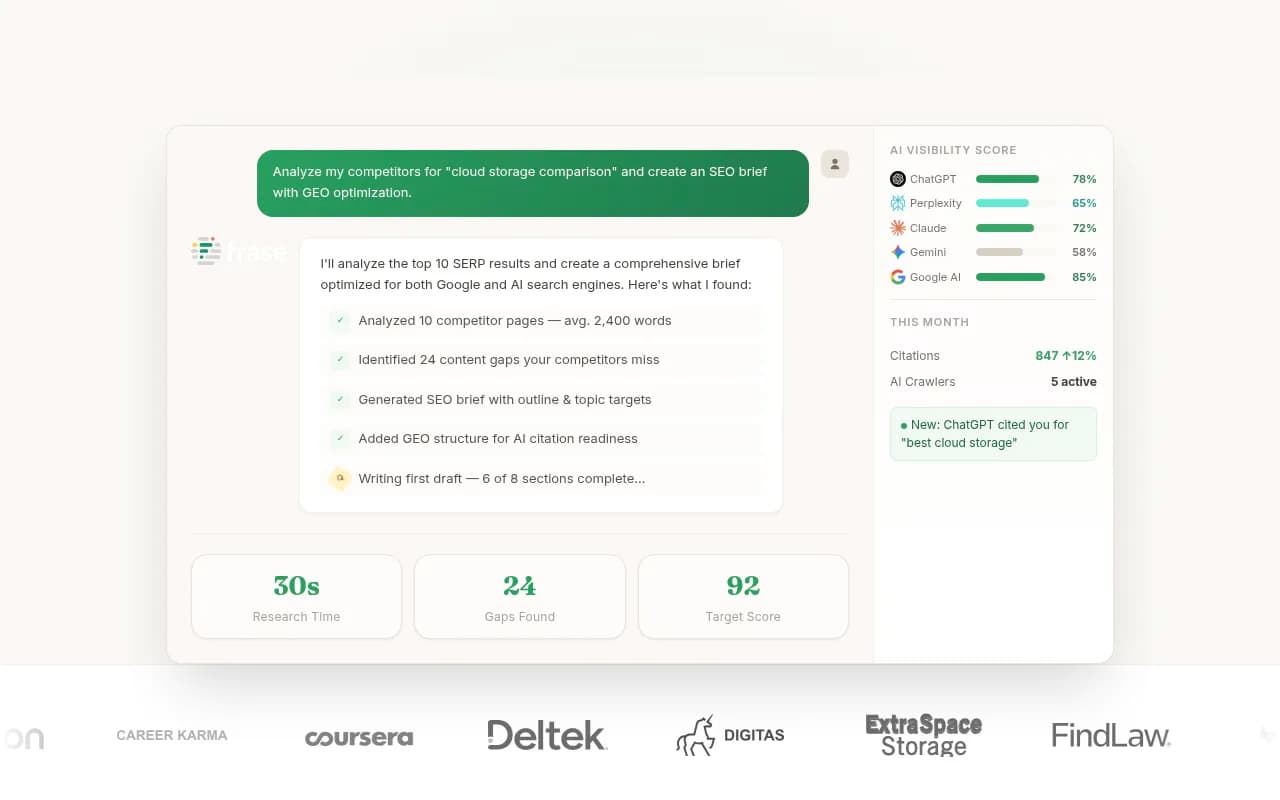
Frase is one of the better budget alternatives to GrowthBar, and it's evolved significantly in 2026. The core workflow — research competitors, generate a brief, write the article, optimize against SERP data — is similar to GrowthBar but with more depth on the research side.
The SERP research in Frase is notably good. It pulls the top 20 results for a keyword, shows you the headings, word counts, and topics covered by each competitor, and lets you build a brief by pulling in the best elements. GrowthBar does something similar but with less control over the process.
Frase has also leaned into GEO (Generative Engine Optimization) in a meaningful way. The platform now tracks visibility across Google, ChatGPT, and Perplexity, and positions itself as an "agentic SEO & GEO platform." The AI agent can analyze competitors, create an SEO brief, and flag GEO optimization opportunities in one workflow. That's a more ambitious scope than GrowthBar.
The AI writing quality in Frase is comparable to GrowthBar — useful for getting a draft down quickly, but not something you'd publish without editing.
Pricing is genuinely competitive: $39/mo for Solo (1 user, 10 articles/mo), $114/mo for Basic (3 users, 30 articles), $214/mo for Team (unlimited users, 100 articles). The Solo plan is one of the most affordable ways to get a research + writing + optimization workflow in one tool.
Best for: Solo content creators, freelancers, and small teams who want more research depth than GrowthBar offers without spending Surfer or Clearscope prices. The $39/mo Solo plan is hard to beat for the feature set.
Scalenut

Scalenut started as an AI SEO content tool and has been expanding into GEO territory. The platform covers the full content workflow — topic research, article writing, NLP optimization, content auditing — and has added AI visibility tracking for brand mentions across AI search engines.
Compared to GrowthBar, Scalenut's content tools are more comprehensive. The Cruise Mode feature generates a full SEO article in a guided workflow, with topic research, outline generation, and writing all connected. The NLP keyword recommendations are solid, though not quite at Clearscope's level of reliability.
The GEO tracking side is newer and covers 4 AI search engines, which is less than dedicated platforms. There's also a backlinks marketplace built in, which is unusual for a content tool — useful for some teams, irrelevant for others.
One honest limitation: Scalenut's execution guidance on the GEO side is relatively thin. It shows you data on where you're missing visibility, but the recommendations on what to do about it are less specific than you'd get from a purpose-built GEO platform.
Pricing: GEO tracking from $30/mo (10 prompts), SEO content tools from $59/mo (5 articles/month). The entry price is competitive with GrowthBar.
Best for: Teams that want a single platform for both traditional SEO content and basic AI visibility monitoring, without paying for two separate tools. Good for smaller budgets that need breadth over depth.
Jasper

Jasper is a different category of tool than GrowthBar. Where GrowthBar is focused on SEO blog content, Jasper is built for marketing teams running multi-channel content operations — campaigns, ads, emails, social, landing pages, and yes, SEO content too.
The AI writing quality in Jasper is generally strong, and the brand voice features are among the best in the market. You can train Jasper on your brand's style, tone, and guidelines, and it maintains that consistency across different content types. GrowthBar doesn't have anything comparable.
For SEO specifically, Jasper has a dedicated SEO/AEO/GEO solution that covers content creation for search and AI visibility. But it's not as tightly integrated with SERP data as Surfer or Clearscope — you'd typically use Jasper alongside a dedicated SEO tool rather than instead of one.
The pricing reflects the enterprise positioning. Creator is $49/mo, Pro is $59/mo, but the Business plan (where the real workflow automation lives) starts around $500-1000/mo. That's a significant jump from GrowthBar's $36/mo entry point.
Best for: Marketing teams at mid-size to large companies who need AI assistance across multiple content types and channels, not just blog posts. If you're just writing SEO articles, Jasper is overkill and overpriced.
Writesonic

Writesonic has repositioned itself as an AI search visibility platform in 2026, which makes it an interesting comparison point. It started as an AI writing tool (similar to GrowthBar's positioning) but now covers tracking brand visibility across ChatGPT, Perplexity, Gemini, and 10+ AI engines, alongside content creation and SEO automation.
The combination of AI writing and AI visibility tracking in one platform is genuinely useful if you need both. You can identify where you're not being cited by AI engines, create content to fill those gaps, and track whether it works — all without switching tools.
The AI writing features are solid and cover more content types than GrowthBar (ads, emails, landing pages, not just blog posts). The SEO automation features include keyword research, content briefs, and on-page optimization.
Where Writesonic is less proven is the depth of its GEO tracking compared to dedicated platforms. It covers the major AI engines but lacks some of the more advanced features like AI crawler logs or prompt volume/difficulty scoring.
Pricing starts at $49/mo (Lite plan) with a free trial available. That's comparable to GrowthBar's pricing range.
Best for: Teams that want AI writing and AI visibility tracking in one affordable platform, without committing to separate specialized tools for each.
Ahrefs Brand Radar

Ahrefs Brand Radar is a feature within the Ahrefs platform, not a standalone tool. If you're already an Ahrefs subscriber, it's worth knowing about. If you're not, it's not a reason to subscribe on its own.
Brand Radar monitors your brand mentions across AI search engines and traditional search. It shows you when AI models cite your brand, which pages they reference, and how your visibility compares to competitors. The data quality is good — Ahrefs has always been strong on data.
The limitation is that Brand Radar is monitoring-only. It shows you what's happening but doesn't help you do anything about it. There's no content gap analysis, no AI writing features, no optimization recommendations. For that, you'd need to use Ahrefs' broader content tools, which are decent but not specialized for AI search.
Compared to GrowthBar, Ahrefs is a completely different price tier and scope. Ahrefs plans start at $83/mo (annual) or $99/mo (monthly) and include far more than just content writing — keyword research, backlink analysis, site audits, rank tracking. If you need all of that, Ahrefs is excellent value. If you just need AI content writing, it's the wrong tool.
Best for: Teams already using Ahrefs for SEO who want to add basic AI visibility monitoring without paying for another platform. Not a GrowthBar replacement — more of a complement to an existing SEO stack.
Semrush
Semrush is the other major all-in-one SEO platform, and like Ahrefs, it's a different category than GrowthBar. The comparison only makes sense if you're considering replacing your entire SEO stack, not just your content writing tool.
Semrush's content tools are solid — the SEO Writing Assistant grades content in real time, the Topic Research tool surfaces content ideas, and the Content Audit feature helps you identify underperforming pages. These are comparable to or better than GrowthBar's content features.
Semrush has also built out an AI Visibility toolkit that monitors brand presence across AI search engines and provides recommendations for improving it. There's also an AI PR feature for finding media outlets trusted by LLMs and launching outreach campaigns. The scope is ambitious.
The honest limitation of Semrush's AI visibility features is that they use fixed prompts rather than letting you define your own. That's a meaningful constraint — the prompts that matter for your business are specific to your industry and audience, not a generic set.
Pricing: From $165.17/mo (Starter), with the AI Visibility add-on at $99/mo extra. That's considerably more than GrowthBar, but you're getting a full marketing platform.
Best for: Marketing teams that need a comprehensive SEO platform and want AI visibility monitoring included, rather than managing separate tools. Not the right choice if you just need better AI content writing.
Byword

Byword is worth serious consideration if your main complaint about GrowthBar is article limits and production speed. It's built specifically for generating SEO articles at scale — the pitch is "under 2 minutes per article," and it mostly delivers on that.
The workflow is more automated than GrowthBar. You feed in keywords, Byword handles the research, generates the article using your choice of GPT, Claude, or Gemini, applies real-time SEO optimization, and publishes directly to WordPress, Webflow, Shopify, Notion, or HubSpot. For teams that need to produce dozens or hundreds of articles per month, that level of automation matters.
The brand voice matching is good — better than GrowthBar's. You can train it on your existing content and it maintains consistency across articles. The multi-model generation (choosing between GPT, Claude, and Gemini for different content types) is a nice touch that GrowthBar doesn't offer.
The trade-off is editorial control. Byword is optimized for speed and scale, which means the articles are good but not exceptional. If you need highly nuanced, expert-level content, you'll still need significant human editing. GrowthBar's more guided workflow actually gives writers more control over the output.
Pricing: 5 free articles to start, then $99/mo (Starter), $299/mo (Standard), $999/mo (Scale), $1,999/mo (Unlimited). The Starter plan is comparable to GrowthBar's pricing, but the higher tiers are for serious content operations.
Best for: Content teams and agencies that need to produce SEO articles at volume and want direct CMS publishing. If you're producing 10+ articles per week, Byword's automation is worth the price.
How to choose
The right GrowthBar alternative depends on what's actually frustrating you about the tool:
If the optimization scoring feels too basic, move to Surfer SEO or Clearscope. Both give you more granular data on what makes top-ranking content work.
If you need more research depth before writing, Frase is the best value option. The SERP research is genuinely better than GrowthBar's at a comparable price.
If you need to produce content at scale with minimal manual work, Byword is built for that. The automation and CMS publishing are ahead of GrowthBar.
If you need AI writing across multiple content types (not just blog posts), Jasper or Writesonic cover more ground.
If you're at a company where AI search visibility (ChatGPT, Perplexity, Claude) is becoming a real concern, that's a different problem than GrowthBar solves. Promptwatch is built specifically for that — tracking where you appear in AI responses, identifying what content you're missing, and helping you create it.
The honest summary: GrowthBar is a reasonable entry-level tool for bloggers and small teams. Most of its alternatives are either more powerful (and more expensive) or more specialized. Pick based on where GrowthBar is actually falling short for you, not on feature lists.