Key takeaways
- For AI search visibility and optimization: Promptwatch is the strongest pick -- it tracks your brand across 10 AI models, shows you exactly which prompts competitors win that you don't, and generates content designed to get cited. It's the only tool here that closes the loop from gap analysis to content creation to traffic attribution.
- For traditional SEO + AI monitoring in one platform: Semrush is the most feature-complete option, though its AI visibility tools are add-ons and the prompt customization is limited.
- For content-focused SEO teams: Surfer SEO and Frase both do solid work combining content writing with optimization, with Frase being the more affordable option.
- For content strategy and topic authority: MarketMuse and Clearscope are the specialists here -- better for planning what to write than for automating deployment.
- For budget-conscious solo operators: ClickRank AI and SEO PowerSuite offer the lowest entry points, with SEO PowerSuite having a free tier.
- Alli AI's real niche: Multi-site SEO deployment automation at scale, particularly for agencies managing 10+ properties. If that's not your situation, most of these alternatives will serve you better.
Alli AI occupies a fairly specific corner of the SEO market: it's built for agencies and teams managing large portfolios of websites who need to push on-page changes at scale without touching each site manually. The JavaScript rendering fix for AI crawlers is genuinely useful if you're running modern frameworks. But outside of that use case, a lot of people end up looking at Alli AI and thinking "this is more than I need" or "this doesn't solve the problem I actually have."
The $299/month starting price (for just 5 sites) is steep if you're not running an agency. The platform is automation-first, which means it's powerful when you know exactly what changes to make -- but it doesn't tell you what to optimize or help you understand how you're performing in AI search. And as search continues to fragment toward ChatGPT, Perplexity, and Gemini, a lot of teams are realizing they need visibility into AI results, not just deployment tools.
So depending on what you're actually trying to solve -- AI visibility, content optimization, multi-site management, or just affordable on-page SEO -- here are the alternatives worth considering.
The alternatives
Promptwatch

If your concern is AI search visibility -- understanding where your brand shows up (or doesn't) when people ask ChatGPT, Claude, Perplexity, or Gemini questions -- Promptwatch is the most complete tool available right now.
Where Alli AI focuses on deploying SEO changes across sites, Promptwatch focuses on what happens after those changes: does AI actually cite you? It monitors your brand across 10 AI models, tracks which prompts your competitors are winning that you're missing, and then does something most tools skip entirely -- it helps you create content to close those gaps.
The Answer Gap Analysis is the standout feature. You see the specific prompts where competitors are visible and you're not, along with the content topics your site is missing. The built-in content agent then generates articles grounded in real citation data (880M+ citations analyzed), not generic SEO filler. You can track whether those articles actually get cited after publishing, and connect that visibility to traffic via GSC integration or server log analysis.
A few things Promptwatch does that Alli AI doesn't touch: AI crawler logs (real-time logs of when ChatGPT, Claude, and Perplexity crawl your pages), Reddit and YouTube citation tracking (surfacing discussions that influence AI recommendations), ChatGPT Shopping monitoring, and prompt volume/difficulty scoring so you know which prompts are worth targeting.
The honest trade-off: Promptwatch doesn't automate on-page SEO deployment across multiple sites the way Alli AI does. It's not a technical SEO tool. If you need to push title tags to 5,000 pages across 20 client sites, Promptwatch isn't the answer. But if you want to understand and improve your AI search presence, it's the most capable option in this list.
Pricing starts at $99/month (Essential: 1 site, 50 prompts, 5 articles), $249/month (Professional: 2 sites, 150 prompts, 15 articles, crawler logs), and $579/month (Business: 5 sites, 350 prompts, 30 articles). There's a 7-day free trial.
Best for: Marketing and SEO teams who want to track and improve visibility in AI search engines, not just traditional Google rankings.
Semrush
Semrush is the closest thing to a true all-in-one platform here. It covers traditional SEO (keyword research, site audits, backlink analysis, rank tracking), content marketing, PPC, social, and now AI visibility through its AI Visibility Toolkit. The breadth is genuinely impressive -- if you want one platform for everything, Semrush makes a reasonable case.
The AI visibility features are real but limited compared to dedicated tools. You can track brand mentions in AI responses, but the prompt customization is restricted -- Semrush uses a fixed set of prompts rather than letting you define the exact queries your customers are actually using. There's no content generation tied to AI citation data, no crawler logs, and no Reddit/YouTube tracking. It's more of a monitoring dashboard than an optimization workflow.
Compared to Alli AI, Semrush doesn't do multi-site deployment automation at all. It identifies issues; you fix them. The AI Visibility Toolkit is an add-on ($99/month on top of base plans), so the full cost adds up quickly. Base plans start at $165.17/month, meaning a professional setup with AI visibility runs $265+/month before you hit any limits.
One notable thing: Semrush was recently acquired by Adobe, which could mean deeper integrations with Adobe's marketing stack -- but also potential pricing and product changes that are hard to predict right now.
Best for: Teams that need a comprehensive traditional SEO platform and want basic AI visibility monitoring as part of the same subscription, without needing deep AI search optimization.
Ahrefs Brand Radar
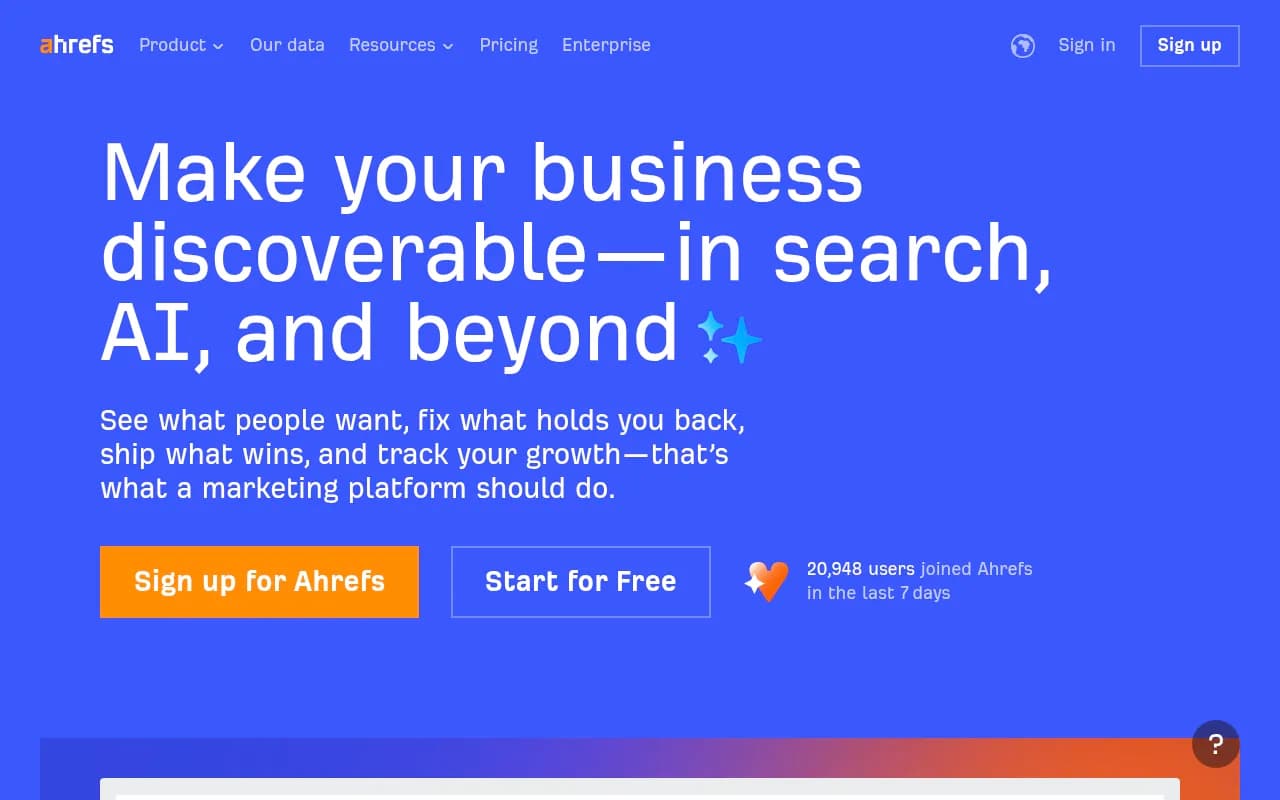
Ahrefs has been expanding into AI search monitoring with Brand Radar, which tracks brand mentions across AI platforms. The appeal is obvious if you're already an Ahrefs user -- it's included in existing plans rather than requiring a separate subscription.
The reality is that Brand Radar is still fairly basic compared to dedicated AI visibility tools. The prompts are fixed (you can't customize them to match your actual customer queries), there's no AI traffic attribution, and there's no content generation tied to what you find. It tells you whether you're being mentioned; it doesn't tell you why you're not, or what to do about it.
Ahrefs' core strength remains its backlink database and traditional SEO tools -- keyword research, site audits, rank tracking. These are genuinely excellent. If you're primarily an SEO professional who wants a glimpse of AI visibility without paying for a separate tool, Brand Radar is a reasonable addition. But it's not a replacement for a dedicated AI visibility platform.
Compared to Alli AI, there's almost no overlap. Ahrefs doesn't do multi-site deployment automation, and Alli AI doesn't do backlink analysis. They solve different problems.
Pricing starts at $83/month (annual) or $99/month (monthly), with a $7 trial. Brand Radar is included in these plans.
Best for: Existing Ahrefs users who want basic AI brand monitoring without paying for a separate tool.
SE Ranking
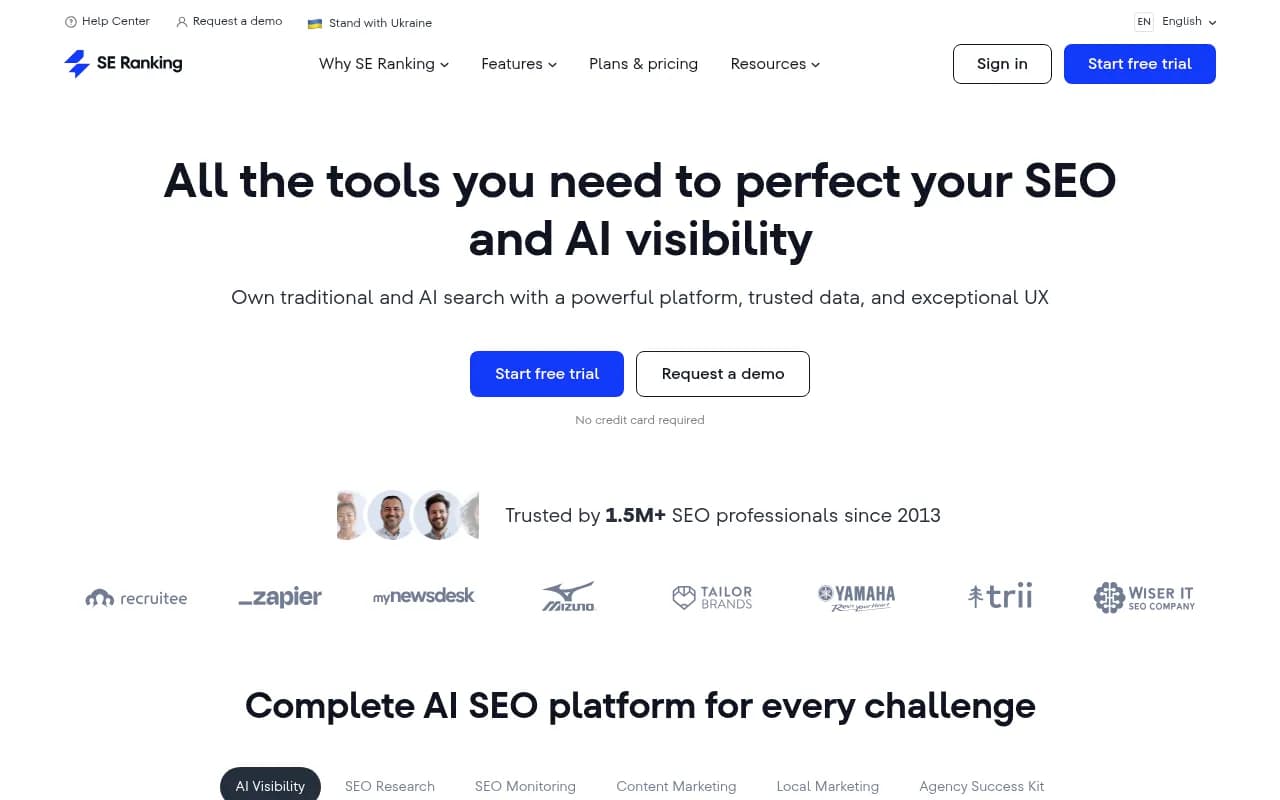
SE Ranking has built a solid reputation as a mid-market SEO platform -- more affordable than Semrush, with a cleaner interface and a genuinely useful AI visibility module called SE Visible. It covers rank tracking, site auditing, keyword research, and content optimization, plus the AI search tracking add-on.
The AI visibility features give you a strategic view of how your brand performs across AI platforms, with clearer presentation than some competitors. The 14-day free trial (no credit card required) is a nice touch for evaluation. The AI Search add-on is $71.20/month on top of the base Core plan ($103.20/month), so you're looking at around $175/month for the combination.
Like Semrush, SE Ranking identifies issues but doesn't automate deployment. It's a research and monitoring tool, not a deployment engine. Compared to Alli AI, it's better for teams that want to understand their SEO situation and make informed decisions, rather than teams that need to push changes across dozens of sites automatically.
Best for: Small to mid-size teams wanting a well-rounded SEO platform with AI visibility monitoring at a more accessible price point than Semrush.
Surfer SEO
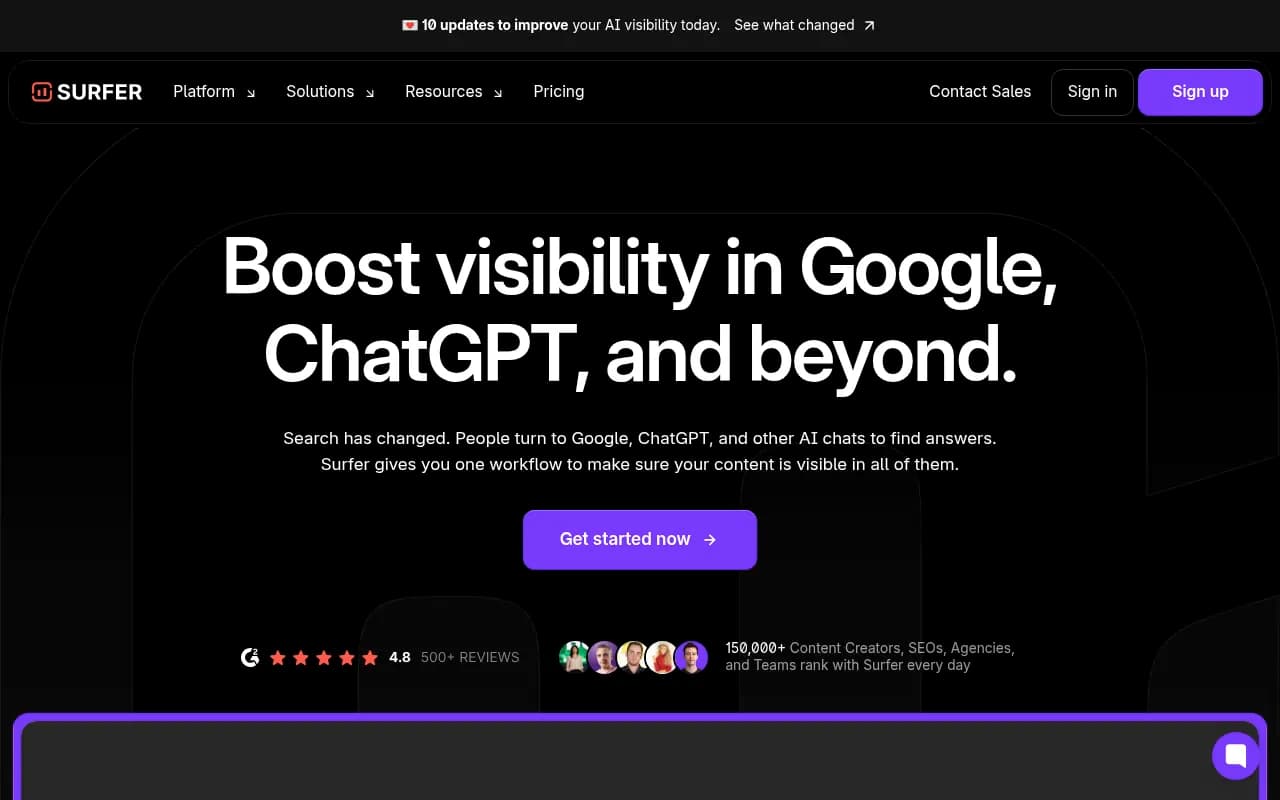
Surfer has evolved from a pure content optimization tool into something broader -- it now covers AI search tracking alongside its core content editor and writing tools. The content editor is genuinely good: it analyzes top-ranking pages for a keyword and gives you real-time guidance on word count, headings, NLP terms, and structure as you write.
The AI visibility tracking is newer and less mature than dedicated tools. Surfer's strength is still in the content creation workflow -- if you're a writer or content team that wants SEO guidance baked into the writing process, it's one of the better options. The AI writing features have improved significantly, and the topical authority mapping helps you plan content clusters rather than just individual articles.
Compared to Alli AI, Surfer is entirely different. Alli AI automates deployment; Surfer helps you create better content. There's no multi-site management, no JavaScript rendering fix, no bulk deployment. Surfer is a content tool that happens to have added some AI visibility monitoring.
Pricing runs from $99/month (Essential: 30 articles, 1 user) to $399/month (Max: 300 articles, 10 users). Annual billing saves 20%.
Best for: Content teams and SEO writers who want optimization guidance during the writing process, with some AI visibility monitoring included.
Clearscope
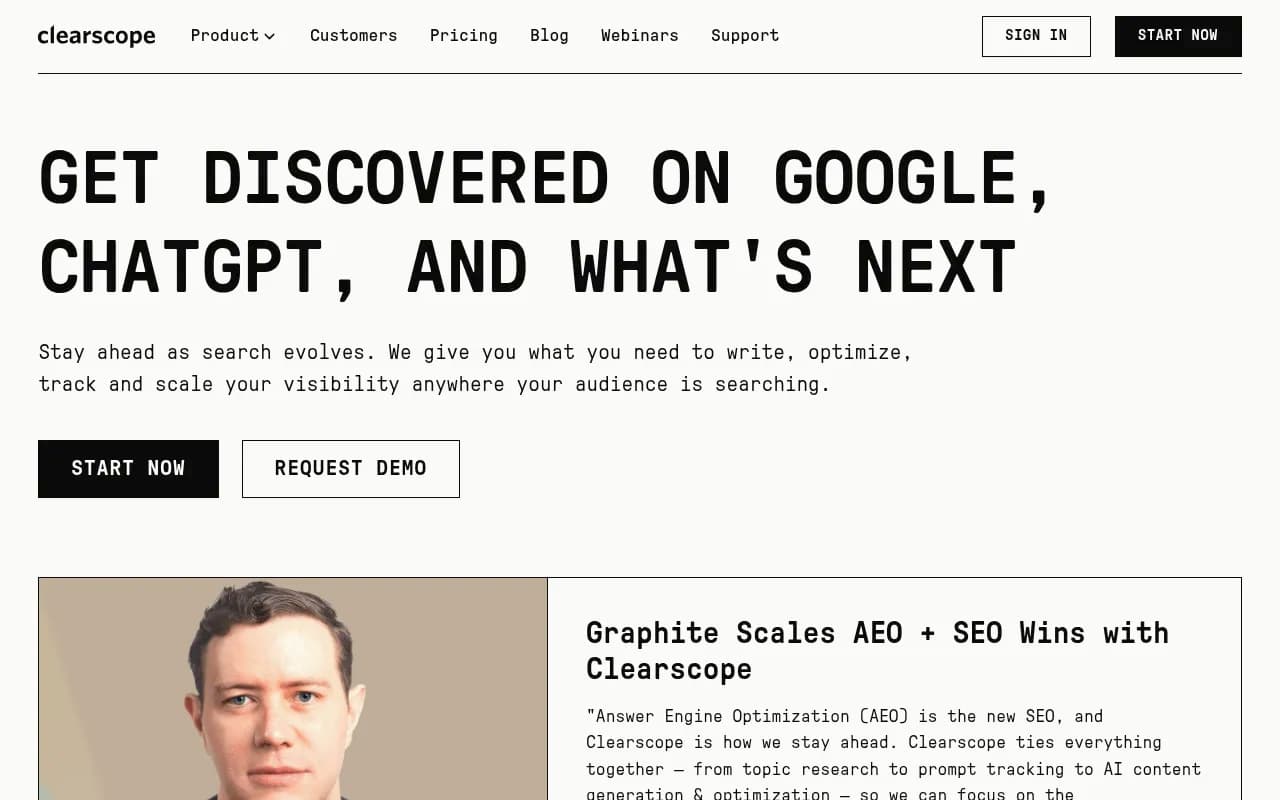
Clearscope is a content optimization platform with a strong focus on topical authority and discoverability. It's added AI visibility tracking -- you can see which sources AI models are using to compile their answers, and track your visibility across Google and AI chatbots. The interface is clean and the data presentation is genuinely useful for content strategists.
The honest limitation: Clearscope is expensive for what it does. At $189/month for the Essentials plan, you're paying more than Frase or Surfer for a tool that's primarily a content optimization editor with AI visibility monitoring added on. The content editor is excellent, and the topic exploration features are well-designed, but the AI visibility component isn't as deep as dedicated platforms.
Compared to Alli AI, there's essentially no overlap. Clearscope is for content teams optimizing individual pieces; Alli AI is for agencies deploying changes at scale.
Best for: Content teams at larger organizations (Clearscope's customer list includes Intuit, Adobe, Shopify, Deloitte) who prioritize content quality and topical authority over bulk automation.
Frase
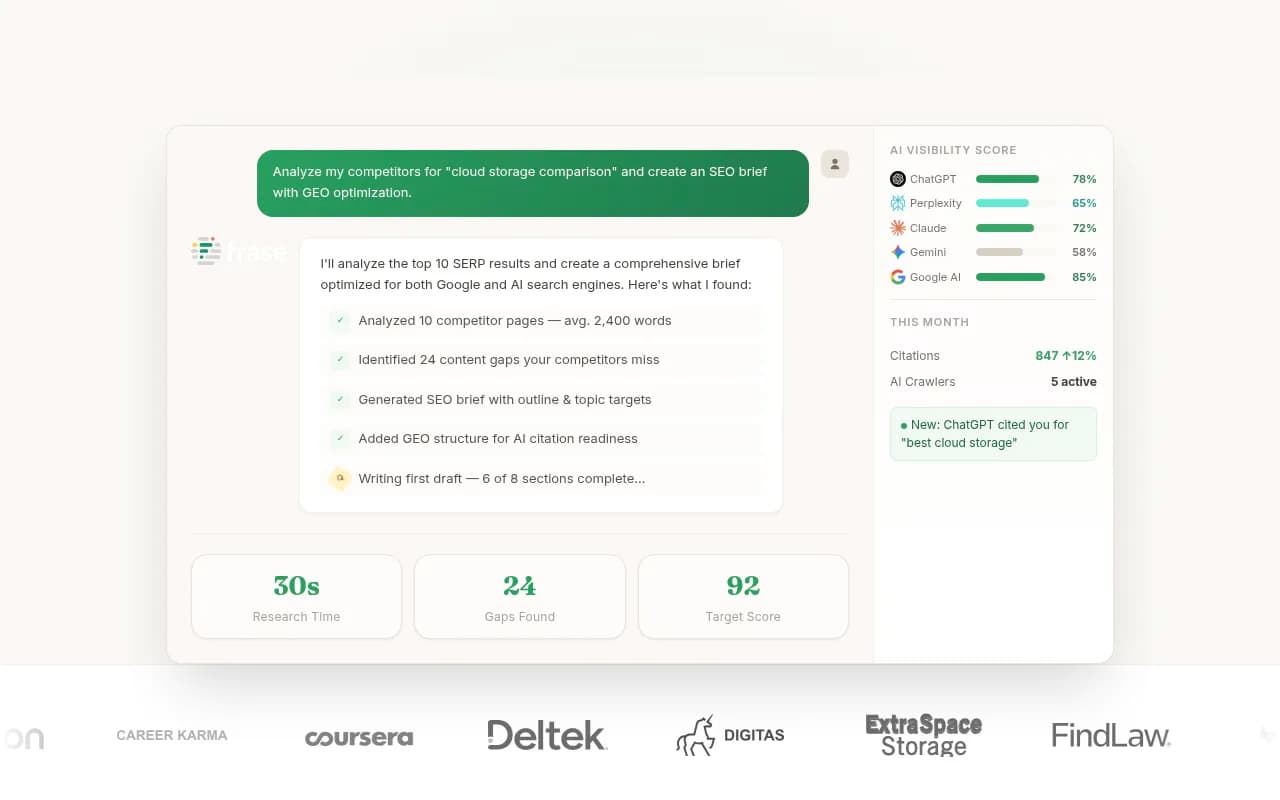
Frase has positioned itself as an "agentic SEO and GEO platform" -- it researches your market, creates content briefs, generates drafts, and now tracks visibility across Google, ChatGPT, and Perplexity. The pitch is consolidation: instead of using separate tools for research, writing, optimization, and tracking, Frase tries to handle the whole workflow.
The content brief generation is genuinely useful -- it analyzes SERP competitors and identifies content gaps quickly. The AI writing is competent. The GEO tracking (monitoring citations in AI search) is a newer addition and less mature than dedicated tools, but it's included in the base price rather than as an add-on.
At $39/month for the Solo plan (10 articles/month) and $114/month for the Basic plan (3 users, 30 articles), Frase is one of the more affordable options here. The trade-off is depth -- the AI visibility features are basic compared to Promptwatch, and the content editor isn't as polished as Surfer or Clearscope.
Compared to Alli AI, Frase is a content creation tool, not a deployment engine. No multi-site management, no bulk on-page changes.
Best for: Small teams and solo operators who want an affordable all-in-one for content research, writing, and basic AI visibility tracking.
MarketMuse
MarketMuse takes a different angle from most tools here. Its patented AI analyzes your entire content inventory, maps your existing topical authority, and tells you which topics are worth creating content for based on your specific site's strengths -- not just generic keyword difficulty scores. The "personalized difficulty" concept is genuinely useful: a topic that's hard for a new site might be easy for you if you already have strong authority in that area.
The content planning features are strong. MarketMuse is good at helping you decide what to write before you write it, and at identifying gaps in your content clusters. It's less focused on the actual writing process than Surfer or Frase.
The AI search visibility features are limited -- MarketMuse is primarily a content strategy tool, not an AI monitoring platform. And the pricing is on the higher end: $150/month for the Standard plan, with a free tier limited to 10 queries/month.
Compared to Alli AI, there's no overlap. MarketMuse helps you plan content strategy; Alli AI deploys changes at scale.
Best for: SEO strategists and content teams at established sites who want data-driven decisions about what content to create, update, or deprioritize.
ClickRank AI
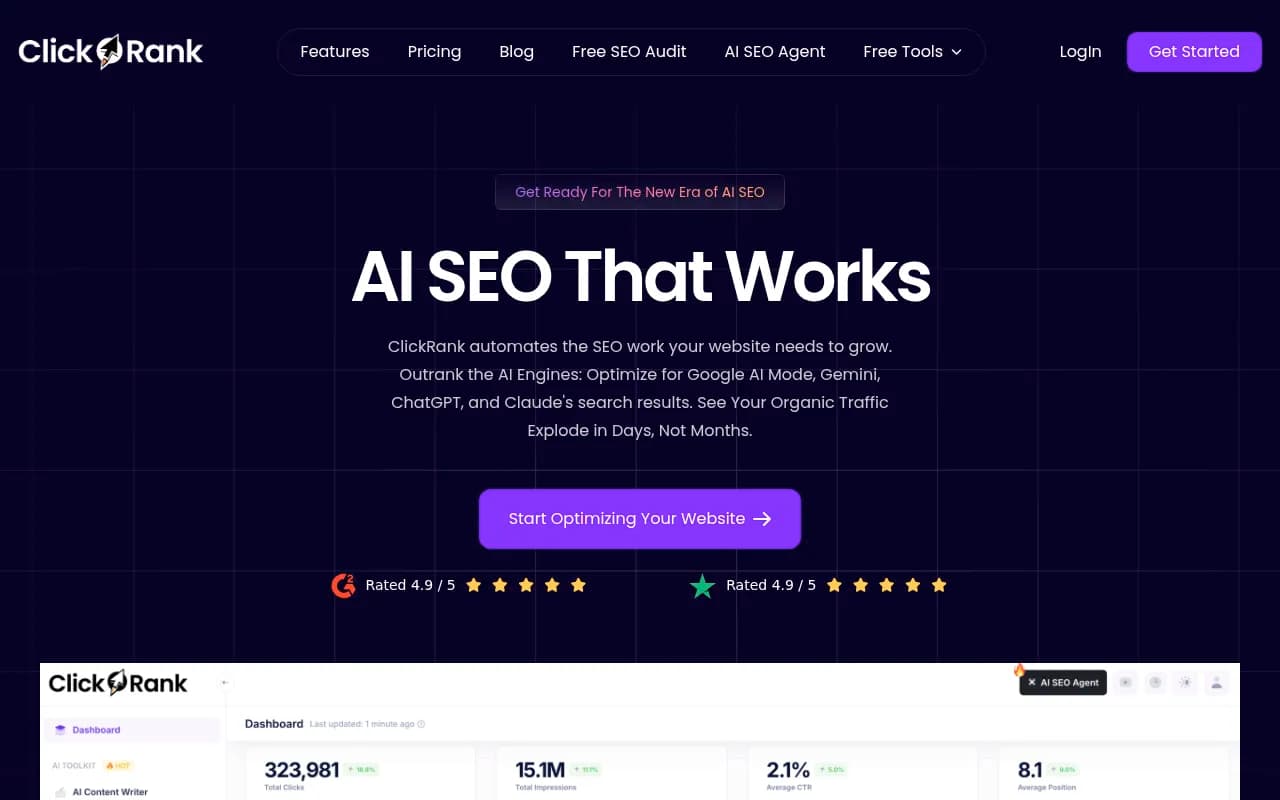
ClickRank AI is the closest direct competitor to Alli AI in terms of what it actually does: automated on-page SEO deployment via a JavaScript snippet. It handles title tags, meta descriptions, schema markup, image alt text, and internal links without requiring manual page-by-page edits. The setup is genuinely simple -- paste a snippet, connect Google Search Console, and it starts working.
The key differences from Alli AI: ClickRank is aimed at SMBs and solopreneurs rather than agencies managing large portfolios. The pricing is more accessible (from $59/month vs. Alli AI's $299/month), but the multi-site management features are less robust. Alli AI's JavaScript rendering fix for AI crawlers is a specific capability ClickRank doesn't match.
ClickRank has a 4.9/5 rating on both G2 and Trustpilot, which suggests users are happy with it for its intended use case. It's not trying to be an enterprise agency tool -- it's trying to make basic SEO automation accessible to smaller operators.
Best for: SMBs, solopreneurs, and small agencies who want automated on-page SEO without the complexity or cost of Alli AI.
SEO PowerSuite
SEO PowerSuite is a desktop-based toolkit covering rank tracking, keyword research, site auditing, backlink analysis, and link building. The defining characteristic is the pricing model: there's a free tier, and paid plans don't use a credit system -- you can run as many queries as you want. For agencies doing heavy data work, this matters.
The trade-off is that it's desktop software, not cloud-based. Collaboration is more awkward, and you don't get the real-time dashboards that web-based tools offer. There's no AI visibility monitoring, no content generation, and no multi-site deployment automation. SEO PowerSuite is a traditional SEO toolkit that does traditional SEO things very well.
Compared to Alli AI, it's cheaper (free to $200/month) but solves a different problem. Alli AI automates deployment; SEO PowerSuite gives you data to make decisions manually.
Best for: Budget-conscious SEO professionals and agencies who need unlimited data access for traditional SEO tasks and don't need AI visibility features.
Which alternative should you pick?
The right choice depends on what you're actually trying to solve:
You want to understand and improve AI search visibility -- Promptwatch is the clear choice. It's the only tool here that combines monitoring, gap analysis, content generation, and traffic attribution in one workflow. If you want to know why ChatGPT isn't recommending you and what to do about it, start there.
You need multi-site on-page SEO automation at a lower price point -- ClickRank AI does much of what Alli AI does for smaller operations, at a fraction of the cost. If you're managing 1-5 sites rather than 20+, it's worth evaluating.
You want a comprehensive traditional SEO platform with some AI monitoring -- Semrush is the most complete option, though you'll pay for it. SE Ranking is a more affordable alternative with similar coverage.
You're primarily a content team -- Surfer SEO and Frase are the most workflow-friendly options. Frase is cheaper; Surfer's editor is more polished. MarketMuse and Clearscope are better for strategic content planning at larger organizations.
You want unlimited data without per-query costs -- SEO PowerSuite's desktop model is unique in this list and genuinely useful for data-heavy agencies.
The honest summary: Alli AI is a specialized tool for a specific problem (large-scale multi-site deployment + JavaScript rendering for AI crawlers). If that's your problem, it's hard to replace directly. If it's not your problem, most of these alternatives will serve you better at lower cost.