SEO PowerSuite Review 2026
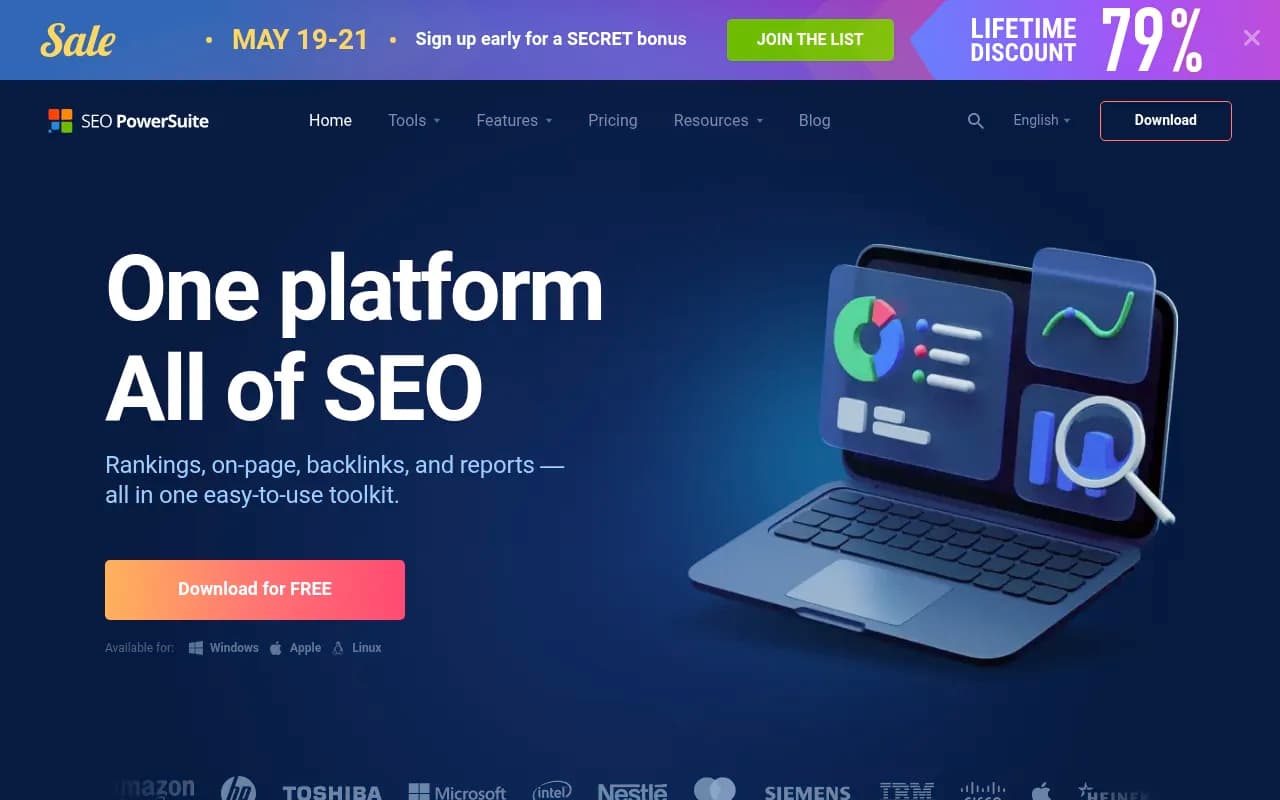
SEO PowerSuite is a desktop-based all-in-one SEO toolkit covering rank tracking, keyword research, site auditing, backlink analysis, and link building. Ideal for SEO professionals, agencies, and small businesses wanting unlimited data without per-query credit limits.
Key takeaways
- SEO PowerSuite is a desktop-installed SEO toolkit (Windows, Mac, Linux) with four specialized tools covering rank tracking, site auditing, backlink analysis, and link building -- no credit limits on data usage.
- Pricing starts at $0 (free forever tier) and goes up to $200/mo for the Max+ plan, making it significantly cheaper than cloud-based competitors like Semrush or Ahrefs at comparable feature depth.
- The desktop model is both its biggest strength and its biggest constraint: unlimited data queries but no real-time collaboration, no browser-based access from any device, and no AI search visibility monitoring.
- Does not monitor AI search engines (ChatGPT, Perplexity, Claude, etc.) -- teams looking for GEO/AEO capabilities will need a separate platform like Promptwatch.
- Best suited for solo SEO practitioners, small agencies, and cost-conscious teams doing traditional search engine optimization at scale.
SEO PowerSuite has been around since 2005, built by Link-Assistant.com, a company that has quietly outlasted dozens of SEO tool startups by doing one thing consistently: giving SEO practitioners a lot of data for a reasonable price. The suite is desktop software -- you download and install it on Windows, Mac, or Linux -- which is an unusual choice in 2026 when almost everything has moved to the cloud. But that desktop architecture is actually the core of its value proposition: because you're running queries from your own machine and storing data locally, there's no per-query credit system eating into your budget.
The target audience is broad but skews toward practitioners who do a lot of SEO work and hate hitting data walls. That includes freelance SEO consultants managing a handful of client sites, small-to-mid-size agencies that need white-label reporting without paying Semrush's agency-tier prices, and in-house SEO teams at SMBs who want comprehensive tooling without enterprise contracts. Over 2 million users have used the suite across its two-decade run, and it holds 543 reviews on G2 with consistently strong ratings around value for money.
The suite recently added RankDots, an AI-powered topic clustering and content generation tool, which signals that Link-Assistant is trying to modernize the product. But the core four tools -- Rank Tracker, WebSite Auditor, SEO SpyGlass, and LinkAssistant -- remain the main draw.
Key features
Rank Tracker is the flagship tool and genuinely one of the more capable rank trackers available at this price point. It monitors keyword positions across 550+ search engines, including Google, Bing, Yahoo, Yandex, Baidu, and YouTube. You can track rankings at the country, city, or street-address level, which matters for local SEO work. Desktop and mobile rankings are tracked separately. Historical data goes back to whenever you started tracking, stored locally, so there's no artificial data retention limit. The SERP analysis view shows you who's ranking for a given keyword and what their on-page signals look like, which is useful for competitive gap analysis.
- Supports unlimited keywords per project (no credit deductions per check)
- Scheduled automatic rank checks with email alerts on position changes
- Competitor tracking alongside your own domain
- Integration with Google Search Console and Google Analytics for blended data views
WebSite Auditor handles technical SEO and on-page analysis. The crawler is configurable -- you can set crawl depth, speed, user agent, and handle JavaScript rendering. It checks for the usual suspects: broken links, redirect chains, duplicate content, missing meta tags, thin pages, and Core Web Vitals. The site structure visualization is genuinely useful for spotting internal linking problems; you get a visual graph of how pages connect, which makes it easy to identify orphaned pages or over-linked hub pages.
The content editor inside WebSite Auditor uses TF-IDF analysis to compare your page against top-ranking competitors and suggest terms you should include. It's not as sophisticated as tools like Surfer SEO's NLP-based recommendations, but it's functional and included in the base price.
SEO SpyGlass is the backlink analysis tool, pulling from a proprietary index that Link-Assistant claims holds 6.5 trillion backlinks across 400 million domains. The index is competitive with mid-tier backlink databases, though Ahrefs and Majestic still have larger and more frequently updated indexes. SpyGlass shows domain authority scores, anchor text distribution, link velocity, and penalty risk scores for each linking domain. The toxic backlink checker flags links that might be hurting your rankings, and you can export a disavow file directly.
- Backlink history tracking shows how a domain's link profile has changed over time
- Competitor backlink comparison to find link gap opportunities
- InLink Rank (their proprietary authority metric) for evaluating link quality
LinkAssistant automates the link-building outreach workflow. It finds link prospects using 10+ methods (guest post opportunities, resource pages, competitor backlinks, etc.), manages contact information, tracks outreach email status, and logs responses. It's essentially a lightweight CRM for link building built into the suite. For agencies running ongoing link-building campaigns, this replaces the need for a separate tool like Pitchbox or BuzzStream, at least at smaller volumes.
RankDots (new) is the AI content clustering and generation addition. It groups keywords into topic clusters and helps generate content briefs or draft articles. This is clearly a response to the content optimization trend, though it's newer and less battle-tested than the core four tools.
White-label reporting is a genuine strength. You get 15 predefined report templates covering rankings, backlinks, site health, and more. Reports can be fully branded with your logo and colors, scheduled for automatic delivery, and exported as PDF or HTML. For agencies, this alone can justify the subscription cost compared to manually assembling reports from multiple tools.
Google integrations include Search Console, Google Analytics, and Google Keyword Planner. Connecting GSC gives you actual click and impression data alongside rank tracking data, which is more reliable than estimated traffic figures.
Who is it for
The clearest fit is the solo SEO consultant or small agency (2-10 people) that does traditional SEO work -- keyword research, technical audits, link building, rank tracking -- and wants to do it without paying $500+/month for Semrush or Ahrefs. If you're managing 5-20 client sites and need white-label reports, unlimited rank tracking, and backlink analysis, SEO PowerSuite covers that workflow at a fraction of the cost.
In-house SEO teams at SMBs are another strong fit, particularly those where one or two people own the entire SEO function. The desktop model means the data lives on your machine, which some teams prefer for data control reasons. The learning curve is real -- the interface is dense and the tools have a lot of settings -- but the documentation and tutorial library is extensive.
Who should look elsewhere: teams that need real-time collaboration across multiple users simultaneously will find the desktop model frustrating. There's no shared workspace where three people can pull up the same project from different locations. Cloud-based tools like Semrush or Ahrefs handle this much better. Enterprise teams with complex workflows, API-first requirements, or needs for AI search visibility monitoring will also find SEO PowerSuite's scope too narrow. And if your SEO strategy increasingly involves understanding how your brand appears in ChatGPT, Perplexity, or Google AI Overviews, SEO PowerSuite has no answer for that -- it's built entirely around traditional search engine rankings.
Integrations and ecosystem
SEO PowerSuite's integration list is shorter than cloud-based competitors, which is an honest limitation of the desktop model.
- Google Search Console: Pulls impression, click, and position data directly into Rank Tracker
- Google Analytics: Blends traffic data with ranking data for a fuller picture
- Google Keyword Planner: Imports keyword volume data
- Backlink API: A separate API product that lets developers query the SpyGlass backlink index programmatically -- useful for building custom dashboards or integrating backlink data into other tools
- Export formats: CSV, XLS, PDF, HTML for most data views
There's no native Zapier integration, no Slack notifications, and no direct CMS integrations. The scheduled reports go out via email. For teams that live in Slack or need webhook-based alerts, this is a gap. The software does support proxy configuration for rank checking, which matters for agencies doing large-scale rank tracking without triggering search engine blocks.
Mobile apps don't exist -- this is desktop software. Browser extensions aren't part of the core suite either, though third-party SEO browser extensions can complement it.
Pricing and value
SEO PowerSuite has a genuinely free tier that doesn't expire -- you get access to all four tools with some limitations on data export and saved projects. It's enough to evaluate the software properly and handle occasional SEO tasks.
Paid plans:
- Professional: $60/month -- aimed at small businesses; includes full data access, scheduled tasks, and report generation. Covers one user.
- Enterprise: $140/month -- for SEO professionals and agencies; adds white-label reporting, client management features, and higher limits on scheduled tasks.
- Max+: $200/month -- the top tier, described as "for professionals who need it all." Includes everything in Enterprise plus additional data allowances and priority support.
Annual billing reduces these prices significantly -- the pricing search results suggest the 12-month option for individual tools runs considerably cheaper per month than monthly billing.
Compared to Semrush (starts at $140/month for a single user with credit limits) or Ahrefs (starts at $129/month), SEO PowerSuite's Enterprise plan at $140/month covers unlimited data queries with no credit system. For high-volume SEO work, that math works out strongly in SEO PowerSuite's favor. The trade-off is the desktop model and the lack of real-time collaboration.
Strengths and limitations
What it does well:
- The no-credit-limit model is genuinely valuable for practitioners who run large keyword lists or frequent rank checks. Running 10,000 keyword rank checks in Semrush would cost a fortune in credits; in SEO PowerSuite it's just a longer crawl.
- White-label reporting at the Enterprise tier is polished and saves agencies significant time. Scheduled delivery, custom branding, and 15 templates cover most client reporting needs.
- The backlink index (6.5 trillion links, 400 million domains) is competitive for the price point. SpyGlass's penalty risk scoring and disavow export are practical features that agencies use regularly.
- Local rank tracking down to street-address level is more granular than many competitors offer at this price.
- The free tier is genuinely usable, not a crippled demo. You can do real SEO analysis without paying anything.
Honest limitations:
- The desktop model creates real friction for teams. No shared projects, no browser access from a client's office, no mobile access. In 2026, this feels dated compared to fully cloud-based alternatives.
- No AI search visibility monitoring whatsoever. SEO PowerSuite tracks rankings in traditional search engines but has zero capability to show you how your brand appears in ChatGPT, Perplexity, Claude, or Google AI Overviews. As AI search becomes a larger share of how people find information, this is a meaningful gap. Platforms like Promptwatch are built specifically for this use case.
- The interface is dense and not particularly modern. New users face a real learning curve, and the UI design hasn't kept pace with cloud-based competitors that have invested heavily in UX.
- RankDots (the AI content tool) is new and unproven compared to dedicated content optimization tools like Surfer SEO or Clearscope.
Bottom line
SEO PowerSuite is the right choice for cost-conscious SEO practitioners -- freelancers, small agencies, and in-house teams at SMBs -- who do high-volume traditional SEO work and want unlimited data without a credit system eating into their budget. The Enterprise plan at $140/month genuinely competes with tools costing twice as much, particularly for rank tracking and backlink analysis at scale.
If your SEO work is expanding into AI search -- tracking how your brand appears in ChatGPT answers, optimizing for Perplexity citations, or understanding your visibility in Google AI Overviews -- SEO PowerSuite won't help you there. That's a separate discipline requiring a dedicated platform like Promptwatch.
Best use case in one sentence: High-volume traditional SEO work (rank tracking, backlink analysis, technical audits, link building) for practitioners who want unlimited data at a price that doesn't scale with usage.
Tags:
Frequently asked questions
What is SEO PowerSuite?
Is there a free version of SEO PowerSuite?
How much does SEO PowerSuite cost?
How does SEO PowerSuite compare to Semrush or Ahrefs?
Does SEO PowerSuite track AI search visibility (ChatGPT, Perplexity, etc.)?
Who is SEO PowerSuite best suited for?
Similar and alternative tools to SEO PowerSuite