Key takeaways
- Promptwatch is the strongest all-round pick if you want tracking plus actual content production: crawler logs, Reddit/YouTube citation tracking, ChatGPT Shopping and Ads Radar, and automated content agents that publish to your CMS. Starts at $95/mo.
- AthenaHQ has the best free tier (300 credits, 5 models, no card required) and adds a predictive citation-scoring feature (ACE) at the enterprise level.
- Otterly.AI is the cheapest true entry point at $29/mo, and its 25+ factor on-page GEO audit goes deeper than Mentionable's, but Gemini, Claude, and AI Mode are paid add-ons.
- Semrush makes sense if you already run SEO through Semrush and want AI visibility bolted onto the same reports, not as a standalone GEO purchase.
- Profound and Rankscale sit at opposite ends of the spectrum: Profound is now sales-led enterprise only (no self-serve paid tier), while Rankscale's credit system starts at $20/mo for teams that just need lightweight tracking across a large number of engines.
Mentionable's whole pitch is a lightweight GEO layer that plugs into an AI agent, ChatGPT, Cursor, n8n, via its public MCP server, rather than another dashboard to check every morning. That's a real, specific differentiator. But it comes with trade-offs: cheaper plans check weekly or bi-weekly instead of daily, there's no permanent free tier, and Mentionable's own comparison pages admit it lacks Otterly's on-page audit depth and 50+ country coverage. If you've hit one of those walls, or you just want a second opinion before committing budget, here's how the field actually stacks up.
Promptwatch

Promptwatch tracks ChatGPT, Claude, Perplexity, Gemini, Copilot, Grok, DeepSeek, Mistral, Google AI Overviews, and Google AI Mode, plus AI coding assistants like Claude Code, and it does something most trackers in this list don't: it acts on what it finds. Prompt trackers answer "was I mentioned?" Promptwatch tries to answer "how do I grow AI-driven revenue?", which is a genuinely different product category once you dig into the feature set.
The part that separates it from Mentionable and most of the others here is the full stack behind the score. Crawler logs (Agent Analytics) show exactly when ChatGPTBot, ClaudeBot, PerplexityBot and 400+ other AI crawlers hit your site, what they read, and where they error out. Citation analytics break down which of your pages get cited, plus dedicated Reddit and YouTube citation reports, two channels almost nobody else in this space tracks properly. Then Content Agents write and publish GEO-optimized content straight to Webflow, Framer, or WordPress on a schedule, with Unified Actions turning all of this into a prioritized to-do list instead of a wall of charts.
Promptwatch is used by 1,840+ brands including Duolingo, Yelp, Typeform, and Fireflies, rated 4.7/5 on G2, and its dataset (4.5B+ citations analyzed) is the source behind independent reports like Promptwatch's average sources per response data, which found ChatGPT typically cites around 5 sources per response versus roughly 10 for AI Overviews and Perplexity, meaning ChatGPT citation slots are more contested than most people assume.
Pricing starts at $95/mo (Essential: 50 prompts, all LLMs, MCP/API access), $245/mo (Professional: adds automated content generation, shopping insights), and $579/mo (Business: 5 sites, dedicated support). There's a 7-day free trial on paid plans and a free Explore tier (10 prompts, ChatGPT only).
Best for: teams that want AI visibility tracking to actually turn into published content and fixed crawler errors, not just a dashboard someone checks once a week.
AthenaHQ
AthenaHQ leans into the "how does AI talk about my brand" angle harder than most competitors: it's not just measuring whether you're cited, it's analyzing sentiment, narrative framing, and perception drift across models. That distinction matters more than it sounds, because a brand can be mentioned constantly while still being framed worse than a competitor.
AthenaHQ's genuine differentiator is its free Essential tier: 300 credits, 5 models (ChatGPT, Perplexity, AI Overviews, Gemini, Copilot), unlimited team members, no card required. That's rare in this category, where Peec AI, Profound, and Semrush all gate access behind a paid plan or a sales call. Paid tiers start at $295/mo (monthly) or roughly $245/mo billed annually, jumping to 11 models and adding on/off-page action agents. Enterprise unlocks ACE (Athena Citation Engine), which scores content for citation potential before you publish it, a predictive feature matched by almost nobody except Profound's FactCheck.
Where it falls short of Promptwatch: no Reddit or YouTube citation tracking, no ChatGPT Shopping/Ads Radar, and the content optimization tools are recommendation-based rather than agentic publishing.
Best for: teams that want to start free and care as much about brand sentiment and narrative as raw citation counts.
Semrush
Semrush's argument is straightforward: your AI visibility and your traditional SEO aren't separate problems, so why buy two tools. The AI Visibility Toolkit is a $99/mo add-on per domain on top of an existing Semrush subscription, or bundled into Semrush One (Starter around $165/mo promo pricing, Pro+ around $248/mo, Advanced around $455/mo). It pulls from Semrush's 289M+ prompt database and covers ChatGPT, Perplexity, Gemini, AI Mode, and AI Overviews, with Claude, DeepSeek, and Grok added at the Enterprise AIO level.
The honest trade-off here is that Semrush is an SEO suite with AI tracking attached, not a purpose-built GEO platform. One agency CMO quoted in a Rankability review called the $99/mo add-on not worth it "for a startup and not for a big brand either," which lines up with the broader complaint that Semrush's AI features feel shallow compared to dedicated GEO tools, no crawler logs, no AI traffic attribution, fixed prompt sets relative to what Promptwatch or Rankscale offer.
Best for: teams already paying for Semrush's core SEO suite who want AI visibility folded into the same reports rather than running a second subscription.
Otterly.AI

Otterly is the budget option that doesn't feel like a budget option on day-to-day usability. Lite starts at $29/mo for 15 prompts across ChatGPT, AI Overviews, Perplexity, and Copilot with daily tracking, which beats Mentionable's cheaper tiers on refresh frequency (Mentionable's lower plans only check weekly or bi-weekly). Standard jumps to $189/mo for 100 prompts, unlimited workspaces, API access, and a Looker Studio connector; Premium goes to $489/mo for 400 prompts.
Otterly's real strength, and this is something Mentionable's own comparison page concedes, is its 25+ factor on-page GEO audit and coverage across 50+ countries, both deeper than what Mentionable ships. The catch: Gemini, Claude, and Google AI Mode aren't in the base plans, they're paid add-ons ranging roughly $9 to $149/mo depending on tier, so the advertised entry price understates what full model coverage actually costs.
Best for: startups and small teams that want daily tracking and solid on-page audits without enterprise pricing, and don't mind paying extra for full model coverage.
Peec AI
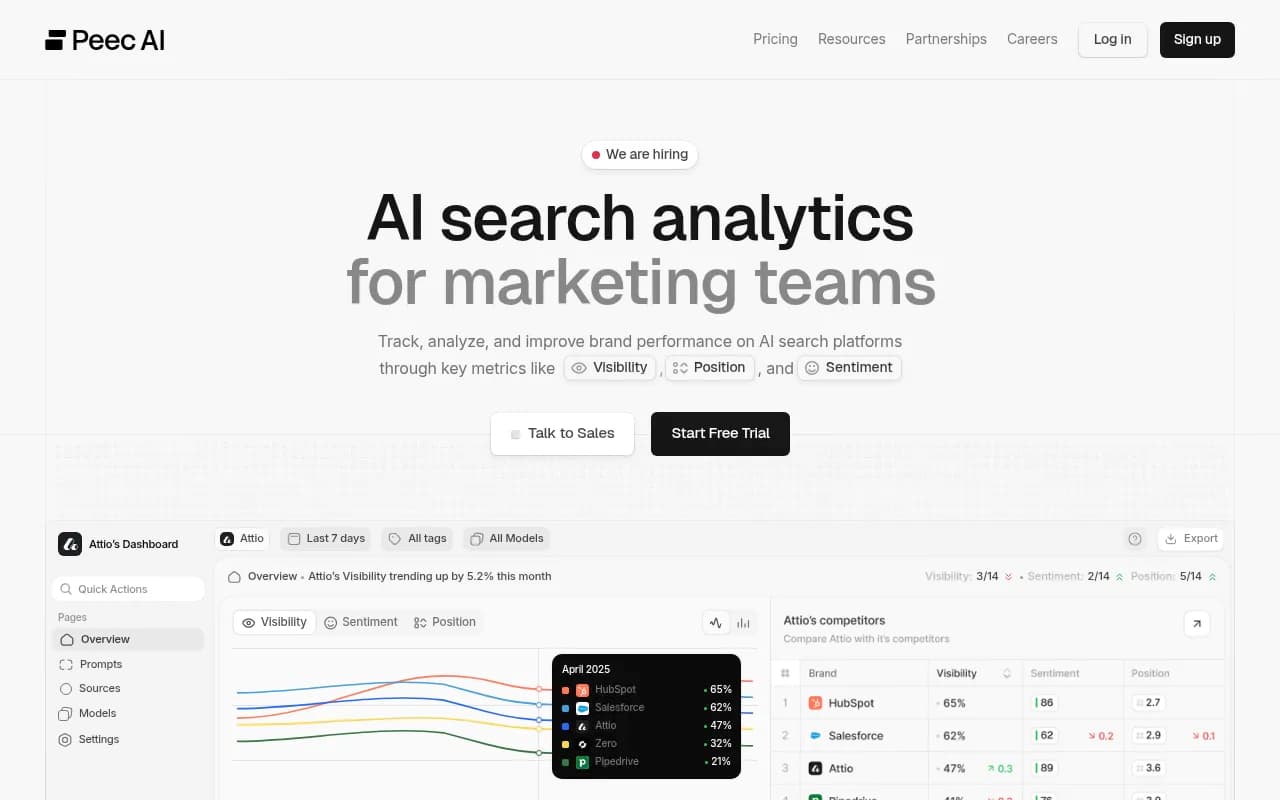
Peec AI sits in the same lightweight-dashboard category as Mentionable but with more polish and a wider price range. Starter is $95/mo for 50 prompts and a choice of 3 of 7 engines, Pro is $245/mo for 150 prompts across 2 projects, and Advanced runs $495/mo with multi-country tracking and a Looker Studio integration. Every tier includes unlimited team seats, a real advantage over Profound, which charges per extra seat.
The limitation worth flagging: all three self-serve plans cap you at 3 of 7 engines by default. Want a 4th model? That's a paid add-on, $35 to $165/mo depending on tier. Reviewer consensus (per GTMOnly and other write-ups) is consistently positive on usability and onboarding speed, with recurring complaints about lighter analytics depth and limited actionable recommendations compared to Promptwatch or Profound.
Best for: agencies and lean marketing teams who want a clean, fast-to-onboard dashboard and don't need more than 3-4 models tracked per project.
Profound
Profound has repositioned itself since its earlier $99/mo Starter tier disappeared. The current public pricing page shows only two options: a free trial (10 prompts, ChatGPT only, run once) and a custom Enterprise tier with sales-led pricing, SSO, SOC 2, and up to 9 answer engines. That's a meaningful shift, and it means Profound is no longer a realistic self-serve option for small or mid-size teams the way Peec AI or AthenaHQ are.
What you get at the enterprise level is genuinely deep: crawler attribution, AI referral analysis, prompt-volume data that works like keyword research for LLMs, and FactCheck, a feature that monitors and corrects AI response inaccuracies by integrating with third-party remediation tools. Profound raised a $180M Series D to build what it calls an "AI Marketer," broadening the product from pure tracking into research, writing, and reporting workflows, similar direction to Promptwatch, but priced and positioned for large enterprise budgets rather than growing SaaS teams.
Best for: enterprises with a dedicated AI search budget and analyst support to build reports from raw exports, not teams wanting a fast self-serve signup.
Rankscale
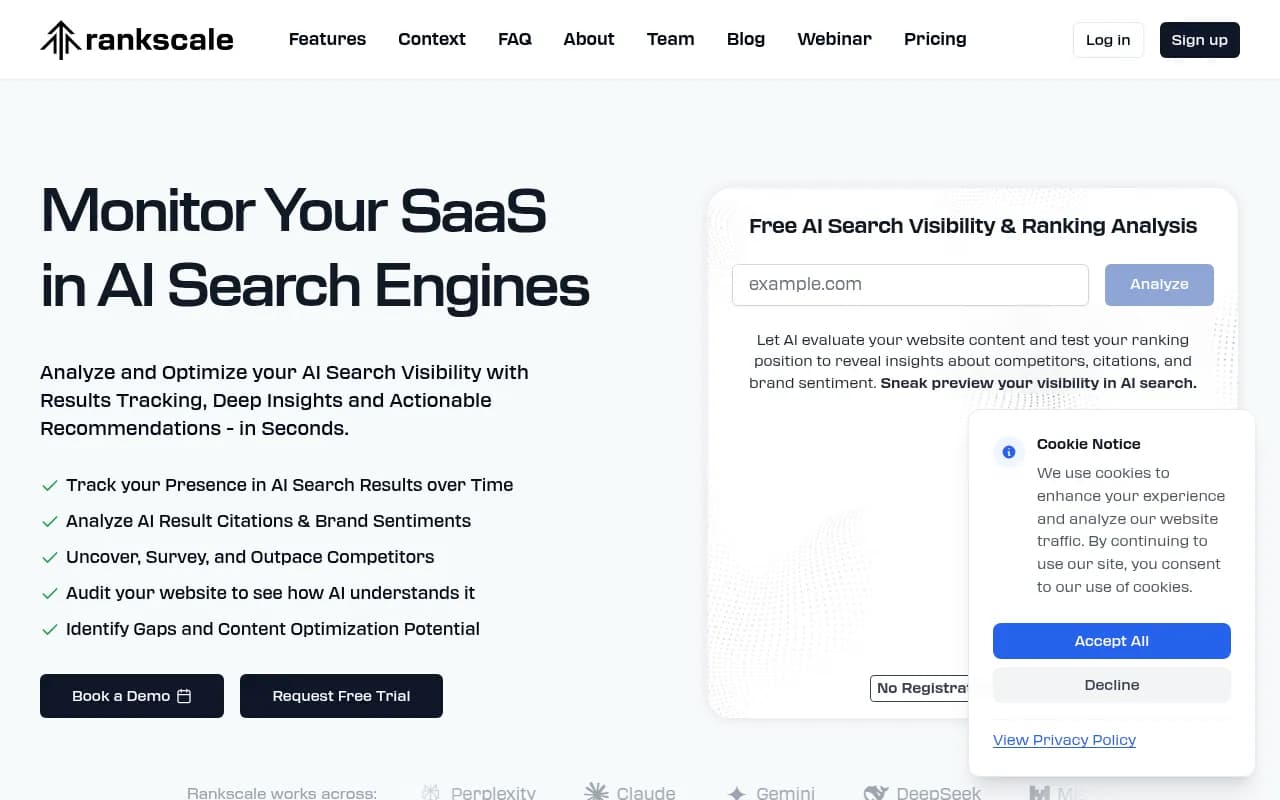
Rankscale's pitch is breadth at low cost: it tracks 17+ (its site claims 54+) AI engines including the usuals plus DeepSeek and Mistral, with a credit-based system starting at $20/mo for roughly 1,500 credits and 6 dashboard slots. Credits scale up through Pro ($99/mo, ~15,000 credits), Growth ($385/mo), and Enterprise ($780/mo), with unused credits rolling over 2-3x, which is friendlier than a hard monthly prompt cap if your usage is uneven month to month.
What's gated behind Pro and above: white-labeled dashboard links, API access, custom dashboards, and MCP integration, so the true entry price for a professional setup is closer to $99/mo than the headline $20/mo. Rankscale also tracks ad placements in ChatGPT Search, a feature that's becoming more relevant as ChatGPT expands ad placement, something worth checking against Promptwatch's own Ads Radar and ChatGPT Shopping tracking if that matters to your category.
Best for: teams that want the widest raw model coverage at the lowest entry price and don't mind a credit system instead of flat prompt counts.
LLM Pulse
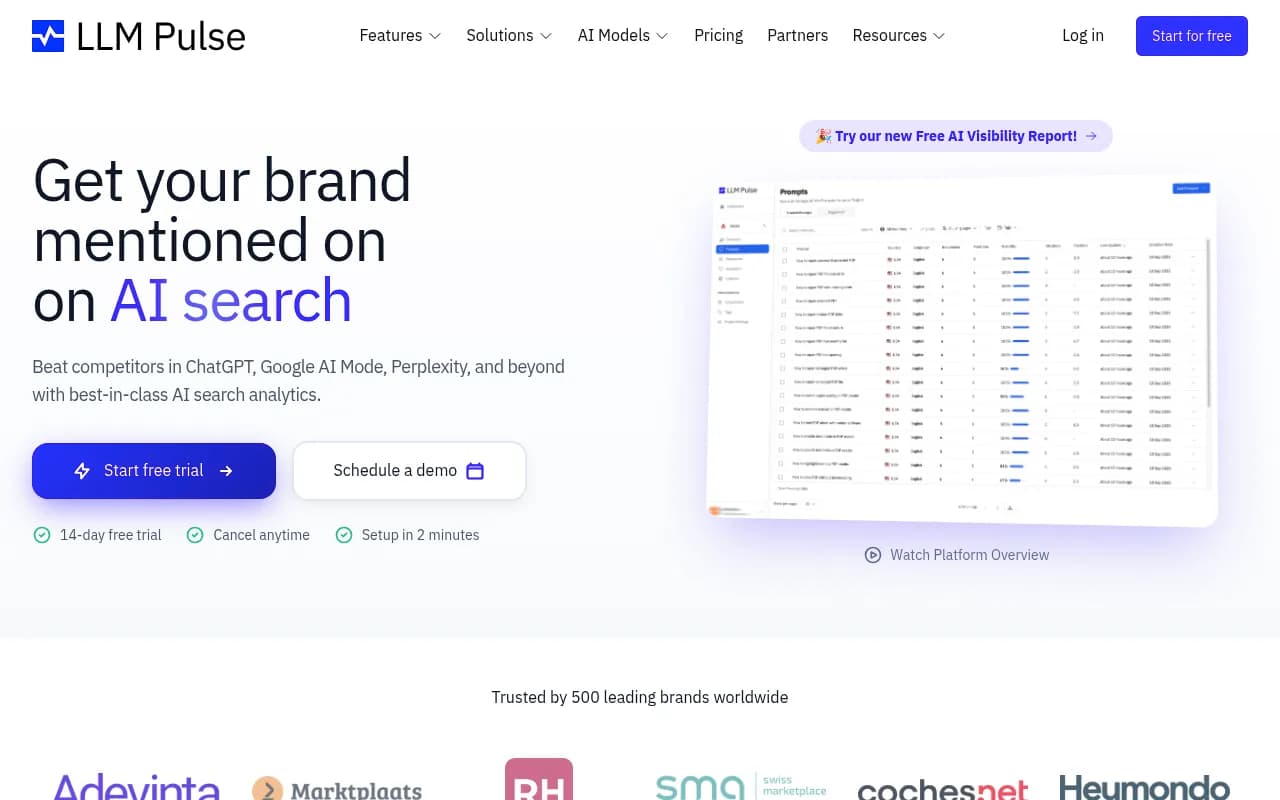
LLM Pulse was built from the ground up as an AI visibility platform rather than an SEO suite with AI tacked on, and it shows in the depth of its sentiment analysis. Current pricing runs Starter $60/mo (50 prompts, 1 project, the 5 standard models: ChatGPT, Perplexity, Gemini, AI Mode, AI Overviews), Growth $120/mo (adds sentiment analysis and AI traffic analytics), and Scale $361/mo (adds ChatGPT Shopping/Ads tracking, API access). Claude, Copilot, Grok, DeepSeek, and Alexa for Shopping are paid add-ons on top of the standard 5.
The share of voice and sentiment combination is genuinely useful if you care not just about being mentioned but about how positively AI models frame you relative to competitors. It's a smaller company (5,000+ users, logos include Salesforce and Volkswagen) than Promptwatch or Semrush, and it doesn't have crawler log analytics or Reddit/YouTube-specific citation tracking.
Best for: mid-market teams that want mention tracking plus real sentiment depth without paying for a full crawler-log/content-generation stack they won't use.
UseWok
Worth including here mainly as a category clarification: UseWok isn't a tracking tool at all, it's a done-for-you visibility service. You pay a one-time fee, Starter at $59 or Growth at $79 (founder pricing, normally $99), and a human team researches, writes, and publishes directory listings, articles, and social posts on your behalf. Prime, at $49/mo, keeps that work going monthly.
If what you actually want from "AI visibility" is more content and citations existing in the world, not a dashboard telling you how visible you already are, UseWok solves a genuinely different problem than Mentionable, Promptwatch, or any tracker on this list. It explicitly does not guarantee approval, indexing, or AI citations, which is honest but also means you're paying for effort, not outcomes. There's no monitoring layer here at all, so most teams will eventually need to pair it with a real tracking tool to know whether the content it publishes is actually getting cited.
Best for: solo founders who want a public presence built without managing another dashboard, and who plan to check results with a separate tracking tool.
Which alternative should you pick
If budget isn't the constraint and you want tracking that turns into finished, published content, Promptwatch is the most complete option here, it's the only one in this list combining crawler logs, Reddit/YouTube citation data, and CMS-connected content agents in one platform. If you want to start free and care about brand sentiment, AthenaHQ's Essential tier is hard to beat. If you're SEO-first and just want AI visibility as another Semrush report, stick with Semrush rather than adding a second subscription. Otterly and Peec AI both work well for lean teams that want a clean dashboard and don't need the full agentic stack, with Otterly winning on price and on-page audit depth, Peec AI winning on usability and seat flexibility. Profound only makes sense once you're enterprise-sized with a sales relationship already in motion, and Rankscale is the pick if raw model breadth at a low credit-based entry price matters more than polish. UseWok, to be clear, solves a different problem entirely and should be paired with a tracker, not treated as a replacement for one.
Whichever you land on, cross-check the vendor's own marketing against something independent. Directories like the GEO software listings at bestgeosoftware.com or the rankings at ai-rank-tools.com are a decent second opinion before you commit a year of budget to any single AI visibility tool.