Key takeaways
- Sitecore acquired Scrunch for a reported $225 million in June 2026 and kept it running as a standalone product — but the roadmap still bent toward the acquirer's enterprise customer base.
- Scrunch's pricing restructured from three self-serve tiers down to a single $250/month Core plan, with the differentiated features (the Agent Experience Platform, MCP access, SSO, API access) pushed exclusively into Enterprise.
- The HubSpot–XFunnel deal shows the opposite integration model: full absorption, rebranding as "HubSpot AEO," and a price drop to $50/month with a reduced feature set. Same industry, opposite outcome.
- For buyers of an acquired tool, the honest question is not "will the product survive?" but "which segment of the acquirer's customer base does my tier serve?"
- For founders, acquisitions can accelerate the roadmap (more resources, faster shipping) while simultaneously killing the parts of it that served customers the acquirer doesn't care about.
Why acquisitions bend roadmaps in the first place
Every startup founder who signs an acquisition term sheet says the same thing: "This accelerates our roadmap." Chris Andrew, Scrunch's CEO, said exactly that in June 2026. Sometimes it's even true.
But the mechanics matter. A startup's roadmap is built around its own customers — usually a mix of self-serve teams and mid-market accounts who chose the product on its own merits. An enterprise acquirer's roadmap is built around its existing revenue base: seven-figure contracts, integration with its own platform, and features that make the combined offering easier to sell.
When those two customer bases overlap, the acquisition is mostly upside. When they don't, something gives. And the thing that usually gives first is the low-ARPU self-serve tier, because the acquirer didn't buy the company for that revenue. They bought the technology, the team, or the category position.
The AI visibility software category went through a wave of these deals in the first half of 2026, which makes it unusually good territory for studying the pattern. Sitecore bought Scrunch. Adobe completed its $1.9 billion Semrush acquisition in late April. HubSpot had already swallowed XFunnel in late 2025 and relaunched it as HubSpot AEO in April 2026. Three deals, three very different integration strategies, three different outcomes for existing customers.

The Scrunch–Sitecore deal: what actually happened
The facts
Sitecore announced the acquisition on June 3, 2026. Bloomberg pegged the deal at roughly $225 million. Scrunch, founded in 2023 by Chris Andrew and Robert MacCloy, had raised $26 million from Mayfield, Decibel, Homebrew, and GTM Capital, and counted 500+ brands and agencies as customers, including Lenovo, Akamai, Crunchbase, and Penn State University.
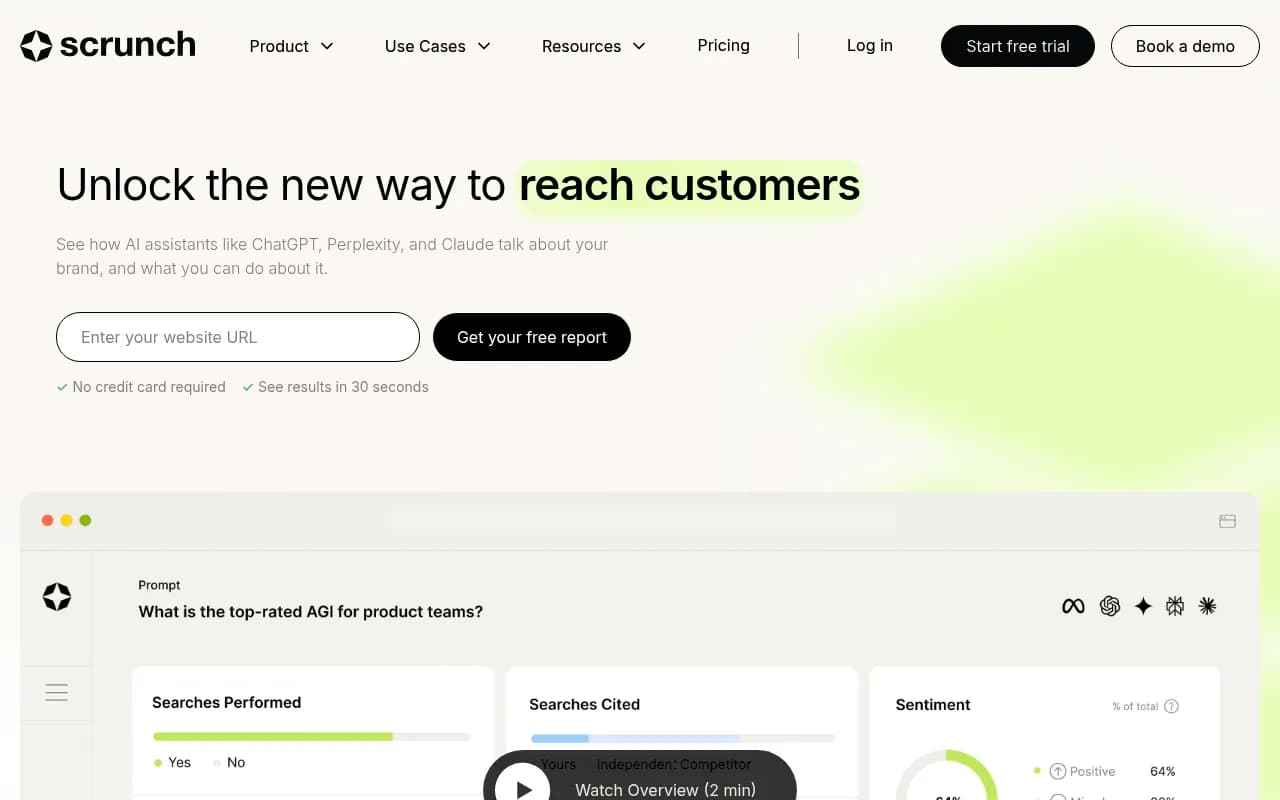
The strategic logic was clean. Scrunch's Agent Experience Platform (AXP) tells brands where they appear (or don't) in AI answers across ChatGPT, Gemini, Perplexity, and others, and reformats content so AI agents can read and use it. Sitecore sells content management, marketing, and digital asset management infrastructure to large enterprises. Scrunch finds the gaps; Sitecore's workflows let teams act on them without leaving the platform. As Mo Cherif, Sitecore's VP of AI and Innovation, put it: "If machines cannot understand you, humans may never find you."
Scrunch arrived with strong proof points, too. Akamai reported a 364% increase in brand presence for non-branded prompts and a 218% increase in citations using AXP-enabled pages. Runpod credited the platform with a 400% increase in paying customers from AI search optimization.
The "standalone platform" promise
Andrew's announcement post said Scrunch would "continue to operate as a standalone platform, support the customers and partners we serve today, and accelerate our product roadmap." Sitecore's materials repeated the framing. This is the softer of the two common integration models — keep the brand, keep the product, keep the customers — versus the HubSpot approach of full absorption.
And to be fair, Scrunch kept shipping. In the same quarter as the acquisition, it launched Scrunch MCP (conversational access to AI search data inside Claude, ChatGPT, and Copilot), Knowledge Studio (turning internal brand knowledge from Notion and SharePoint into AI-readable source material), and Sentiment Trends (tracking which topics and personas drive brand perception shifts in AI answers). That's not a company that stopped building.

But look at the pricing page
Here's where the roadmap gravity shows up. Before and shortly after the acquisition, Scrunch's pricing had three tiers: Starter at $300/month (3 seats, 350 custom prompts), Growth at $500/month (5 seats, 700 custom prompts), and custom Enterprise.
By late 2026, the public pricing page showed just two options: Core at $250/month with 125 unique prompts, 5 site audits a month, and 4 LLMs tracked — and Enterprise, with custom everything. And the split isn't subtle about who it's for. AXP access, MCP access, API access, SSO/SAML/OIDC, and support for 9 LLMs including Claude, Gemini, and Grok all sit behind the Enterprise wall. Core customers get monitoring and analysis. The action layer — the part Sitecore actually paid $225 million for — is enterprise-only.
One independent review of the deal put it more bluntly than I could: "When a $300/month self-serve tier and a seven-figure enterprise platform live under one roof, self-serve is rarely the side that gets the roadmap attention."
This is the predictable pattern, playing out in real time. The product survives. The roadmap survives. What quietly disappears is the roadmap for you, if you're not the customer the acquirer bought the company to serve.
Three deals, three integration models
The 2026 consolidation wave is useful because the acquirers chose visibly different strategies. Here's how they compare:
| Deal | Integration model | What happened to the standalone product | Who won | Who should worry |
|---|---|---|---|---|
| Sitecore buys Scrunch ($225M, June 2026) | Standalone brand, "a Sitecore company" | Kept alive, but self-serve tiers consolidated and advanced features (AXP, MCP, API) moved to Enterprise | Enterprise teams on or near the Sitecore stack | Self-serve buyers under ~$300/month |
| HubSpot buys XFunnel (Oct 2025) | Full absorption, rebranded "HubSpot AEO" (April 2026) | Standalone product discontinued; relaunched as a $50/month add-on with 25 prompts and 3 engines | Marketing Hub customers who get AEO as a cheap bolt-on | XFunnel's original customers, who lost the standalone product and got "zero detail on migration" in the announcement |
| Adobe buys Semrush ($1.9B, closed April 2026) | Feature extraction into the Adobe stack | Semrush's AI Visibility Toolkit folded into Experience Manager, LLM Optimizer, Commerce, and Brand Concierge as "Adobe Brand Visibility" | Adobe enterprise customers | Semrush users outside the Adobe ecosystem, watching the roadmap get parsed into Adobe-branded modules |
The XFunnel case deserves a moment, because it's the cautionary tale. XFunnel tracked 5+ engines at enterprise scope. After absorption, it re-emerged as HubSpot AEO: a $50/month Marketing Hub add-on tracking 25 prompts across ChatGPT, Perplexity, and Gemini. That's a 90%+ price reduction, and for some small businesses it's genuinely a better deal. But for the customers who chose XFunnel as a product, the thing they bought stopped existing.

Adobe's Semrush deal sits somewhere in between. Semrush still operates as a brand, but the AI visibility capability — the strategic reason Adobe paid $1.9 billion — is being carved out and distributed across the Adobe Experience Cloud. Adobe even standardized its own terminology for the category: SEO, GEO (generative engine optimization), and ASO (agentic search optimization). When the acquirer starts naming your product category, you know where the roadmap attention is going.
Why now? The economics of citation slots
The timing of this consolidation wave isn't random. AI answers have a brutally limited inventory. Promptwatch's data on average sources per response shows ChatGPT typically cites around 5 sources per web-search answer, while Google AI Overviews cites roughly 10, and Perplexity lands at almost exactly 10 with unusual consistency. (Promptwatch Data, "Average Sources Per Response")
That scarcity is the whole ballgame. If your brand isn't one of the ~5 sources ChatGPT picks for a given prompt, you're invisible at the exact moment a buyer is forming an opinion. Enterprises understand this now, which is why Sitecore, Adobe, and HubSpot all decided in the span of eight months that buying AI visibility capability was faster than building it. And each ChatGPT citation slot is more contested than a Google AI Overviews slot, because there are half as many of them — which is exactly why the category got hot enough to consolidate.
The buyer behavior driving this is real. Sitecore's own framing for the deal is that buyers now ask AI for comparisons and vendor recommendations before their first click, meaning brand perception forms upstream of any direct engagement. Scrunch's founding bet — that the most important visitor to a website would eventually be an AI agent acting on a person's behalf — went from contrarian in 2024 to consensus by 2026. That's the prize the acquirers are paying for.
What buyers of acquired tools should actually do
If you're a customer (or prospective customer) of a startup that just got acquired, ignore the blog post and look at the evidence. Here's a practical checklist:
Read the pricing page, not the press release. The press release says "we'll continue to operate as standalone." The pricing page shows which tiers are getting feature investment. Scrunch's three-tier-to-two-tier restructure, with advanced features moving upmarket, told the story months before any official statement would.
Ask about the self-serve roadmap in writing. One of the more useful pieces of advice from independent analysts covering the Scrunch deal: take the trial before committing to annual billing, and explicitly ask the vendor, in writing, what the standalone product roadmap looks like post-acquisition. Public assurances are not contractual guarantees.
Figure out whose roadmap you're riding. If you're an enterprise team on or near the acquirer's stack — a Sitecore customer, a Marketing Hub customer, an Adobe Experience Cloud customer — the acquisition is probably good news for you. The combined product will be built for you. If you're a $95–$300/month self-serve customer, the feature tier you need is the one most likely to stagnate.
Have an exit plan. Know which independent alternatives fit your use case, and keep your prompt lists, brand guidelines, and historical data in a format you can export. Migration between AI visibility platforms is much easier when you're not reconstructing two years of tracked prompts from scratch. If you're evaluating the broader market, the directories at bestgeosoftware.com and ai-rank-tools.com are good starting points for seeing which platforms are still independent.
For teams that want to avoid this entire category of risk, independent platforms still exist and some are growing fast. Promptwatch, for example, has stayed independent and backed by its own investors, with a full monitoring-plus-execution stack including AI crawler logs, content generation, and CMS publishing — worth considering if vendor independence matters to your procurement process.

What founders should take from Scrunch's exit
There's a version of this story that reads as a warning. It isn't one. Scrunch's exit at $225 million, three years after founding, with a seed investor (Mayfield's Patrick Salyer) noting that "the company celebrating today is not the one we first funded" — because the product pivoted hard enough along the way — is a good outcome by any measure. Andrew and MacCloy had both been through acquisition cycles before (MacCloy was CTO at Hearsay Systems when Yext bought it), and they structured this one deliberately.
A few lessons for founders watching from the outside:
Build for the buyer's problem, not the category. Scrunch didn't sell "AI visibility tracking." It sold the answer to a specific enterprise question: how do we know what AI says about us, and how do we fix it? The second half of that sentence — the action layer, AXP — is what Sitecore paid for. Monitoring dashboards are commodities; the connection from insight to execution is what commands a premium.
Your customer mix is your exit geometry. Scrunch had 500+ customers, but its strongest case studies (Akamai, Runpod, ADP) were enterprise-scale. That's what made it valuable to an enterprise acquirer, and it's also why the self-serve tier was the predictable casualty. If you want to preserve a self-serve product post-acquisition, build a customer base the acquirer will want to keep serving.
The roadmap you publish and the roadmap the acquirer funds are different documents. Andrew insisted the deal "accelerates our roadmap rather than redirecting it," and in Q2 2026 that was even visibly true — MCP, Knowledge Studio, and Sentiment Trends all shipped. But acceleration with enterprise money means shipping the enterprise parts faster. Founders should be honest with themselves about which parts of their vision survive the funding shift.
The honest bottom line
Consolidation in AI visibility software isn't finished. When Adobe, Sitecore, and HubSpot all make category-defining moves within a year, more martech acquisitions are coming, and every one of them will come with a "standalone platform" press release and a quietly restructured pricing page.
The Scrunch case gives us the cleanest data point so far on what actually changes: the product lives, the founding team stays, features keep shipping — and the self-serve tiers get consolidated while the differentiated capabilities migrate upmarket. If you're an enterprise buyer on the acquirer's stack, that's mostly good news. If you're a small team on a $250–$300/month plan, read the pricing page every quarter and keep your export options open.