Summary
- Webhooks deliver real-time AI visibility data to the tools your team already uses (Slack, email, CRMs) instead of forcing you to check dashboards manually
- Setting up citation webhooks involves creating a Slack incoming webhook, configuring your AI visibility platform to send events, and optionally routing data to email or CRM systems
- Real-time alerts catch pipeline problems early -- like when a competitor suddenly outranks you for a high-value prompt or when a new citation appears for your brand
- Most AI visibility platforms (including Promptwatch) support webhook integrations, and you can build custom routing logic with tools like Zapier or Make
Why webhooks matter for AI visibility
You're tracking citations in ChatGPT, Claude, Perplexity. You've got a dashboard showing your visibility scores. But here's the problem: dashboards are passive. They wait for someone to remember to check them.
By the time you notice a competitor jumped ahead of you in AI search results, they've already captured three weeks of traffic. By the time you see a new citation for your brand, the conversation has moved on.
Webhooks flip this model. Instead of pulling data from a dashboard, data pushes to you -- in Slack, in your inbox, in your CRM -- the moment something changes. You react in real time instead of discovering problems after the fact.

What you can alert on
Before you start building webhooks, decide what's worth alerting on. Not every data point deserves a Slack ping.
High-value alerts
Citation changes: When your brand gets cited (or stops getting cited) for a tracked prompt. This is the core signal -- it means AI models are changing how they talk about you.
Competitor movements: When a competitor appears in a response where they weren't before, or when they move up in ranking. This tells you what's working for them.
Prompt volume spikes: When a tracked prompt suddenly gets 3x more searches. This is an opportunity to optimize for a trending topic.
New prompts discovered: When your AI visibility platform detects a new high-volume prompt related to your category. You want to know about this immediately so you can create content for it.
Crawler activity: When AI crawlers (ChatGPT, Claude, Perplexity) hit your website. This tells you which pages AI models are reading and how often they're refreshing their knowledge.
Low-value alerts (skip these)
Daily summary reports: These belong in email, not Slack. Real-time channels should be reserved for actionable events.
Minor ranking fluctuations: If you drop from #2 to #3 for a low-volume prompt, that's noise. Only alert on meaningful changes.
Visibility score updates: Unless the score crosses a threshold (e.g. drops below 50%), this is dashboard data.
Step 1: Create a Slack incoming webhook
Slack incoming webhooks are the simplest way to push data into a channel. You get a unique URL, and any HTTP POST request to that URL appears as a message.
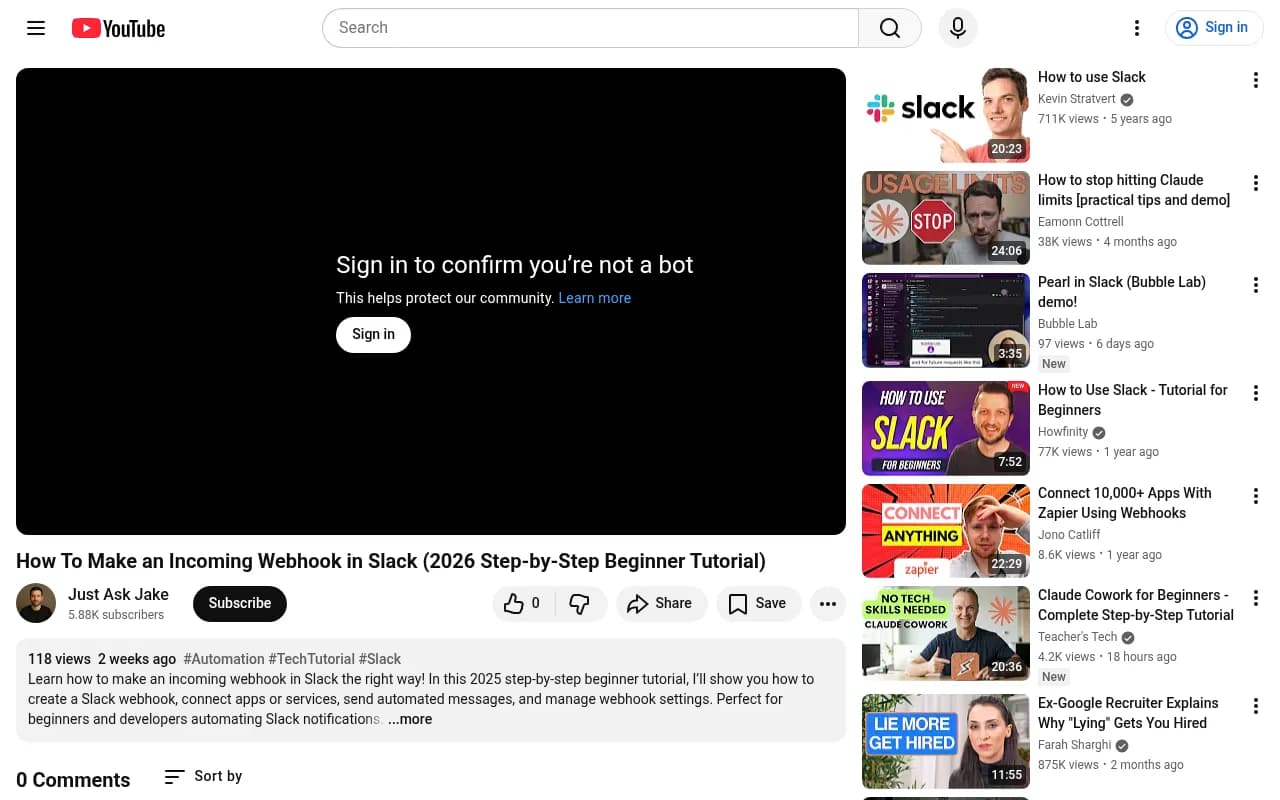
Create the webhook
- Go to api.slack.com/apps and click Create New App
- Choose From scratch
- Name your app something descriptive like "AI Visibility Alerts" or "Citation Tracker"
- Select the workspace where you want alerts to appear
- In the left sidebar, click Incoming Webhooks under Features
- Toggle Activate Incoming Webhooks to On
- Click Add New Webhook to Workspace
- Select the channel where alerts should post (create a dedicated #ai-visibility channel if you don't have one)
- Click Allow
You'll see a webhook URL that looks like:
https://hooks.slack.com/services/T00000000/B00000000/XXXXXXXXXXXXXXXXXXXX
Treat this URL like a password. Anyone with it can post to your channel.
Test the webhook
Before connecting it to your AI visibility platform, confirm it works:
curl -X POST -H 'Content-type: application/json' \
--data '{"text":"Test alert: AI visibility webhook is live"}' \
YOUR_WEBHOOK_URL
You should see a message appear in your Slack channel immediately.
Format rich messages
Basic text alerts work, but rich formatting makes alerts scannable and actionable. Slack supports Block Kit for structured messages:
{
  "blocks": [
    {
      "type": "header",
      "text": {
        "type": "plain_text",
        "text": "🚨 New Citation Alert"
      }
    },
    {
      "type": "section",
      "fields": [
        {
          "type": "mrkdwn",
          "text": "*Prompt:*\nBest project management tools for remote teams"
        },
        {
          "type": "mrkdwn",
          "text": "*Model:*\nChatGPT-4"
        },
        {
          "type": "mrkdwn",
          "text": "*Your Position:*\n#3 (was #5)"
        },
        {
          "type": "mrkdwn",
          "text": "*Cited Page:*\n/blog/remote-project-management"
        }
      ]
    },
    {
      "type": "actions",
      "elements": [
        {
          "type": "button",
          "text": {
            "type": "plain_text",
            "text": "View in Dashboard"
          },
          "url": "https://promptwatch.com/prompts/12345"
        }
      ]
    }
  ]
}
This renders as a structured card with fields and an action button -- much easier to scan than plain text.
Step 2: Configure your AI visibility platform
Most AI visibility platforms support webhook integrations. The setup varies by tool, but the pattern is the same: you provide your webhook URL and configure which events trigger alerts.
Promptwatch webhook setup
Promptwatch supports webhooks for citation changes, competitor movements, and crawler activity. Here's how to set it up:
- Go to Settings > Integrations > Webhooks
- Click Add Webhook
- Paste your Slack webhook URL
- Select which events to track:
- New citations for your brand
- Citation position changes (up or down)
- Competitor citations in tracked prompts
- AI crawler visits to your site
- Set thresholds (e.g. only alert if position changes by 2+ spots)
- Save and test
Promptwatch will send a test event to confirm the webhook is working.
Other platforms
If you're using a different AI visibility tool:
- Otterly.AI: Supports Slack webhooks under Settings > Notifications. Limited to daily summaries, not real-time events.
- Peec.ai: No native webhook support as of 2026. You'll need to use Zapier or Make to poll their API.
- AthenaHQ: Webhooks available in Business plan and above. Configure under Integrations.
- Search Party: Agency-focused tool with custom webhook setup. Contact support to enable.
| Platform | Webhook Support | Real-time Events | Setup Difficulty |
|---|---|---|---|
| Promptwatch | Native | Yes | Easy |
| Otterly.AI | Native | No (daily only) | Easy |
| Peec.ai | Via Zapier | No | Medium |
| AthenaHQ | Native (paid) | Yes | Easy |
| Search Party | Custom | Yes | Hard |
Step 3: Route data to email
Not every alert belongs in Slack. Some stakeholders prefer email, especially executives who don't live in Slack.
Email via webhooks
Most AI visibility platforms let you add email addresses as webhook targets. Promptwatch, for example, sends formatted HTML emails when you configure an email webhook:
- Go to Settings > Integrations > Webhooks
- Click Add Webhook
- Select Email as the type
- Enter recipient addresses (comma-separated for multiple)
- Choose event types (same as Slack)
- Save
Emails include the same data as Slack alerts but formatted for inbox reading.
Email via Zapier
If your platform doesn't support email webhooks natively, route through Zapier:
- Create a Zap with Webhooks by Zapier as the trigger
- Copy the webhook URL Zapier provides
- Add it to your AI visibility platform
- Add Email by Zapier as the action
- Map webhook fields to email subject and body
- Test and enable
This works for any platform that supports outgoing webhooks.
Step 4: Push data to your CRM
The most powerful use case for citation webhooks: connecting AI visibility directly to your CRM. When a competitor gets cited for a prompt your prospect cares about, that's a signal your sales team needs to see.
Why CRM integration matters
Imagine this scenario:
- Your prospect is evaluating project management tools
- They ask ChatGPT: "Best project management tools for remote teams"
- ChatGPT cites your competitor in position #1, you're #4
- Your sales rep has no idea this just happened
Now imagine the webhook fires, and a task appears in your CRM:
Action needed: Competitor cited ahead of us for "Best project management tools for remote teams" -- prompt volume 12K/month. Prospect Acme Corp is evaluating this category. Send comparison guide.
That's actionable intelligence, not just data.
HubSpot webhook integration
HubSpot supports incoming webhooks via workflows:
- In HubSpot, go to Automation > Workflows
- Create a new workflow triggered by Webhook
- Copy the webhook URL HubSpot provides
- Add it to your AI visibility platform
- In the workflow, add actions:
- Create a task for the account owner
- Log a note on the company record
- Send an internal notification
- Test with a sample payload
Now every citation change creates a CRM task tied to the relevant account.

Salesforce webhook integration
Salesforce requires a bit more setup:
- Create an Apex REST endpoint to receive webhook data
- Write logic to create tasks or update records based on the payload
- Expose the endpoint URL
- Add it to your AI visibility platform
- Test with sample data
If you're not comfortable with Apex, use Zapier or Make as a bridge:
- Webhook trigger in Zapier
- Salesforce action (create task, update record, etc.)
- Map fields from the webhook payload
Pipedrive, Zoho, and other CRMs
Most modern CRMs support webhooks or have Zapier/Make integrations:
- Pipedrive: Use Zapier to create activities from webhook data
- Zoho CRM: Native webhook support under Settings > Developer Space
- Close CRM: Webhooks available via API, or use Zapier

Step 5: Build custom routing logic
The real power of webhooks comes from conditional logic: route different events to different channels based on priority, team, or context.
Example: Priority-based routing
High priority (executive Slack channel + email to VP Marketing):
- Competitor cited ahead of you for a prompt with 10K+ monthly volume
- Your brand dropped out of top 3 for a tracked prompt
- New high-volume prompt detected in your category
Medium priority (team Slack channel):
- Citation position changed by 2+ spots
- AI crawler visited a key landing page
- New citation for your brand
Low priority (daily email digest):
- Minor ranking fluctuations
- Crawler activity on blog posts
- Visibility score updates
Build it with Make
Make (formerly Integromat) is better than Zapier for complex routing:
- Create a scenario with Webhooks as the trigger
- Add a Router module
- Define filters for each route:
- Route 1:
prompt_volume > 10000 AND position_change < 0→ Slack executive channel + email - Route 2:
abs(position_change) >= 2→ Slack team channel - Route 3: Everything else → Daily digest (aggregate and send once per day)
- Route 1:
- Connect each route to the appropriate action (Slack, email, CRM)
- Test with sample payloads
Build it with n8n (self-hosted)
If you want full control and don't want to pay per-execution pricing, n8n is an open-source alternative:
- Deploy n8n (Docker, cloud, or self-hosted)
- Create a workflow with a webhook trigger
- Add Switch nodes for routing logic
- Connect to Slack, email, and CRM nodes
- Run it on your own infrastructure
n8n is free and gives you unlimited executions, but you're responsible for hosting and maintenance.
Real-world example: Deal alerts
Here's how a B2B SaaS company uses citation webhooks to drive sales:
The setup
- Track 200 prompts related to their product category (e.g. "best CRM for small business")
- Webhook fires when a competitor gets cited for a tracked prompt
- Zapier checks if the prompt matches any open deal in HubSpot (based on industry or company size)
- If match found, create a task for the account owner: "Competitor X cited for [prompt]. Send comparison guide."
- Post alert in #sales-intel Slack channel with deal context
The result
Sales reps now have real-time intelligence about what prospects are researching and which competitors are being recommended. Instead of generic follow-ups, they send targeted content that directly addresses what the prospect just learned from ChatGPT.
Conversion rate on deals with citation alerts: 34% higher than deals without.
Common webhook mistakes
Alerting on everything
The biggest mistake: sending every data point to Slack. Your team will mute the channel within a week.
Be ruthless about what deserves an alert. If it's not immediately actionable, it doesn't belong in real-time channels.
No ownership
An alert without an owner is just noise. Every webhook should have a clear answer to: "Who is responsible for acting on this?"
If the answer is "everyone," the answer is actually "no one."
Ignoring rate limits
Slack rate limits incoming webhooks to 1 message per second. If your AI visibility platform sends 10 alerts in one second, some will fail.
Solution: batch alerts or add a delay between sends.
Webhook URL in public repos
If you're building custom integrations, never commit webhook URLs to public GitHub repos. Anyone can post to your Slack channel if they have the URL.
Use environment variables or secret management tools.
No error handling
Webhooks fail. Networks drop. Services go down. If your integration doesn't handle failures, you'll miss critical alerts.
Add retry logic and fallback notifications (e.g. if Slack fails, send email).
Advanced: Multi-channel alerting
The most sophisticated setups route the same event to multiple channels based on context:
Scenario: Competitor cited ahead of you for "best CRM for real estate agents"
Actions:
- Post in #sales-intel Slack channel
- Create task in HubSpot for all deals in real estate vertical
- Send email to product marketing with prompt details
- Log event in analytics dashboard
- Trigger content creation workflow (if prompt volume > 5K/month)
This requires a central routing system (Make, n8n, or custom code) that receives the webhook and fans out to multiple destinations.
Monitoring and maintenance
Check webhook health weekly
- Are alerts still firing?
- Are they reaching the right channels?
- Are people acting on them?
Webhooks fail silently. You won't know they're broken unless you check.
Review alert thresholds monthly
What felt like a high-priority alert in January might be noise by March. Adjust thresholds as your visibility improves and your team's needs change.
Audit webhook URLs quarterly
Rotate webhook URLs every few months, especially if they've been shared widely or committed to repos. Treat them like passwords.
Tools that support citation webhooks
Not all AI visibility platforms support webhooks. Here's what's available in 2026:
| Platform | Native Webhooks | Real-time Events | CRM Integration |
|---|---|---|---|
| Promptwatch | Yes | Yes | Via webhooks |
| Otterly.AI | Limited | No | No |
| Peec.ai | No | No | Via Zapier |
| AthenaHQ | Yes (paid) | Yes | Via webhooks |
| Search Party | Custom | Yes | Custom |
| Semrush | No | No | No |
| Ahrefs Brand Radar | No | No | No |
If your platform doesn't support webhooks, you can poll their API with Zapier or Make, but you lose real-time alerting.
What to do next
- Create a Slack webhook following the steps in this guide
- Configure your AI visibility platform to send citation events to that webhook
- Test with a sample alert to confirm the integration works
- Add routing logic if you need to send different events to different channels
- Connect to your CRM if you want sales intelligence tied to deals
- Monitor for a week and adjust thresholds based on alert volume
The goal is actionable intelligence, not data overload. Start with one high-value alert type, prove it works, then expand from there.