Summary
- The GEO market has matured fast: What was a handful of experimental tools in 2024 is now a crowded field of 40+ platforms, each claiming to solve AI visibility. Most are monitoring dashboards -- only a few help you actually fix the problem.
- Three categories emerged: Monitoring-only trackers (Otterly.AI, Peec.ai), content optimization platforms (Writesonic, NeuronWriter), and full-stack GEO systems that close the loop from diagnosis to content creation to measurement (Promptwatch, Profound, Evertune).
- What's genuinely new in 2026: AI crawler logs (see which AI engines are reading your site), Reddit/YouTube citation tracking (understand what influences AI recommendations), ChatGPT Shopping monitoring (track product recommendations), and AI-generated content grounded in real citation data.
- The action gap separates leaders from followers: Most platforms show you where you're invisible. The best ones show you what content to create, then help you create it, then prove it worked.
- Pricing spread is wild: From $29/mo hobbyist trackers to $2,000+/mo enterprise platforms. The difference isn't just features -- it's whether the tool helps you take action or just gives you more data to stare at.
What is GEO and why does it matter in 2026?
Generative Engine Optimization (GEO) is the practice of making your brand, product, or content visible and accurately represented when AI models like ChatGPT, Claude, Perplexity, Gemini, and Google AI Overviews generate answers. It's not about ranking on Page 1 of Google anymore -- it's about being the source AI engines cite when someone asks a question in your category.
Gartner predicted traditional search volume would drop 25% in 2026 as users shift to AI-powered answer engines. That prediction is playing out. Google's AI Overviews now reach 2 billion monthly users. ChatGPT serves 800 million users weekly. Perplexity processes hundreds of millions of queries every month. If your brand isn't visible in these AI-generated answers, you're losing discovery traffic you used to get from organic search.
The problem: AI models don't crawl the web like Google does. They rely on training data, real-time retrieval from specific sources, and citation patterns that traditional SEO tools can't measure. You need a different toolkit.
The three types of GEO platforms
The GEO platform market has split into three categories, each solving a different part of the problem:
1. Monitoring-only trackers
These tools run prompts against AI models and show you whether your brand appears in the response. They track visibility scores, citation counts, and competitor mentions. What they don't do: tell you why you're invisible or how to fix it.
Examples: Otterly.AI, Peec.ai, Airefs, LLMrefs, Mentions.so, Trakkr.ai
Strengths: Affordable ($29-$99/mo), easy setup, good for basic awareness of where you stand.
Limitations: No content gap analysis, no optimization recommendations, no way to connect visibility to traffic or revenue. You see the problem but you're stuck.
Best for: Small teams that just want to know if they're being cited, with no budget for deeper optimization.
2. Content optimization platforms
These tools analyze what AI models want to see and help you create content that's more likely to get cited. They often include AI writing assistants, SEO optimization, and semantic analysis.
Examples: Writesonic, NeuronWriter, Surfer SEO, Frase, MarketMuse, ContentMonk
Strengths: Help you create better content, often with built-in AI writing tools. Good bridge between traditional SEO and GEO.
Limitations: Most lack real AI visibility tracking. They optimize for what should work, not what's actually getting cited. The feedback loop is broken.
Best for: Content teams that need help writing but already have a visibility tracking solution.
3. Full-stack GEO platforms
These platforms close the entire loop: track visibility, diagnose content gaps, help you create optimized content, then measure the results. They combine monitoring, analysis, and action in one system.
Examples: Promptwatch, Profound, Evertune, Scrunch, AthenaHQ, Conductor

Strengths: End-to-end solution. You see where you're invisible, what content you're missing, and you can generate that content inside the platform. Then you track whether it worked.
Limitations: Higher price points ($249-$2,000+/mo). More complex setup. Overkill if you only need basic monitoring.
Best for: Marketing teams, agencies, and brands that want to actually improve AI visibility, not just measure it.
What's genuinely new in early 2026
The GEO platform landscape has evolved fast. Here's what didn't exist 12 months ago:
AI crawler logs
Most platforms track what AI models say about you. The new capability: tracking what AI crawlers are actually reading on your website. Promptwatch, Profound, and a few others now offer real-time logs of ChatGPT, Claude, Perplexity, and other AI crawlers hitting your site -- which pages they read, how often they return, errors they encounter.
Why it matters: If an AI model never crawls your content, it can't cite you. Crawler logs show you indexing issues before they kill your visibility. Most competitors still don't have this.
Reddit and YouTube citation tracking
AI models don't just cite official websites. They pull heavily from Reddit discussions, YouTube videos, and user-generated content. Platforms like Promptwatch and Scrunch now surface which Reddit threads and YouTube videos are influencing AI recommendations in your category.
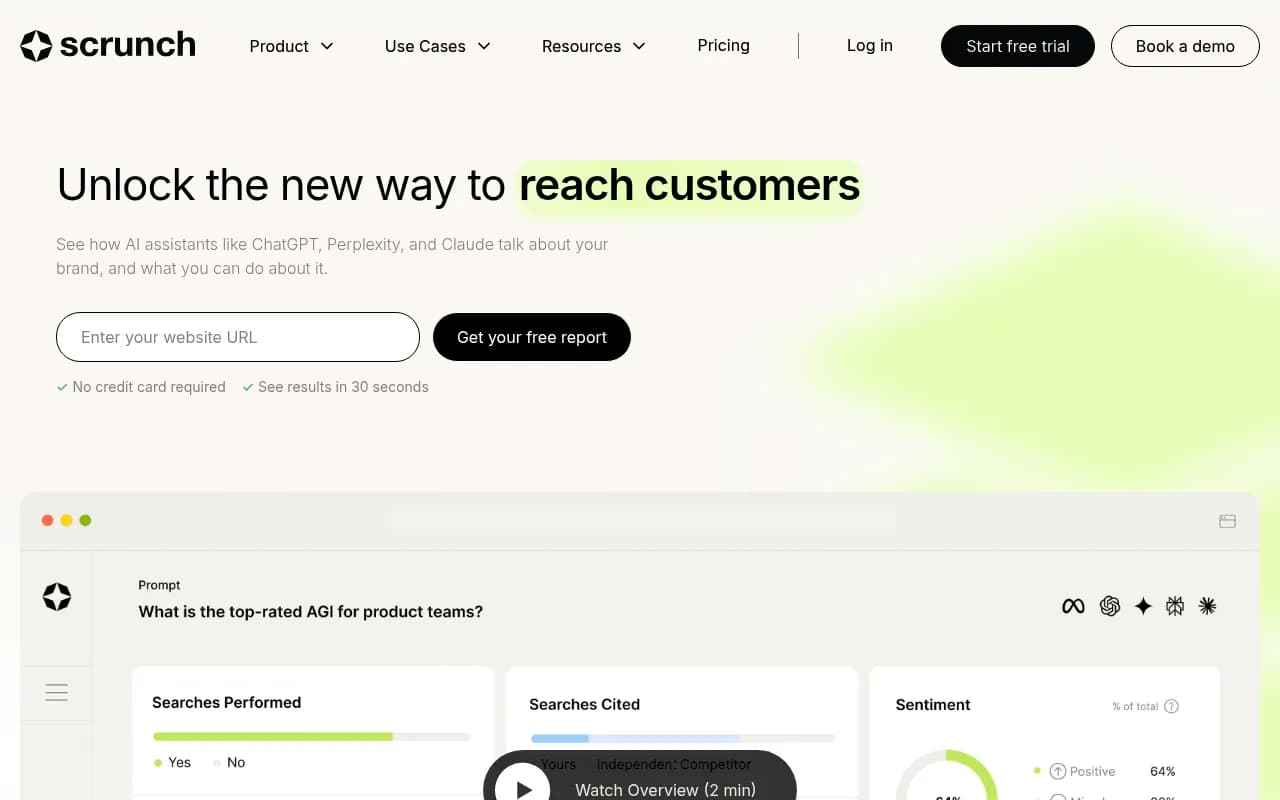
Why it matters: If a Reddit thread about "best project management tools" is getting cited by ChatGPT 50 times a day, you need to know about it. You can't optimize for sources you don't know exist.
ChatGPT Shopping monitoring
ChatGPT now has a shopping mode that recommends products directly in the chat interface. A handful of platforms (Promptwatch, Profound) track when your products appear in these recommendations and how you're positioned vs competitors.
Why it matters: This is direct revenue impact. If ChatGPT is recommending competitor products over yours, you're losing sales. Most GEO platforms still don't track this channel.
AI-generated content grounded in citation data
The big innovation in 2026: platforms that don't just tell you what content to create -- they generate it for you, using real citation data to inform the writing. Promptwatch's AI writing agent, for example, analyzes 880M+ citations to understand what angles, topics, and formats AI models prefer, then writes articles designed to get cited.
Why it matters: Generic AI content doesn't rank in AI search. Content that's engineered around actual citation patterns does. This is the difference between guessing and using data.
Prompt intelligence and query fan-outs
Newer platforms like Promptwatch and Profound now show volume estimates and difficulty scores for each prompt, plus query fan-outs that reveal how one prompt branches into sub-queries. This helps you prioritize high-value, winnable prompts instead of chasing everything.
Why it matters: Not all prompts are equal. Some drive 10x more volume than others. Some are impossible to rank for. Prompt intelligence tells you where to focus.
Platform-by-platform breakdown: what's worth your time
Here's an honest look at the major players, what they're good at, and where they fall short.
Promptwatch: The action-oriented leader
Promptwatch is the only platform rated as a "Leader" across all categories in a 2026 comparison of 12 GEO tools. The core difference: it's built around taking action, not just monitoring.
What it does well:
- Answer Gap Analysis shows exactly which prompts competitors are visible for but you're not, then shows the specific content your site is missing
- Built-in AI writing agent generates articles, listicles, and comparisons grounded in 880M+ citations analyzed
- AI crawler logs show real-time activity from ChatGPT, Claude, Perplexity crawlers
- Reddit and YouTube insights surface discussions that influence AI recommendations
- ChatGPT Shopping tracking monitors product recommendations
- Page-level tracking connects visibility to actual traffic (code snippet, GSC integration, or server log analysis)
- Multi-language and multi-region support with customizable personas
Where it's weak: Higher price point than monitoring-only tools. Professional plan starts at $249/mo.
Best for: Marketing teams and agencies that want to close the loop from diagnosis to content creation to measurement. If you need to actually improve AI visibility, not just track it, this is the platform.
Pricing: Essential $99/mo (1 site, 50 prompts, 5 articles), Professional $249/mo (2 sites, 150 prompts, 15 articles, crawler logs), Business $579/mo (5 sites, 350 prompts, 30 articles). Free trial available.
Profound: Enterprise visibility with strong analytics
Profound is a strong enterprise option with deep analytics and multi-model tracking. It's one of the few platforms that competes with Promptwatch on feature depth.
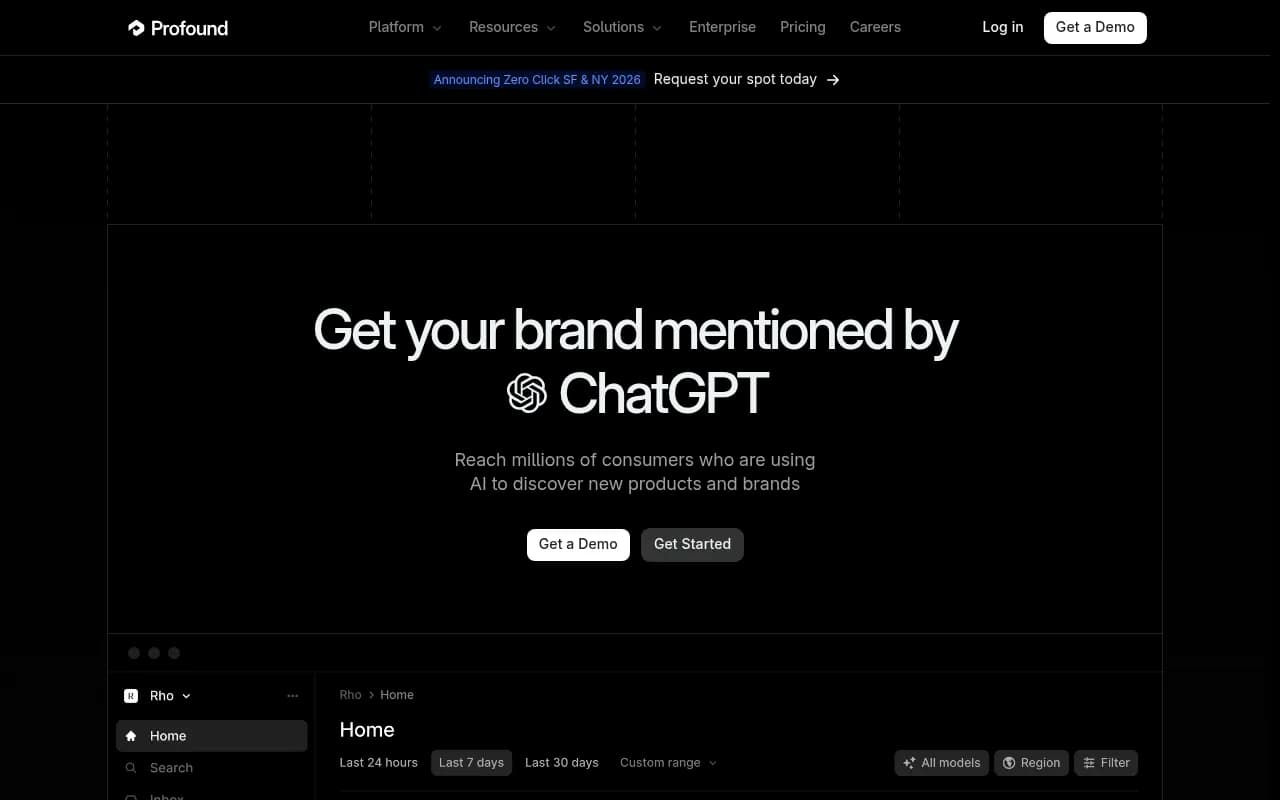
What it does well:
- Tracks 10+ AI models including ChatGPT, Perplexity, Gemini, Claude
- Prompt volume estimates and competitive analysis
- Citation tracking and source analysis
- Shopping and product recommendation monitoring
- Clean enterprise UI
Where it's weak: No built-in content generation. No Reddit/YouTube tracking. No AI crawler logs. You see the gaps but you're on your own to fix them.
Best for: Enterprises that want deep visibility analytics and have separate content teams to act on the insights.
Pricing: Custom enterprise pricing, typically $1,500+/mo.
Otterly.AI: Affordable monitoring for small teams
Otterly.AI is one of the most popular low-cost trackers. It does one thing: runs prompts and shows you visibility scores.

What it does well:
- Simple setup, clean dashboard
- Affordable ($29-$99/mo)
- Good for basic brand mention tracking
Where it's weak: No content gap analysis, no optimization tools, no crawler logs, no traffic attribution. You see the problem but have no path to fix it.
Best for: Solopreneurs and small teams that just want to know if they're being mentioned, with no budget for deeper tools.
Pricing: Starts at $29/mo.
Writesonic: Content generation with visibility tracking
Writesonic started as an AI writing tool and added GEO tracking in 2025. It's a content-first platform with visibility monitoring bolted on.
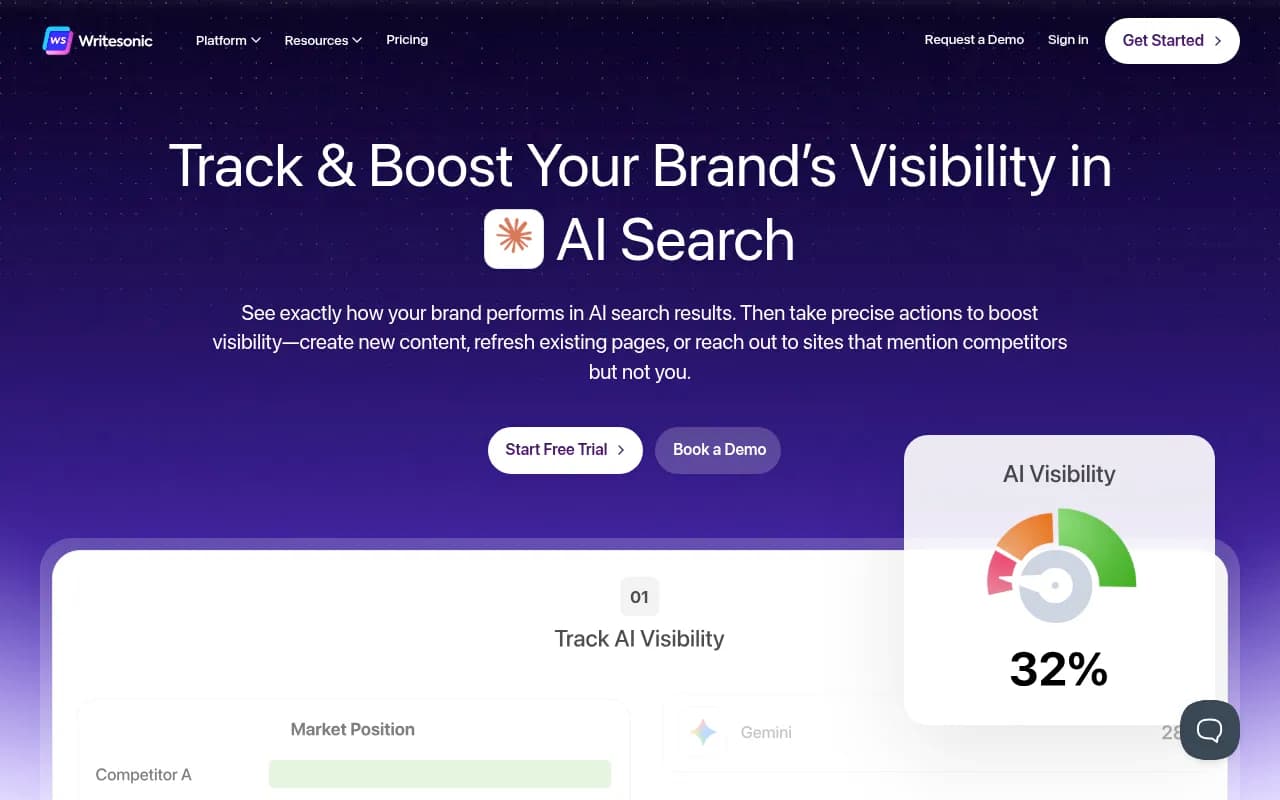
What it does well:
- Strong AI writing assistant for articles, ads, social posts
- Basic visibility tracking across ChatGPT, Perplexity, Gemini
- Good for teams that need content help more than analytics
Where it's weak: Visibility tracking is shallow -- no crawler logs, no Reddit/YouTube, no prompt intelligence. The writing tool is generic, not grounded in citation data.
Best for: Content teams that need an AI writing assistant and want basic visibility awareness.
Pricing: Starts at $16/mo for writing tools, GEO features on higher tiers.
AthenaHQ: Narrative tone monitoring
AthenaHQ focuses on how AI models describe your brand -- the tone, sentiment, and narrative framing of citations.

What it does well:
- Sentiment analysis and narrative tracking
- Good for brand reputation monitoring
- Tracks how competitors are positioned
Where it's weak: No content gap analysis, no optimization tools, no crawler logs. It's a monitoring tool with a narrative focus.
Best for: PR and brand teams that care more about how they're described than citation volume.
Pricing: Custom pricing, typically $500+/mo.
Semrush: Traditional SEO with AI add-ons
Semrush added AI visibility tracking in late 2025. It's a bolt-on feature to their core SEO platform.
What it does well:
- Integrated with Semrush's massive SEO toolkit
- Good if you're already a Semrush customer
- Tracks Google AI Overviews
Where it's weak: Uses fixed prompts (you can't customize), no ChatGPT or Claude tracking, no content generation, no crawler logs. It's an afterthought feature, not a core GEO platform.
Best for: Existing Semrush customers who want basic AI visibility awareness without switching tools.
Pricing: Included in Semrush plans starting at $139.95/mo.
Peec.ai: Multi-language monitoring
Peec.ai is a lightweight tracker with strong multi-language support.
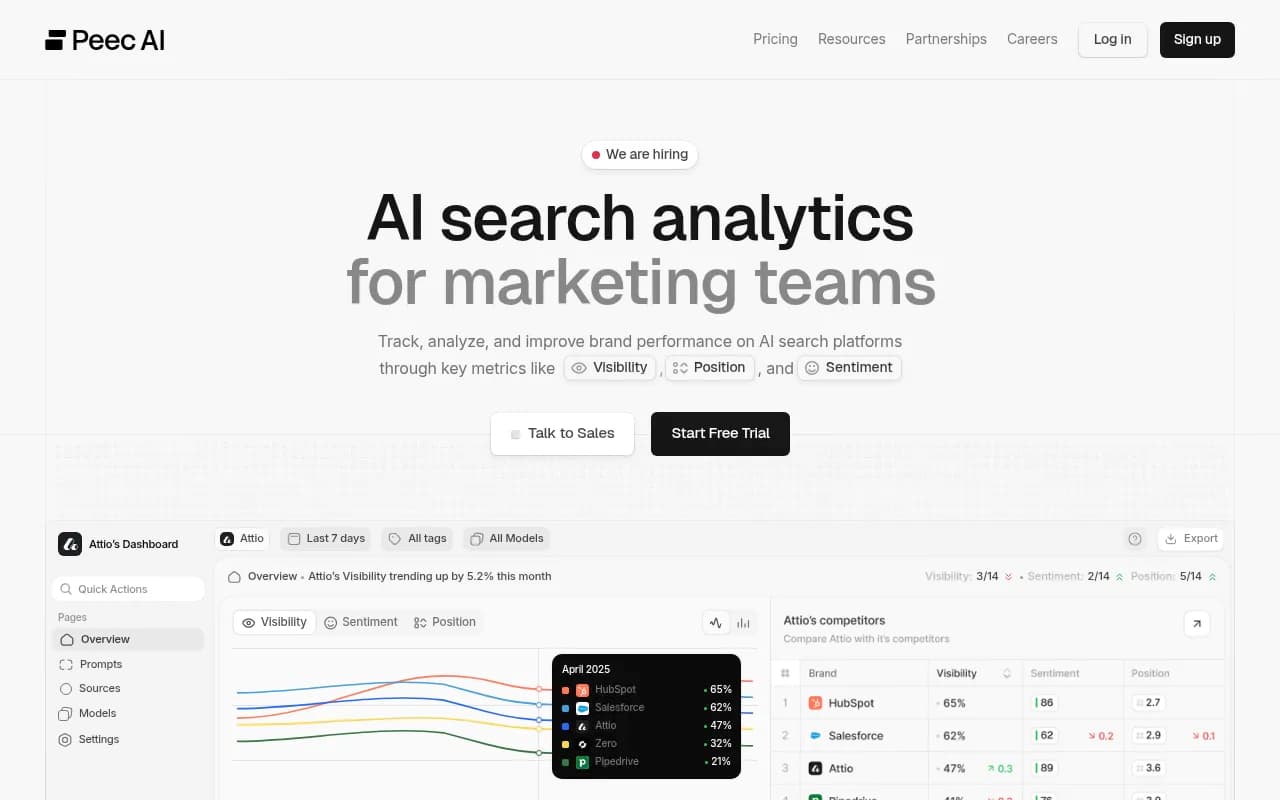
What it does well:
- Tracks visibility in 50+ languages
- Affordable ($49-$149/mo)
- Good for international brands
Where it's weak: Monitoring only. No content tools, no crawler logs, no optimization recommendations.
Best for: International brands that need multi-language tracking on a budget.
Pricing: Starts at $49/mo.
Scrunch: Influencer signal analyzer
Scrunch focuses on understanding which influencers, Reddit threads, and YouTube videos are shaping AI recommendations.
What it does well:
- Reddit and YouTube citation tracking
- Influencer impact analysis
- Good for understanding what's driving AI model opinions
Where it's weak: No content generation, no crawler logs, no traffic attribution. It's an analysis tool, not an optimization platform.
Best for: Brands that want to understand the social signals influencing AI models.
Pricing: Custom pricing, typically $800+/mo.
Comparison table: Key features across platforms
| Platform | Monitoring | Content gaps | AI writing | Crawler logs | Reddit/YouTube | ChatGPT Shopping | Traffic attribution | Starting price |
|---|---|---|---|---|---|---|---|---|
| Promptwatch | ✓ | ✓ | ✓ | ✓ | ✓ | ✓ | ✓ | $99/mo |
| Profound | ✓ | ✓ | ✗ | ✗ | ✗ | ✓ | ✓ | $1,500+/mo |
| Otterly.AI | ✓ | ✗ | ✗ | ✗ | ✗ | ✗ | ✗ | $29/mo |
| Writesonic | ✓ | ✗ | ✓ | ✗ | ✗ | ✗ | ✗ | $16/mo |
| AthenaHQ | ✓ | ✗ | ✗ | ✗ | ✗ | ✗ | ✗ | $500+/mo |
| Semrush | ✓ | ✗ | ✗ | ✗ | ✗ | ✗ | ✗ | $139.95/mo |
| Peec.ai | ✓ | ✗ | ✗ | ✗ | ✗ | ✗ | ✗ | $49/mo |
| Scrunch | ✓ | ✗ | ✗ | ✗ | ✓ | ✗ | ✗ | $800+/mo |
How to choose the right GEO platform
The right platform depends on what you're trying to accomplish:
If you just want to know if you're being cited: Go with a monitoring-only tool like Otterly.AI or Peec.ai. They're cheap and simple. You won't get optimization help, but you'll know where you stand.
If you need help creating content: Look at Writesonic, NeuronWriter, or Surfer SEO. They'll help you write better content, though they won't tell you if it's actually getting cited by AI models.
If you want to actually improve AI visibility: You need a full-stack platform like Promptwatch, Profound, or Evertune. These tools close the loop from diagnosis to content creation to measurement. They cost more, but they're the only ones that help you take action.
If you're an enterprise with complex needs: Profound, Evertune, or Promptwatch Business/Enterprise plans. You need multi-site tracking, team collaboration, API access, and custom reporting.
If you care about social signals: Scrunch or Promptwatch. Most platforms ignore Reddit and YouTube, but these channels heavily influence AI recommendations.
If you're international: Peec.ai or Promptwatch. Multi-language support varies wildly across platforms.
What to avoid: Common GEO platform traps
Trap 1: Paying for monitoring you can't act on. If a tool shows you that you're invisible for 200 prompts but gives you no path to fix it, you're paying for anxiety, not progress. Make sure the platform helps you close the gap.
Trap 2: Generic AI content tools. Most AI writing assistants generate content that sounds good but doesn't get cited. Look for platforms that ground their content generation in real citation data, like Promptwatch's 880M+ citation analysis.
Trap 3: Ignoring crawler logs. If AI models aren't crawling your site, they can't cite you. Platforms without crawler logs leave you blind to indexing issues.
Trap 4: Fixed prompt sets. Some platforms (Semrush, Ahrefs) use fixed prompts you can't customize. This is useless if those prompts don't match how your customers actually search.
Trap 5: No traffic attribution. Visibility scores are nice, but you need to connect AI citations to actual traffic and revenue. Look for platforms with code snippets, GSC integration, or server log analysis.
The state of GEO in early 2026: Where we're headed
The GEO platform market is maturing fast. A year ago, most tools were experimental. Now we have clear categories, established leaders, and real differentiation.
Three trends are shaping the next 12 months:
1. Consolidation is coming. There are 40+ GEO platforms right now. Most are monitoring-only dashboards with no moat. Expect acquisitions and shutdowns as the market consolidates around platforms that actually help you optimize, not just measure.
2. AI content generation is table stakes. In 2025, having an AI writing assistant was a differentiator. In 2026, it's expected. The new differentiator: content grounded in real citation data, not generic SEO filler.
3. The action gap separates winners from losers. Monitoring-only tools are becoming commoditized. The platforms that win will be the ones that close the loop from diagnosis to action to measurement. Promptwatch is leading this shift, but others will follow.
If you're picking a GEO platform in 2026, ask yourself: Does this tool just show me the problem, or does it help me fix it? The answer determines whether you're buying a dashboard or an optimization system.
Final take: What's actually worth your money
Most GEO platforms are monitoring dashboards. They show you where you're invisible, then leave you stuck. A handful go further -- they diagnose content gaps, help you create optimized content, and prove it worked.
Promptwatch is the only platform that does all three at a price point that makes sense for mid-market teams ($249/mo Professional plan). Profound is a strong enterprise option if you have budget and separate content teams. Otterly.AI and Peec.ai are fine for basic monitoring if you're on a tight budget.
Everything else is either overpriced, under-featured, or solving the wrong problem. The GEO market is still young, but the leaders are pulling away fast. Pick a platform that helps you take action, not just stare at dashboards.