Key takeaways
- All three platforms track brand visibility across AI search engines like ChatGPT, Perplexity, and Google AI Overviews -- but they stop at very different points in the workflow.
- Peec AI is a solid monitoring tool for teams that want multi-language tracking and clean dashboards, but it doesn't help you act on what it finds.
- Rankscale focuses on scaling AI search presence with some optimization features, though its content generation capabilities are limited compared to full-stack platforms.
- Promptwatch is the only one of the three that closes the full loop: find visibility gaps, generate AI-optimized content to fill them, then track whether that content gets cited.
- If you're just starting to monitor AI search, Peec AI is a reasonable entry point. If you want to actually grow your AI visibility, Promptwatch is the stronger choice.
The AI search visibility category has gotten crowded fast. Two years ago, barely anyone was tracking whether their brand appeared in ChatGPT responses. Now there are dozens of tools claiming to solve the problem, and the differences between them matter a lot more than their marketing pages suggest.
This comparison focuses on three platforms that come up regularly in 2026: Rankscale, Peec AI, and Promptwatch. They're all positioned around AI visibility and GEO (generative engine optimization), but they approach the problem differently. One is primarily a tracker. One tries to bridge monitoring and optimization. One is built around a full action loop. Let's get into it.
What "AI visibility scaling" actually means
Before comparing tools, it's worth being precise about what we're measuring. AI visibility is how often -- and how prominently -- your brand appears when users ask AI engines questions in your category. Not just whether you're mentioned, but whether you're cited as a source, recommended by name, or included in a product comparison.
"Scaling" that visibility means systematically increasing those appearances over time. That requires three things:
- Knowing where you're invisible (gap analysis)
- Creating content that AI models want to cite (optimization and generation)
- Confirming that new content actually improved your visibility (tracking and attribution)
Most tools in this category do step three reasonably well. Fewer do step one with any depth. Almost none do step two. That gap is where the real differences between Rankscale, Peec AI, and Promptwatch show up.
Rankscale
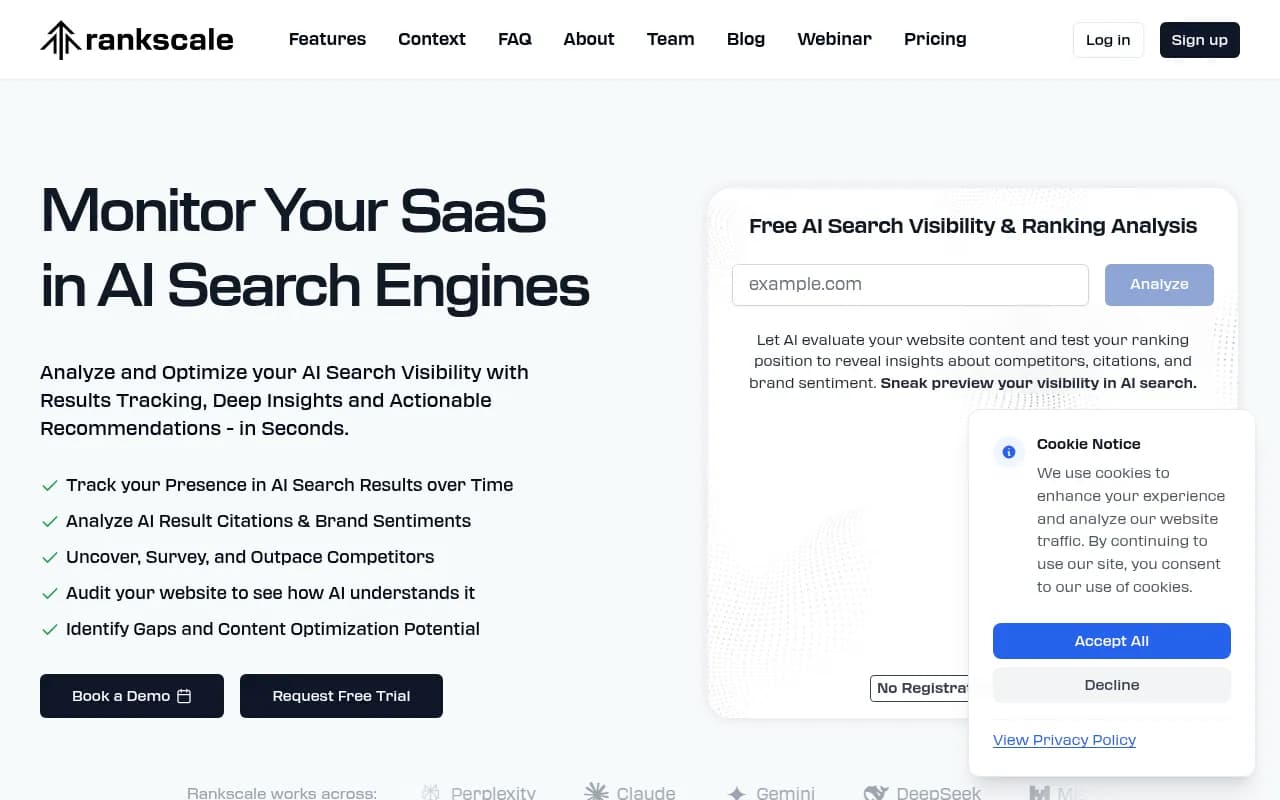
Rankscale positions itself as an AI visibility scaling platform -- the name is pretty literal about the goal. It tracks brand mentions and citations across major LLMs and gives you a view of how your visibility compares to competitors across different prompt categories.
Where Rankscale stands out is in its focus on scaling workflows. It's designed with the assumption that you're not just monitoring one brand but potentially managing visibility across multiple sites or clients. The interface reflects that: dashboards are structured around prompt-level data, and there's some functionality around identifying which prompts you're missing.
That said, Rankscale's content optimization features are thin. You can see where you're not appearing, but the platform doesn't generate content to fill those gaps or provide detailed guidance on what your pages are missing. It's closer to a monitoring-plus tool than a full optimization platform.
Pricing information for Rankscale is not publicly detailed, which makes it harder to evaluate for budget-conscious teams. You'd need to contact them for a quote, which suggests it's positioned toward agencies or larger teams rather than individual marketers.
Best for: Agencies managing multiple client brands who want prompt-level visibility data and competitive benchmarking, and are comfortable handling content creation separately.
Peec AI
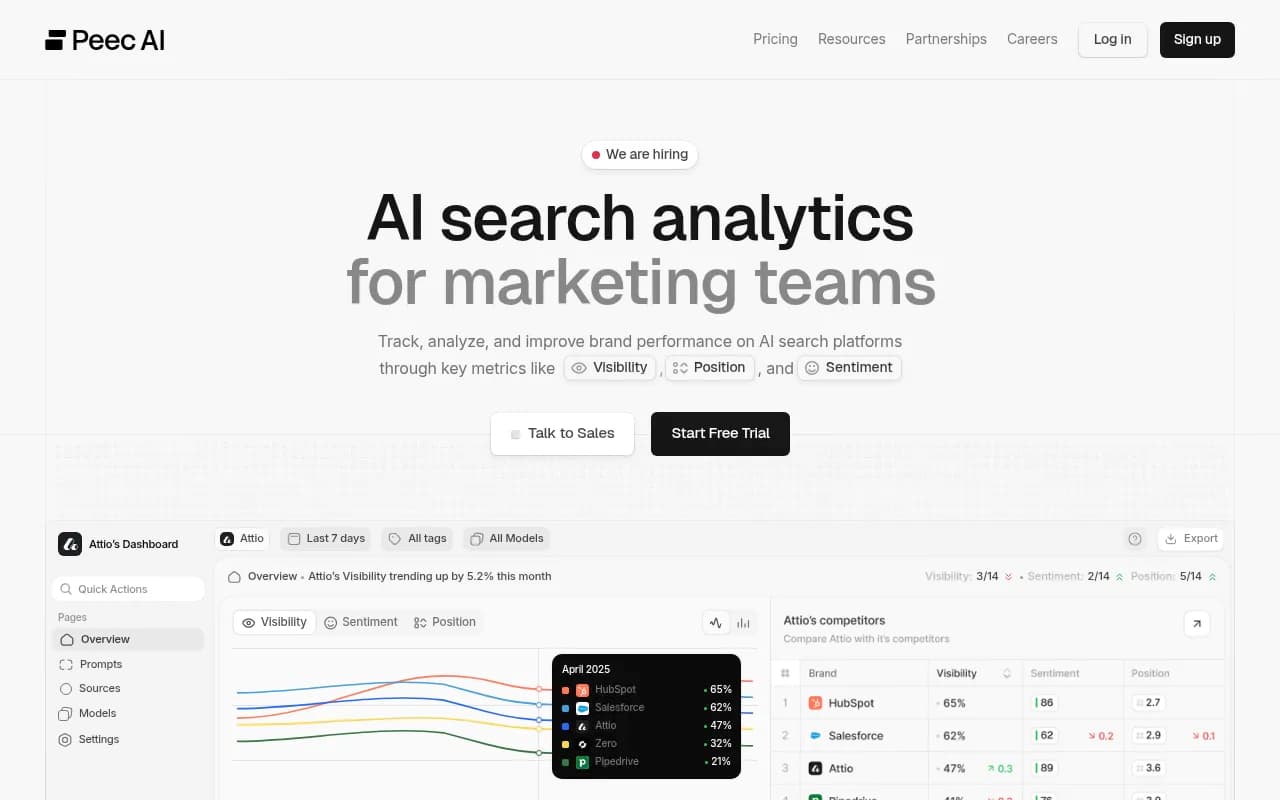
Peec AI has built a reputation as one of the cleaner monitoring tools in the category. Its strengths are multi-language support, a well-organized dashboard, and solid coverage across several AI engines. If your brand operates across multiple markets and languages, Peec AI's localization features are genuinely useful -- most competitors treat international tracking as an afterthought.
The platform tracks brand mentions, sentiment, position, and share of voice. It also supports add-ons for expanded model coverage, which gives it some flexibility as your tracking needs grow.
The honest limitation: Peec AI is monitoring-focused. It tells you where you appear and where you don't, but it doesn't prescribe specific content actions or generate anything to help you close the gaps. You get the data; you figure out what to do with it. For teams with strong in-house content capabilities, that's fine. For teams looking for a tool that does more of the heavy lifting, it falls short.
Peec AI's entry pricing starts around €85/month for 50 prompts and 3 AI engines, which is reasonable for what you get. The add-on model for more engines can push costs up quickly if you need broad coverage.
Best for: SEO and content teams that want clean visibility tracking across multiple languages and are comfortable running their own content optimization workflows.
Promptwatch
Promptwatch takes a different approach from both of the above. Where Rankscale and Peec AI are primarily tracking tools, Promptwatch is built around what it calls an action loop: find the gaps, create content to fill them, track the results.

The gap analysis piece is genuinely useful. Promptwatch's Answer Gap Analysis shows you the specific prompts where competitors are visible but you're not -- not just categories, but the actual questions AI models are answering with your competitor's content instead of yours. That level of specificity makes it much easier to prioritize what to fix.
The content generation piece is where it really separates from the field. Promptwatch has a built-in AI writing agent that generates articles, listicles, and comparison pages grounded in citation data from over 880 million citations analyzed. This isn't generic content -- it's engineered around the specific prompts and topics where AI models are looking for sources. The difference between content written for traditional SEO and content written to get cited by ChatGPT or Perplexity is real, and Promptwatch's agent accounts for it.
On the tracking side, Promptwatch monitors 10 AI models (ChatGPT, Perplexity, Claude, Gemini, Google AI Overviews, Google AI Mode, Grok, DeepSeek, Copilot, and Mistral) and provides page-level citation tracking -- you can see exactly which pages on your site are getting cited, by which models, and how often. The AI crawler logs feature is particularly useful: it shows you in real time when AI crawlers from ChatGPT, Claude, and Perplexity visit your site, which pages they read, and any errors they hit. Most competitors don't have this at all.
Traffic attribution is also more developed than in most tools. You can connect visibility to actual traffic and revenue through a code snippet, Google Search Console integration, or server log analysis.
Pricing is transparent: Essential at $99/month (1 site, 50 prompts, 5 articles), Professional at $249/month (2 sites, 150 prompts, 15 articles, crawler logs), and Business at $579/month (5 sites, 350 prompts, 30 articles). A free trial is available.
Best for: Marketing and SEO teams that want to move beyond monitoring and actually grow their AI search visibility -- especially those who don't want to manage content creation and optimization as a separate workflow.
Side-by-side comparison
| Feature | Rankscale | Peec AI | Promptwatch |
|---|---|---|---|
| AI engines monitored | Multiple (not fully disclosed) | 3+ (add-ons available) | 10 (ChatGPT, Perplexity, Claude, Gemini, Grok, DeepSeek, Copilot, Mistral, Google AI Overviews, Google AI Mode) |
| Brand mention tracking | Yes | Yes | Yes |
| Share of voice / sentiment | Yes | Yes | Yes |
| Competitor benchmarking | Yes | Limited | Yes (heatmaps) |
| Answer gap analysis | Partial | No | Yes (detailed, prompt-level) |
| Content generation | No | No | Yes (AI writing agent, grounded in citation data) |
| AI crawler logs | No | No | Yes |
| Page-level citation tracking | Limited | No | Yes |
| Traffic attribution | No | No | Yes (snippet, GSC, server logs) |
| Reddit / YouTube tracking | No | No | Yes |
| ChatGPT Shopping tracking | No | No | Yes |
| Multi-language support | Limited | Strong | Yes |
| Transparent pricing | No | Yes (€85+/mo) | Yes ($99+/mo) |
| Free trial | Not confirmed | Yes | Yes |
| Best for | Agencies, multi-brand | Multi-language SEO teams | Full-cycle AI visibility optimization |
Where each tool fits in a real workflow
The comparison table tells part of the story. The more useful question is: what does your day-to-day workflow actually look like with each tool?
With Peec AI
You log in, check your brand's mention rate and sentiment across the AI engines you're tracking, compare it to last week, and note which competitors gained ground. You export a report. Then you go figure out what to do about it -- probably in a separate content brief, with a separate writing tool, and a separate process for publishing and tracking results. It's a solid monitoring dashboard, but the workflow stops there.
With Rankscale
Similar to Peec AI, but with more emphasis on prompt-level data and a structure that works better for agencies managing multiple brands. You can see which prompt categories you're winning and losing, and the competitive data is useful for client reporting. Content creation and optimization still happen outside the platform.
With Promptwatch
You run an Answer Gap Analysis and get a list of specific prompts where competitors are visible and you're not. You pick the highest-priority ones based on prompt volume and difficulty scores. You use the built-in writing agent to generate an article targeting those prompts. You publish it. A few weeks later, you check your page-level citation data and see whether that article is getting picked up by ChatGPT or Perplexity. You check your crawler logs to confirm AI bots are actually reading the new page. You connect the dots to traffic through the attribution tools.
That's a closed loop. The other two tools give you part of it.
The monitoring-only trap
One thing worth naming directly: there's a real risk in using a monitoring-only tool and treating it as an optimization strategy. Knowing your AI visibility score is going down doesn't help you fix it. Knowing which competitors are outranking you doesn't tell you what content to create.
A lot of teams in 2026 are spending money on AI visibility monitoring and then doing nothing with the data because the tool doesn't tell them what to do next. That's not a knock on Peec AI or Rankscale specifically -- it's a category-wide problem. Most AI visibility tools were built by people who came from analytics backgrounds, not content or SEO backgrounds. They're good at measuring. They're not built around fixing.
Promptwatch was built with the fix in mind from the start. The citation data (880M+ citations analyzed) feeds directly into the content generation. The gap analysis feeds directly into the writing agent. The crawler logs feed directly into the indexing troubleshooting. It's a different philosophy, and it shows in the product.
Who should use which tool
Choose Peec AI if:
- You need strong multi-language and multi-region tracking
- Your team has solid in-house content capabilities and just needs the data
- You're early in your AI visibility journey and want a clean, affordable monitoring baseline
Choose Rankscale if:
- You're an agency managing AI visibility for multiple clients
- Prompt-level competitive benchmarking is your primary need
- You're comfortable with a custom pricing conversation
Choose Promptwatch if:
- You want to actually grow your AI visibility, not just measure it
- Content creation and optimization are part of your mandate
- You need traffic attribution to connect AI visibility to revenue
- You want crawler logs and page-level citation data
- You're managing 1-5 sites and want a single platform that covers the full workflow
A note on the broader market
The AI visibility tools market in 2026 is genuinely crowded. Beyond these three, you'll find tools like Otterly.AI, Profound, AthenaHQ, Search Party, Scrunch, and others all competing for the same budget. Most of them are monitoring-first, with varying degrees of optimization capability bolted on.
The pattern that keeps showing up in independent roundups: brands that monitor AND optimize AI visibility outperform brands that only monitor. One figure cited by Visiblie's research: a B2B SaaS brand saw a 39% rise in inbound leads within six weeks of implementing AI visibility optimization. Monitoring alone doesn't produce that kind of result.
That's the core argument for choosing a platform that does more than track. The question isn't whether to monitor your AI visibility -- you should. The question is whether your tool helps you do anything about what you find.
Final take
Peec AI and Rankscale are both legitimate tools for teams that need AI visibility data. Peec AI is particularly good for multi-language use cases. Rankscale has a structure that suits agencies. Neither of them will help you create content that gets cited by ChatGPT, troubleshoot why AI crawlers aren't reading your pages, or connect your visibility improvements to actual revenue.
Promptwatch does all of that. It's more expensive than Peec AI's entry tier, but it's also doing significantly more work. If your goal is to actually scale AI visibility results -- not just report on them -- it's the stronger platform.