Levity AI Review 2026
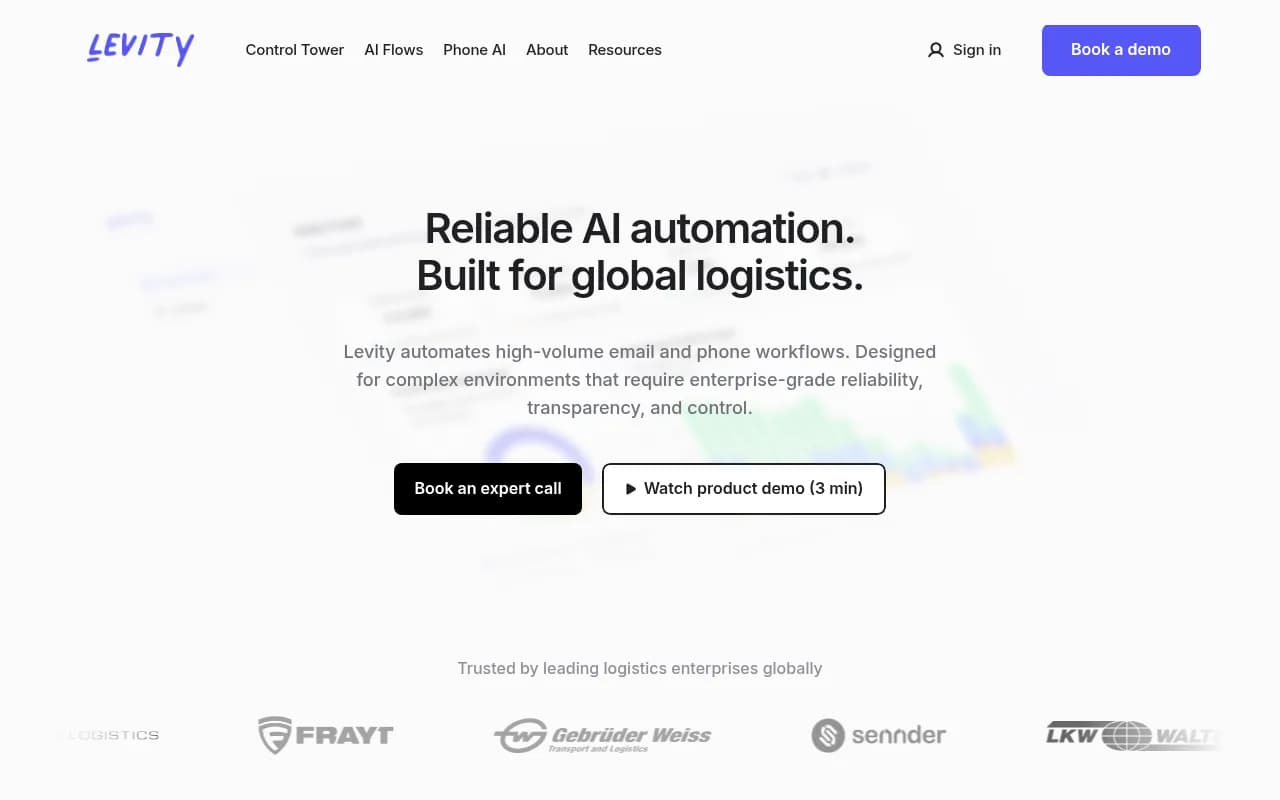
Levity AI automates high-volume email classification, document processing, and phone workflows for global logistics companies. Built for freight forwarders, 3PLs, and supply chain teams handling thousands of daily communications, it combines AI with rule-based logic to deliver enterprise-grade relia
Key Takeaways
- Built specifically for logistics and freight operations -- not a generic automation tool adapted for the industry
- Combines AI classification with rule-based fallback logic to hit >99% accuracy in production environments
- Control Tower analytics turn unstructured email/phone workflows into measurable, optimizable processes
- Phone AI handles load check-ups, tracking inquiries, and scheduling calls without human intervention
- Integrates with TMS platforms (McLeod, TMW, Turvo, Descartes, etc.) and standard tools (Outlook, Gmail, Slack, Zapier)
- Enterprise-focused: ISO 27001, SOC 2, GDPR compliant, hosted in EU and US regions
- Custom pricing (no public tiers) -- requires sales conversation to scope deployment
- Best for mid-to-large logistics operations (3PLs, freight forwarders, brokerages) processing 500+ emails/day
Levity AI is an automation platform purpose-built for the chaos of logistics communications. If you've ever worked in freight operations, you know the reality: thousands of unstructured emails per day, phone calls about load status, attachments in every format imaginable, and systems that don't talk to each other. Levity's pitch is that it doesn't just monitor this mess -- it automates it end-to-end, from email classification to phone call handling to TMS data entry.
The company was founded in 2018 in Berlin by a team with direct logistics experience (not AI researchers trying to find a vertical). They've raised funding from Cavalry Ventures, Picus Capital, and others, and count major European logistics players like Gebrüder Weiss, FRAYT, and Hellmann Worldwide Logistics as customers. The focus is narrow: freight, supply chain, and 3PL operations. They're not trying to be Zapier or Make.com for every industry.
What Levity Actually Does
Levity's core value is turning unstructured logistics communications (emails, attachments, phone calls) into structured, actionable data that flows into your TMS or workflow tools. The platform has three main components:
Control Tower is the analytics layer. Before you automate anything, you need to understand what's actually happening in your inbox and phone queues. Control Tower ingests your email history and call logs, then surfaces patterns: how many spot quote requests you're getting per day, average response time, which workflows are bottlenecks, where manual tagging is inconsistent. It quantifies the cost of manual processes so you can prioritize what to automate first. Most logistics teams have no idea how much time they spend on repetitive email triage -- Control Tower makes it visible.
The insight here is that logistics communications are a black box. You know your team is busy, but you can't measure exactly where the time goes or what ROI you'd get from automation. Control Tower solves that by treating your email and phone data like operational metrics. You see volume trends, response time distributions, classification accuracy, and edge cases that need human review. It's the foundation for everything else Levity does.
AI Flows is the automation engine. Once you know what to automate, AI Flows builds the workflows. This is where Levity's approach differs from generic AI tools. Instead of pure LLM magic (which fails unpredictably in production), Levity combines AI classification with rule-based logic and fallback handling. For example:
- Incoming email arrives
- AI classifies it as a spot quote request (vs. tracking inquiry, invoice question, etc.)
- AI extracts load details: origin, destination, weight, commodity, pickup date
- Rule-based logic checks if the lane is in your coverage area and if capacity is available
- If yes, AI generates a quote using your rate tables and replies automatically
- If no, it routes to a human with context pre-filled
- If the AI is uncertain about any step, it flags for review instead of guessing
This hybrid approach is how Levity claims to hit >99% accuracy in production. Pure AI is fast but unreliable. Pure rules are reliable but brittle. Combining them with explicit confidence thresholds and human-in-the-loop fallbacks gives you both speed and control. You can see exactly why each decision was made, which is critical for enterprise deployments.
AI Flows handles:
- Spot quoting: Auto-identify quote requests, extract load details, calculate rates, reply with quotes or route to sales
- Track & trace: Parse tracking inquiries, look up shipment status in TMS, reply with updates or estimated delivery times
- Document collection: Identify PODs, BOLs, invoices, customs docs in attachments, extract key fields, file in correct folders or push to TMS
- Order entry: Extract shipment details from customer emails, validate against business rules, create orders in TMS or flag exceptions
- Email triage: Classify all incoming emails by type (quote, tracking, billing, complaint, etc.) and route to correct queues or auto-respond
Each workflow is customizable. Levity's team works with you to map your specific processes, terminology, and edge cases. This isn't a self-service tool -- it's a managed deployment where their engineers build and tune the flows for your environment.
Phone AI automates outbound and inbound phone calls. This is newer (launched in 2024 based on the site's positioning) and targets high-volume, repetitive call workflows:
- Load check-ups: Call carriers to confirm pickup times, get status updates, verify delivery appointments
- Tracking inquiries: Answer inbound calls from customers asking "Where's my shipment?" by looking up status in TMS and reading it back
- Invoice follow-ups: Call customers with overdue invoices, confirm receipt, schedule payment
- Appointment scheduling: Call warehouses or customers to book dock times, confirm appointments, handle rescheduling
Phone AI uses voice recognition, natural language understanding, and text-to-speech to conduct conversations. It can handle multi-turn dialogues ("What's the status?" "It's out for delivery." "When will it arrive?" "By 5pm today.") and escalates to a human if the conversation goes off-script or the caller requests it. Calls are recorded and transcribed for compliance and quality review.
The value here is that logistics operations make and receive thousands of routine calls per week. A human spending 5 minutes per call on 50 calls per day is burning 4+ hours on tasks a machine can handle. Phone AI doesn't replace customer service -- it handles the repetitive, low-complexity calls so your team can focus on exceptions and relationship management.
Integrations and Ecosystem
Levity integrates with the tools logistics teams actually use:
- TMS platforms: McLeod, TMW Systems, Turvo, Descartes, MercuryGate, 3Gtms, Tai TMS, Ascend TMS, and others via API or custom connectors
- Email: Outlook, Gmail, Office 365 -- Levity connects via IMAP/SMTP or Microsoft Graph API
- Communication tools: Slack, Microsoft Teams for notifications and approvals
- Automation platforms: Zapier, Make.com for connecting to other apps
- File storage: Google Drive, Dropbox, SharePoint for document management
- CRM/ERP: Salesforce, HubSpot, NetSuite, SAP for customer and financial data
The integration approach is flexible. For standard platforms, Levity has pre-built connectors. For proprietary TMS systems or custom workflows, their team builds custom API integrations as part of the deployment. This is a white-glove service, not a DIY integration marketplace.
Levity also offers an API for developers who want to build custom workflows or embed Levity's classification models into their own applications. The API is RESTful, documented, and supports webhooks for real-time event notifications.
Who Is Levity For
Levity is built for mid-to-large logistics operations that process high volumes of unstructured communications. Specific personas:
- Freight brokerages with 10-50+ agents handling 500-5000 emails per day across spot quoting, carrier communication, and customer service. The ROI case is reducing time-to-quote from 15 minutes to 2 minutes (as in the FRAYT case study) and unlocking capacity to handle more volume without hiring.
- 3PLs and freight forwarders managing multi-modal shipments with complex documentation requirements (customs, BOLs, PODs, invoices). Levity automates document collection, validation, and filing so your team isn't chasing paperwork.
- Supply chain teams at shippers (manufacturers, retailers, distributors) who need to track hundreds of shipments per day and respond to internal stakeholders asking for status updates. Levity auto-responds to tracking inquiries and escalates only when there's an issue.
- Operations managers who need visibility into team performance and workflow bottlenecks. Control Tower gives you the metrics to optimize processes and justify automation investments to leadership.
Team size: Levity makes sense when you have at least 5-10 people spending significant time on email and phone workflows. Smaller teams (1-3 people) probably don't have enough volume to justify the deployment effort and cost. Larger teams (50-200+ in operations) are the sweet spot -- the ROI is massive because even small efficiency gains multiply across headcount.
Industry fit: Levity is laser-focused on logistics. If you're in freight, supply chain, warehousing, or transportation, this is built for you. If you're in e-commerce, SaaS, or professional services, Levity is not the right tool -- you'd be better off with a general-purpose automation platform like Zapier or a customer service AI like Intercom.
Who Should NOT Use Levity
- Small logistics companies (under 10 employees) -- the deployment effort and cost won't pencil out
- Teams that need self-service, no-code automation -- Levity is a managed service, not a DIY tool
- Companies outside logistics -- the platform is purpose-built for freight workflows and won't adapt well to other industries
- Teams that want to start small and scale gradually -- Levity's pricing and deployment model assumes you're committing to a meaningful rollout, not a $50/month experiment
Pricing and Value
Levity does not publish pricing tiers. Based on the site and third-party sources, the platform starts around $99/month for basic plans, but most enterprise deployments are custom-priced based on email volume, number of workflows, integrations required, and support level.
The sales process involves:
- Discovery call to understand your workflows and volume
- Scoping the deployment (which workflows to automate, which integrations to build)
- Custom pricing proposal
- Pilot deployment (typically 30-90 days) to prove ROI
- Full rollout and ongoing optimization
This is not a credit-card-and-go product. You're buying a managed service where Levity's team builds and maintains the automation for you. The value proposition is ROI, not low cost. If you're processing 2,000 emails per day and Levity saves your team 30 seconds per email, that's 16 hours per day or 2+ FTEs worth of capacity. At $50k per FTE per year, the ROI is obvious even if Levity costs $50k-100k annually.
The FRAYT case study is instructive: they cut time-to-quote from 15 minutes to 2 minutes and unlocked 4,000+ additional quote opportunities per month without increasing headcount. That's the kind of ROI Levity targets -- not "save a few hours per week" but "fundamentally change what your team can handle."
Compared to competitors (generic automation platforms like Zapier, AI tools like ChatGPT, or logistics-specific software), Levity is more expensive upfront but delivers higher ROI because it's purpose-built for the complexity of logistics workflows. You're not cobbling together Zaps or prompting an LLM -- you're deploying a system that's been battle-tested in production environments.
Strengths
- Logistics-native design: Every feature is built for freight workflows, not adapted from a generic tool. The team understands the domain deeply.
- Hybrid AI + rules approach: Combining AI with fallback logic and confidence thresholds delivers production-grade reliability that pure AI can't match.
- Control Tower analytics: Quantifying the cost of manual processes before automating is a huge differentiator. Most tools skip this step.
- Phone AI: Automating voice calls is rare in logistics tech. Levity's Phone AI handles a channel most competitors ignore.
- White-glove deployment: You're not left to figure it out yourself. Levity's team builds and tunes the workflows for your environment.
- Enterprise security and compliance: ISO 27001, SOC 2, GDPR, EU and US hosting options. This matters for large logistics companies with strict data requirements.
Limitations
- No self-service option: You can't sign up, connect your email, and start automating today. The deployment process takes weeks to months, which is a barrier for smaller teams or those who want to experiment.
- Custom pricing opacity: Not knowing the cost upfront is frustrating. You have to go through a sales process to get a quote, which adds friction.
- Logistics-only focus: If you're not in freight or supply chain, Levity won't work for you. The platform is too specialized to adapt to other industries.
- Limited public documentation: The website is heavy on positioning and light on technical details. You don't get a clear sense of how the platform works under the hood until you're in a sales conversation.
- No free trial or freemium tier: You can't test the platform without committing to a pilot. This is typical for enterprise software but limits accessibility.
Bottom Line
Levity AI is the right choice for mid-to-large logistics operations (freight brokerages, 3PLs, forwarders) that are drowning in email and phone volume and need enterprise-grade automation that actually works in production. If you're processing 500+ emails per day, spending hours on routine calls, and struggling to scale without adding headcount, Levity delivers measurable ROI by automating the repetitive work and giving your team capacity to focus on exceptions and customer relationships.
It's not for small teams, DIY tinkerers, or companies outside logistics. The deployment model assumes you're committing to a meaningful rollout with custom integrations and ongoing optimization. But if you fit the profile and have the budget, Levity is one of the few tools purpose-built for the chaos of logistics communications.
Best use case in one sentence: Freight brokerages and 3PLs processing 1,000+ emails per day who need to cut response times, unlock capacity, and scale operations without hiring.
Similar and alternative tools to Levity AI