Key takeaways
- Review platform presence is a binary inclusion gate. In Quoleady's 2026 study of ChatGPT answers for SaaS "alternatives" keywords, 100% of recommended tools had Capterra reviews and 99% had G2 reviews. No profile, no shortlist.
- Once you're listed, review volume and star ratings barely move your position. The correlation between review count and rank is slightly negative (Capterra −0.21, G2 −0.16), and star rating correlation is near zero.
- What does matter: correct category placement, a steady flow of recent reviews (G2 weights the past 18 months, Capterra the past 24), and the specific language in your profile and reviews.
- February 2026 reshaped the market: G2 acquired Capterra, Software Advice, and GetApp from Gartner for roughly $110 million. One company now controls most of the review citation category.
- Review site traffic is collapsing while AI citations of those same sites grow. You're now optimizing profiles for machines, not visitors.
The short answer: reviews are a gate, not a dial
Start with the finding that should reframe how you budget review effort.
Quoleady picked dozens of high-intent SaaS keywords like "Trello alternatives" and "Slack alternatives," asked ChatGPT for recommendations, then collected review data for every tool that appeared. The result: 100% of the tools ChatGPT named had Capterra reviews, 99% had G2 reviews, and 78.8% had a Wikipedia page. These platforms function as an inclusion signal. If your tool isn't listed, you're likely excluded from the answer entirely.
Then came the surprise. Presence predicted inclusion, but neither review volume nor star rating predicted position within the answer. The correlation between review count and rank was −0.21 on Capterra and −0.16 on G2. Slightly negative. Star rating correlation came in at +0.02 on Capterra and −0.11 on G2, which is basically noise.
The example worth committing to memory: for "Google Workspace alternatives," ChatGPT ranked OnlyOffice third. OnlyOffice has 325 Capterra reviews and 64 on G2. Slack ranked eighth, with 23,992 Capterra reviews, 34,992 on G2, and 3.4 million monthly brand searches.
So the honest answer to the question in the title: reviews get you into the room. They don't decide where you sit.
Which review signals actually move AI recommendations
Here's how the signals break down, based on the 2026 research:
| Review signal | What it is | Effect on AI recommendations |
|---|---|---|
| Presence and coverage | A claimed, complete profile on G2 and Capterra | High. Inclusion gate: 100% of ChatGPT-recommended tools had Capterra reviews, 99% had G2 |
| Category placement | Listed in the correct software category | High. AI maps the query to a category before selecting tools |
| Recency and velocity | A steady flow of recent reviews | Medium. G2 weights the past 18 months, Capterra the past 24 |
| Review volume | Total review count | Low past thresholds. Correlation with position is slightly negative |
| Star rating | Average score | Very low. Near-zero correlation with position |
Presenc.ai's 2026 research adds estimated citation lifts for specific profile attributes:
| Profile attribute | Estimated citation lift |
|---|---|
| Top 20 ranking in your primary G2 category | +210% vs. absent |
| 100+ total reviews | +130% vs. fewer than 20 reviews |
| G2 Leader or High Performer badge | +20 to +35% |
| 40%+ of reviews from the past 12 months | +25 to +40% on recency-weighted platforms |
| Capterra presence in addition to G2 | +15 to +22% incremental |
| TrustRadius presence with analyst recognition | +10 to +18% incremental |
These two datasets look contradictory at first glance. One says volume doesn't correlate with position. The other says 100+ reviews lifts citations 130%. My read: volume matters up to the points where it unlocks something, like Grid placement at 10 reviews, Shortlist consideration, badge eligibility, and enough review text for AI to extract meaningful patterns. Past those thresholds, more volume adds almost nothing, and position gets decided by relevance, backlink strength, corroborating mentions, and how well your profile language matches the query. That would explain the slightly negative correlation, too. Enormous review counts tend to belong to enormous, generalist tools that match narrow queries worse than specialists do.
The traffic paradox: fewer humans, more machines
Here's the strange part of this story. G2's visits fell from about 2.56 million in January 2024 to roughly 397,000 by December 2025, an 84.5% drop. Capterra fell around 89%, from 1.63 million to 179,000. TrustRadius lost 92.2%. Those numbers come from SE Ranking's January 2026 analysis of 30,000 commercial keywords.
Meanwhile, the same study found that 34.5% of Google AI Overviews cite at least one review platform. Review platforms make up only 8.5% of all cited links, but three of the top five most-cited domains are review sites: Gartner Peer Insights, G2, and Capterra. The top five platforms, adding Software Advice and TrustRadius, account for 88% of all review-platform citations.
The irony is thick. Buyers stopped visiting review sites and started asking chatbots, and the chatbots answer partly by reading review sites. The destination died. The data source survived.
Buyer behavior confirms the shift is real. G2's 2026 Buyer Behavior Report, surveying 1,038 B2B decision-makers, found 82% had sourced software recommendations from an AI chatbot in the past 24 months, and for the first time review sites (38%) edged out AI chatbots (37%) as the top source influencing shortlists. G2's Answer Economy report found 51% of buyers now start research with an AI chatbot more often than Google, up from 29% a year earlier, and 69% picked a different vendor than planned based on AI guidance. A third bought from a vendor they'd never heard of.
The deeper in the funnel, the more review sites matter. Kevin Indig's data, cited in G2's report, shows review platform citations in AI answers rise 1.8x from 7% at discovery to 13% at evaluation. Review sites are the only source besides AI chatbots that gains influence as buyers approach a decision.
The February 2026 consolidation changes the math
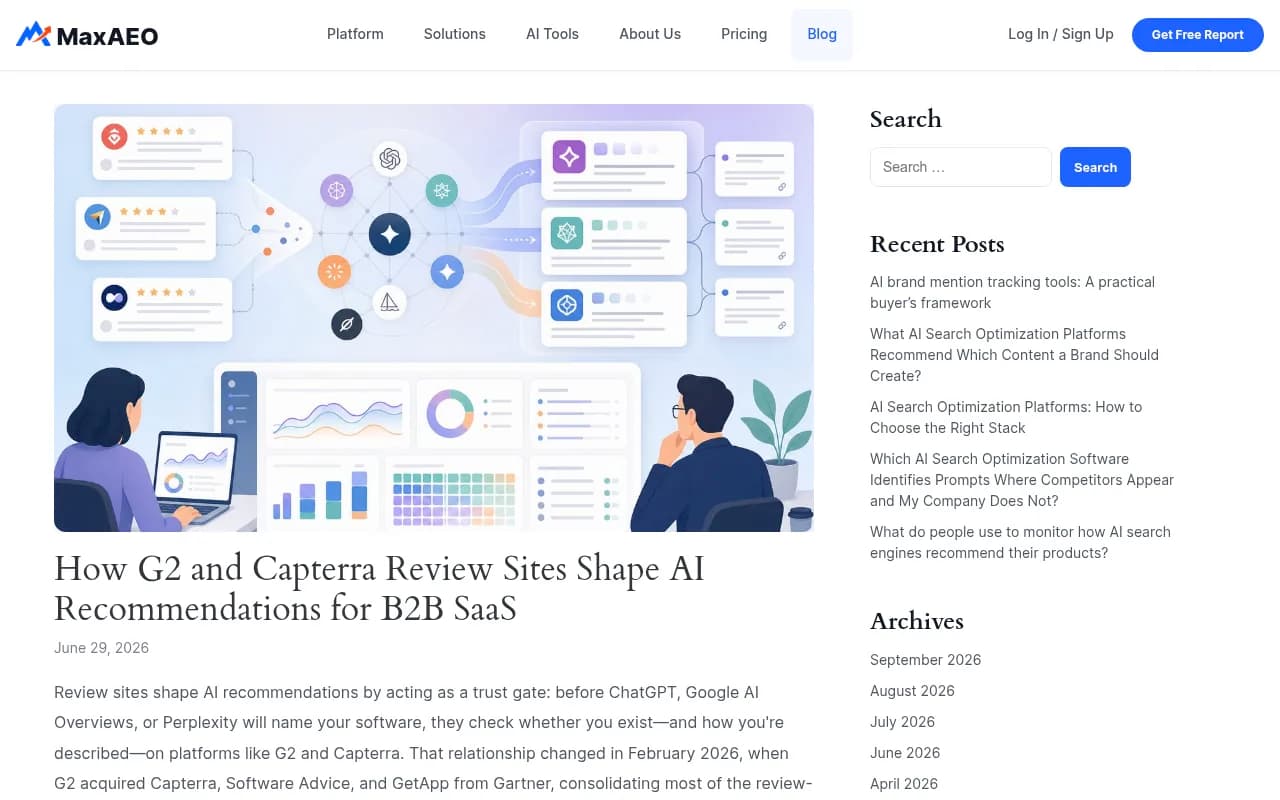
On February 5, 2026, G2 closed a roughly $110 million deal to acquire Capterra, Software Advice, and GetApp from Gartner. The three acquired properties now operate as G2 Digital Markets, and the combined company holds nearly 6 million verified reviews.
Three practical consequences:
- Capterra reviews syndicate automatically to GetApp and Software Advice. One review now covers three sites.
- Reviews do not currently syndicate up to G2 itself, but G2 has signaled unification is next. Plan for a world where one review program feeds the whole network.
- Beomniscient estimated the acquisition could raise G2's AI citation share by 76% in bottom-of-funnel prompts, combining G2's 2.09% and Capterra's 0.94% solution-aware citation share.
There's a concentration risk worth naming. Most of the review citation category now sits under one company's policies, algorithms, and pricing. If your AI visibility depends on review platforms, it depends on G2's decisions. Diversifying your citation base with Reddit threads, YouTube reviews, analyst content, and comparison pages on your own site is the hedge.
How AI actually reads your review profiles
Query wording matters more than most teams realize. SE Ranking found review platforms appear in 49% of AI Overviews for queries containing "review" or "rating," versus 17.1% for "best" or "top" queries. A buyer asking "is ToolX any good" hits review data roughly three times more often than a buyer asking "best CRM."
The mechanics, as best anyone can tell from outside the models: the AI maps the query to a software category, retrieves vendors associated with that category, and ranks them using authority and corroboration signals. Review platforms feed all three steps. They confirm the category through your listing, supply the candidate set through category pages and grids, and provide third-party validation through ratings, review language, and badges. Badge language in particular gets retrieved verbatim by AI systems, which is why a Leader badge matters well beyond the logo on your website.
When review platforms do appear in an AI Overview, 60.3% of the time it links to just one. You're competing for a single slot, usually against Gartner Peer Insights, G2, or Capterra.
The 2026 B2B review playbook
Weeks 1 and 2: claim and complete every profile
Both G2 and Capterra offer free listings that take under an hour each. Claim the profile, then actually finish it:
- Write the product description in the language buyers use. If buyers ask about "project management software for a 15-person agency," your profile should contain phrases an AI can lift. ChatGPT receives precise questions and looks for descriptions that match.
- Get category placement right. Category defines which shortlists you're eligible for. A misplaced listing is an invisible listing.
- Fill every field. Incomplete profiles give AI less to work with and suggest a neglected product.
Months 1 to 3: get to 10 reviews, then 50
Ten reviews is the minimum for G2 Grid visibility in most categories and for Capterra Shortlist consideration. Presenc.ai's priority order: reach 50 reviews on G2 and Capterra for your primary category first, build toward a Leader or High Performer badge through sustained review velocity second, and make your profile language match how buyers phrase procurement queries third.
Timing on the ask matters. The best moments are immediately after positive support interactions, successful onboarding milestones, or quarterly business reviews. Use your NPS, CSAT, and health score data to find advocates. And once G2 is moving, start Capterra: AISOS found companies with active profiles on at least two review platforms are 3.4 times more likely to be mentioned in ChatGPT responses.
Ongoing: velocity beats volume
G2 weights the past 18 months more heavily. Capterra looks at the past 24. A steady trickle of reviews beats a one-time push, and having 40% or more of your reviews from the past 12 months is worth an estimated 25 to 40% citation lift on recency-weighted platforms like Perplexity and Gemini.
Most teams do the opposite. They run one big campaign, collect 40 reviews in a month, and stop. Eighteen months later the profile reads as stale, and stale profiles invite outdated AI descriptions of your product.
The language matters more than the score
Since star ratings barely correlate with position, the review text is where the leverage lives. Detailed, industry-specific reviews shape AI descriptions far more than generic praise does. Capterra's 100-character minimum per section, versus G2's 40, tends to produce more substantive reviews, which is a quiet argument for running Capterra campaigns even when G2 is your primary platform.
You can't coach review content, and you shouldn't try. But you can choose who you ask and when. A project manager at a 40-person logistics company describing how she uses your tool every week gives AI exactly the use-case language it needs to match her peers' queries.
Stay inside the rules
This is where profiles get flagged. The current rules, per Capterra's Community Guidelines updated May 4, 2026 and G2's guidelines:
- Incentivize the act of reviewing, never the rating. G2 caps incentives at $100 per review and labels incentivized reviews. Capterra allows gift cards up to $25, offered equally no matter what rating the reviewer picks.
- Ask a broad cross-section of your user base. Selective solicitation, meaning only asking happy customers, is explicitly prohibited on both platforms.
- Don't touch AI-generated reviews. Capterra bans reviews written by third parties or AI tools and uses human moderators plus detection tech for plagiarism and generative AI.
- No non-disparagement clauses in customer contracts. Federal law prohibits them, and platforms check.
- Violations trigger a Buyer Alert on your profile, which is exactly the kind of negative signal that can outlast the violation itself.
Approval timelines matter for planning. G2 takes up to 3 business days. Capterra takes up to 5 for vendor-sourced reviews and up to 2 weeks for organic ones. Start campaigns at least two weeks before any deadline you care about.
Which platform first
| Platform | Best for | When to prioritize |
|---|---|---|
| G2 | B2B SaaS, especially US and UK markets | First, if you sell software |
| Capterra | SMB-focused software, less competitive categories | Immediately after G2; reviews syndicate to GetApp and Software Advice |
| TrustRadius | Enterprise deals with analyst-driven buyers | After G2 and Capterra are moving; skip until you have enterprise revenue |
| Gartner Peer Insights | Enterprise IT decision-makers | Optional, unless your buyers are enterprise IT |
| Trustpilot | B2C and mixed B2B/B2C brands | First, if you sell to consumers |
One platform mastered beats four platforms neglected. Eighty reviews on one platform outperforms 15 spread across four, both for platform algorithms and for AI extraction.
Measuring whether it worked
Review programs pay off on a lag. Expect one to two quarters between establishing review presence and measurable changes in inbound quality or sales cycle length.
For the AI side, track whether your profiles start getting cited. Tools like Promptwatch show which sources AI engines cite for your category's prompts, so you can watch G2 and Capterra citations climb (or stall) after a campaign, and see which prompts still aren't finding you at all.

If you want a quick read on which sources AI cites in your category before committing budget, MentionBird does exactly that, and it's a fast way to see whether you're competing against G2 pages or Reddit threads for the queries you care about.
What you can safely skip for now
Paid G2 tiers. The median G2 contract runs $27,813 a year, per Vendr's data across 528 purchases, ranging from $12,000 to $73,517. The free listing delivers the AI citation gate. Buyer intent data, Grid Report licensing, and category reports are demand-gen decisions, not GEO decisions. Revisit paid tiers once you're post-PMF and your review presence is established.
Also skip fake or incentivized-sentiment reviews. Beyond the ethics, platforms detect pattern anomalies, and the FTC's Fake Reviews Rule creates real legal exposure. The math never worked, and now the detection does.
The honest limits
Quoleady's conclusion is worth repeating: what influences ChatGPT results is broader and more nuanced than reviews. Backlink strength, mention relevance, consistent messaging, and machine-readable formatting all matter. Reviews are necessary infrastructure for B2B software in 2026, but a great G2 profile won't rescue a product with no corroborating presence anywhere else on the web.
Get the profiles claimed and complete, get past the thresholds, keep the review flow steady, and put your energy into the language rather than the count. That's the whole playbook, and most of your competitors still haven't run it.
If you'd rather have a team handle the broader GEO program around this, this site is published by 1001 SEO Media, an agency that builds AI search visibility strategies end to end.