Kompyte Review 2026
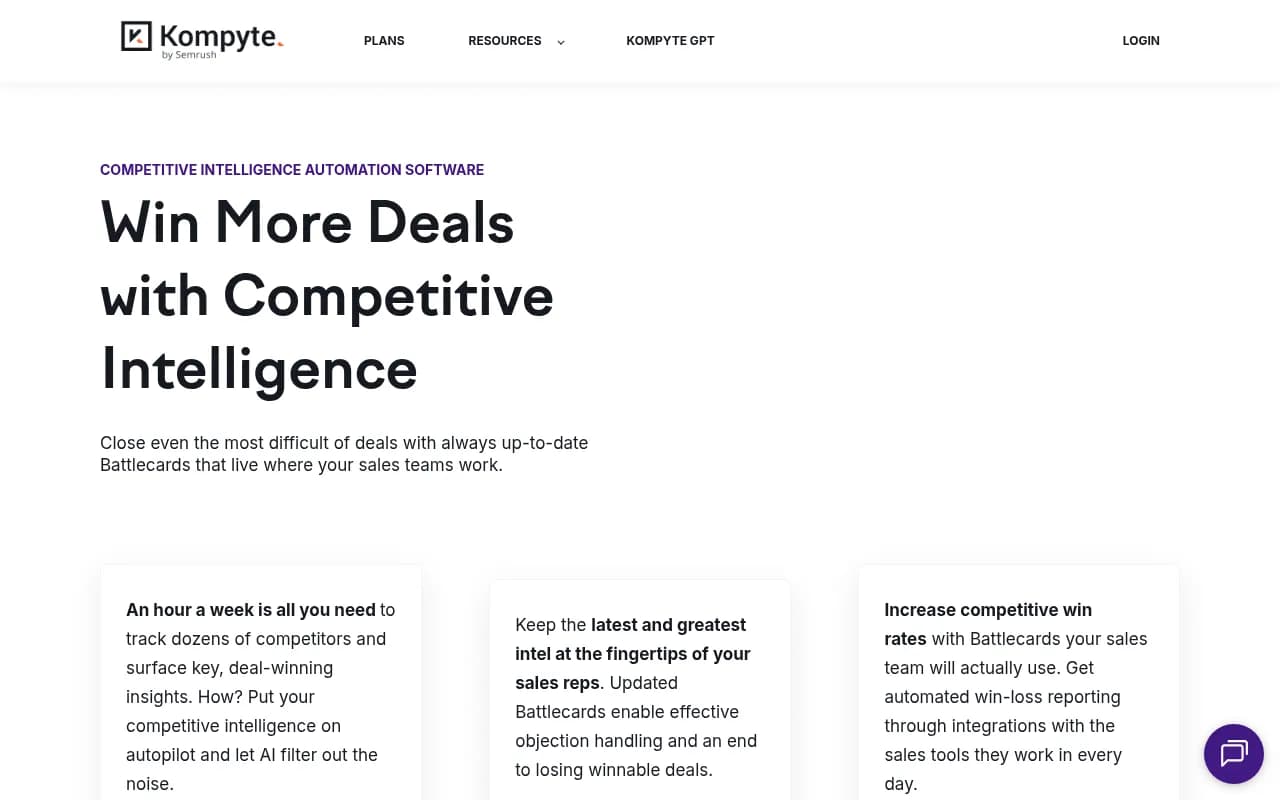
Kompyte is a competitive intelligence and sales battlecard platform that automatically tracks competitors across websites, reviews, ads, and social, then uses AI to surface deal-winning insights for sales teams via CRM-integrated battlecards.
Key takeaways
- Kompyte automates competitor tracking across hundreds of sources (websites, reviews, ads, job postings, social) and uses AI to filter noise into actionable summaries
- Strong sales enablement focus: battlecards integrate directly with Salesforce, HubSpot, Highspot, and Showpad -- where reps already work
- Win/loss analysis is a genuine differentiator, with a research partner (IcebergIQ) for qualitative interview data alongside automated quantitative reporting
- Acquired by Semrush, which gives it a larger data infrastructure but also means pricing and roadmap decisions are tied to a larger corporate parent
- Pricing is not publicly listed; expect enterprise-level quotes based on number of competitors tracked and boards used, with setup taking 7-8 weeks
Kompyte is a competitive intelligence automation platform built for product marketing and sales enablement teams. The core pitch is simple: instead of spending days manually checking competitor websites, reading review sites, and scanning job boards, Kompyte does it automatically and surfaces what actually matters. It tracks competitors across websites, ads, content, social media, reviews, and job postings, then uses AI to filter out the noise and deliver summaries that a team can act on in roughly an hour a week.
The platform was originally an independent company before being acquired by Semrush, the SEO and digital marketing data giant. That acquisition gave Kompyte access to Semrush's underlying web data infrastructure, which is a meaningful advantage for tracking competitor SEO activity, traffic estimates, and ad spend. The Semrush connection also shows up in G2 recognition -- Semrush (with Kompyte as part of its portfolio) was named a leader in 19 G2 categories including Competitive Intelligence and Market Intelligence in the Summer 2023 report.
The target audience is primarily B2B SaaS companies with dedicated product marketing managers or competitive intelligence analysts. Customers like LegalZoom, BetMGM, Podium, and GetResponse suggest it scales from mid-market to enterprise. The sales enablement angle -- battlecards that live inside Salesforce and HubSpot -- means it's also relevant to sales operations and revenue teams, not just marketing.
Key features
Automated competitor tracking across multiple source types
Kompyte monitors competitors continuously across six main source categories: websites (page changes, new content), online reviews (G2, Capterra, Trustpilot), content (blog posts, whitepapers), social media, paid ads, and job postings. Job posting tracking is particularly useful -- a sudden spike in engineering hires often signals a product pivot before any public announcement. The platform claims to track "hundreds of sources and millions of data points," which is plausible given the Semrush data infrastructure behind it.
- Website change detection flags when competitors update pricing pages, feature pages, or messaging
- Review monitoring surfaces patterns in what customers are praising or complaining about
- Ad tracking shows creative and copy changes, useful for understanding competitor positioning shifts
AI Daily Summaries
This is Kompyte's answer to information overload. Rather than dumping every competitor update into a feed, the AI Daily Summaries digest activity and surface what's actually significant. The claim that competitive monitoring can be reduced to "an hour a week" is tied directly to this feature. In practice, the quality of these summaries depends heavily on how well the AI is trained to distinguish meaningful strategic signals from routine website tweaks -- which is a known challenge across all CI tools.
Sales battlecards
Battlecards are the product's most distinctive feature and the one that differentiates Kompyte from pure monitoring tools. These are structured, templated documents that give sales reps quick-reference guides for handling objections against specific competitors. Key capabilities:
- Pre-built templates covering overviews, differentiators, objection handling, and pricing comparisons
- Automatic updates when new competitor intelligence is captured -- reps always see current information
- Adoption tracking so product marketing can see which battlecards are actually being used
- Bi-directional CRM integration means battlecards surface contextually (e.g., when a Salesforce opportunity has a competitor tagged)
The adoption tracking piece is genuinely valuable. Most battlecard programs fail because reps don't use them. Kompyte's ability to measure usage and tie it to win rates gives product marketing a feedback loop that most teams lack.
CRM and sales tool integrations
Kompyte integrates with Salesforce and HubSpot for CRM, Slack and Microsoft Teams for notifications, Google Drive and OneDrive for document storage, and Highspot and Showpad for sales enablement platforms. The bi-directional nature of the CRM integrations is important -- it's not just pushing battlecards into Salesforce, it's also pulling win/loss data back out to measure impact.
Win/loss analysis
This goes beyond simple win rate tracking. Kompyte surfaces competitive revenue data, competitor frequency in deals, and win rates with and without battlecard usage. The IcebergIQ research partner integration is a notable differentiator -- it adds qualitative win/loss interview data to the quantitative CRM data, giving teams a more complete picture of why deals are won or lost. Most CI tools stop at quantitative reporting.
Competitive reports and boards
Beyond battlecards, Kompyte generates broader competitive reports that can be shared across the organization. These boards aggregate intelligence by competitor and can be customized to highlight what matters most for different audiences (product team vs. sales team vs. executive team).
Who is it for
Kompyte fits best with B2B SaaS companies that have at least one dedicated product marketing manager and a sales team of 20+ reps. At that scale, the manual work of maintaining competitive intelligence becomes genuinely painful, and the ROI of automation becomes clear. A company tracking 10-15 competitors with reps losing deals to objections they're unprepared for is the ideal Kompyte customer.
Product marketing managers are the primary users. They set up competitor tracking, curate the AI-surfaced updates, build and maintain battlecards, and use the win/loss data to refine messaging. Sales operations teams are secondary users who care about the Salesforce integration and the win rate reporting. Executives occasionally consume the competitive reports.
Industries where it particularly shines: SaaS, fintech, legal tech, and any B2B vertical with a crowded competitive landscape and a consultative sales process. The IcebergIQ win/loss interview integration makes it especially useful for companies selling complex, high-ACV products where understanding the "why" behind losses matters.
Who should not use this tool: early-stage startups without a dedicated product marketing function, companies with fewer than 5 competitors worth tracking, or teams that primarily need market research rather than sales enablement. The 7-8 week setup time and enterprise pricing also make it a poor fit for small teams that need something running quickly on a tight budget. Simpler tools like Crayon's lower tiers or even manual processes with Notion templates may be more appropriate.
Integrations and ecosystem
The integration story is one of Kompyte's stronger selling points. The key integrations:
- Salesforce: Bi-directional sync for opportunity data and battlecard delivery
- HubSpot: CRM integration for deal tracking and battlecard surfacing
- Slack and Microsoft Teams: Real-time competitor update notifications
- Google Drive and OneDrive: Export and share competitive reports
- Highspot and Showpad: Push battlecards into sales enablement platforms where reps already access content
- Semrush: Given the acquisition, Semrush data (traffic, keywords, ad spend) feeds into competitor profiles
There's no public API documentation prominently featured on the site, which suggests API access may be limited to enterprise tiers or custom arrangements. Browser extension support isn't prominently mentioned. Mobile app availability is unclear from public information.
The Semrush acquisition means Kompyte customers effectively get access to Semrush's underlying data layer for competitor web analytics, which is a meaningful advantage over standalone CI tools that rely on third-party data providers.
Pricing and value
Kompyte does not publish pricing on its website. Based on available information from comparison sources, pricing varies based on the number of competitors tracked and "boards" used, with different tiers for user access levels. Setup takes 7-8 weeks, which implies a white-glove onboarding process typical of enterprise software.
Every plan reportedly includes:
- All automation features and integrations
- Personalized onboarding and setup
- A dedicated customer success manager
The dedicated CSM on every plan is notable -- it signals this is positioned as a managed service as much as a self-serve tool. That's appropriate given the setup complexity, but it also means the cost is likely higher than self-serve alternatives.
For comparison: Crayon and Klue, the two most direct competitors, also operate in the $15,000-$50,000+ annual range for mid-market to enterprise customers. Kompyte likely sits in a similar range. Teams expecting a $200/month SaaS tool will be disappointed. The value proposition is strongest for companies where losing a single enterprise deal to a competitor costs more than a year of Kompyte's subscription.
There's no publicly available free trial or freemium tier. The site directs visitors to "get started" with a platform tour, which typically means a sales-led demo process.
Strengths and limitations
What it does well
- The battlecard-to-CRM integration is genuinely well-executed. Surfacing the right battlecard inside Salesforce when a specific competitor is tagged in an opportunity is the kind of workflow automation that actually changes rep behavior.
- Win/loss analysis with qualitative interview data via IcebergIQ is a real differentiator. Most CI tools only give you quantitative win rates; understanding the "why" requires this kind of qualitative layer.
- The breadth of tracking sources (websites, reviews, ads, job postings, social, content) in a single platform reduces the need to stitch together multiple tools.
- Semrush's data infrastructure gives Kompyte better web analytics data on competitors than most standalone CI tools can provide.
- Adoption tracking for battlecards closes a loop that most product marketing teams never close -- you can actually see if your work is being used.
Limitations and honest gaps
- The 7-8 week setup time is a real friction point. For teams that need competitive intelligence now, this is a significant barrier. Competitors like Crayon can be up and running faster.
- Pricing opacity is frustrating. Not publishing any pricing information forces every potential customer through a sales process before they can evaluate fit, which wastes time for teams that are clearly outside the budget range.
- AI summary quality is hard to evaluate without hands-on use. The "hour a week" claim depends entirely on the AI correctly distinguishing signal from noise, and this varies significantly by industry and competitor type. Early-stage or less digitally active competitors are harder to track well.
- No self-serve option means smaller teams or those with tighter budgets are effectively excluded, even if the product would otherwise fit their needs.
Bottom line
Kompyte is a solid choice for B2B SaaS companies with dedicated product marketing teams, 20+ person sales organizations, and a competitive landscape that's active enough to justify the investment. The battlecard-CRM integration and win/loss analysis with qualitative data are the features that genuinely set it apart from simpler monitoring tools.
Best use case in one sentence: a product marketing team at a mid-market SaaS company that's losing deals to 5-10 competitors and needs to arm sales reps with current, contextual competitive intelligence without spending 20 hours a week maintaining it manually.
Tags:
Frequently asked questions
What is Kompyte?
Who owns Kompyte?
How much does Kompyte cost?
How long does Kompyte take to set up?
How does Kompyte compare to Crayon and Klue?
Does Kompyte have a free trial?
Similar and alternative tools to Kompyte