Key takeaways
- Contractors need two kinds of tools in 2026: an AI visibility platform that shows whether ChatGPT, Perplexity, Gemini, and Google AI name you, and a local listings and reviews tool that fixes the signals those answers rely on.
- Most visibility tools only monitor. For a small contracting business the useful question is which one tells you what to fix, not which one has the prettiest dashboard.
- ChatGPT cites product and landing pages more than anything else (22.4% and 16.8% of citations, Sep 28 to Oct 4, 2026, per Promptwatch Data). For a contractor, that means complete service pages and service-area pages matter more than blog volume. That mapping is my inference, since the report does not cover home services.
- Marketplaces such as Angi and Thumbtack dominate hiring-style queries in the 5WPR index, so your reviews and listings on those platforms matter as much as your own site.
- Check pricing on each vendor's site before buying. Prices and plans change often.
Why home services is its own AI visibility problem
A SaaS company wants to be named in a "best project management tool" answer. A plumber in Pinellas County wants to be named when someone types "emergency plumber near me" into ChatGPT at 11 pm. Same channel, very different mechanics.
Three things make contractors different:
- Queries are local. The answer depends on city, neighborhood, and service type, so a single national score tells you almost nothing.
- Third parties dominate. In the 5WPR Home Services & Improvement AI Visibility Index 2026, Angi leads "find a contractor" citations, Thumbtack is a close challenger, and Yelp shows up mostly as a review source. Your own website competes with all of them.
- The business outcome is a phone call, not a signup. A tool that cannot connect AI mentions to calls and booked jobs only gets you halfway.
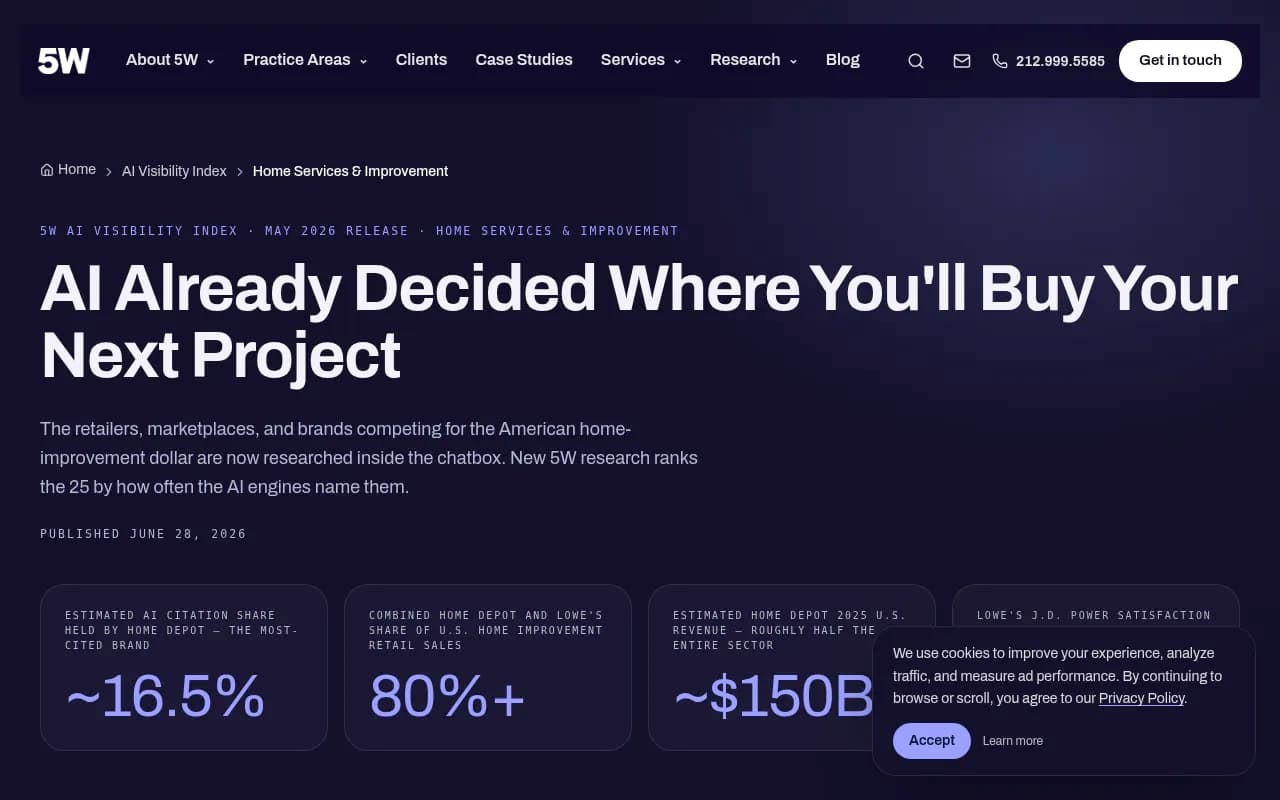
The 5WPR report is worth a skim. It measured citation share across ChatGPT, Claude, Perplexity, Gemini, and Google AI Overviews for Q2 2026, and its marketplace findings (Thumbtack beating Angi in AI citations overall, Angi leading on hiring queries) tell you where homeowners are being sent before they ever reach a contractor's site.
The local numbers are stark too. The Foxxr 2026 Home Service AI Visibility Report listed small contractors with a Share of AI Voice of 100 next to others, in the same trades and similar towns, at 0. I have not verified that study, so treat it as an illustration, not a benchmark. The point stands: the gap between visible and invisible is wide, and it is not obviously tied to company size.
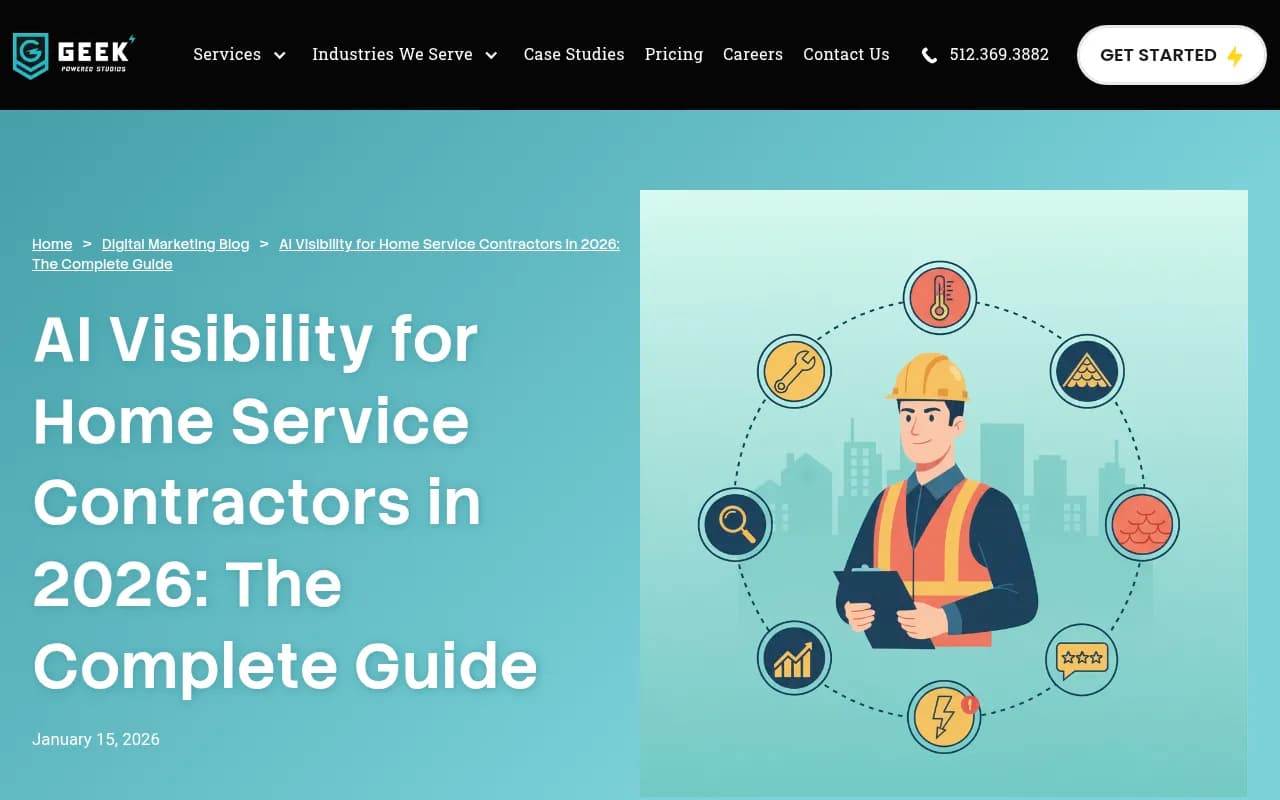
Geek Powered Studios, an agency, claims 45% of consumers now use AI to find contractors and that AI-driven traffic converts at 4.4 times organic search. Those are vendor numbers I could not verify, so use them as directional, not gospel.
What an AI visibility platform should do for a contractor
Before comparing tools, decide what you need. I would rank these requirements for a home services business:
- Local prompt tracking. You need to track prompts by city or region, such as "best HVAC company in Norcross GA", not just generic ones.
- Real answers, not just API calls. What ChatGPT shows in its interface can differ from what its API returns. Ask whether the tool checks the real user interface.
- Citation sources. You need to see which pages AI actually pulls from: your site, Yelp, Angi, Facebook, a local news site.
- A way to act. A list of gaps is useless if nobody on a five-person crew has time to turn it into pages.
- Traffic and call attribution. Even a rough link from AI referrals to leads beats nothing.
- Price that makes sense against a job value. A $95 monthly tool pays for itself if it contributes to one extra water heater install. A $500 tool needs more thought.
The best AI visibility platforms for contractors
Promptwatch
Promptwatch is the one I would start with if you want more than a scoreboard. It tracks the real interfaces of ChatGPT, Google AI Overviews, Google AI Mode, Gemini, Perplexity, and Copilot, by country, and on Business plans down to state and city level, which matters when your whole market is one metro area.

What sets it apart for a contractor is the action side. Its Action Board produces a prioritized to-do list from your data, its content gap analysis shows which prompts competitors win that you do not, and its Content Agent can write and publish pages to WordPress, Webflow, or Framer. AI crawler logs show whether ChatGPT's bots can read your site at all, which is a common hidden problem with older contractor sites built on page builders.
Pricing as listed at promptwatch.com/pricing: a free Explore tier (10 prompts, ChatGPT only), Essential at $95 per month for 50 prompts, Professional at $245, and Business at $579 with city-level tracking and the automated Content Agent. There is a 7-day trial on monthly plans. Agencies serving many contractors should look at the Kick-off, Growth, and Scale agency plans.
Honest caveat: if you run a two-truck plumbing company with no one to look at a dashboard, even Essential may be more than you need. Start with the free tier and the free AI Visibility Report.
Otterly.AI
Otterly is a straightforward prompt tracker with a low entry price. It tells you whether you were mentioned and where. It does not tell you why or write the fix, which is fine if you already have someone doing the work.

Peec AI
Peec AI is another monitoring-focused option, clean and quick to set up. Same trade-off: good at showing the problem, silent on remedies.

Profound
Profound is built for enterprise brands. For a national home services franchise with hundreds of locations it is a serious candidate. For a local contractor it is almost certainly too much tool and too much money.

Scrunch
Scrunch monitors how AI assistants describe your brand and has content features aimed at larger marketing teams. Best suited to multi-location businesses with a dedicated marketer.
Tibly
Tibly is pitched specifically at local businesses, which is why it makes this list even though I could not verify its depth. If you want something built around local rather than adapted to it, take a look and test with the free options first.

Semrush and Ahrefs Brand Radar
If you already pay for Semrush or Ahrefs, their AI visibility add-ons are convenient. The downside is that prompt sets are fixed and the data is shallower than purpose-built platforms, and neither is designed for city-by-city local questions.
Free checkers for a first look
Before paying anything, run a free scan. Several tools in our catalog give you a one-off snapshot: [tool:hubspot-ai-search-grader] and [tool:aeo-express] are quick, and [tool:answergist] gives prioritized fixes.
Comparison table
| Tool | Local/city tracking | Tells you what to fix | Publishes content | Best for |
|---|---|---|---|---|
| Promptwatch | Country on all paid plans, state/city on Business | Yes (Action Board, gap analysis) | Yes (Content Agent to CMS) | Contractors and agencies who want to act |
| Otterly.AI | Limited | No | No | Budget monitoring |
| Peec AI | Limited | No | No | Simple monitoring |
| Profound | Yes | Partly | No | National franchises |
| Scrunch | Yes | Partly | Some | Multi-location marketing teams |
| Tibly | Local focus | Unverified | Unverified | Small local shops testing the water |
| Semrush / Ahrefs | Weak | Limited | Separate tools | Teams already on these suites |
I did not research competitor pricing for this guide, so confirm every price on the vendor's page.
Local listings and reviews: the other half of the stack
An AI visibility platform tells you what AI says. It does not fix your Google Business Profile or get you reviews. The 5WPR index shows marketplaces and review sites sitting between homeowners and contractors, so these signals are not optional.
Tools worth considering:
- [tool:birdeye] and [tool:podium] for review requests and text-first lead capture. Podium also came up in a Reddit roundup of AI tools for home service businesses.
- [tool:nicejob] for automated review and referral requests, aimed squarely at trades.
- [tool:brightlocal] and [tool:moz-local] for citation building and NAP consistency across directories.
- [tool:synup] and [tool:yext] when you run multiple locations and need listings synced.
- [tool:highlevel] as an all-in-one CRM and marketing system popular with contractors and the agencies that serve them.
- [tool:schema-app] if you want LocalBusiness structured data handled properly.
Geek Powered Studios recommends 100+ photos on a Google Business Profile, listings consistent across 30 to 50 directories, and 5 to 10 job-specific reviews a month. Those are agency numbers, not a controlled study, but the habits are sensible regardless. For a sanity check on traditional rankings, [tool:google-search-console] is free.
What the data says about where to focus
Promptwatch's analysis of ChatGPT citations by content type ran from Sep 28 to Oct 4, 2026. You can read it in Promptwatch's ChatGPT citation share by content type report. Findings relevant to a contractor:
- Product pages get 22.4% of citations and landing pages 16.8%. Listicles get 13.6%.
- For commercial prompts like "best X for...", product pages reach 26.0% and landing pages 20.6%.
- For branded prompts such as "is [brand] good", reviews rise to 5.6%, more than three times their overall share.
The report does not cover home services, so take the translation with a grain of salt. My read: give every service you sell its own complete, factual page, with price ranges, service areas, licensing, and FAQs. Then make sure reviews exist on sites AI will look at.
One more point on freshness. Promptwatch's content half-life report found that news pages lost half their citations within about five weeks, while landing pages and docs stayed cited for months. Evergreen service pages are a better investment than seasonal blog posts.
On social, Promptwatch's October 2026 social citations data shows ChatGPT drew only 0.46% of its citations from social platforms in the week of Sep 28 to Oct 4, while Google AI Overviews drew 12.2%. YouTube (4.28%) and Facebook (2.38%) led in AI Overviews. So a Facebook page with real job photos and a few short YouTube walkthroughs can help in Google, but do not expect them to move ChatGPT. Reddit also fell sharply in ChatGPT, per Promptwatch's Reddit citation drop report, so skip Reddit as a plan A.
A practical setup by business size
Solo or small crew (1 to 5 trucks)
Run the free scans above. Fix your Google Business Profile, get a steady flow of reviews, and make sure every service has its own page. Add a free Explore plan with Promptwatch to watch 10 prompts that include your city. Total cost: close to zero, plus time.
Growing company (5 to 25 trucks)
Pay for one AI visibility platform with city tracking and some way to act on it. Pair it with a review tool like NiceJob or Podium. Track which pages AI cites and publish the missing ones. Promptwatch Essential or Professional fits here, though check whether city-level tracking, which starts on Business, matters in your market.
Multi-location or franchise
You need location-level listings management (Yext, Synup, or Uberall) and a visibility platform that can handle many markets. Promptwatch Business, Profound, or Scrunch are the shortlist, and you will want to demo each.
Agency serving contractors
A multi-client setup with white-label reporting is the main requirement. Promptwatch's agency plans cover unlimited projects, and tools like [tool:agencyanalytics] help with reporting. If you would rather hand the whole thing off, agencies such as WebFX, Silverback Strategies, and HigherVisibility appear on 2026 lists of GEO agencies for home services. I have not vetted them, so ask for contractor case studies.
Hiring help instead of buying software
Plenty of contractors would rather not touch any of this. That is reasonable. A full-service agency like 1001 SEO Media combines technical SEO, local SEO, content, and generative engine optimization, with no long-term contracts, and uses Promptwatch for AI visibility tracking. Whoever you pick, ask how they will tie AI visibility to calls and booked jobs, and what they will report monthly.
If you want to browse more options, the GEO software directory at bestgeosoftware.com lists many platforms side by side.
A 30-day starter plan
- Week 1: Run a free AI visibility scan and ask ChatGPT, Perplexity, and Google your top ten customer questions with your city name. Write down who gets named.
- Week 2: Fix the basics. Complete your Google Business Profile, align your name, address, and phone number everywhere, add LocalBusiness schema, and confirm your site is not blocking AI crawlers in robots.txt.
- Week 3: Build or rewrite one page per service and service area, with prices or ranges, FAQs, and real project photos.
- Week 4: Start a review request routine after every finished job, then set up tracking for 20 to 50 local prompts and check back monthly.
AI answers shift week to week, so one snapshot is never the whole story. Track the same prompts over time, and judge progress by calls and booked jobs, not by whether a chatbot said your name once.
Final take
For most contractors the best setup is cheap and boring: tidy listings, steady reviews, thorough service pages, and one tracking tool that points to the next fix. Among the platforms I looked at, Promptwatch is the one that moves furthest from watching to doing, while Otterly and Peec are fine if you only need a scoreboard. Start free, measure for a month, and only then decide what to pay for.