Influ2 Review 2026
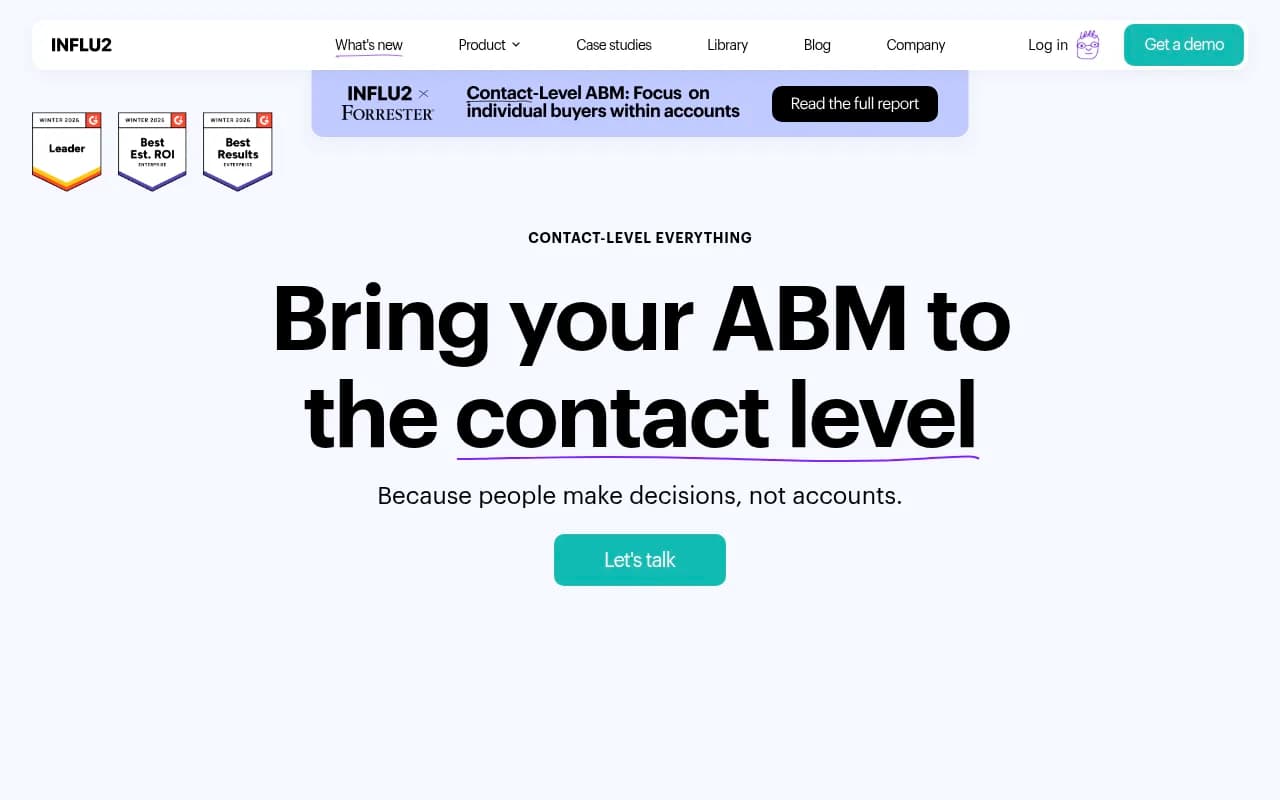
Account-based marketing platform that enables precise targeting of decision-makers with person-level tracking and engagement analytics.
Key Takeaways
- Influ2 is the only ABM platform that targets and tracks individual contacts by name, not just accounts -- you see exactly which VP or director engaged with your ad, not just "someone at Acme Corp"
- Built for B2B teams running account-based strategies who need to prove marketing's revenue impact to sales and leadership
- Strong on ad targeting precision and pre-form engagement tracking, but pricing is opaque (contact sales) and the platform requires a learning curve
- Best for mid-market to enterprise B2B companies with defined target account lists and sales teams that need actionable contact-level signals
Most ABM platforms treat accounts like monoliths. You target "Salesforce" or "IBM" and hope the right person sees your ad. Influ2 flips that. It targets specific people -- the VP of Sales at Salesforce, the Director of IT at IBM -- and tells you by name who engaged, what they clicked, and when. That's the pitch, and for B2B marketers tired of account-level guesswork, it's compelling.
Influ2 launched as a contact-based advertising platform and has expanded into a full ABM suite. It's used by companies like Amplitude, Papaya Global, Chargebee, and Capgemini -- brands with complex sales cycles and multiple decision-makers per deal. The platform is GDPR and CCPA compliant, ISO 27001 certified, and SOC 2 Type II attested, which matters when you're tracking individuals.
Contact-Level Ad Targeting
This is Influ2's core feature and what sets it apart. You upload a list of contacts (names, emails, LinkedIn profiles) from your CRM or sales team's target accounts. Influ2 matches those contacts to their online activity and serves display ads to them across the web -- news sites, industry publications, social feeds. The match rate varies (typically 40-60% of your list), but when it works, you know exactly who saw your ad.
The targeting happens through a combination of deterministic matching (email hashes, LinkedIn IDs) and probabilistic signals (device fingerprints, behavioral patterns). You're not buying impressions on "people who work in SaaS" -- you're buying impressions on John Smith, VP of Marketing at Acme Corp, because your sales team wants to talk to John Smith specifically.
Ad formats include standard display (banners, rectangles), native ads, and video. You can run multiple creatives and A/B test messaging. The platform integrates with major ad exchanges, so your ads appear on premium inventory, not just low-tier remnant placements.
The real value is the engagement data. Influ2 shows you which contacts viewed your ad, how many times, whether they clicked, and what content they engaged with -- all before they fill out a form. This is pre-form intent data tied to named individuals. Your sales team gets a notification: "Sarah Johnson at Target Account X viewed your ad 5 times this week and clicked through to the pricing page." That's a warmer call than "someone at Target Account X visited your website."
Contact-Level Intent Signals
Beyond ads, Influ2 tracks intent signals from your target contacts across the web. It monitors when they research topics related to your product category, read competitor content, or engage with industry discussions. The intent data is tied to specific people, not anonymous accounts.
The platform uses a combination of first-party data (your website visitors, ad engagements) and third-party intent signals (content consumption, search behavior). You can set up alerts for high-intent actions -- e.g., "notify me when a VP at a target account reads three articles about marketing automation in one week."
Intent scoring is customizable. You define what signals matter (competitor research, pricing page visits, whitepaper downloads) and weight them. The platform aggregates these into an intent score per contact and per account. This helps prioritize outreach -- focus on the contacts showing active buying signals, not the entire account list.
One limitation: the intent data is strongest for contacts already in your system. Influ2 doesn't surface net-new contacts showing intent at your target accounts the way some intent platforms do. It's built to track people you already know about, not discover unknown stakeholders.
Buyer Journey Orchestration
Influ2 lets you build multi-stage ad campaigns that adapt based on contact behavior. You can set up sequences like: "Show ad A to all contacts at target accounts. If they click, show ad B with a case study. If they visit the pricing page, show ad C with a demo offer. If they don't engage after 10 impressions, pause and move to the next segment."
The orchestration is rule-based, not AI-driven. You define the logic: if contact does X, then show Y. It's flexible but requires upfront planning. You can sync with CRM stages -- e.g., "show different ads to contacts in Opportunity stage vs. MQL stage" -- so your messaging aligns with where the deal actually is.
This is where Influ2 gets interesting for complex B2B sales. You're not running one generic campaign to an account. You're running personalized sequences to the CFO, the CTO, and the VP of Ops at the same account, each seeing messaging tailored to their role and engagement history. It's labor-intensive to set up but powerful when executed well.
The platform also supports retargeting based on website behavior. If a contact visits your site but doesn't convert, you can retarget them with ads addressing their specific page views. Visited the integrations page? Show an ad about your Salesforce integration. Visited the security page? Show an ad about your SOC 2 compliance.
Revenue Attribution and Reporting
Influ2 integrates with Salesforce, HubSpot, and other CRMs to tie ad engagement to pipeline and revenue. You can see which contacts engaged with ads before a deal closed, how many touchpoints they had, and the revenue influenced by those engagements.
The attribution model is multi-touch. Influ2 tracks every ad impression, click, and intent signal for each contact, then maps those to CRM opportunities. You get reports like "Contacts who engaged with ads had a 2x higher win rate" or "Deals with 5+ ad touchpoints closed 30% faster." This is the data marketing leaders need to justify ABM spend.
The platform also shows account-level engagement heatmaps -- which accounts have the most engaged contacts, which are cold, which are showing intent but not converting. This helps prioritize sales outreach and budget allocation.
One gap: Influ2 doesn't natively track offline conversions (phone calls, in-person meetings) unless you manually log them in your CRM. The attribution is strong for digital touchpoints but less complete for multi-channel sales motions.
Integrations and Ecosystem
Influ2 integrates with Salesforce, HubSpot, Marketo, Pardot, and other major CRMs and marketing automation platforms. The sync is bidirectional -- you can push target lists from your CRM to Influ2 and pull engagement data back into CRM records.
It also integrates with LinkedIn Sales Navigator, so your sales team can see Influ2 engagement data directly in their LinkedIn workflow. There's a Slack integration for real-time alerts when high-priority contacts engage.
The platform has an API for custom integrations and data exports. You can pull engagement data into your data warehouse or BI tool (Looker, Tableau, etc.) for custom reporting.
No native integration with Google Analytics or web analytics platforms, which is a miss. You can't easily tie Influ2 ad engagement to on-site behavior in GA4 without custom tracking setup.
Who Is It For
Influ2 is built for B2B companies with defined target account lists and complex sales cycles. Think enterprise SaaS, professional services, IT infrastructure, fintech -- industries where deals involve multiple stakeholders and six-figure contracts.
The ideal user is a mid-market to enterprise company (50-5000 employees) with a dedicated ABM or demand gen team. You need someone who can build and manage multi-stage campaigns, analyze engagement data, and coordinate with sales on follow-up. This isn't a set-it-and-forget-it tool.
It's particularly strong for companies with small, high-value target account lists (50-500 accounts). If you're trying to land 10 Fortune 500 accounts, Influ2's precision targeting makes sense. If you're running broad demand gen to thousands of accounts, the contact-level approach is overkill.
Agencies running ABM programs for clients also use Influ2. The white-label reporting and multi-client management features support agency workflows.
Who should NOT use Influ2: Early-stage startups without a defined ICP, companies with transactional sales cycles (e-commerce, SMB SaaS with self-serve), or teams without CRM hygiene. If your contact data is messy or your sales team doesn't follow up on intent signals, the platform's value drops significantly.
Pricing and Value
Influ2's pricing is not publicly listed. You have to contact sales for a quote. Based on user reviews and industry benchmarks, pricing is based on the number of contacts targeted, with platform fees and ad spend bundled together. Expect to pay $3,000-$10,000+ per month depending on list size and ad budget.
There's no free trial, but Influ2 offers a pilot program where you can test the platform on a small segment before committing to a full contract. Contracts are typically annual.
Compared to competitors like Demandbase, 6sense, or RollWorks, Influ2 is mid-tier on price but higher on targeting precision. You're paying for contact-level data, not just account-level. Whether that's worth it depends on your sales motion -- if your deals require buy-in from 5-10 stakeholders, knowing which specific people are engaged is valuable. If you're selling to single decision-makers, the premium is harder to justify.
The ROI case studies are strong. Amplitude reported 5.6x ROI on ad spend. Bonterra saw 2x win rates. Marketbridge got 6x more pipeline. These are real numbers from real customers, not vendor-created hypotheticals.
Strengths
- Contact-level targeting and tracking: The only platform that shows you by name who engaged with your ads, not just which accounts. This is a real differentiator.
- Pre-form engagement data: You get intent signals before contacts fill out forms, which is gold for sales teams. They can reach out with context, not cold.
- CRM integration and attribution: The Salesforce/HubSpot sync is solid, and the revenue attribution reports are what CFOs want to see.
- Buyer journey orchestration: The ability to run multi-stage, role-based campaigns to different stakeholders at the same account is powerful for complex B2B sales.
- Compliance and security: GDPR, CCPA, ISO 27001, SOC 2 -- all the checkboxes for enterprise procurement.
Limitations
- Opaque pricing: No public pricing is frustrating. You have to sit through a sales call to get a quote, which slows down evaluation.
- Match rate variability: Not every contact on your list will be matched and targetable. Match rates of 40-60% are common, which means you're not reaching everyone you want.
- Learning curve: The platform is feature-rich but not intuitive. Expect a ramp-up period for your team to learn campaign setup, orchestration rules, and reporting.
- Limited intent discovery: Influ2 tracks contacts you already know about. It doesn't surface new stakeholders at your target accounts the way some intent platforms do.
- No native web analytics integration: The lack of Google Analytics integration means you can't easily tie ad engagement to on-site behavior without custom tracking.
Bottom Line
Influ2 is the best option for B2B teams that need to target and track individual decision-makers within accounts, not just spray ads at company domains. If your sales team needs to know which VP engaged with your content and when, Influ2 delivers that data. If you're running broad demand gen or selling to single decision-makers, the contact-level precision is overkill and you'll pay for features you don't need.
Best use case in one sentence: Enterprise B2B companies with 50-500 high-value target accounts and multi-stakeholder sales cycles who need to prove marketing's revenue impact with contact-level engagement data.
Tags:
Similar and alternative tools to Influ2