Key takeaways
- ChatGPT has no fixed rank. Answers vary run to run, so trackers that report one position are reporting a single sample, mostly noise.
- The main causes of disagreement are sample size, persona or context, model version, location, prompt wording and how each tool defines a mention.
- Model rollouts can shift results overnight. Promptwatch Data saw citations per response fall about 27% after the GPT-5.3 rollout on March 4, 2026.
- Compare tools on rates (mention rate, citation rate) over many runs, not on single-run screenshots.
- Pick one methodology, hold it constant, and read trends, not absolute numbers.
The problem: same prompt, different numbers
You sign up for two ChatGPT rank trackers. You load the same 50 prompts. One says your brand shows up in 34% of answers. The other says 18%. Your first instinct is that one of them is broken.
Usually neither is. They are measuring different things in slightly different ways, and ChatGPT itself is not a stable target. A Google rank tracker checks a deterministic-ish list. A ChatGPT tracker samples a probabilistic system, and every choice about how it samples changes the answer.
This guide walks through the specific reasons trackers disagree, what the research says, and how to reconcile the numbers so you can make decisions with them.
Why ChatGPT is not a ranked list
In classic SEO you rank at position 4 for a keyword, and for a given location and device, that is close to a fact. ChatGPT generates an answer. Your brand may be mentioned, cited as a source, recommended first, or left out, and a second run can flip any of those.
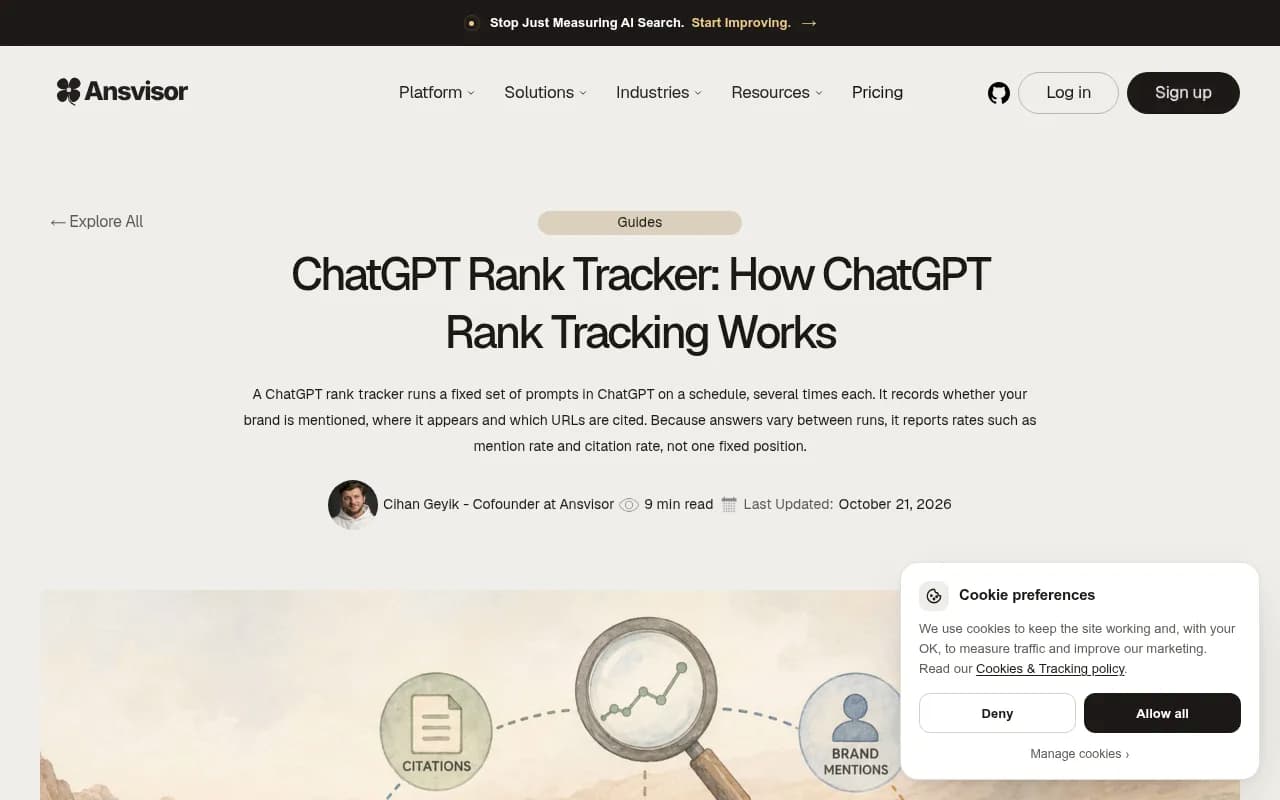
That is why serious tools don't report one fixed position. Ansvisor describes the standard design well: a tracker runs a fixed set of prompts on a schedule, several times each, and reports rates such as mention rate and citation rate instead of one position.
SparkToro published research on this too, finding that AIs are highly inconsistent when recommending brands or products and that marketers should be careful when tracking AI visibility. I haven't re-verified its exact figures here, but the direction matches what anyone running repeated tests sees.
If the underlying thing is a distribution, then two tools sampling it differently will give different answers. Let's go through the ways they differ.
Cause 1: sampling and how many runs per prompt
This is the biggest one. A tool that runs each prompt once per day is reporting a coin flip. A tool that runs each prompt five or ten times and averages is reporting an estimate with much tighter error bars.
Say your brand truly appears in 40% of answers to a prompt. Run it once and you see 0% or 100%. Run it ten times and you will probably land somewhere from 20% to 60%. Run it fifty times and you will be close to 40%.
So when one tool shows 34% and another 18%, ask these questions first:
- How many times is each prompt run per reporting period?
- Is the number a daily snapshot or a rolling average?
- How many prompts are in the set? Small sets swing hard on a few answers.
Topify's testing notes make the same point: advanced trackers use repeat multi-sampling to smooth out LLM variability. And Dageno's roundup says free tools are fine for a snapshot, but ongoing reporting needs saved prompts, repeated sampling, citation evidence and exports.
Promptwatch Data backs up the "one prompt tells you little" idea from another angle. In its unique domains per response report (Sep 28 to Oct 4, 2026), 47.6% of ChatGPT responses cited 10 or more domains, and its advice is to measure citations across many organic prompts, not just one.
Cause 2: personas and who is asking
This one surprises people. ChatGPT builds a picture of the user before it recommends anything.
Andy Chadwick ran a simple test. Same question about running shoes, same model, same day. He changed one sentence about who he was. As a CrossFitter training for a marathon he got the Adidas Adizero Evo SL. As a rock climber training for the London Marathon he got the ASICS Novablast 5. Even the Brooks Ghost came back as different versions (Ghost 18 versus Ghost 17).
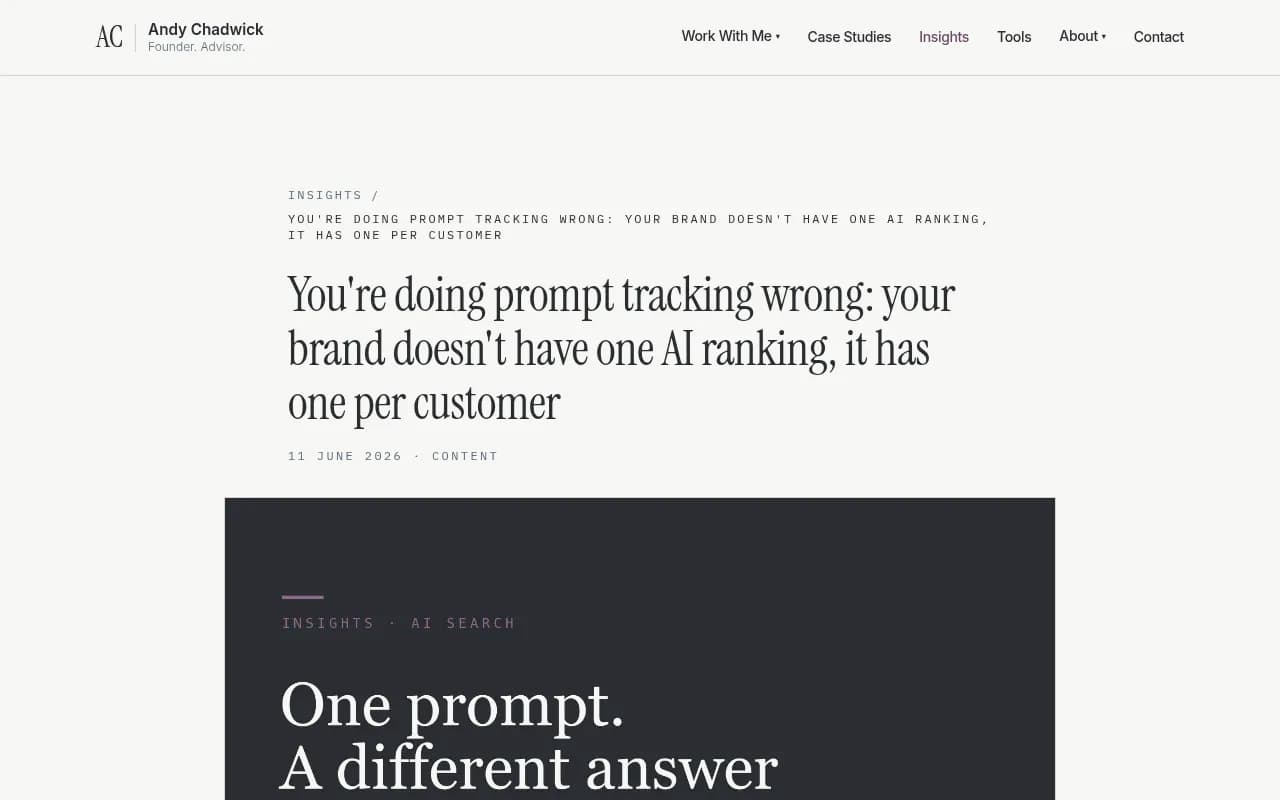
He points to a paper from Unusual.ai, Persona Conditioning of Brand Recommendations, which used 10 personas built from industry, company size, job role and location, and ran 8 buying questions against OpenAI and Anthropic models. Worth remembering that Unusual.ai is a vendor in this space, though the method is published.
The implication for trackers is direct. Some tools send the bare prompt with no context. Some add a persona sentence. Some use logged-in sessions with memory and custom instructions. Each of those is a different "user," and each gets a different answer. Your brand does not have one AI ranking. It has one per type of buyer.
When two tools disagree, check:
- Is the prompt sent bare or with a persona?
- Are personas fixed and documented, or implicit?
- Does the tool test your actual buyer types?
A tracker that lets you define personas and stack them against the same prompt set is giving you more truth than one that sends a context-free question nobody actually types.
Cause 3: model versions and silent rollouts
"ChatGPT" is not one model. It is a product that routes to different models, and OpenAI changes them. A tool tracking GPT-5-Mini behavior and one tracking a default flagship model are looking at different systems.
The effects can be large and fast. Promptwatch Data's citation drop report covers Feb 26 to Mar 11, 2026, counting only responses where web search was triggered. In the week before the GPT-5.3 rollout on March 4, ChatGPT cited about 6.4 sources per search-enabled response. By late March it had settled at roughly 4.7 to 4.9, about 27% fewer, with no recovery a month later. The change landed within a day.
That has two consequences for comparing trackers:
- A tool that switched models mid-month will show a break in its series that another tool won't.
- If your visibility dipped on a specific date, check model release dates before blaming your content. Also track citations per response, so you can tell "we lost visibility" from "ChatGPT cites fewer sources everywhere."
Promptwatch's own takeaway is that single-snapshot audits are unreliable and continuous monitoring is needed. I agree, and it is the quiet reason one-off free checkers rarely match a paid tracker.
Cause 4: query fan-outs and search behavior
When ChatGPT searches the web, it writes its own queries from your prompt. Those fan-out queries determine which pages get retrieved, and they drift.
Promptwatch's query fanout data shows fan-outs averaging 2.15 per response in early December 2025 and about 1.84 by early March 2026, then returning in April at 1.0 per response. Average query length fell from about 117 characters to roughly 53. Then, per Promptwatch's site: operator report, ChatGPT began using the site: operator at scale on August 8, 2026, going from about 0.4% to about 17% of fan-out queries overnight.
So even with the same prompt and same model name, the retrieval layer changes. A tool collecting from the real ChatGPT interface will see this. A tool calling an API without web search won't. Which brings us to the next cause.
Cause 5: UI scraping versus API calls
Trackers collect data in two ways. They either drive the actual ChatGPT interface, or they call the model through an API.
The answers can differ. The consumer product has its own system prompt, search integration, shopping modules and citation formatting. An API response may not browse at all. If one tool reports citations and another reports pure model recall, the numbers will not line up, and neither is wrong.
Promptwatch says it collects from the real user interfaces of ChatGPT, Gemini, Perplexity, Claude, AI Overviews and others. If you care about what real users see, that is the method to look for. Ask every vendor which one they use.
Cause 6: location, language and timing
A prompt asked from New York and one asked from Berlin can return different brands. Language matters too. So does time of day, since fan-outs hit live search. Two tools running from different regions or proxies will disagree even if everything else matches.
Local and multi-location businesses feel this most. If your tracker can't pin a location, it is averaging over a place nobody is actually in.
Cause 7: definitions of a mention and a rank
The last cause is boring and common. Tools define their metrics differently.
- Does a mention need the exact brand name, or do aliases and misspellings count?
- Is a competitor-comparison answer where you appear in a table counted the same as a first-place recommendation?
- Is "position" the order in the text, or the order in the source list?
- Is a citation a link to your domain, or a mention of your brand inside a cited third-party page?
Two tools can both be accurate by their own definition and still differ by double digits. Always read the metric definitions before comparing.
Quick diagnostic table
| Source of disagreement | What to ask the vendor | Typical effect |
|---|---|---|
| Sampling | Runs per prompt per day? Averaged or snapshot? | Large swings on small prompt sets |
| Personas | Bare prompt, or persona-conditioned? | Different brands recommended |
| Model version | Which model, and when did it last change? | Step changes in a series |
| Fan-outs | Real UI with live search, or API? | Different sources retrieved |
| Collection method | UI scraping or API? | Citations present or absent |
| Location | Country, city, or coordinates? | Local brands appear or vanish |
| Definitions | What counts as a mention or position? | Constant offset between tools |
Tools that handle this well, and what to look for
No tool can remove the randomness, but several handle it in the open. Here is a short, honest sorting based on what the tools say about themselves. Confirm current details on each vendor's site, since I did not compare pricing or features here.
Promptwatch tracks the real interfaces of ChatGPT, Google AI Overviews, Gemini, Perplexity and others, supports personas and country or city targeting, and shows query fan-outs, so you can see why a result changed. It also layers crawler logs and visitor analytics on top, which helps when you need to separate a visibility change from a traffic change.

Otterly.AI is a lower-cost option focused on tracking.

Peec AI is another monitoring-focused tracker.

Profound targets enterprise teams.

Ansvisor publishes a clear explanation of its rate-based approach, and is worth reading even if you pick something else.
Dageno AI offers a free plan, handy for a first snapshot.
For wider browsing, the GEO software directory at bestgeosoftware.com lists more options by category.
| Tool | Good for | Check before buying |
|---|---|---|
| Promptwatch | Real-UI tracking, personas, fan-outs, action workflow | Plan limits on prompts and responses |
| Otterly.AI | Affordable monitoring | Runs per prompt, persona support |
| Peec AI | Monitoring dashboards | Optimization features are limited |
| Profound | Enterprise reporting | Price and prompt caps |
| Ansvisor | Rate-based reporting, open approach | Coverage and team features |
| Dageno AI | Free starting point | Sampling depth on the free tier |
A practical way to reconcile two trackers
If you already have two sets of numbers, here is what I would do.
- Pick 10 prompts and run them by hand in ChatGPT at least ten times each, in fresh sessions. Note mention rate. This is your ground truth, rough as it is.
- Compare each tool to your manual rate, not to each other.
- Check the metric definitions side by side. Align aliases and what counts as a mention.
- Confirm both use the same location and language.
- Look at dates. Overlay model release dates on both series.
- Pick one tool as your system of record and keep its settings frozen.
Step 6 matters more than people think. The value of a tracker is trend, not the absolute number. If you change prompt wording, persona or location every month, you have broken your own baseline.
How to set up tracking so it holds up
- Track prompts in sets. Dozens beat one. Promptwatch's reasoning on 10-plus domains per answer makes this plain.
- Define your buyer personas and run the same prompts against each. Report them separately.
- Report rates with the number of runs behind them.
- Log model release dates next to your charts.
- Track citations per response alongside your own citations, so market-wide shifts don't read as personal failures.
- Segment by prompt type. Brand-specific prompts behave differently from organic ones. In Promptwatch Data, 21.3% of brand-specific prompts cited 10 or more domains versus 52.5% of organic ones.
When disagreement is actually useful
There is a flip side. MultipleChat makes the argument that disagreement between independently trained models is information: when ChatGPT, Claude, Gemini and Perplexity converge, confidence goes up, and when they diverge, you are in territory where no single answer should be trusted.
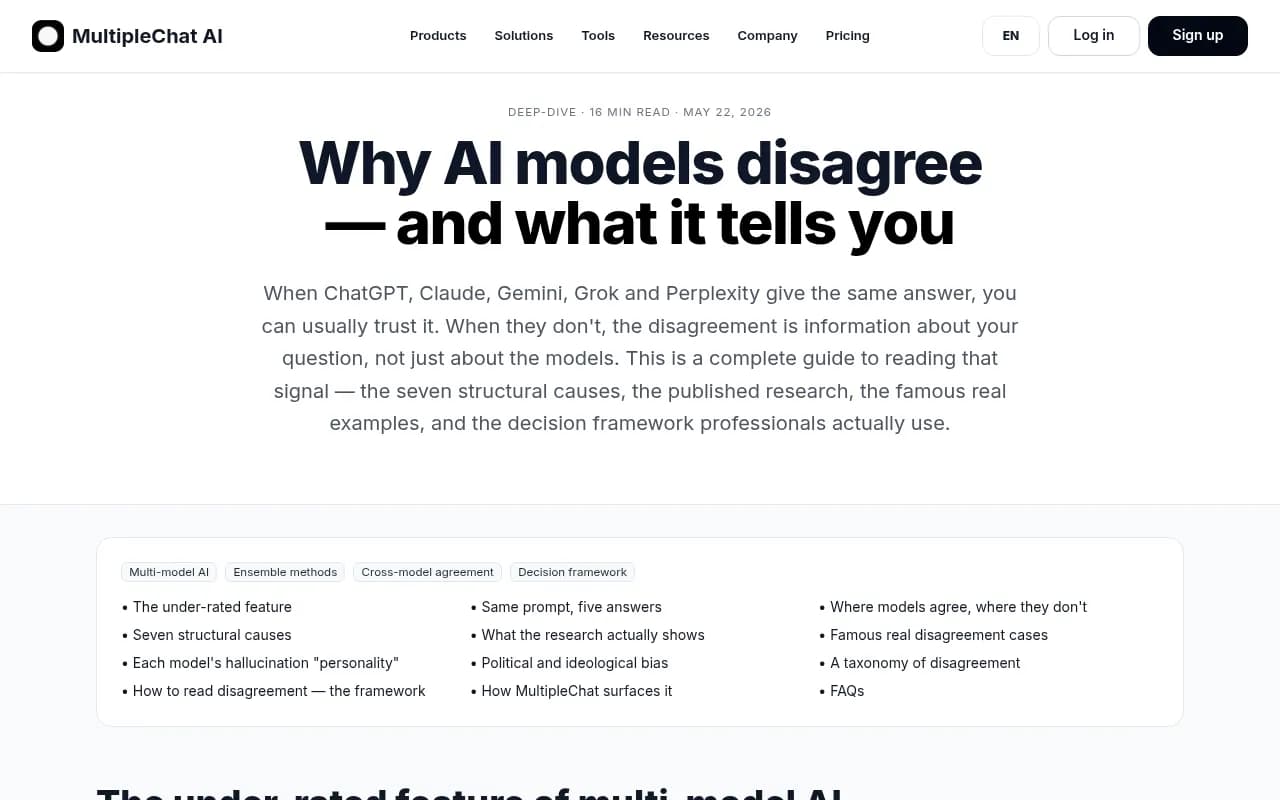
That is about model answers generally, not rank trackers specifically, but the logic transfers. If your brand shows up across ChatGPT, Perplexity and AI Overviews, it is robust. If you only appear in one tool's ChatGPT sample, treat it as fragile.
What I would do
I would stop asking which tracker is right. I would ask which one is transparent about runs per prompt, personas, model, location and definitions, and then I would stick with it for at least a quarter. Run manual spot checks to keep it honest. When a number moves, check the model release calendar first, then your content.
A monthly or weekly snapshot from a free checker is fine for curiosity. For anything you will report to a boss or a client, you need repeated sampling and a record of how the data was collected. For more on how citation behavior shifts, the Promptwatch Data hub tracks it with dated reports.