Key takeaways
- "White-label" covers four depths: your own domain, a branded client portal or read-only link, branded PDF/DOCX exports, or a connector/API you brand yourself. Vendors use the word for all of them.
- Some tools have no native white-labeling at all. Otterly's help center says the interface can't be re-branded and points agencies to its Looker Studio connector.
- Pricing model matters more than sticker price. Per-client workspace fees (Profound) and pooled plans (Promptwatch, Peec, Prefer) produce wildly different costs at 20 clients.
- Ask exactly what carries your brand: PDF, portal, domain, email sender, API. Get it in writing.
- Annotate platform-wide shifts in your reports. ChatGPT's drop in sources per response in March 2026 looked like client underperformance to anyone who didn't know about it.
Why this question keeps coming up
Clients now ask why ChatGPT recommends a competitor instead of where they rank on Google. Agencies want to answer that under their own name, with their own logo on the deliverable. Fair enough.
The problem is that vendor pages say "white-label reporting" and leave it there. One tool puts your logo on a PDF cover. Another hands your client a login page on your own domain. These are not the same product, and the difference shows up the first time a client sees a vendor's name in the corner of a dashboard.
A note on sources: most of the pricing and feature detail below comes from vendor pages and third-party comparison articles, many of them written by vendors who rank themselves first. Treat the figures as starting points and confirm on each vendor's pricing page before you quote anything to a client.
The four depths of white-label
The cleanest way to sort the market is by how much of the experience you actually own. This taxonomy comes from a comparison published by Prefer, which sells a competing product, so take its scoring with a grain of salt. The categories themselves hold up.
| Depth | What you brand | Typical examples | What to watch |
|---|---|---|---|
| 1. Whole platform on your domain | Domain, logo, email sender, dashboard | LLM Pulse (Partner plans), AgencyAnalytics for SEO, Trakkr (claimed) | Usually the most expensive tier; confirm domain and email setup |
| 2. Branded portal or read-only link | Client-facing dashboard or shared link | Promptwatch, Prefer, Rankability, Ceyo | Check whether the vendor name still appears anywhere |
| 3. Branded exports | PDF or DOCX reports | Geoptie, Ayzeo, Amadora, Peec AI (page says "white-label reporting" without detail) | Clients never log in; you are emailing files |
| 4. Connector or API you brand | Whatever you build | Otterly and Peec via Looker Studio, Scrunch via API | You build and maintain the template; budget the hours |
None of these is wrong. A five-client boutique may be perfectly happy with branded PDFs. A 40-client agency selling a monthly retainer probably wants a portal. The mistake is buying depth 3 while promising a client depth 1.
What each vendor actually lets you brand
Promptwatch
Promptwatch gives agencies a white-label dashboard and a client portal with branded, read-only access to each client's reporting. Agency plans (Kick-off at $199/mo, Growth at $399/mo, Scale at $799/mo) include unlimited projects, pitch projects, prompts, and team seats, so adding a client doesn't trigger a per-workspace fee. PDF reports can be exported and scheduled to any inbox with your own branding. SSO and a fully white-labeled client portal sit on Enterprise, so check which tier carries the portal you want. Pricing is on promptwatch.com/pricing. The agency page covers the workflow, and Monks, for example, uses the Answer Gap Report and Visibility Score to build content roadmaps for enterprise clients.
The difference from most reporting-only tools is what happens after the report. The platform also includes crawler logs, visitor analytics, and a Content Agent, so the monthly deck can show what you published and whether AI crawled and cited it. Agency plans don't include the Content Agent or Knowledge Base, though; agencies that need content generation go to Enterprise.

Peec AI
Peec's own agency guidance is to build one Looker Studio template and clone it per client. Clients open a read-only link with no Peec login. Seats are unlimited and pitch projects are free and unlimited. Third-party sources list agency plans at $245, $495, and $795 per month for 10k, 25k, and 65k credits, while another lists €205, €425, and €675. That gap likely comes from currency and annual versus monthly billing, so verify.
Credits matter here. One credit is roughly one prompt, per model, per day, so 50 prompts on 3 models daily is 4,500 credits for a single client. At 100 prompts per client, five clients already push you to the top tier.

Otterly.AI
This is the clearest example of "no native white-label." Otterly's help center says the interface can't be re-branded, and the Looker Studio connector (Standard, Premium, and Enterprise plans) is the recommended route. If a client login would expose the vendor's name, that's a dealbreaker for some agencies. Sources disagree on which tier holds agency workspaces, so confirm before buying.

Profound
Profound's agency model is per-workspace: Agency Growth is reported at $99/mo plus $399 per client workspace, which a third party calculated at roughly $2,094 for 5 clients, $4,089 for 10, and $8,079 for 20. Pitch workspaces expire after about 30 days. Client-facing branding isn't clearly documented publicly, and one comparison advises getting it in writing rather than inferring it from silence. Good advice for any vendor.

Ceyo
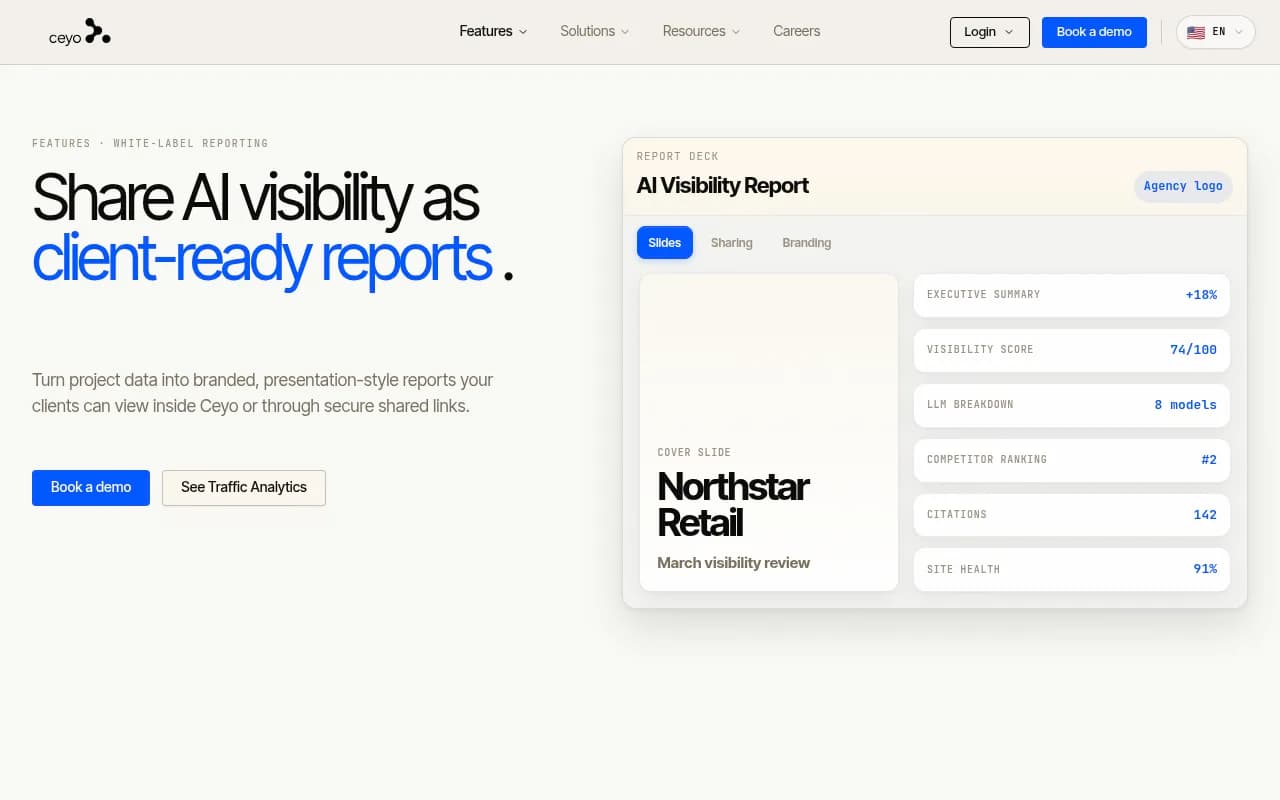
Ceyo builds presentation-style report decks: cover, executive summary, visibility score, an 8-model LLM breakdown, competitor ranking, citations, sentiment, prompts, and site health. Branding is modest but real: your workspace logo in the header and a chosen footer color when white-label is enabled.
Where it stands out is sharing governance. Reports go out through tokenized links or email invites that expire after 7, 14, or 30 days. A share-management view tracks active, expired, revoked, and viewed shares, and you can revoke access. If you've ever worried about a stale client link floating around, that's a real feature.
Ayzeo
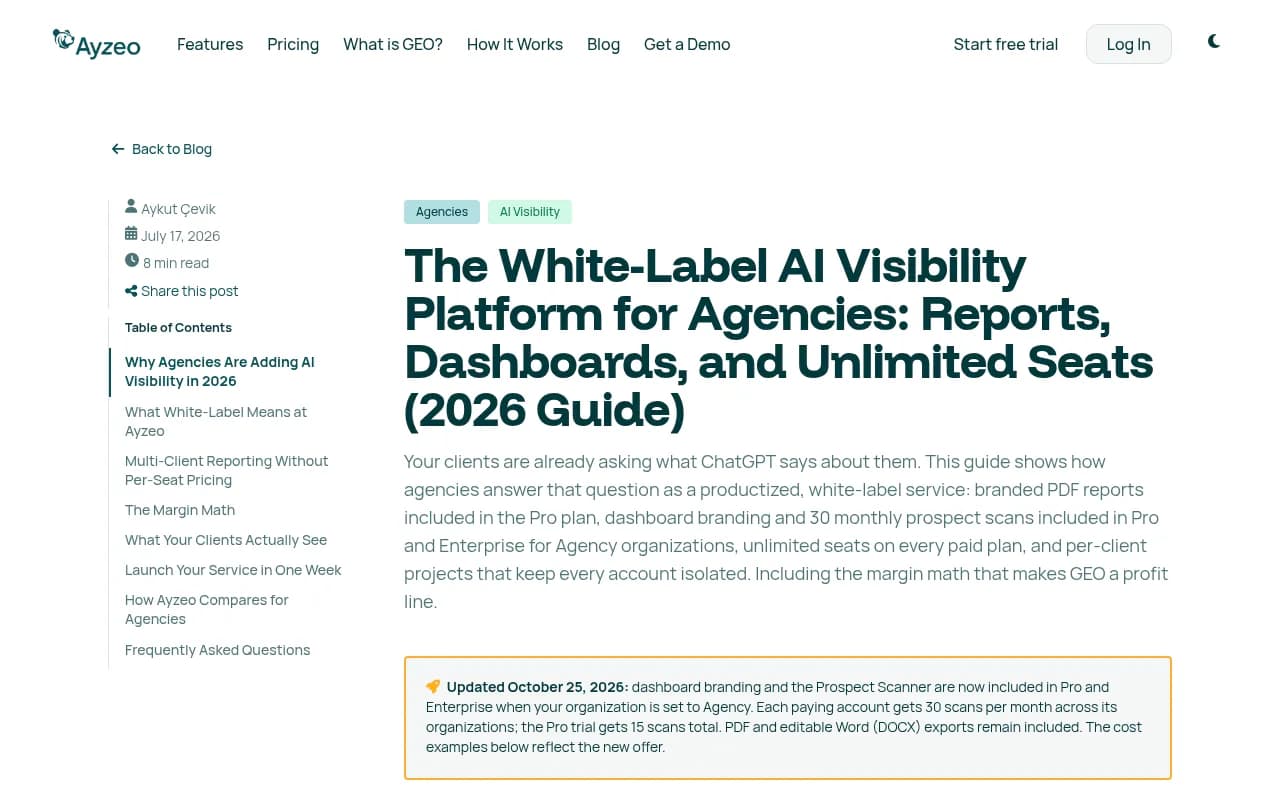
Ayzeo puts white-label PDF and editable Word (DOCX) reports in its Pro plan at $149/month. The DOCX export is the interesting bit: same sections, numbers, and charts, but with editable tables so you can reword the executive summary or drop a section before it reaches the client. Its October 25, 2026 update says dashboard branding and a Prospect Scanner are now included in Pro and Enterprise when your organization is set to Agency, with 30 scans per month. Scheduled delivery sends PDFs in emails attributed to your agency via Ayzeo.
Rank Prompt, Prefer, Amadora, and others
- Rank Prompt claims white-label at $149/mo, with 50 brands on Agency and 500 brands plus client logins and prospecting on Agency Plus. That's from its own ranking page, so it is self-published.
- Prefer is $199/mo for up to 10 clients, with 250 shared prompts across 5 engines and 10 white-label pitch audits a month. White-label is agency-plan only.
- Amadora has white-label branding on its Agency plan from $499/mo ($399 annual), with audits delivered as branded HTML and editable DOCX.
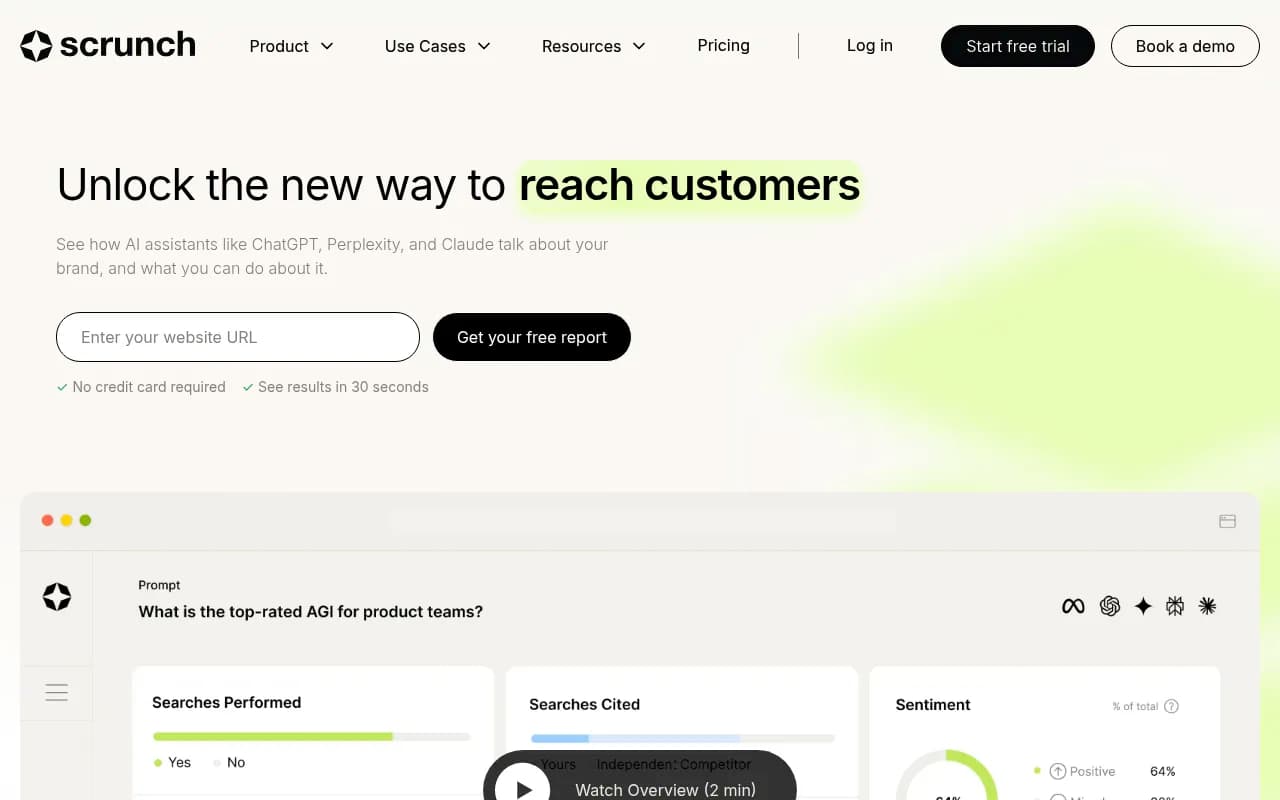
- Scrunch has an agency tier from $500/mo, with white-label outputs via API.
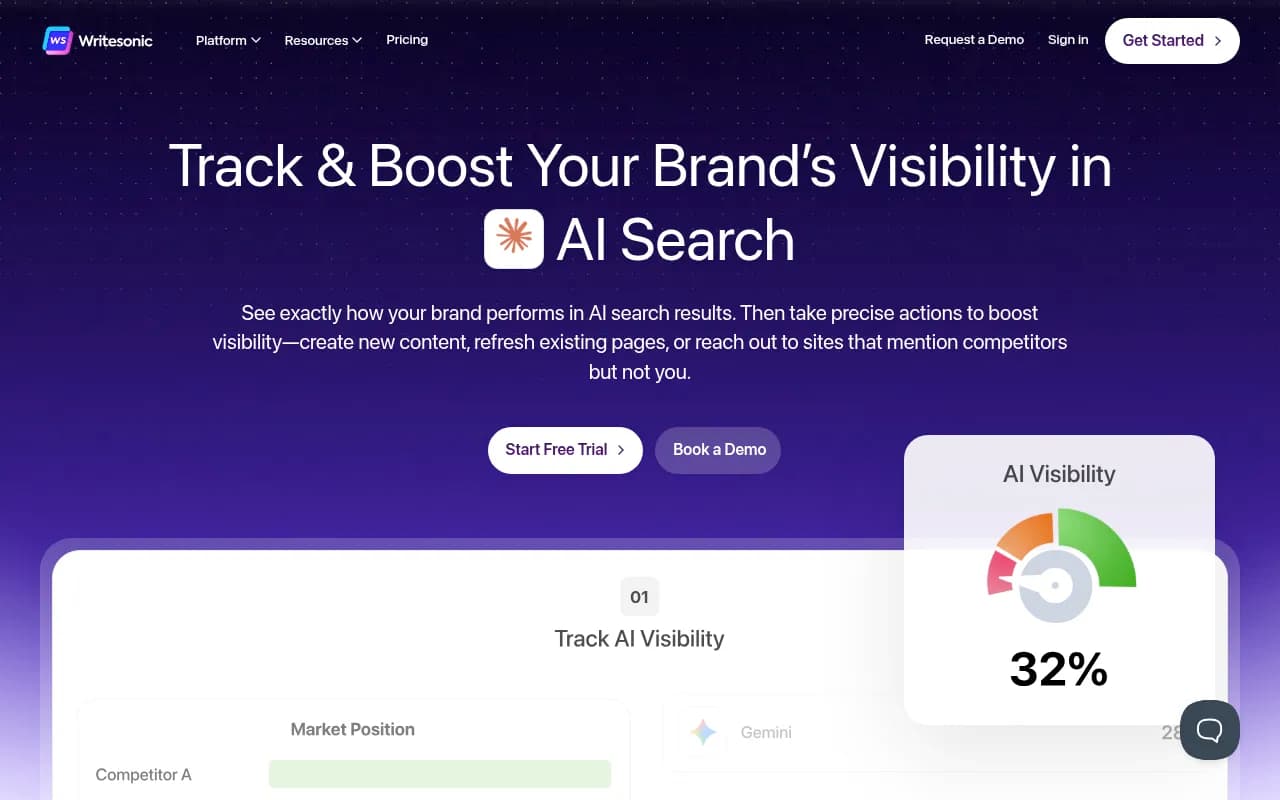
- Writesonic offers white-label reporting, multi-client management, a pitch workspace, and pre-built statements of work.
The SEO suites
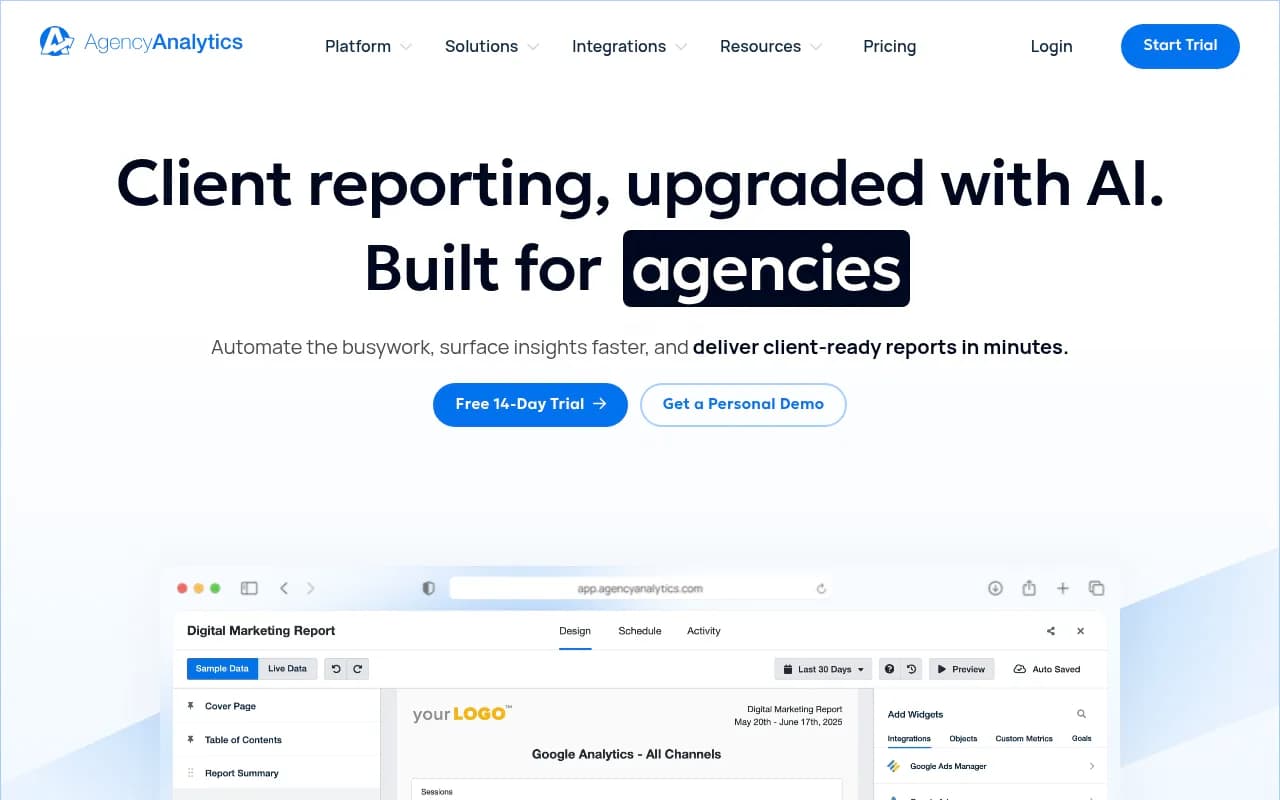
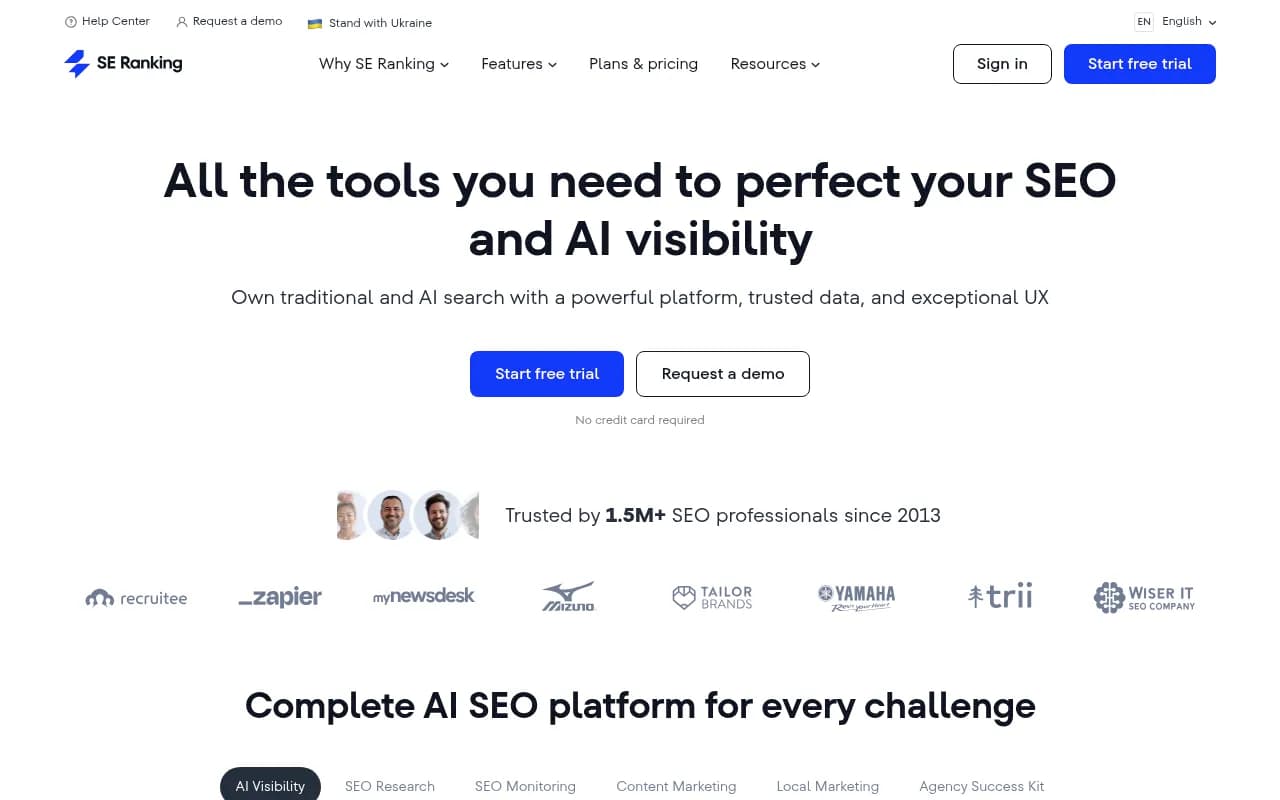
If your clients already live in an SEO reporting platform, adding AI tracking there may be the lowest-friction path. AgencyAnalytics offers per-client portal logo and accent color, a branded subdomain or a custom domain through a CNAME with automatic SSL, and your logo on the login screen, report cover, and header. SE Ranking's Agency Pack is +$69/mo on annual billing with 30 client seats, and its AI Search add-on is +$89/mo for 200 prompts. Semrush's AI toolkit starts around $99/mo per domain, which one comparison put near $1,485/mo at 15 clients.
The trade-off is depth. Suites tend to bolt AI tracking onto a broader product, so you get a white-label experience that's mature and an AI dataset that's thinner.
Pricing models: pooled versus per-client
Two models dominate, and they don't scale the same way.
| Model | How it charges | Example | Behavior at scale |
|---|---|---|---|
| Per-client workspace | Base fee plus a fee per client | Profound | Cost climbs linearly with every client |
| Pooled plan | One allowance shared across clients | Promptwatch, Peec, Otterly, Prefer, Geoptie | Cheap per client until you hit the prompt or credit ceiling |
At 20 clients, one third-party calculation put list prices anywhere from about $9 to about $404 per client per month depending on the model. Take that spread as directional, since the source sells a competing product.
Two cautions. First, pooled plans can run out. Do the math on prompts per client times models times days before you promise a client daily tracking. Second, several top-tier agency plans are custom-quoted, so published list prices at 10+ clients are a negotiation starting point, not a final number.
There's also a contrarian view worth sitting with. Brandlight argues the reporting layer is becoming a commodity, and clients can buy a tool directly for around $99. If that's right, the white-labeled report isn't your product. The service on top of it is: strategy, content, fixes. Agencies reselling AI visibility reportedly charge $500 to $1,500 per client per month (Ayzeo's figure), and that only holds if the retainer covers more than a logo on a PDF.
Questions to ask every vendor
I'd put these in an email before any demo. Vague answers are an answer.
- Exactly what carries my brand: PDF, DOCX, dashboard, portal, domain, email sender, or API output?
- Does any client-facing screen show your name or logo?
- Which plan tier holds multiple client workspaces? The cheap tier and the multi-client tier can be far apart.
- Are pitch or prospect audits white-labeled, and how many do I get? Prefer gives 10 a month, Ayzeo 30 scans a month, Peec's pitch projects are unlimited, Profound's last about 30 days.
- How do shared links expire, and can I revoke them? Ceyo is the clearest example of doing this well.
- If I use Looker Studio, who builds and maintains the template? Budget the time into the retainer.
- Does the tool report one brand at a time? One comparison estimates about an hour per account per month of manual cross-client rollups when it does.
- What do my overage options look like when a client adds prompts?
If you're still building your shortlist, the GEO software directory at bestgeosoftware.com is a decent place to browse the wider field.
Quick decision guide
| If you need... | Look at | Why |
|---|---|---|
| A portal clients log into, pooled pricing, and an action layer | Promptwatch, Prefer | Branded read-only portal and unlimited client projects on pooled plans |
| Editable branded deliverables | Ayzeo, Amadora | PDF plus DOCX you can rewrite before sending |
| Tight link governance | Ceyo | Expiring, revocable tokenized links |
| Your own domain for the whole experience | AgencyAnalytics, LLM Pulse | Subdomain or custom domain |
| Maximum flexibility and you can build | Peec, Otterly, Scrunch | Looker Studio or API |
| One bill for SEO and AI reporting | SE Ranking, Semrush | AI add-ons inside tools you already use |
Make your reports hard to misread
Branding isn't the only thing that makes a report client-ready. Context does, too.
Promptwatch Data tracked what happened when GPT-5.3 rolled out on March 4, 2026: average sources cited per search-enabled ChatGPT response fell from about 6.4 the week before to about 4.7 to 4.9 by late March, roughly 27% fewer, with no recovery a month later. The shift happened within a day. If your client's citation count dipped that week and your report said nothing, the client concluded you failed. If it carried a one-line annotation, the conversation went differently.
Two habits that follow from that:
- Check the date against model releases before explaining a dip. Tracking citations per response lets you separate "we lost visibility" from "ChatGPT cites fewer sources overall."
- Judge noisy platforms on monthly trends. Promptwatch's average sources per response page (dated September 2025, so treat the figures as possibly stale) showed Copilot swinging from under 2 to nearly 17 sources within weeks, while Perplexity stayed near 10 every day.
The broader point: single-snapshot audits are unreliable because citation behavior is platform-controlled and can change overnight. Continuous monitoring and annotated reports protect both you and the client. More platform research lives in the Promptwatch Data hub.
Where the agency itself fits
A branded report is the easy part. The harder part is the strategy behind it: technical fixes, content, digital PR, and a clear read on what moves AI citations. Agencies that don't want to build all of that in-house sometimes partner with specialists, such as 1001 SEO Media, which publishes this directory and runs technical SEO, content, and generative engine optimization for clients. Whether you build or partner, price the service layer separately from the tooling.
Bottom line
Pick the depth first, then the vendor. Decide whether your clients get a file, a link, a portal, or a whole domain, and make sure the pricing model survives your client count in 12 months. Then get the branding scope in writing, because "white-label" on a vendor page means whatever the vendor needs it to mean.