Key takeaways
- Meteoria.ai monitors brand visibility in ChatGPT, Perplexity, and Google AI Overviews -- a genuinely useful starting point for GEO
- Its core strength is daily prompt querying with tone and source analysis, which goes beyond simple mention tracking
- Six real limitations -- including limited model coverage, no content generation, weak traffic attribution, and no crawler logs -- push teams toward more complete platforms
- Teams that need to act on their data (not just read dashboards) consistently outgrow Meteoria quickly
- Several alternatives cover the full loop: find gaps, create content, track results
There's a version of Meteoria.ai's pitch that lands really well. The idea that brands are no longer just "found" in search -- they're quoted, described, interpreted by AI models -- is genuinely true and still underappreciated by most marketing teams. Meteoria spotted this shift early, and their framing around perception as a performance driver is sharp.
But a compelling vision and a complete platform are different things. After spending time with Meteoria and comparing it against the broader GEO tool landscape in 2026, a clear picture emerges: Meteoria does some things well, and then it stops. For teams just getting started with AI visibility monitoring, that might be fine. For teams trying to actually move the needle, the gaps add up fast.
Here's an honest breakdown.
What Meteoria.ai actually does
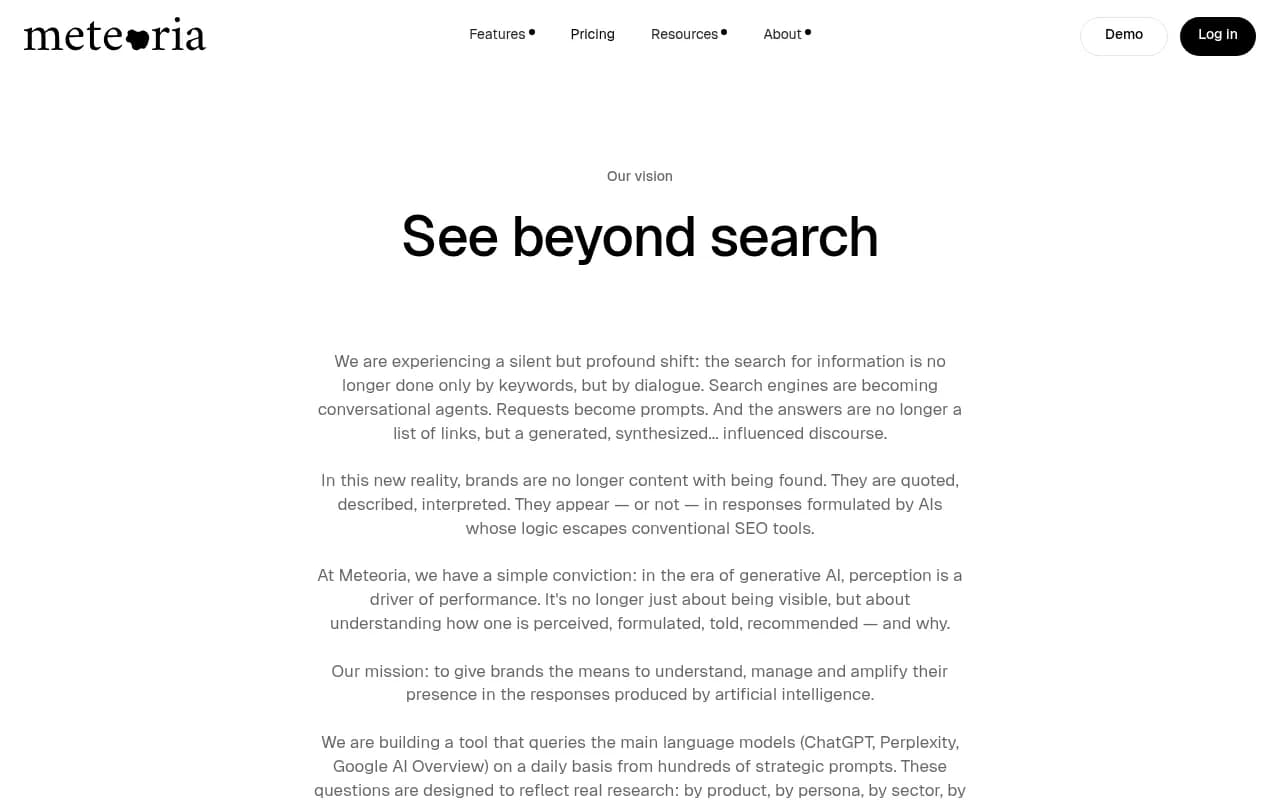
Meteoria queries the main language models -- ChatGPT, Perplexity, and Google AI Overviews -- on a daily basis using hundreds of strategic prompts. Those prompts are designed to reflect real user research: by product, by persona, by sector, by geography. The platform collects responses, analyzes whether your brand appears, where it appears, what tone the AI uses, what sources it cites, and how you compare to competitors.
That's a solid foundation. Daily querying beats weekly snapshots. Tone analysis is genuinely useful -- knowing that an AI describes your brand as "affordable but limited" versus "premium and reliable" is actionable information that pure mention-tracking misses entirely. And the competitor comparison angle means you're not just measuring yourself in isolation.
Meteoria also connects these signals to your content and traffic data, which is the right instinct. The goal is to understand why you appear or don't appear -- not just whether you do.
So far, so good. Here's where it gets complicated.
The 6 problems teams run into
1. Model coverage is too narrow
Meteoria monitors ChatGPT, Perplexity, and Google AI Overviews. That's three models. In 2026, AI search is happening across Claude, Gemini, Grok, DeepSeek, Meta AI, Copilot, Mistral, and Google AI Mode -- each with different citation behaviors, different training data, and different user bases.
A brand that's well-cited in Perplexity might be nearly invisible in Claude. A competitor might be dominating Gemini while you're focused on ChatGPT. If your monitoring only covers three models, you're working with an incomplete picture -- and potentially optimizing for the wrong signals.
For teams with serious AI visibility goals, three models isn't enough coverage to make confident decisions.
2. No content generation or optimization tools
This is the biggest gap. Meteoria identifies where you're missing -- which prompts your competitors appear for that you don't -- but then leaves you to figure out what to do about it. There's no built-in content generation, no AI writing agent, no brief creation, no optimization workflow.
That means your team takes the gap analysis, hands it to a writer or content strategist, and starts a separate workflow to actually produce content. That's not terrible, but it's a meaningful friction point. The most effective GEO platforms in 2026 close this loop internally: they show you the gap, then help you fill it with content engineered to get cited by AI models.
When the whole point of the platform is to improve your AI visibility, stopping at "here's what's missing" feels like handing someone a map with no roads.
3. Traffic attribution is limited
Knowing your brand appears in AI responses is one thing. Knowing that those appearances are driving actual visitors -- and converting them -- is another. Meteoria connects to traffic data in principle, but the attribution layer is thin compared to what teams actually need.
Proper AI traffic attribution requires either a code snippet on your site, a Google Search Console integration, or server log analysis. Without that infrastructure, you're left guessing whether your improved visibility scores are translating into business outcomes. For any team that needs to justify GEO investment to leadership, "we appear more in Perplexity" isn't a complete answer.
4. No AI crawler logs
This one matters more than most teams realize. AI crawler logs show you which pages ChatGPT, Claude, Perplexity, and other models are actually reading, how often they return, and what errors they encounter. This is how you understand whether AI engines can even discover your content in the first place -- before worrying about whether they cite it.
Meteoria doesn't offer this. So if your content isn't being cited, you have no way to know whether that's because the content isn't good enough, or because the AI crawler never found the page at all. Those are very different problems with very different solutions.
5. Prompt intelligence is shallow
Not all prompts are equal. Some are high-volume and competitive; others are niche but highly winnable. Some branch into dozens of sub-queries; others are narrow and specific. Understanding which prompts to prioritize -- based on volume estimates, difficulty scores, and query fan-out patterns -- is what separates strategic GEO from random content production.
Meteoria runs hundreds of prompts, but the intelligence layer around those prompts (what's the volume? how hard is it to win? what sub-queries does it generate?) is limited. Teams end up guessing which gaps to fill first, which wastes content budget on low-value prompts.
6. No Reddit, YouTube, or shopping tracking
AI models don't just cite brand websites. They cite Reddit threads, YouTube videos, third-party reviews, and forum discussions. Understanding which of these sources are influencing AI recommendations -- and whether your brand appears in those sources -- is increasingly important for a complete GEO strategy.
Meteoria focuses on direct brand mentions in AI responses but doesn't surface the Reddit discussions or YouTube content that might be shaping those responses upstream. Similarly, there's no tracking for ChatGPT's product recommendations or shopping carousels, which are becoming a significant channel for e-commerce brands.
Who Meteoria works for (and who it doesn't)
To be fair: Meteoria is a reasonable starting point for teams that are just beginning to take AI visibility seriously. If you've never tracked how AI models describe your brand, daily monitoring across three models with tone analysis is a meaningful step up from nothing.
It's also worth noting that Meteoria's framing -- "perception is a driver of performance" -- is philosophically sound. The platform understands what it's trying to solve, even if the current feature set doesn't fully solve it.
Where it falls short is for teams that need to move beyond awareness into action. If you're running a marketing team that needs to demonstrate ROI, produce content that actually improves AI citations, and understand the full picture across 10+ models, Meteoria's current scope creates real bottlenecks.
What to look for in an alternative
Before jumping to specific tools, it's worth being clear about what a more complete platform looks like. The best GEO platforms in 2026 do three things in sequence:
- Find the gaps -- which prompts are competitors winning that you're not?
- Help you create content that fills those gaps -- not generic SEO filler, but content engineered to get cited
- Track whether your visibility actually improves -- with attribution back to traffic and revenue
Most monitoring-only tools (and Meteoria falls into this category) do step one reasonably well and then stop. The platforms worth switching to are the ones that complete the loop.
The alternatives worth considering
Here's how the main alternatives compare across the dimensions where Meteoria has gaps:
| Platform | Models tracked | Content generation | Crawler logs | Traffic attribution | Reddit/YouTube tracking | Prompt intelligence |
|---|---|---|---|---|---|---|
| Meteoria.ai | 3 | No | No | Limited | No | Basic |
| Promptwatch | 10+ | Yes (AI writing agent) | Yes | Yes (3 methods) | Yes | Yes (volume + difficulty) |
| Profound | 8+ | No | No | Limited | No | Moderate |
| Otterly.AI | 5 | No | No | No | No | Basic |
| Peec AI | 4 | No | No | No | No | Basic |
| Scrunch AI | 6+ | No | No | Limited | No | Moderate |
| Athena HQ | 8 | No | No | No | No | Moderate |
Promptwatch -- the most complete option
Promptwatch is the platform that most directly addresses all six of Meteoria's gaps. It monitors 10+ AI models (ChatGPT, Claude, Perplexity, Gemini, Grok, DeepSeek, Meta AI, Copilot, Mistral, Google AI Overviews, and Google AI Mode), which means you're not making decisions based on three models when ten matter.
The content generation piece is where Promptwatch genuinely separates itself. Its built-in AI writing agent generates articles, listicles, and comparisons grounded in real citation data -- 880M+ citations analyzed -- rather than generic SEO logic. The idea is that you see a gap, you generate content designed to fill it, and you track whether your visibility improves. That's the full loop, not just step one.
Crawler logs are included on the Professional plan and above, which means you can see exactly which pages AI models are reading and fix indexing issues before they become visibility problems. Traffic attribution works through a code snippet, GSC integration, or server log analysis. Reddit and YouTube tracking surfaces the discussions that are actually shaping AI recommendations. And prompt intelligence includes volume estimates, difficulty scores, and query fan-outs.

Pricing starts at $99/month for the Essential plan (1 site, 50 prompts, 5 articles), $249/month for Professional (2 sites, 150 prompts, 15 articles, crawler logs), and $579/month for Business (5 sites, 350 prompts, 30 articles). There's a free trial available.
Profound -- strong enterprise option
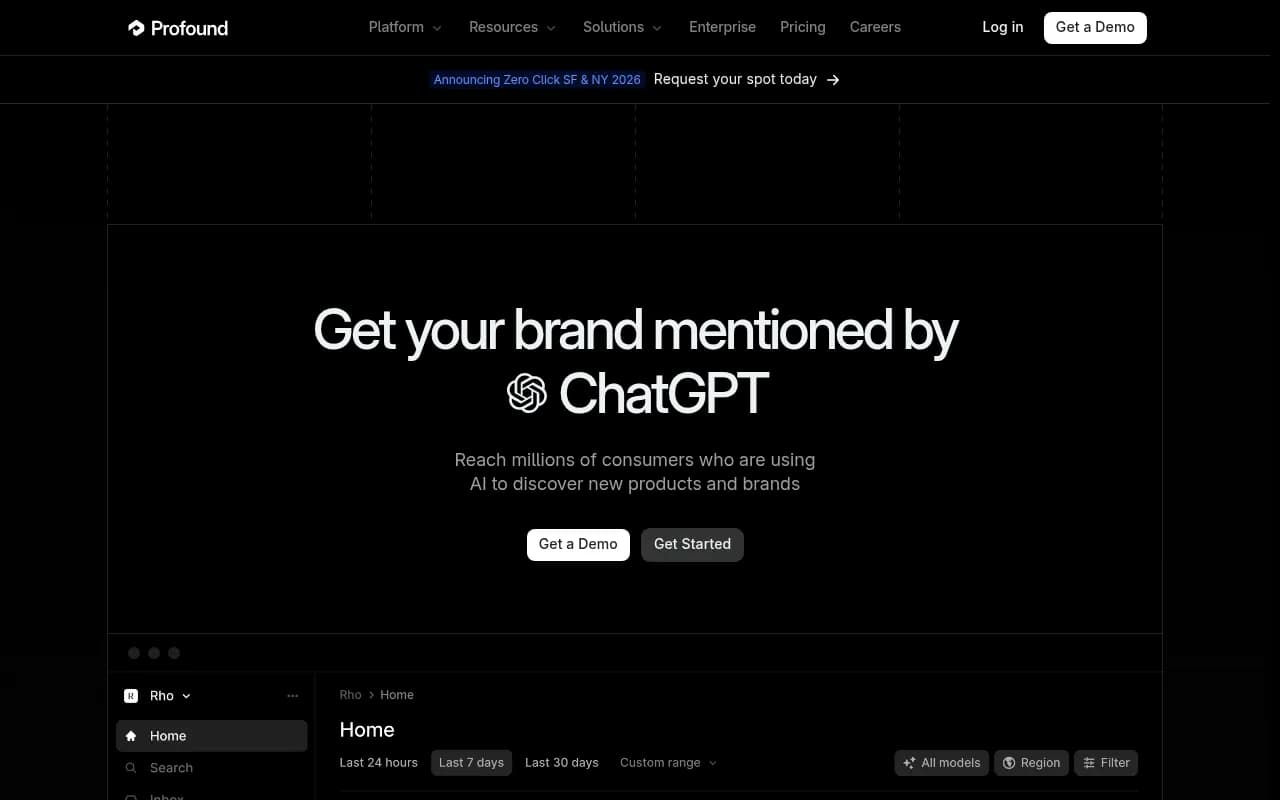
Profound has a solid feature set and monitors more models than Meteoria. It's a reasonable choice for enterprise teams that need depth of data and have separate content workflows. The main trade-off is price -- Profound sits at a higher price point -- and it doesn't have content generation or Reddit tracking, so you're still handling the "fix it" part externally.
Otterly.AI -- budget monitoring

Otterly.AI is affordable and easy to get started with. If your only goal is basic mention tracking across a handful of models, it works. But it's firmly monitoring-only -- no content generation, no crawler logs, no attribution -- so the same gaps that exist in Meteoria exist here too, just at a lower price point.
Peec AI -- simple and limited

Peec AI covers the basics of AI search monitoring without much depth. It's fine for teams that want a lightweight dashboard and aren't ready to invest in a full GEO platform. Like Otterly, it stops at monitoring.
Scrunch AI -- mid-range monitoring
Scrunch covers more models than Meteoria and has a cleaner interface for competitive comparison. It's a step up in coverage but still doesn't offer content generation or crawler logs. Worth considering if model coverage is your primary concern and you have a separate content team.
Athena HQ -- monitoring with some depth

AthenaHQ monitors across 8+ AI models and has reasonable prompt analytics. It's monitoring-focused, which means the same "find gaps but not fill them" limitation applies. Good for teams that want broader model coverage than Meteoria without committing to a full optimization platform.
Making the switch: what to check first
If you're evaluating whether to move away from Meteoria, a few practical questions help clarify the decision:
- Are you actually producing content based on your gap analysis, or is the data sitting in a dashboard? If it's sitting there, the problem isn't the tool -- it's the workflow. A platform with built-in content generation forces the loop to close.
- Do you need to report AI visibility ROI to leadership? If yes, you need proper traffic attribution, not just visibility scores.
- Are you operating in multiple languages or regions? Meteoria's multi-region support is limited compared to platforms built for international teams.
- How many AI models matter for your audience? If your customers use Claude and Gemini as much as ChatGPT, three-model coverage is a real blind spot.
The honest answer for most teams that have outgrown Meteoria is that they need a platform that treats GEO as an optimization discipline, not a reporting exercise. Monitoring what's happening is the starting point. Changing what's happening is the goal.
Meteoria understands the problem clearly. The platform just doesn't yet have the tools to fully solve it.