Key takeaways
- Several free tools give you a snapshot of how AI describes your brand: Ahrefs' AI Visibility Checker, HubSpot's AI Search Grader, and a handful of smaller graders and audits.
- Free checkers are single snapshots. AI answers vary by prompt type and by how many sources get cited, so one result tells you little.
- A manual test across branded, comparison and category prompts is free and often more revealing than any grader.
- Check what the AI says (accuracy, tone) as well as whether it mentions you at all.
- When you need trends, competitors and fixes, move to a continuous platform. Until then, free is fine.
What "AI perception" actually means
Two questions get mashed together here. The first: does AI mention my brand at all? The second: when it does, what does it say, and is it right?
Most free tools lean on the first. The second is where the damage usually hides. An AI that calls your product "expensive for small teams" or lists a feature you dropped two years ago is shaping buyer opinion before anyone visits your site.
A useful perception check covers four things:
- Visibility: are you named in answers to category questions?
- Representation: does the description match how you position yourself?
- Accuracy: are pricing, features and audience correct?
- Sources: which pages and review sites does the AI lean on?
Keep those four in mind as you go through the options below.
Free tool 1: Ahrefs AI Visibility Checker
Ahrefs offers a free AI Visibility Checker that shows how your brand appears in ChatGPT, Gemini, Perplexity, Copilot and Google AI Overviews. No signup is required and results come back in seconds. It is powered by Ahrefs Brand Radar, and the YouTube, TikTok and Reddit coverage is described as free while in beta. There are also separate AI Mode and AI Overviews trackers on the same site.
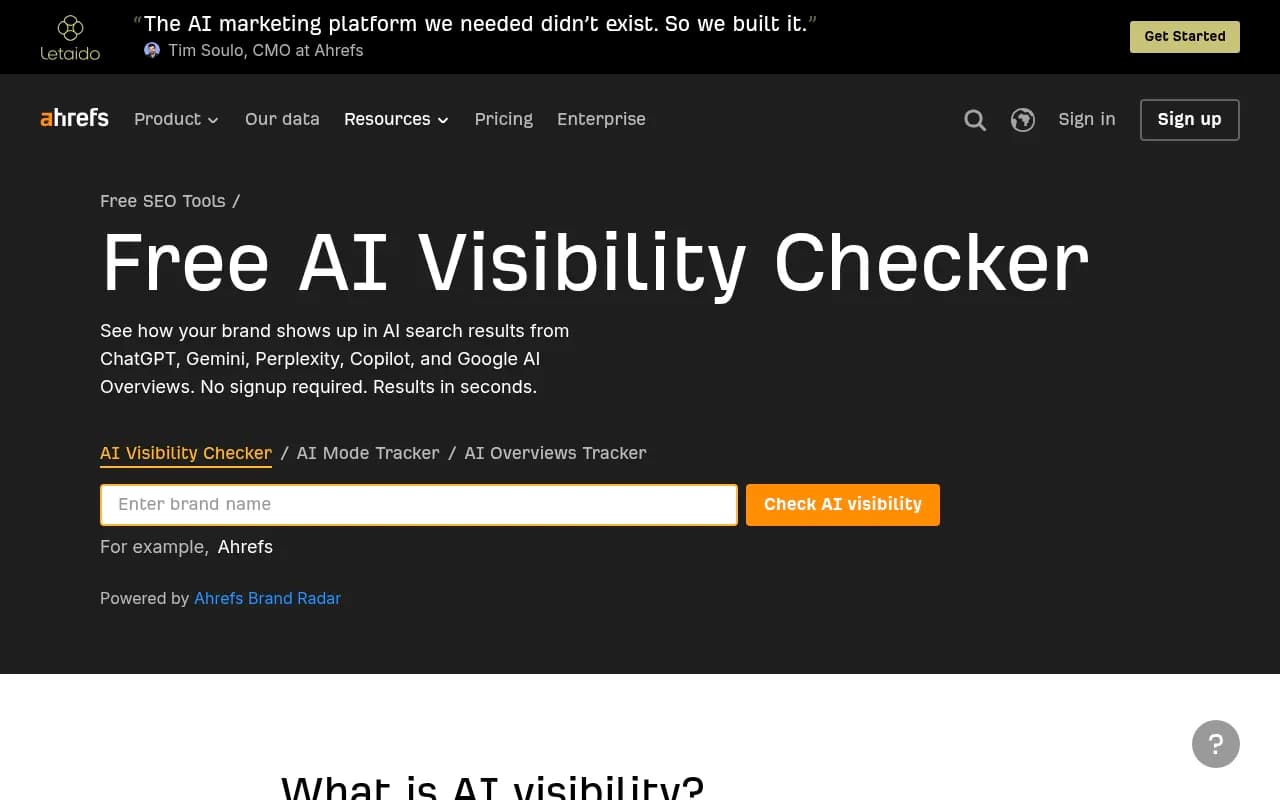
A small tip from their page: type your brand the way your audience says it, so "Ahrefs" and not "Ahrefs Pte Ltd." Same applies to yours.
It is a fast way to see whether you register at all. I would treat it as a first pass, not a verdict.
Free tool 2: HubSpot AI Search Grader
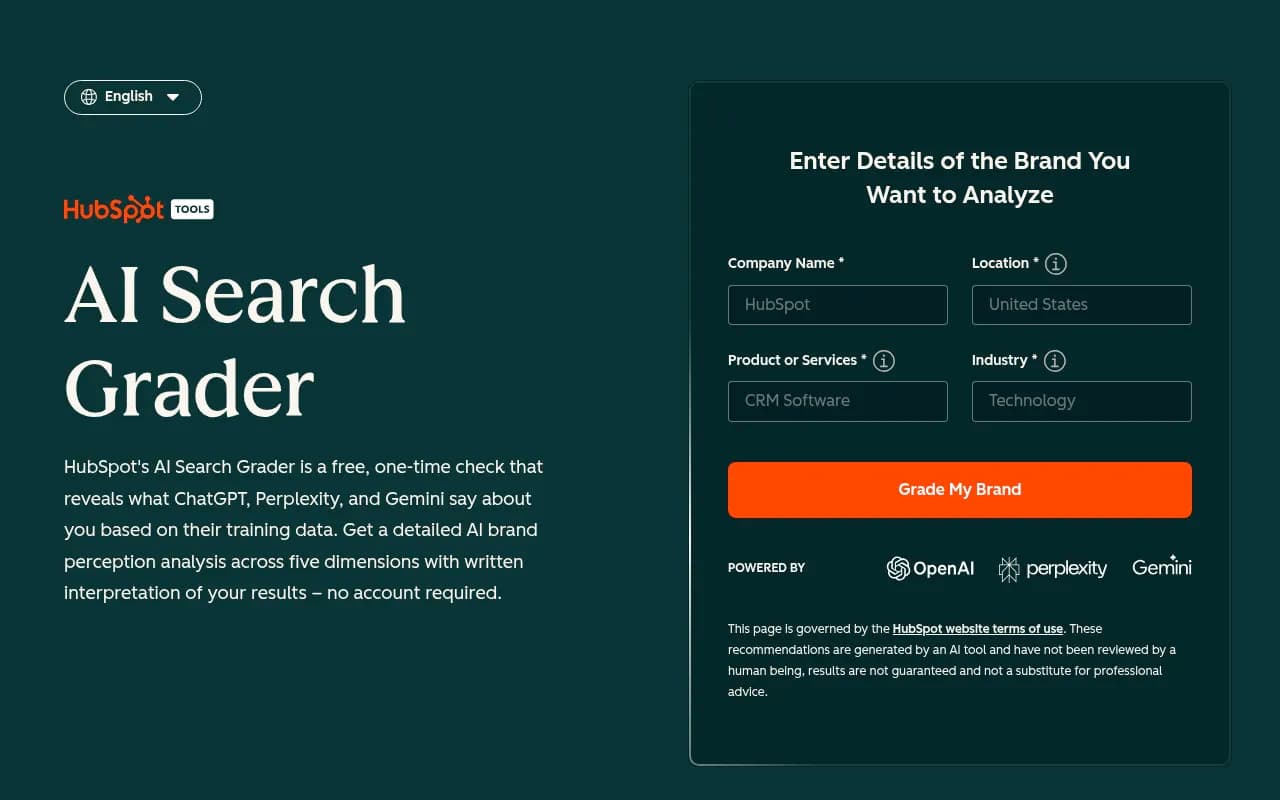
HubSpot's AI Search Grader is a free, one-time check of what ChatGPT, Perplexity and Gemini say about you based on their training data. It asks for company name, location, product or service, and industry, then returns an analysis across five dimensions with written interpretation. No account needed.
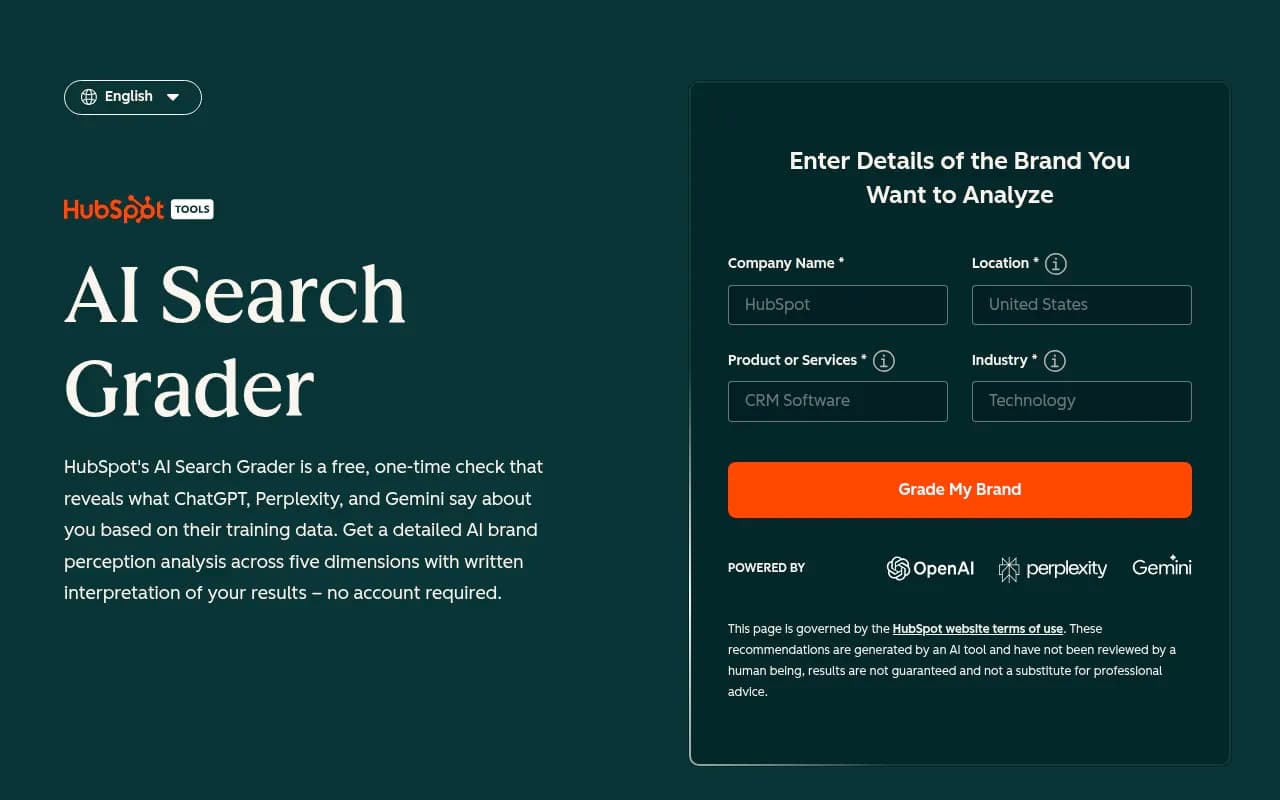
This one is closer to a perception check than a pure mention counter, because it frames the result as how the engines represent you. The catch is in the name: one-time. Continuous tracking is a separate product, HubSpot AEO. HubSpot also notes the output is AI-generated and not human reviewed, so read it with a skeptical eye.
Free tool 3: Semrush's free AI visibility checker
Semrush has a free AI search visibility checker. I could only confirm the landing page, which routes into a Semrush One trial, so check the limits yourself before relying on it. Worth a look if you already use Semrush.
Other free graders and audits worth trying
Our catalog lists several other free or free-entry options. I have not tested each one deeply, so treat these as a shortlist to try rather than endorsements.
| Tool | What it offers | Good for |
|---|---|---|
| Amplitude AI Visibility | Free AI visibility analysis | Quick snapshot |
| AEO.express | Answer engine optimization snapshot | Fast readiness check |
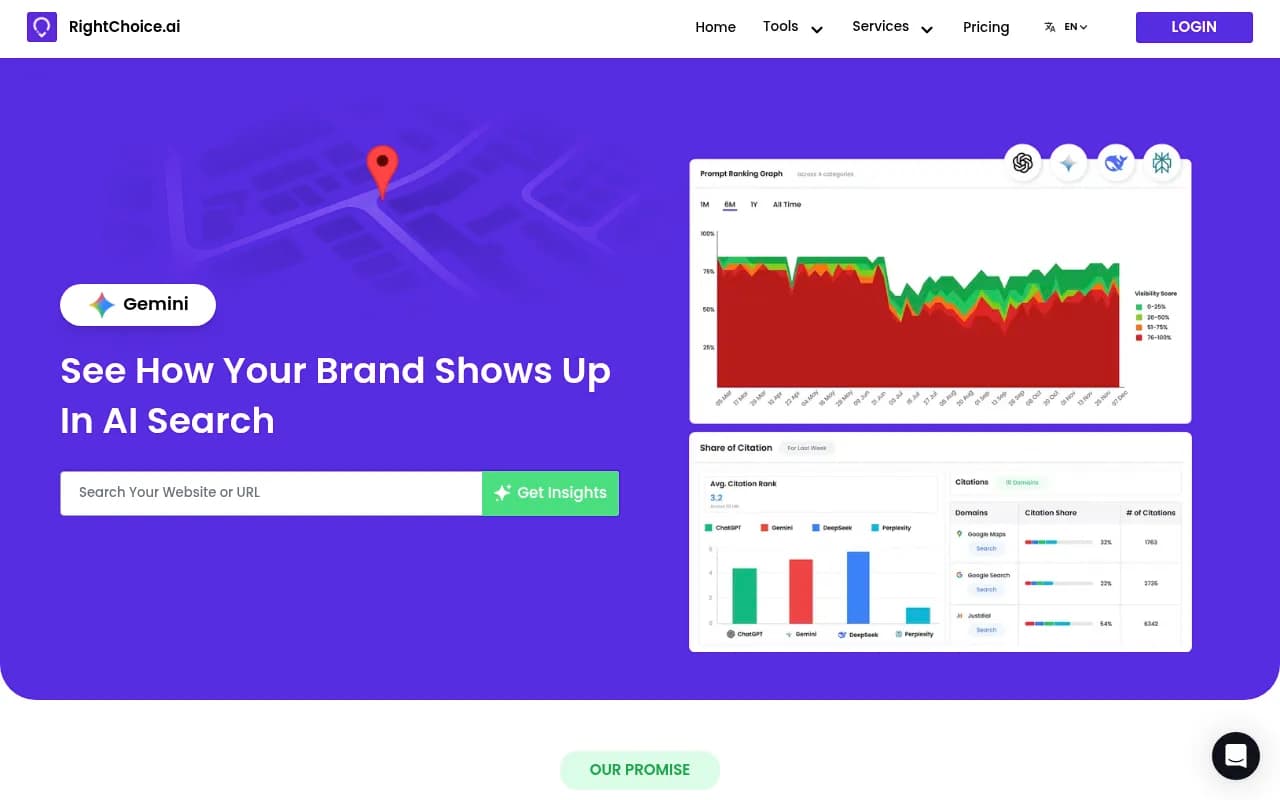
| RightChoice.Ai | Free brand AI visibility and citation checker | Citation spot checks |
| AnswerGist | Free AI visibility audit with prioritized fixes | Getting a to-do list |
| Prismic Free GEO Audit | Free one-off audit of AI answer presence | One-time audit |
| Geotoolbox | Free GEO graders and AI reachability checks | Technical access checks |
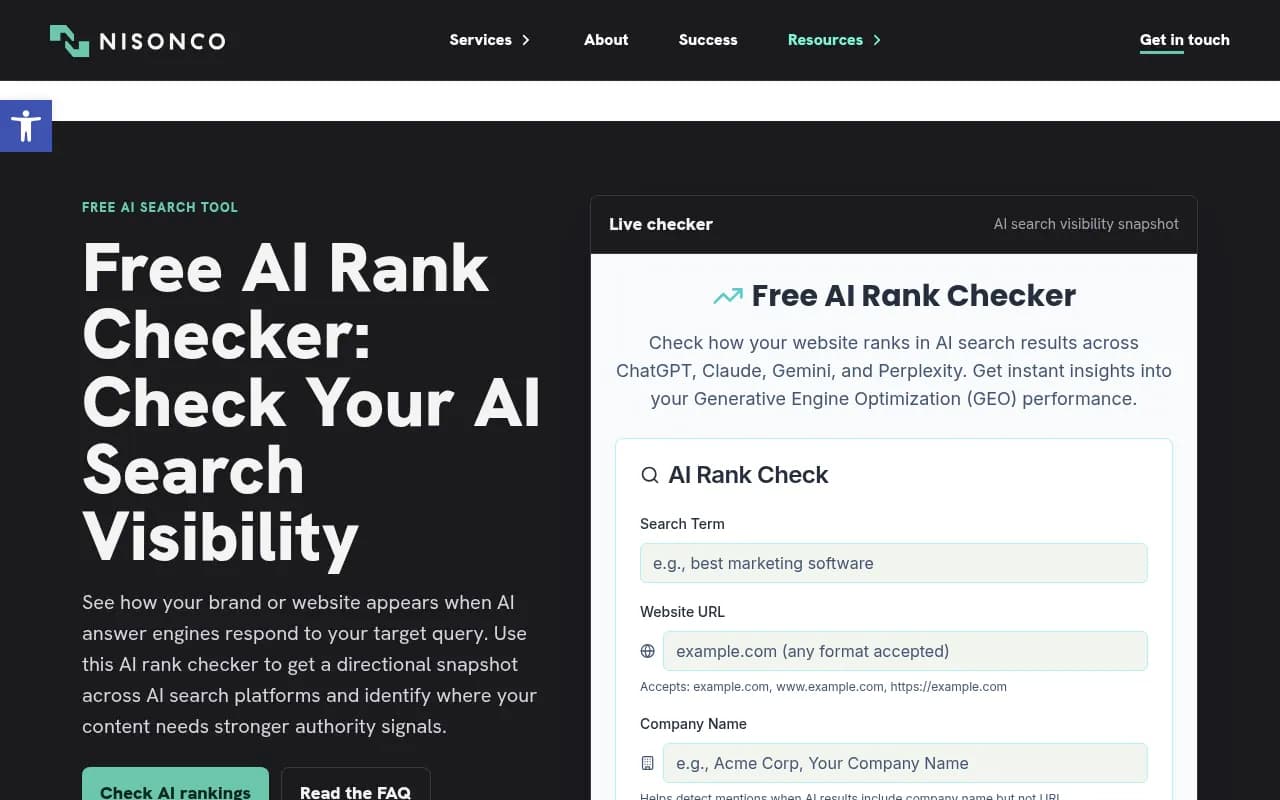
| NisonCo AI Rank Checker | Free AI rank checker from an SEO/PR agency | Rank-style view |


Running three or four of these and comparing the results is a legitimate method. When they disagree, that disagreement is itself information: your visibility is unstable.
The free method that beats most graders: manual prompt testing
You do not need a tool to see what AI says about you. You need a spreadsheet and about an hour.
Step 1: Build a prompt set
Write 15 to 25 prompts in three groups:
- Branded: "Is [brand] good for startups?", "What does [brand] cost?", "[Brand] reviews"
- Comparison: "[Brand] vs [competitor]", "[Competitor] alternatives"
- Category: "Best [product category] for [audience]", with no brand named
The split matters. Promptwatch's data on unique domains per ChatGPT response (Sep 28 to Oct 4, 2026) found that 52.5% of organic prompts cite 10 or more domains, while only 21.3% of brand-specific prompts do. Branded answers lean on a smaller set of sources, so they are easier to influence and worth checking separately.
Step 2: Run them in each engine
Use a fresh session in ChatGPT, Gemini, Perplexity and Google (for AI Overviews). Logged-in history and location skew results, so use a private window where you can.
Perplexity
Step 3: Score what you see
For each answer record four things: were you mentioned, where in the answer, what claims were made, and which sources were cited. A simple table works:
| Prompt | Engine | Mentioned? | Position | Claims made | Accurate? | Sources cited |
|---|---|---|---|---|---|---|
| Best CRM for startups | ChatGPT | Yes | 4th | "Good value" | Yes | G2, listicle |
| Brand pricing | Perplexity | Yes | n/a | Old price | No | Old blog post |
Step 4: Repeat a few times
AI answers are not stable. Run each prompt two or three times and note how often you appear. One answer is an anecdote. Ten is a pattern.
What to look at in the answers
Sources tell you how you are being described
On branded prompts, content type shifts. Promptwatch's content type data (Sep 28 to Oct 4, 2026) shows product pages at 23.3% and landing pages at 22.8% of ChatGPT citations on branded prompts, but reviews jump to 5.6%, more than three times their share across all prompts. So when someone asks ChatGPT about you by name, your own pages and the review sites carry most of the weight.
That gives you a practical checklist. Do your homepage, product pages and docs answer questions about pricing, features and who the product is for? Are your reviews on trusted sites current? Is there a plain-language FAQ?
Engines differ a lot
Do not assume one engine speaks for all. In Promptwatch's social citation data (Oct 11 to Nov 9, 2026), social platforms were 13.16% of Google AI Overviews citations, against 0.64% for ChatGPT and 1.94% for Perplexity. YouTube alone was 6.71% of AI Overviews citations. If your reputation lives on YouTube, that matters for Google and barely at all for ChatGPT. Note the October report covered 7 days and the November report 30, so the comparison is not like-for-like.
Reddit is a good example of volatility. Promptwatch's Reddit data shows reddit.com's share of ChatGPT citations falling from about 4% to 0.5% on August 14, 2026. Any perception check you ran in July is stale.
Check claims, not just mentions
Being mentioned with the wrong price is worse than not being mentioned. For every answer, ask whether you would be happy if a buyer read it. Flag wrong claims, then trace which page the AI probably learned it from. Often it is an outdated blog post or a third-party comparison.
Free checkers vs manual testing vs a platform
| Approach | Cost | Strength | Weakness |
|---|---|---|---|
| Ahrefs AI Visibility Checker | Free, no signup | Fast, multi-engine | Snapshot only |
| HubSpot AI Search Grader | Free, no account | Perception framing, written read-out | One-time, training-data based |
| Other free graders | Free | Different angles, cross-checking | Mixed depth, limited history |
| Manual prompt testing | Your time | Full control, shows claims and sources | Tedious, hard to repeat |
| Continuous platform | Paid | Trends, competitors, actions | Cost |
Free signals you can pull from your own data
Some perception evidence is already in tools you own.
- Google Search Console shows the queries and pages that earn impressions, which are good seeds for your prompt set.
- Alerts and listening tools catch mentions of your name across the web. Brand24 and Meltwater are paid, but Alertmouse is positioned as smarter Google Alerts.
- Your server logs show whether AI crawlers can reach your pages at all. If they cannot, no amount of content work matters.

Promptwatch also offers a free AI visibility report with no login, plus an Agentic Readiness Check that tests which AI crawlers can read your site.
Where free stops working
I would say free checks are enough for roughly the first month. After that, three limits show up.
- No trend line. You cannot tell if a change you made worked.
- No competitor context. Visibility is relative, and a one-off score says nothing about share.
- No path to a fix. Knowing you are invisible is step one. Finding out why and doing something about it is the work.
If you reach that point, a continuous platform is the next step. Promptwatch monitors the real interfaces of ChatGPT, Gemini, Perplexity, Claude and Google AI Overviews, and its Brand Narrative feature pulls out the individual claims AI makes about you, which is the accuracy question this guide keeps returning to. It then connects to content gaps and publishing. There is a 7-day free trial on monthly billing, and you can confirm current plans at promptwatch.com/pricing.

Other options worth a look in the catalog include Otterly.AI, Peec AI and Profound. For a broader list, the GEO software directory at bestgeosoftware.com is a good place to compare.



One caution on research. Plenty of "top tools" lists, including those from Ranktracker, TrustSignals and SitePoint, are written by vendors. Read their rankings as marketing and test tools yourself.

A simple 60-minute plan
- Run Ahrefs and HubSpot checks (10 minutes). Note the headline results.
- Build your 20-prompt list (15 minutes).
- Run the prompts across ChatGPT, Gemini, Perplexity and Google (25 minutes).
- Log wrong claims and cited sources (10 minutes).
- Repeat in 30 days and compare.
Then fix what you found. Update the pages the AI is quoting wrongly, publish a clear FAQ, and get fresh reviews onto the sites that show up in citations.
Final thoughts
Free tools tell you whether AI knows you exist. Manual testing tells you what it says about you and why. Do both, repeat monthly, and keep the spreadsheet. When the spreadsheet gets too big to maintain by hand, that is your signal to move to a platform.