Geotoolbox Review 2026
GEO toolkit with free graders and checks for whether AI systems can reach your pages, suited to marketers who want to start without paying.
Key takeaways
- GEO Toolbox is a 14-tool workflow for tracking where ChatGPT, Gemini, Perplexity, Claude, AI Overviews, AI Mode, Bing Copilot and Grok cite your brand, then fixing the gaps.
- Compared with Promptwatch, it lacks IP-verified AI crawler logs, Reddit/YouTube/LinkedIn citation reports, AI Shopping and Ads Radar, prompt volume and difficulty scoring, and a Content Agent that publishes straight to a CMS.
- The free tools (AI Crawler Checker, Agent Readiness Scanner, Keyword to AI Prompts) are the best entry point and need no signup.
- Credits are the catch. Claude costs 20 per check and Grok 31, so "8 engines" is limited by your budget. Scans are weekly on every plan.
- Best for solo SEOs and small agencies who want a lower-cost tracker with an audit layer. Less suited to enterprises that need volume data, daily scans or an API.
GEO Toolbox (geotoolbox.ai) is a generative engine optimization platform made by an SEO agency for SEO teams. It tracks whether eight AI engines cite your domain, shows who appears instead, and then gives you tools to work out why a page isn't being cited. The pitch is a connected workflow rather than a single dashboard: scan, diagnose, brief, write, re-scan.
The audience is clear from the plan structure. There is a brand/consultant tier (Starter, Plus, Pro) and an agency tier (Growth, Scale). The company describes itself as built by SEOs who use it daily, and that shows in the product: it separates a "cited" result (a linked source) from a "mentioned" one (named but not linked), which is a distinction plenty of cheaper trackers blur.
I found no independent reviews, G2 listings or changelog, so everything below rests on the vendor's own pages. Worth knowing too: the vendor publishes "best GEO tools" and alternatives articles that rank its own product, so treat those with caution.
Key features
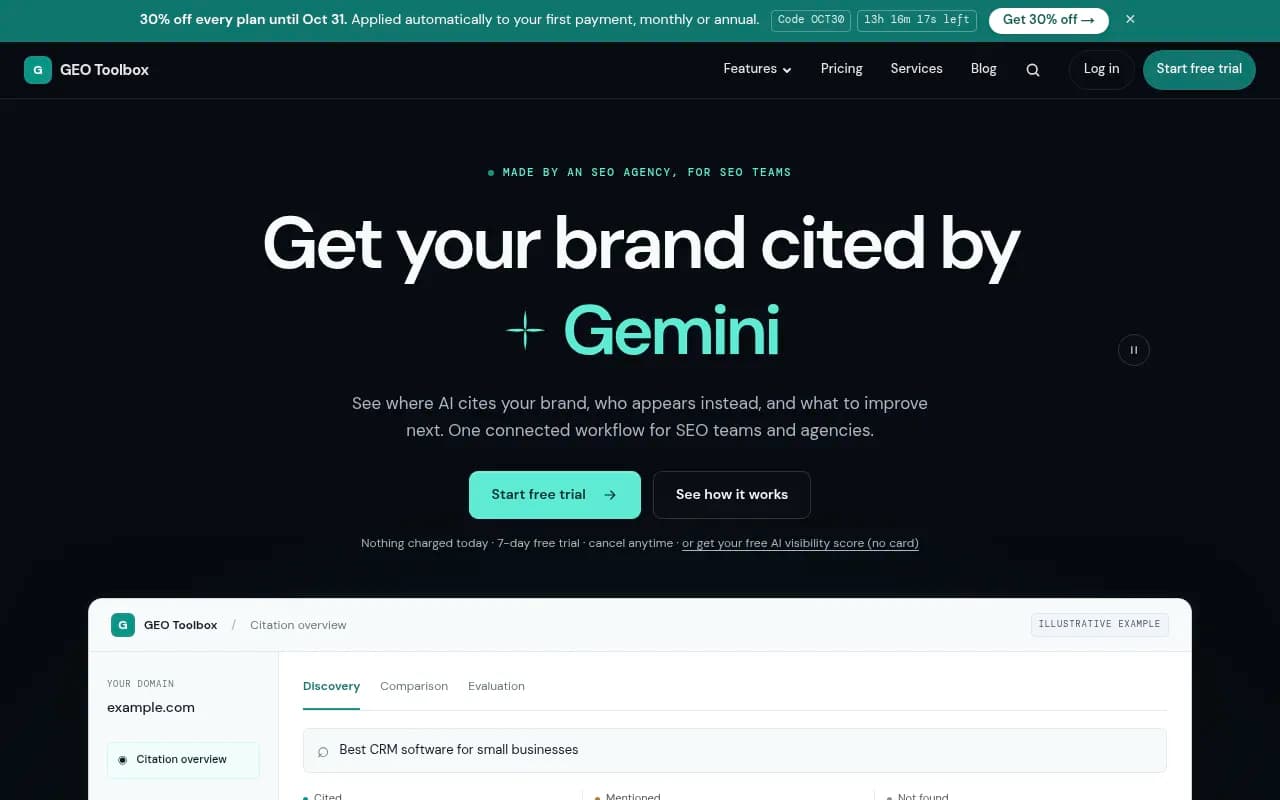
GEO Scan. One prompt runs across the engines in parallel and returns a visibility score from 0 to 100, verbatim citation snippets, an engine-by-engine breakdown and a competitor read-out. The vendor says the first scan takes under two minutes. The sample report on the homepage is illustrative data, not real results, but the layout is useful: per prompt, you see Cited, Mentioned or Not found for each engine, with the cited URL alongside.
Query Fan-Out. Captures the sub-questions engines actually run behind a single prompt. This matters because content that answers the fan-out queries tends to be the content that gets pulled in. It is included on every plan.
Content Analyzer. Grades any URL on two scores, Citability and AI Readability, using 21 signals: schema markup, AI bot access, JavaScript rendering, freshness and answer-first formatting. Each signal maps to a specific fix, and results are benchmarked against pages AI engines do cite. This is the diagnostic piece most pure trackers skip.
Agent Readiness Scanner and AI Crawler Checker. The scanner runs live crawler probes plus a real browser render and gives a Level 0 to 4 verdict. The checker tells you which of 34 AI crawlers your robots.txt allows or blocks. Both are free. The scan catches WAF rules and bot-management defaults that quietly refuse GPTBot or ClaudeBot, and content that only appears after JavaScript runs. Note it probes your site from the outside. It does not give you server-side logs of what crawlers actually fetched.
Competitor Intel, Citation Interceptor and Community. Competitor Intel tracks who is cited instead of you. Citation Interceptor and Community (Reddit and forum citations) surface the offsite threads AI quotes. Both of the latter start at Plus. Community is Reddit and forums only, with no dedicated YouTube or LinkedIn reporting.
Content Studio and AI article writing. From Plus up you get SEO briefs (15 a month) and a 5-stage article writer, with a framework-aware outline (pillar, cluster, comparison or FAQ), an entity checklist and competitor facts coverage. Article volume is 15 a month on Plus, 30 on Pro and Growth, 60 on Scale. There is no direct CMS publishing described, so the last mile is manual.
Analytics and Actions. Connect Google Search Console and GA4 to see AI referral traffic next to organic data. A weekly prioritized Actions list and AI prompt suggestions arrive from Plus. The vendor is refreshingly honest that attribution is partial: some engines send no referrer, and many answers are read without a click.
Ask GeoToolBox. An AI analyst chat over your data: 10 questions a month on Plus, 50 on Pro, 100 on Growth, 300 on Scale. Those caps are tight if you lean on chat as your main interface.
Multi-market tracking. Scheduled tracking runs across 29 markets, which helps when an engine cites a local competitor for a Spanish prompt and you for the English one.
Who is it for
The natural buyer is a solo SEO or consultant who needs to show one or a few brands where they stand in AI answers, and who also wants a diagnostic tool to explain why. A freelancer managing three small-business domains on Plus ($199/mo) fits well. So does an in-house SEO at a mid-size SaaS company who wants to run a baseline scan, ship fixes, and re-scan.
Agencies are served by Growth ($499/mo, 15 client brands, white-label reports, unlimited seats) and Scale (25 brands, all eight engines, priority support). A 10-person agency pitching AI visibility audits to local service businesses could make this work. The free tools double as lead-gen material for that.
Who should skip it? Enterprises that want real-conversation prompt-volume data. The vendor itself admits it lacks the dataset that platforms like Profound and AthenaHQ sell. Teams that need daily scans (an add-on only on Scale), a live API or MCP access (listed as coming soon) will also hit walls. And if you need keyword rank tracking, backlink analysis or site-speed auditing, the vendor says plainly to keep a general SEO suite.
Integrations and ecosystem
Integrations are thin compared with the more mature platforms. Documented connections are Google Search Console and GA4. API and MCP access is not live yet and is slated for the Scale plan. I found no Slack, Zapier, Looker Studio or CMS publishing connections, and no browser extension or mobile app.
On the export side, white-label client reports are available from Growth. Scan history is retained for 180 days on Starter, a year on Plus and Pro, and unlimited on Growth and Scale.
Pricing and value
Prices below are monthly, with annual billing at 20% off. A 30% promotion (code OCT30) applies to the first payment until October 31. Check geotoolbox.ai/pricing for current numbers.
- Starter, $99/mo ($79 annual): 1 brand, 50 prompts, 3 engines (ChatGPT, Perplexity, AI Overviews), 12,000 credits, 180-day history, 1 seat.
- Plus, $199/mo ($159 annual): up to 3 brands, 100 pooled prompts, pick 5 of 8 engines, 30,000 credits, 2 seats, plus Citation Interceptor, Community, Content Studio and Actions.
- Pro, $399/mo: up to 5 brands, 150 pooled prompts, all 8 engines, 50,000 credits, 3 seats.
- Growth, $499/mo ($399 annual): 15 client brands at 50 prompts each, 5 of 8 engines, 80,000 credits, unlimited seats, white-label reports.
- Scale: 25 brands, all 8 engines, 130,000 credits, priority support, daily-scan add-on. No free trial.
- Enterprise: custom, with SSO/SAML, an audit log and a 4-hour support SLA.
The 7-day trial needs a card, and it only gives 25% of monthly credits, so you can't fully stress-test a plan before paying. A free AI visibility score and 10 free tools need no card.
The credit system deserves a careful read. Costs per check are Perplexity 1, ChatGPT 4, Gemini 8, Claude 20 and Grok 31. The vendor's own example, a 10-prompt brand on five standard engines checked weekly, uses roughly 1,000 credits a month, and adding Claude and Grok about triples that. So tracking all eight engines on 150 prompts will burn through 50,000 credits faster than the plan table suggests.
Against competitors, the entry price is comparable to Promptwatch's Essential ($95/mo) but you get fewer engines (3) and 50 prompts, versus Promptwatch's 50 prompts across all models plus site audit, 360 Insights, content gap analysis and MCP/API access. Promptwatch's agency plans start at $199/mo with unlimited projects and prompts, which undercuts GEO Toolbox's per-brand math on the agency side.
Strengths and limitations
Strengths
- The free tools are good. The AI Crawler Checker and Agent Readiness Scanner give real answers without signup.
- The Content Analyzer's 21-signal audit links diagnosis to specific fixes.
- Honest framing. It tells you llms.txt is unproven as a citation lever and that traffic attribution is partial.
- Cited vs mentioned is reported separately for every engine.
- Public pricing, no demo wall.
Limitations
- Weekly scans on every plan, daily only as a Scale add-on.
- Starter covers just 3 engines, and Claude/Grok credit costs make the full eight-engine claim expensive in practice.
- No API or MCP yet, email-only support below Scale, and small prompt caps.
- Per-brand cost is high on the brand plans.
What it lacks compared with Promptwatch
This is a direct competitor, and the gaps are real. Promptwatch offers:
- IP-verified AI crawler logs with a crawl-to-citation path per page. GEO Toolbox only probes from outside.
- Visitor analytics that attribute real AI traffic and conversions, not just GSC and GA4 overlays.
- A Content Agent that plans, writes and publishes to WordPress, Webflow or Framer, and tracks each page afterward.
- Reddit, YouTube and LinkedIn citation reports, plus offsite mentions and page-level tracking.
- AI Shopping (ChatGPT, Amazon Alexa) and Ads Radar.
- Prompt volumes, difficulty scores and personas.
- Real-UI monitoring across 15+ engines, including Meta AI, Amazon Alexa and coding agents like Codex and Claude Code.
- A live MCP server with 110+ tools and REST API v2, plus an Action Board and Agent Chat with 500 to 6,500 credits included per paid plan.
- ISO/IEC 27001 certification and 1,840+ customers.
Bottom line
GEO Toolbox is a sensible pick for SEO freelancers and small agencies who want a visibility tracker with a built-in audit layer and who value the free crawler tools. Treat the credit math and weekly cadence as the real constraints, and budget for Plus or above, since Starter's 3 engines and missing features are limiting.
If you want optimization and not just monitoring, Promptwatch is the stronger choice: crawler logs, traffic attribution, a publishing Content Agent and broader citation coverage in one platform. For more options, see the directory at bestgeosoftware.com.
Best use case in one sentence: a small SEO team that wants to scan, audit and re-scan a handful of brands on a modest budget.
Tags:
Frequently asked questions
What is GEO Toolbox?
How much does GEO Toolbox cost?
Does GEO Toolbox have a free plan?
Which AI engines does it track?
How do credits work?
How does it compare to Promptwatch?
Similar and alternative tools to Geotoolbox