Key takeaways
- Surfer SEO ($99/mo) is the best all-rounder for teams that write at volume and want real-time optimization feedback alongside AI drafting.
- Clearscope ($170-199/mo) delivers the cleanest, most reliable content grading -- worth the premium if your writers need simplicity and your content quality bar is high.
- NeuronWriter ($19/mo) punches well above its price point for solo SEO writers and small teams who don't need enterprise features.
- MarketMuse ($149/mo) is the right pick when topical authority strategy matters more than individual article scoring -- it thinks at the site level, not the page level.
- All four tools optimize for traditional Google rankings. If you also want visibility in ChatGPT, Perplexity, and other AI search engines, you'll need a separate GEO layer.
Content optimization tools have become table stakes for anyone serious about organic search. The premise is simple: analyze what the top-ranking pages cover, then score your content against those benchmarks as you write. Stop guessing. Start closing gaps.
But "content optimization tool" now describes a pretty wide range of products. Some are glorified keyword stuffers with a nice UI. Others are genuinely sophisticated platforms that think about your entire content strategy, not just the article you're writing right now.
Surfer SEO, Clearscope, NeuronWriter, and MarketMuse are four of the most-discussed options in 2026. They're all credible. They're also meaningfully different from each other. This guide breaks down exactly where each one wins, where it falls short, and which type of team or workflow it actually fits.
What these tools actually do
Before comparing them, it's worth being precise about the job they're doing.
A content optimization tool takes a target keyword, fetches the top-ranking pages for that query, and extracts patterns: which terms appear frequently, what topics are covered, how long the content is, how headings are structured. It then scores your draft against those patterns in real time.
The better tools go further. They build content briefs before you start writing, track existing content for decay, map topic clusters across your site, and generate AI drafts grounded in competitive analysis rather than thin generation.
What none of them do particularly well yet -- and this is worth knowing -- is optimize for AI search. Getting cited in ChatGPT or Perplexity is a different problem from ranking on Google page one. The signals overlap but aren't identical. If AI search visibility matters to your business, tools like Promptwatch are built specifically for that layer.

For now, let's focus on the four tools in question.
Surfer SEO
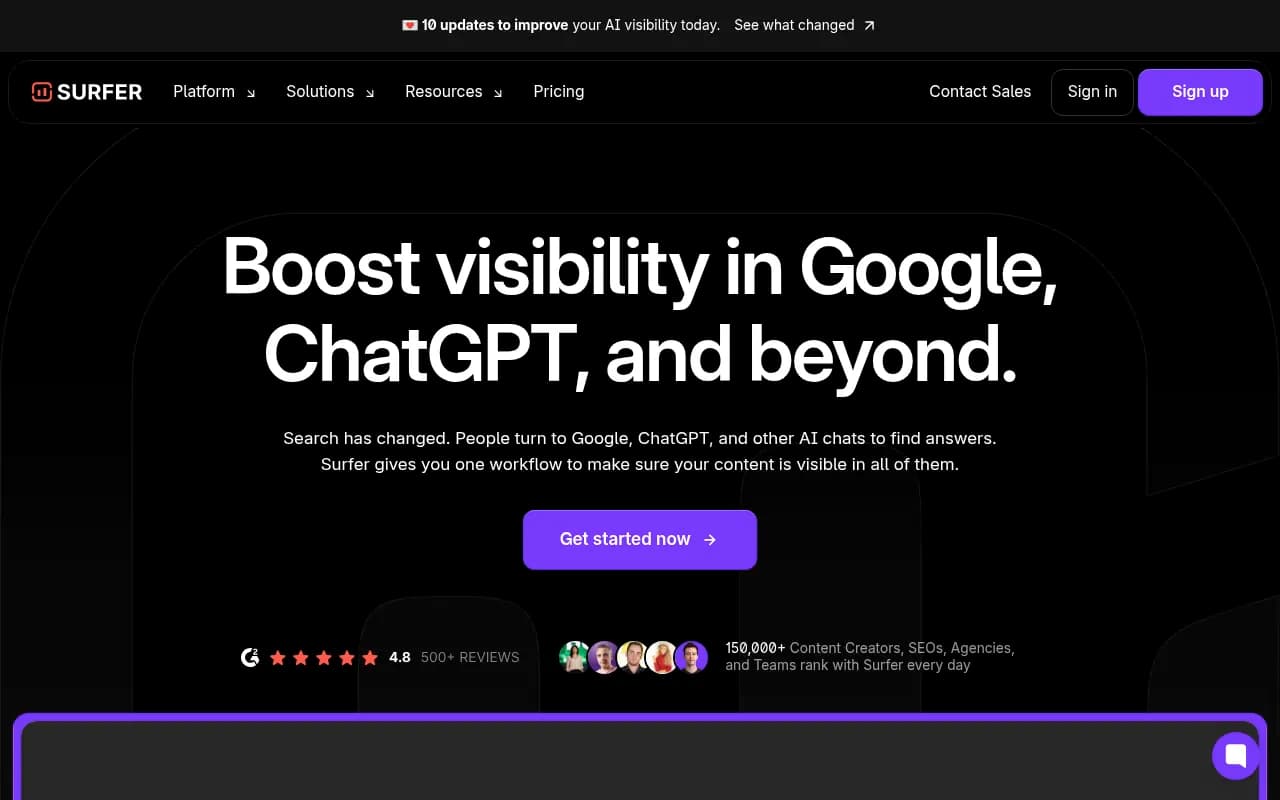
Surfer is the most widely used content optimization platform on the market. Over 150,000 professionals use it, and it's not hard to see why -- the product covers a lot of ground without becoming overwhelming.
The core feature is the Content Editor: paste in your draft or write directly in the tool, and Surfer scores it 0-100 based on NLP analysis of top-ranking competitors. It tells you which terms to include, how many times, and flags structural issues like missing headings or thin sections. The score updates in real time as you write, which makes it genuinely useful during the drafting process rather than just a post-hoc audit.
Surfer also ships with a keyword research tool, a content audit feature for existing pages, and an AI writing assistant (Surfer AI) that generates full drafts optimized for the target keyword. The AI drafts aren't perfect, but they're a solid starting point that saves time.
Where Surfer is strongest: teams producing content at volume. The workflow is fast, the interface is clean, and the scoring is reliable enough that writers can internalize it quickly. It's also the most affordable of the four tools with serious capabilities, starting at $99/month.
Where it's weaker: Surfer thinks at the article level. It doesn't have MarketMuse's ability to model topical gaps across your entire site, and its content briefs are less detailed than what you'd get from a dedicated brief-building tool. The AI writing output is also more generic than some competitors.
Best for: Content teams writing 10+ articles per month who want fast, reliable on-page optimization without a steep learning curve.
Clearscope

Clearscope is the premium option in this group, and it earns that positioning in a specific way: the product is exceptionally clean and the content grading is genuinely good.
Instead of a numerical score, Clearscope uses letter grades (A++ down to F) to rate your content against top-ranking competitors. This sounds like a minor UX difference, but in practice it changes how writers interact with the tool. The letter grade feels like a quality benchmark rather than a game to be optimized, which tends to produce better writing rather than keyword-stuffed drafts chasing a high score.
The term recommendations are powered by NLP analysis of top-ranking pages, and Clearscope is notably good at surfacing semantically related terms rather than just exact-match keywords. Writers who use it consistently report that it helps them think about topics more completely, not just tick boxes.
Clearscope also integrates directly with Google Docs and WordPress, which matters for teams that don't want to change their writing workflow. You can optimize inside the tools you already use.
The main knock against Clearscope is price. It starts around $170/month and scales up from there. For a solo writer or small team, that's a meaningful commitment. The product also doesn't include AI writing, keyword research, or site-level strategy tools -- it's focused on content optimization and does that one thing very well.
A real-world data point: one B2B content team tested 12 tools over 90 days and found that Clearscope pushed 3 articles to the #1 position, with Surfer close behind. That's not a controlled experiment, but it's consistent with what practitioners report.
Best for: Marketing teams with a dedicated content operation who prioritize quality over speed, and where the $170+/month price is justifiable.
NeuronWriter

NeuronWriter is the surprise of this group. At $19/month for the entry plan, it's priced like a budget tool but delivers capabilities that would have cost 5x more a couple of years ago.
The core optimization engine is solid: NLP-based term analysis, competitor content breakdown, content scoring, and a built-in editor. It also includes AI writing assistance, content brief generation, and internal linking suggestions. For the price, the feature set is genuinely impressive.
NeuronWriter's interface is less polished than Surfer or Clearscope, and the AI writing quality is a step below what you'd get from dedicated writing tools. But if you're a solo SEO writer or running a small agency on tight margins, those tradeoffs are very easy to accept.
One thing NeuronWriter does well that often gets overlooked: it includes SERP analysis features that show you not just what terms to use, but how competitors structure their content, what questions they answer, and where the gaps are. This is useful for brief-building even if you're writing the content elsewhere.
The ceiling is lower than the other tools in this comparison. NeuronWriter doesn't do site-level strategy, doesn't have enterprise features, and the support and documentation aren't as mature. But for the use case it serves, it's hard to argue with the value.
Best for: Solo SEO writers, freelancers, and small agencies who want serious optimization capabilities without a serious price tag.
MarketMuse
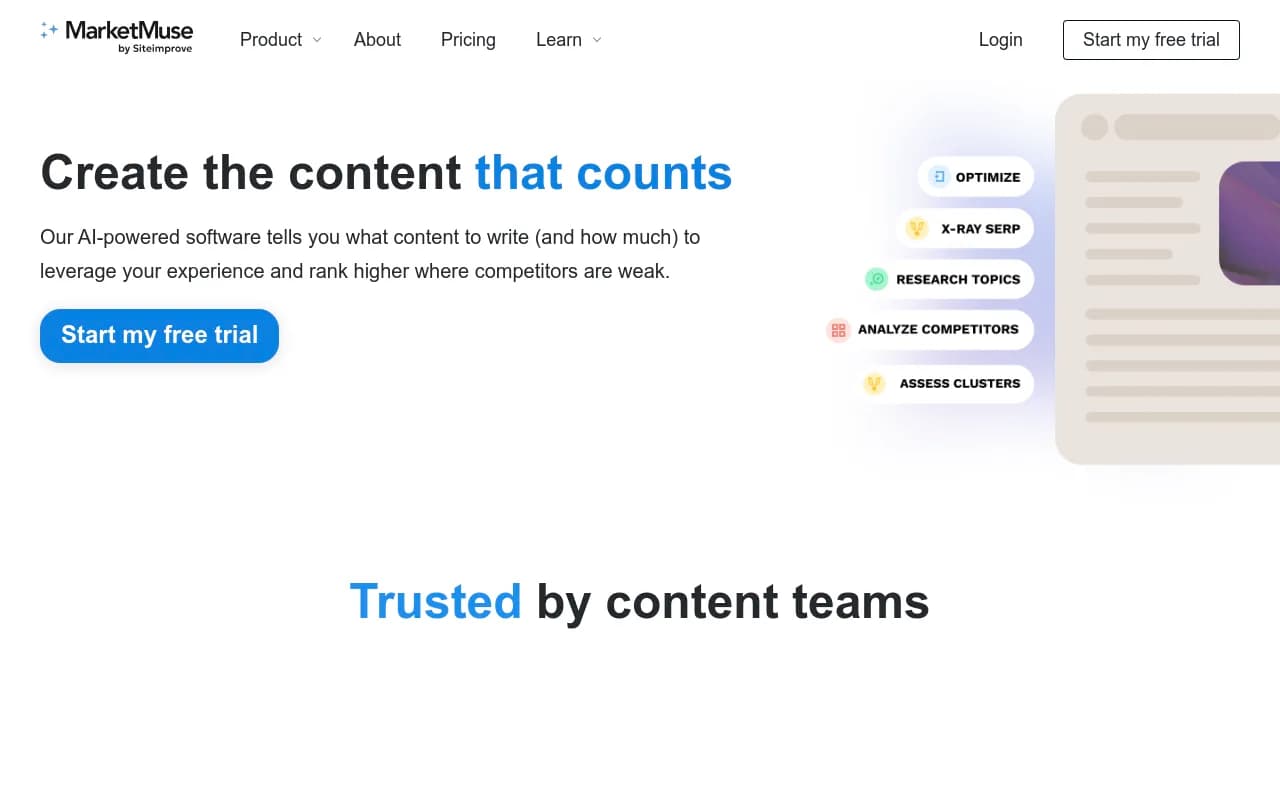
MarketMuse is the most strategically oriented tool in this comparison. Where Surfer and Clearscope think at the article level, MarketMuse thinks at the site level.
The core differentiator is its Topic Model: MarketMuse analyzes your entire domain and maps your topical authority across subject areas. It shows you which topics you own, which you're weak in, and which you should prioritize based on competitive difficulty and your existing content inventory. This is genuinely useful for content strategy, not just execution.
The Content Score feature works similarly to Surfer and Clearscope -- it scores your article against top-ranking competitors -- but MarketMuse layers in a "Personalized Difficulty" score that accounts for your site's existing authority in that topic area. A site with strong topical coverage in B2B SaaS will get different difficulty scores than a new site, even for the same keyword. That's a meaningful insight that the other tools don't provide.
MarketMuse also generates detailed content briefs that go beyond term lists: they include recommended questions to answer, related topics to cover, and internal linking suggestions based on your existing content.
The downsides are real. MarketMuse is expensive ($149/month for the basic plan, with meaningful limitations at that tier), the interface has a learning curve, and the value is harder to see if you're writing one article at a time rather than managing a content strategy across hundreds of pages. It's also slower to use day-to-day than Surfer or Clearscope.
Best for: Content strategists and SEO leads managing large content programs who need site-level topical authority planning, not just article-level optimization.
Head-to-head comparison
| Surfer SEO | Clearscope | NeuronWriter | MarketMuse | |
|---|---|---|---|---|
| Starting price | $99/mo | ~$170/mo | $19/mo | $149/mo |
| Content scoring | 0-100 score | Letter grade (A++ to F) | NLP score | Content Score + Personalized Difficulty |
| AI writing | Yes (Surfer AI) | No | Yes (basic) | Yes (briefs + drafts) |
| Keyword research | Yes | No | Limited | Yes |
| Site-level strategy | Limited | No | No | Yes (Topic Model) |
| Content briefs | Yes | Basic | Yes | Detailed |
| Google Docs integration | Yes | Yes | No | No |
| WordPress integration | Yes | Yes | Yes | No |
| Internal linking | Limited | No | Yes | Yes |
| Best for | Volume content teams | Quality-focused teams | Solo writers / small agencies | Content strategists |
| Free trial | Yes | Yes | Yes | Yes |
Which tool should you actually pick?
The honest answer is that it depends on one question: are you optimizing individual articles, or are you managing a content strategy?
If you're optimizing individual articles at volume, Surfer SEO is the default choice. The workflow is fast, the scoring is reliable, and $99/month is reasonable for what you get. Most content teams doing 10+ articles per month will find it covers 90% of their needs.
If your content quality bar is high and you have writers who need clear, intuitive feedback, Clearscope is worth the premium. The letter grading system genuinely changes how writers approach optimization -- less gaming, more thinking. The Google Docs integration also means zero workflow disruption.
If you're a solo writer or small agency and budget is a real constraint, NeuronWriter is the obvious pick. $19/month for a tool that does NLP analysis, AI writing, and content briefs is remarkable value. You'll hit its ceiling eventually, but for most solo operations, that ceiling is far away.
If you're running a content program at scale and need to think about topical authority across hundreds of pages, MarketMuse is the tool built for that job. The site-level Topic Model is genuinely differentiated. Just be prepared for a learning curve and a price that only makes sense at a certain content volume.
One thing all four tools miss
None of these tools are built for AI search visibility. They optimize for Google rankings, which is still the dominant traffic source for most businesses. But AI search -- ChatGPT, Perplexity, Google AI Overviews, Gemini -- is now a real traffic channel, and the optimization logic is different.
Getting cited in an AI response requires different signals than ranking on page one: topical authority, clear factual claims, structured content that LLMs can parse and quote. If your business cares about showing up when someone asks ChatGPT for a recommendation in your category, that's a separate problem that content optimization tools don't solve.
For that layer, Promptwatch tracks your visibility across 10 AI models, identifies which prompts competitors are getting cited for that you're not, and generates content specifically engineered to get cited by AI engines -- not just ranked by Google. It's a different tool for a different (and increasingly important) job.
Other tools worth knowing
If none of the four main options quite fit your workflow, a few others are worth considering:
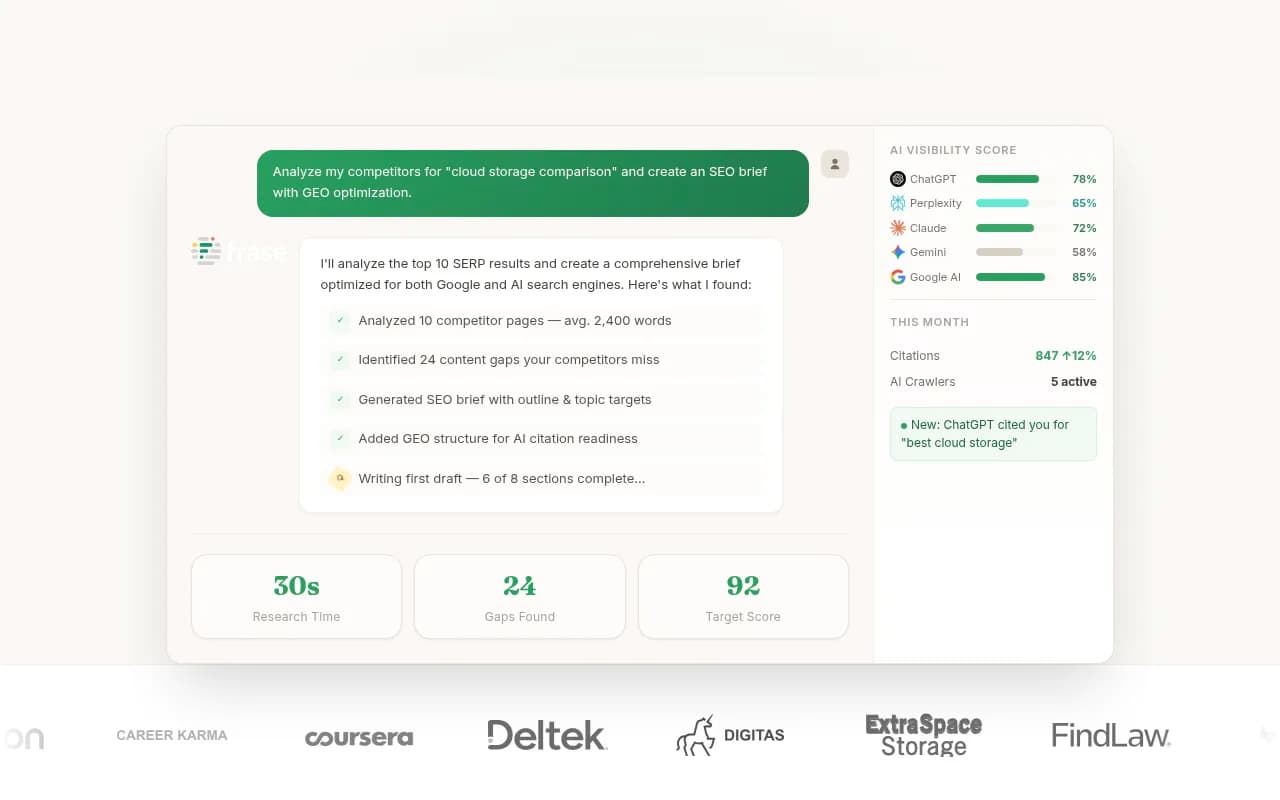
Frase is a strong research-to-draft tool at $49/month, particularly good for writers who want to build content briefs quickly before writing.
Scalenut offers an all-in-one platform at $39/month that covers keyword research, briefs, and optimization -- a good middle ground for teams scaling output on a budget.

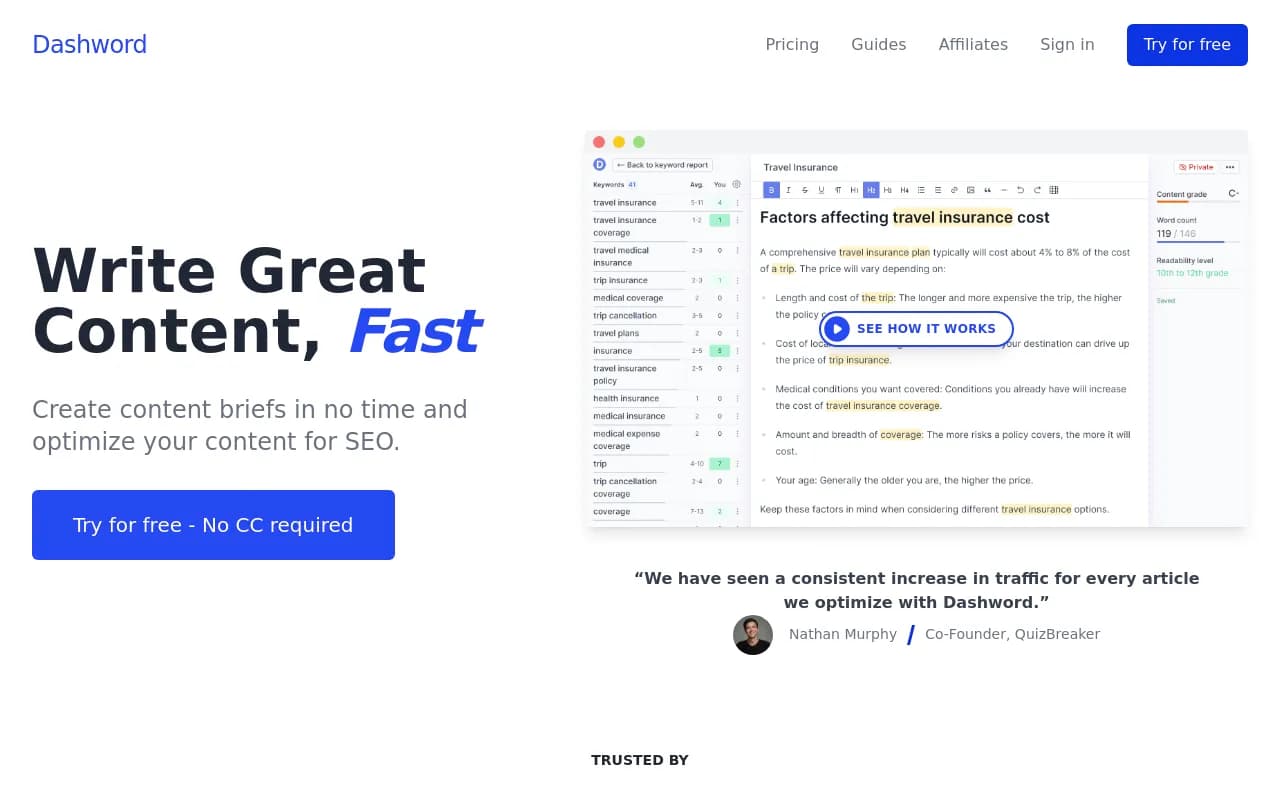
Dashword is the simplest option in the market: clean briefs, basic scoring, no complexity. Good for teams that want the minimum viable optimization workflow.
SEMrush Writing Assistant makes sense if you're already paying for SEMrush and want optimization built into that ecosystem rather than a separate tool.
The bottom line
Content optimization tools work. The evidence from real campaigns is consistent: using NLP-based term analysis and competitive benchmarking to guide your writing produces better-ranking content than writing without those signals. The question isn't whether to use one -- it's which one fits your workflow and budget.
For most teams in 2026, Surfer SEO is the pragmatic default. Clearscope is the quality upgrade. NeuronWriter is the budget winner. MarketMuse is the strategy tool. Pick based on where you actually are, not where you aspire to be.