Key takeaways
- Surfer SEO ($89/mo) is the best all-rounder for teams that need to produce optimized content at volume -- its NLP scoring and AI writing assistant make it fast to use at scale
- Clearscope ($189/mo) has the cleanest interface and the most reliable grading, making it the go-to for editorial teams where multiple writers need consistent guidance
- MarketMuse is the only tool of the three built around topical authority strategy -- it tells you what to write across your entire site, not just how to optimize a single page
- None of the three tools were built for AI search visibility (ChatGPT, Perplexity, Google AI Overviews) -- they optimize for traditional Google rankings, which is a meaningful gap in 2026
- If AI search visibility matters to your strategy, you'll need a separate tool alongside whichever of these you pick
Content optimization tools have been around long enough that the category feels mature. Surfer SEO, Clearscope, and MarketMuse are all genuinely good. They've each been refined over years of real-world use, and any of them will improve your content quality compared to writing without one.
But 2026 is a different environment than 2022. AI search engines -- ChatGPT, Perplexity, Google AI Overviews, Claude -- now handle a significant share of informational queries. The question isn't just "will this rank on Google?" anymore. It's "will this get cited by an AI model?"
That's a real gap in how these tools were designed, and it's worth being honest about before diving into the comparison.
What these tools actually do
All three tools work on the same basic principle: analyze the top-ranking pages for a keyword, extract the semantic terms and content patterns that correlate with high rankings, and give you a score as you write. The differences are in how they present that information, how deep they go, and what else they bundle in.
According to Semrush's 2025 State of Content Marketing report, teams using content optimization tools produce pages that rank in the top 10 at nearly twice the rate of teams writing without them. That baseline value is real -- the question is which tool delivers it best for your specific situation.

Head-to-head feature comparison
| Feature | Surfer SEO | Clearscope | MarketMuse |
|---|---|---|---|
| Starting price | $89/mo | $189/mo | Free (limited); $149/mo paid |
| Content editor | Yes | Yes | Yes |
| NLP term suggestions | Advanced | Good | Good |
| AI writing assistant | Yes (Surfer AI) | No | Yes (First Draft) |
| Content briefs | Yes | No | Yes |
| Topical authority mapping | No | No | Yes |
| Content audit | Yes | No | Yes |
| Keyword clustering | Yes | No | Yes |
| SERP analysis | Yes | Yes | Limited |
| Google Docs integration | Yes | Yes | No |
| WordPress plugin | Yes | Yes | No |
| Free trial | 7-day money back | No | Free plan (limited) |
| Best for | NLP scoring at scale | Editorial teams | Content strategy |
Surfer SEO: best for volume and speed
Surfer is the most widely used of the three, with over 150,000 users. Its Content Editor is fast, the NLP term suggestions are the most granular of any tool in this category, and the real-time content score gives writers immediate feedback as they type.
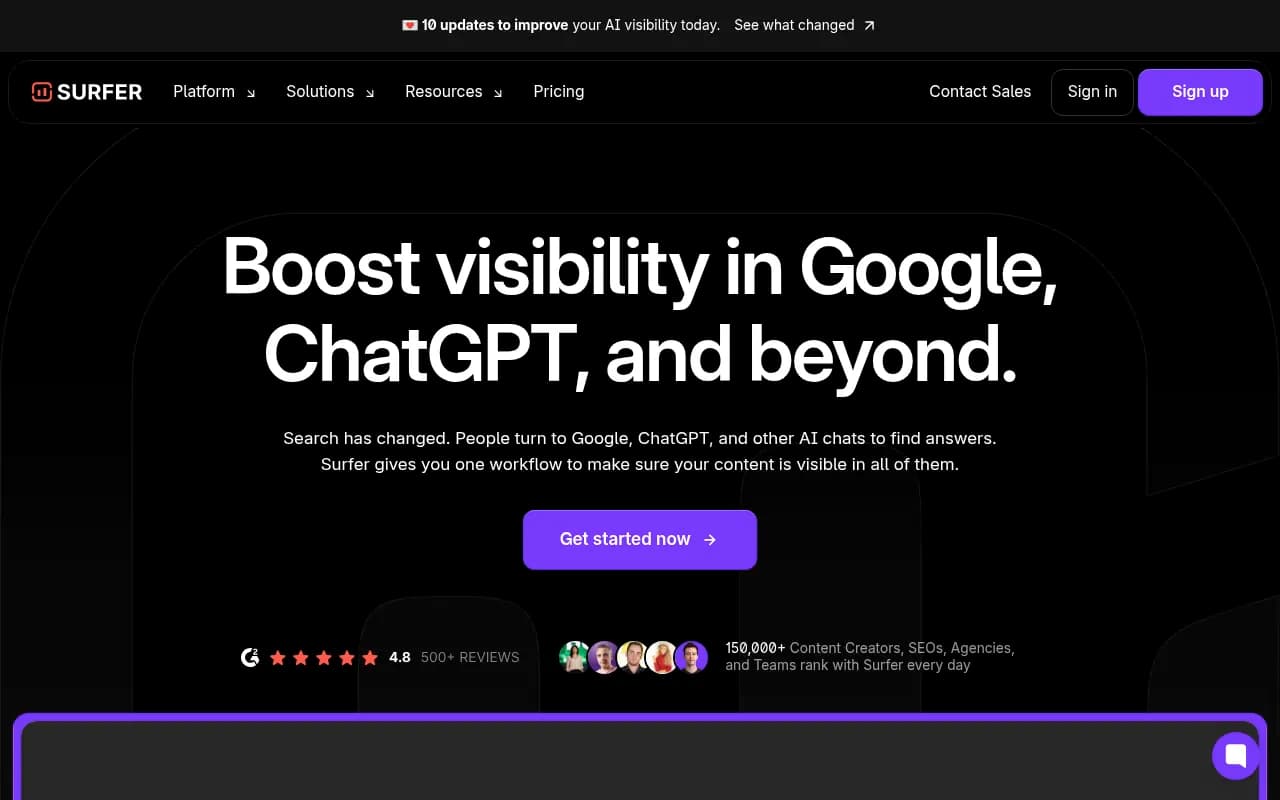
What makes Surfer genuinely useful is the combination of features. The keyword clustering groups related terms so you can plan topical coverage, not just individual articles. The content audit tool scans existing pages and flags what needs updating. And Surfer AI can generate an optimized draft from scratch -- useful when you need to publish 20 articles a month and can't spend four hours on each one.
The correlation data is interesting here: Surfer's content score has a 26% correlation with rankings, compared to Clearscope's 17.5%. That's a meaningful difference, though it's worth noting neither number is particularly high -- which tells you that content scores are directional signals, not guarantees.
Where Surfer falls short is depth of strategy. It's excellent at telling you how to optimize a specific page. It's less useful for figuring out which pages to create in the first place, or how your entire content library fits together.
For agencies and content teams producing high volumes of content, Surfer is probably the right choice. The $89/mo entry point is also the most accessible of the three.
Clearscope: best for editorial teams and consistency
Clearscope costs more ($189/mo) and does less on paper. No AI writing assistant, no content briefs, no keyword clustering. So why do so many editorial teams swear by it?
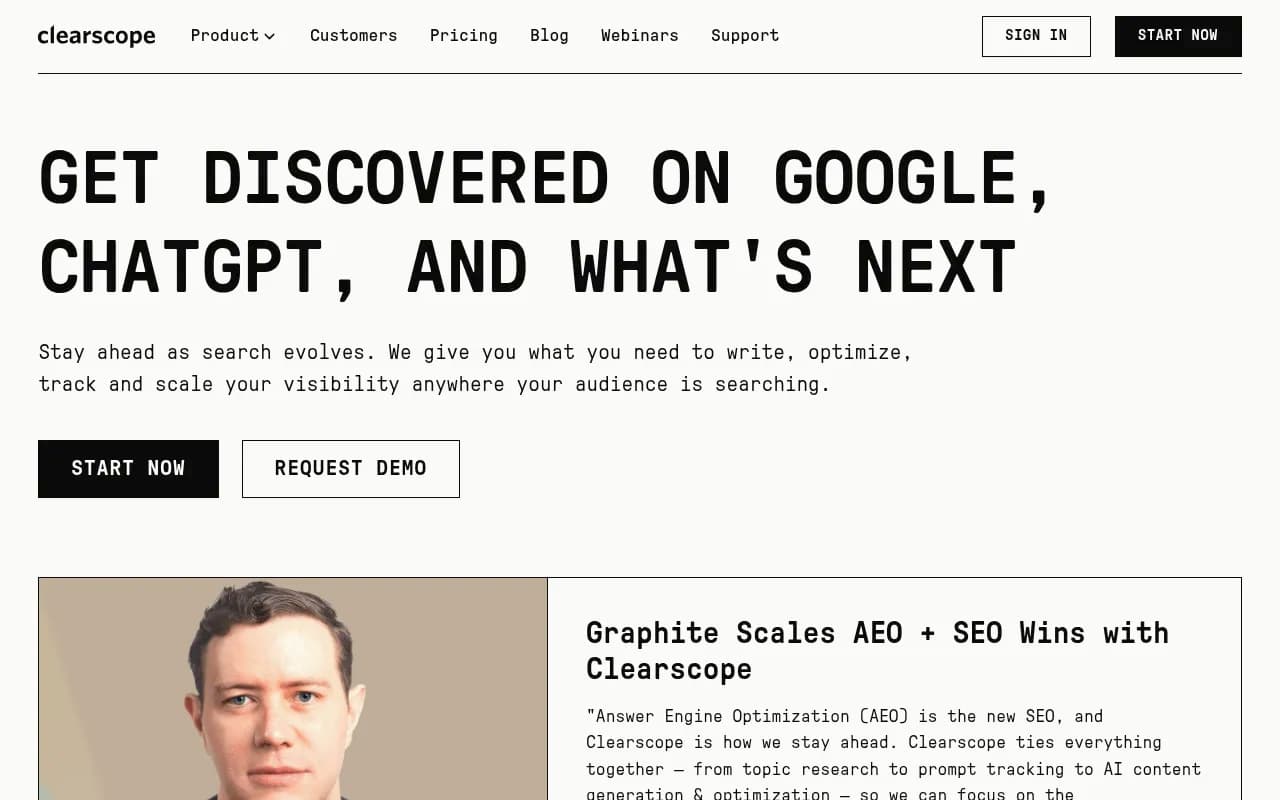
The interface. Clearscope's content editor is genuinely simpler to use than Surfer's, and that matters when you're onboarding a team of writers who aren't SEO specialists. The grading system (A++ down to D) is intuitive in a way that a numerical score isn't. Writers understand "you're at a B, get to an A" without needing to understand what NLP term weighting means.
The data quality is also consistently cited as reliable. One test from marketbetter.ai found that Clearscope pushed three B2B articles to the #1 position -- though Surfer at $99/mo was close behind.
The Google Docs integration is smooth and well-maintained, which matters for teams that live in Docs. The WordPress plugin works similarly.
What you're paying for with Clearscope is simplicity and reliability. If your bottleneck is getting writers to actually use the tool consistently, Clearscope's interface removes friction in a way that Surfer's more feature-heavy editor doesn't.
The lack of an AI writing assistant is a real limitation if you're trying to scale content production. Clearscope is a grading and guidance tool -- it doesn't help you write, only helps you improve what you've written.
MarketMuse: best for content strategy
MarketMuse is a different kind of tool. Where Surfer and Clearscope are primarily page-level optimizers, MarketMuse is built around site-level content strategy.
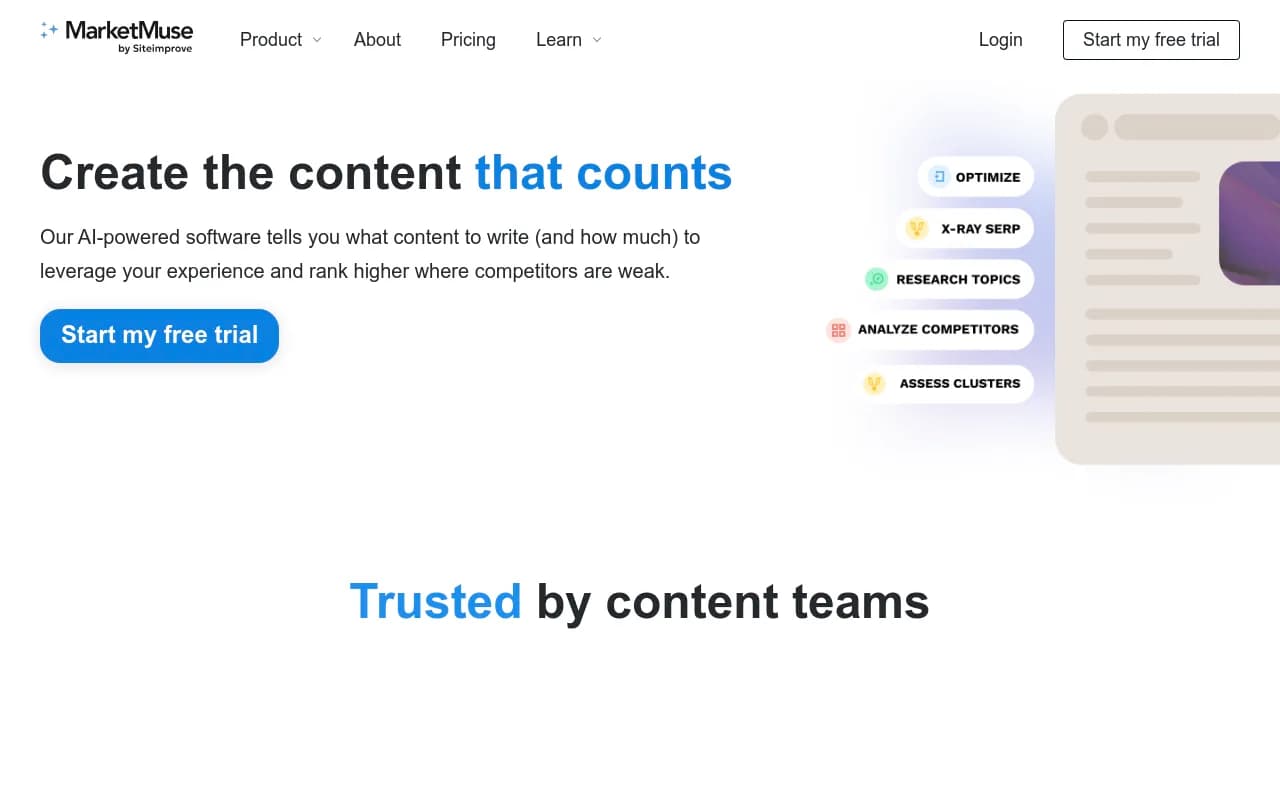
The topical authority mapping is the core differentiator. MarketMuse analyzes your entire domain, identifies the topics you have authority in, and shows you the gaps -- the questions your site should be answering but isn't. This is genuinely useful for content planning in a way that neither Surfer nor Clearscope attempts.
The content briefs are more detailed than Surfer's, with competitive analysis baked in. The First Draft AI writer generates content based on that research. The content audit covers your whole site, not just individual pages.
The tradeoff is complexity and price. MarketMuse takes longer to learn, and the paid tiers ($149/mo and up) are a bigger commitment. The free plan is genuinely limited -- useful for testing the interface but not for real work.
For content strategists and SEO managers who are responsible for a site's overall content direction, MarketMuse is the most powerful option. For writers who just need to know what terms to include in an article, it's overkill.
The AI search gap none of them fully address
Here's the thing that matters most in 2026: all three tools were built to optimize for traditional Google rankings. They analyze SERP data, extract signals from top-ranking pages, and help you match those patterns.
That's still valuable. Google is still the dominant search engine. But AI search engines work differently. ChatGPT, Perplexity, and Google's AI Overviews don't just rank pages -- they synthesize information and cite sources. Getting cited by an AI model requires different signals than ranking in a traditional SERP: authority, clarity, structured answers, and being present in the sources AI models trust.
None of Surfer, Clearscope, or MarketMuse tracks whether your content is being cited by AI models. None of them show you which prompts your competitors are visible for in ChatGPT or Perplexity. None of them help you identify the content gaps that are costing you AI visibility specifically.
If that matters to your strategy -- and for most brands it should in 2026 -- you need a separate tool. Promptwatch is built specifically for this: tracking AI citations across ChatGPT, Claude, Perplexity, Google AI Overviews, and more, identifying which prompts your competitors rank for that you don't, and helping you create content that gets cited by AI models.

The practical workflow for a lot of teams will be: use one of the three tools above to optimize content for traditional search, and use an AI visibility platform to optimize for AI search. They're solving different problems.
Which tool should you pick?
The honest answer depends on what your team actually needs.
Pick Surfer SEO if:
- You're producing a high volume of content (10+ articles/month)
- You want an AI writing assistant built in
- You need keyword clustering and content auditing in one tool
- Budget matters and you want the most features per dollar
Pick Clearscope if:
- You have a team of writers who aren't SEO specialists
- Consistency and ease of use matter more than feature depth
- You live in Google Docs and want seamless integration
- You're willing to pay a premium for a cleaner experience
Pick MarketMuse if:
- You're responsible for a site's overall content strategy
- Topical authority planning is a priority
- You want to understand your entire content library's gaps and strengths
- You have the time to learn a more complex tool
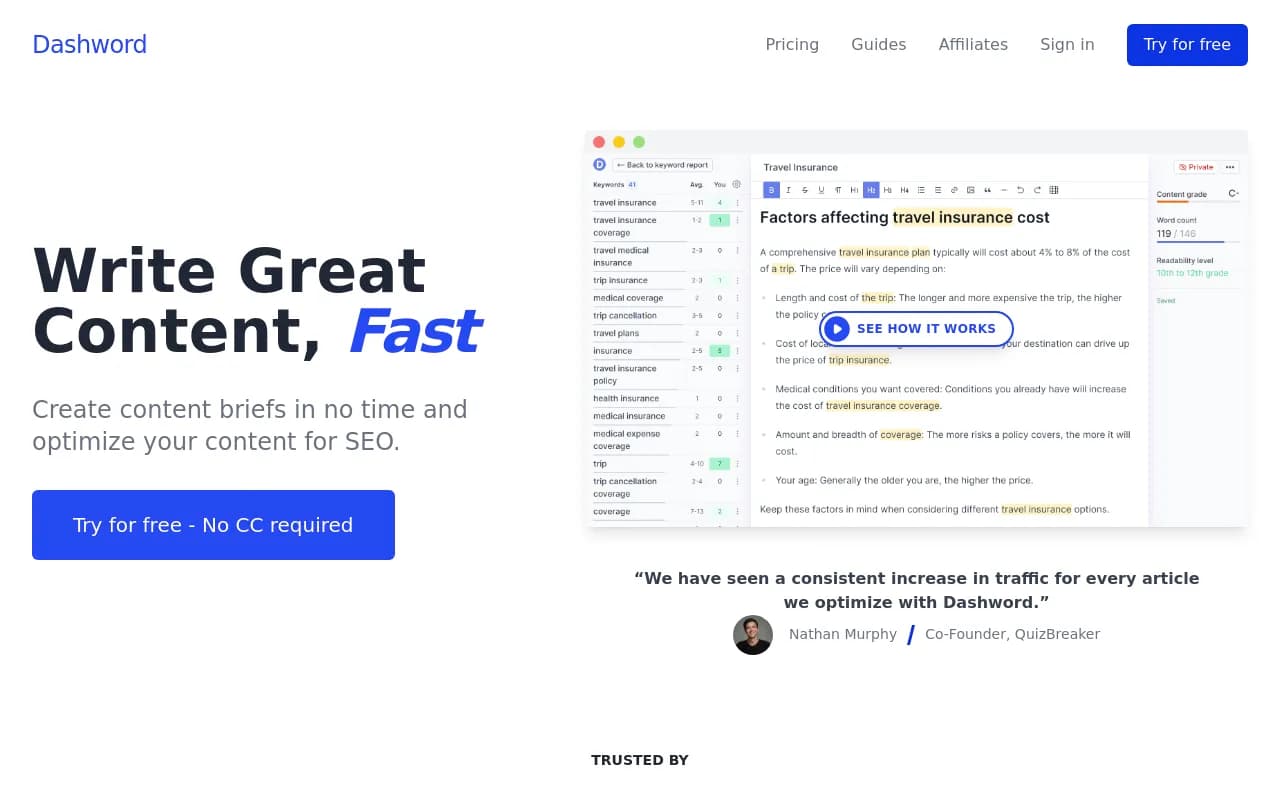
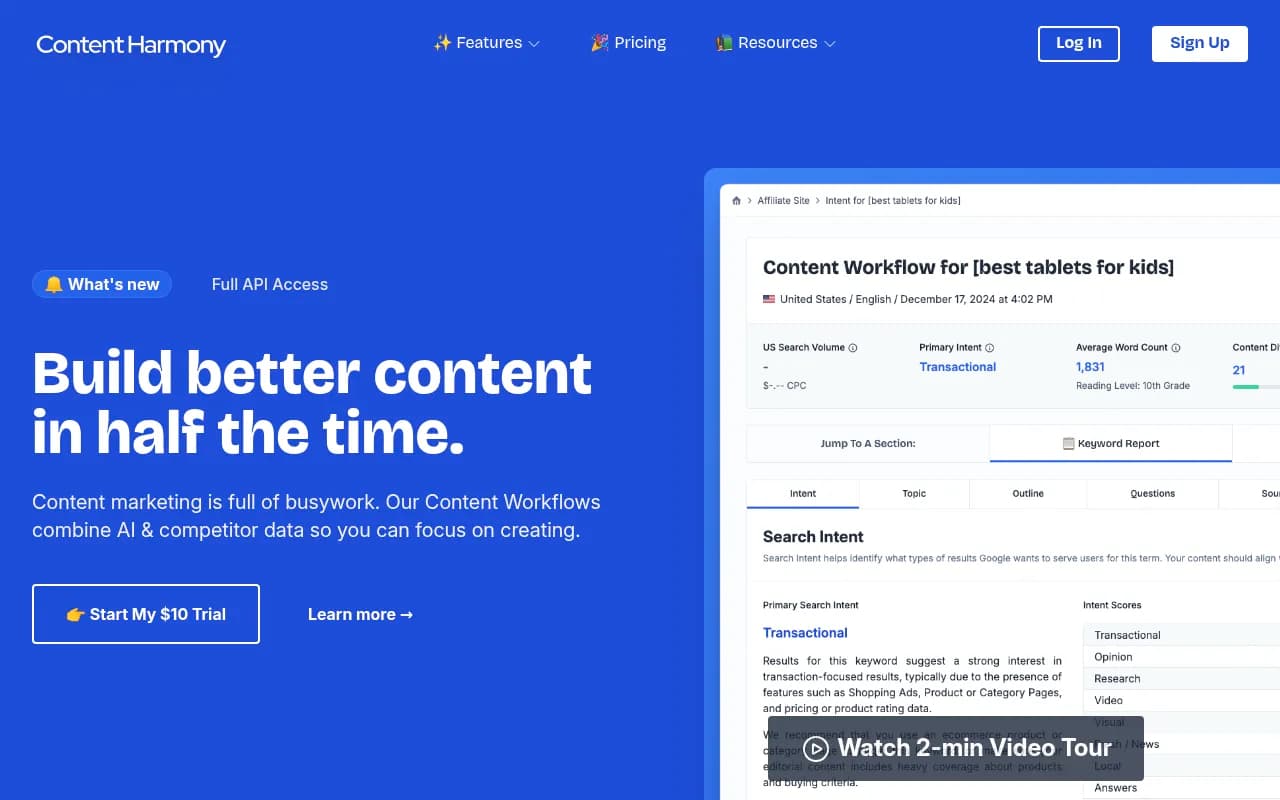
For teams that want to go deeper on content strategy and topical authority planning without the MarketMuse price tag, tools like Dashword and Content Harmony are worth looking at as well.
A note on pricing reality
The price differences are real but context-dependent. Surfer at $89/mo looks like the obvious value play, but if your team of five writers each needs access, you're looking at higher tiers. Clearscope's $189/mo includes unlimited users on the base plan, which changes the math for larger teams. MarketMuse's free plan lets you test the tool before committing.
Run the numbers for your actual team size and content volume before deciding based on the headline price.
The bottom line
Surfer SEO, Clearscope, and MarketMuse are all solid tools. Surfer wins on features and value for high-volume teams. Clearscope wins on simplicity and editorial workflow. MarketMuse wins on strategic depth.
What none of them do is prepare your content specifically for AI search -- which is increasingly where the traffic is going. Building a content strategy for 2026 means thinking about both traditional rankings and AI citations, and right now those require different tools.
The teams that will do best are the ones that pick the right content optimization tool for their workflow, then layer in AI visibility tracking on top. That combination -- optimized content plus AI citation monitoring -- is what a complete content strategy looks like now.