Key takeaways
- Scrunch is a solid monitoring tool -- it tells you where you stand in AI search, but stops there. No content generation, no crawler logs, no traffic attribution.
- Relixir adds AI content generation on top of monitoring, which is a meaningful step forward, but its citation database and prompt intelligence are thinner than Promptwatch's.
- Promptwatch is the only platform in this comparison that closes the full loop: find gaps, generate content engineered for AI citation, then track whether it worked -- down to actual revenue.
- If your team just needs a dashboard to report AI visibility to stakeholders, Scrunch is fine. If you need to actually improve visibility, you need something that takes action.
There's a real split happening in the GEO tool market right now. On one side, you have monitoring-only platforms that show you a score and a chart. On the other, you have platforms trying to be end-to-end optimization tools. The question isn't which category sounds better -- it's which one actually produces results for marketing teams under pressure to show ROI.
Scrunch, Relixir, and Promptwatch each represent a different point on that spectrum. Let's get into what each one actually does, where they fall short, and which approach makes sense depending on what you're trying to accomplish.
What "monitoring-only" actually means in practice
Before comparing tools, it's worth being clear about what monitoring-only means -- and why it matters.
A monitoring-only GEO platform answers one question: "Is my brand being mentioned in AI responses?" It tracks prompts, measures share of voice, and shows you how you compare to competitors across ChatGPT, Perplexity, Claude, and similar engines.
That's genuinely useful. A year ago, most brands had zero visibility into this. But in 2026, the bar has moved. Knowing you're invisible is table stakes. The harder problem is figuring out what to do about it -- and then doing it.
Monitoring-only tools leave you with a gap. You see the data, you feel the urgency, and then you're on your own to figure out what content to create, where to publish it, and whether it worked.
Scrunch: clean monitoring, nothing more
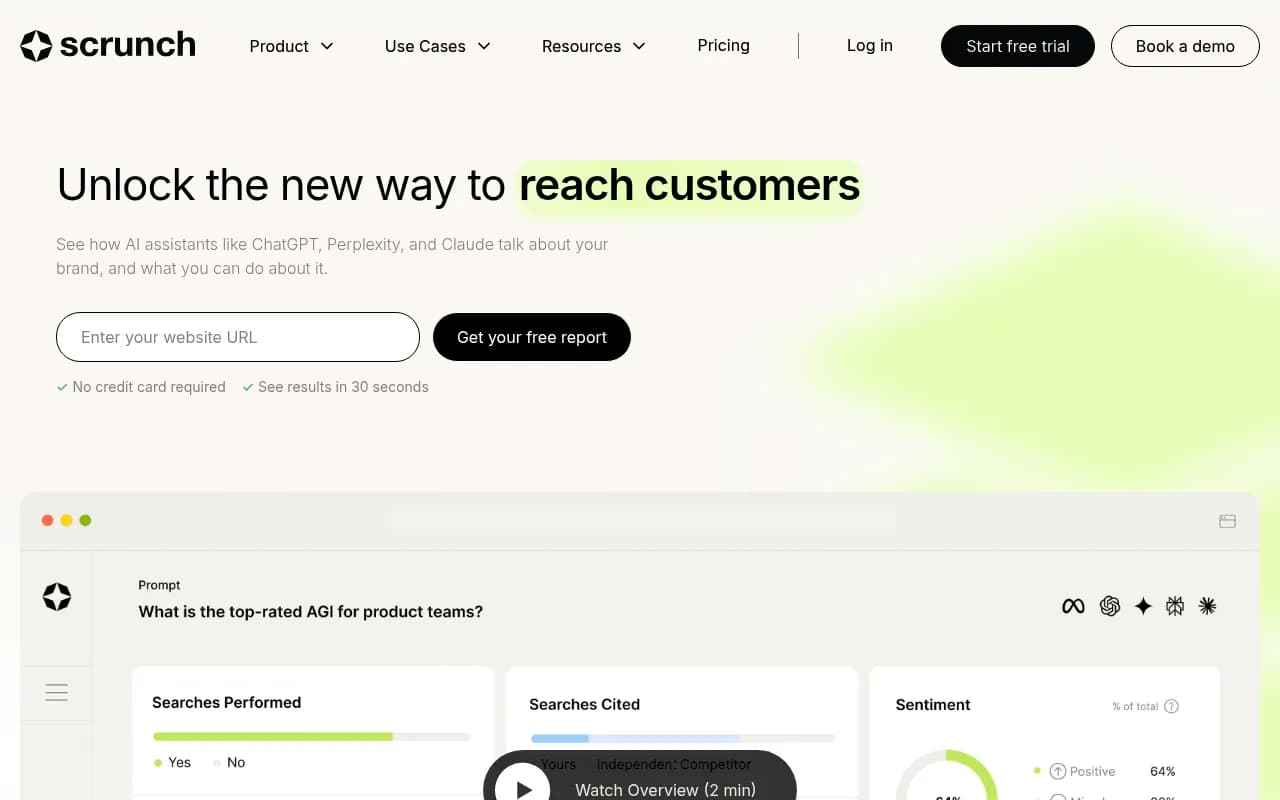
Scrunch tracks how AI assistants like ChatGPT and Claude reference your brand. It covers prompt monitoring, share of voice, competitor comparisons, and sentiment analysis. The interface is clean and the setup is relatively fast.
Where Scrunch works well: teams that need to report AI visibility metrics to leadership without a lot of setup friction. If your CMO wants a weekly slide showing "are we being cited in AI search?" Scrunch can produce that.
Where it hits a wall: the moment you ask "what do we do about it?" Scrunch doesn't have an answer. There's no content gap analysis, no AI writing tools, no crawler log visibility, and no traffic attribution. You're looking at a dashboard that tells you the problem exists.
For a brand just getting started with GEO tracking, that's acceptable. For a team that's been monitoring for six months and wants to actually move the needle, it starts to feel like a dead end.
Relixir: monitoring plus content generation
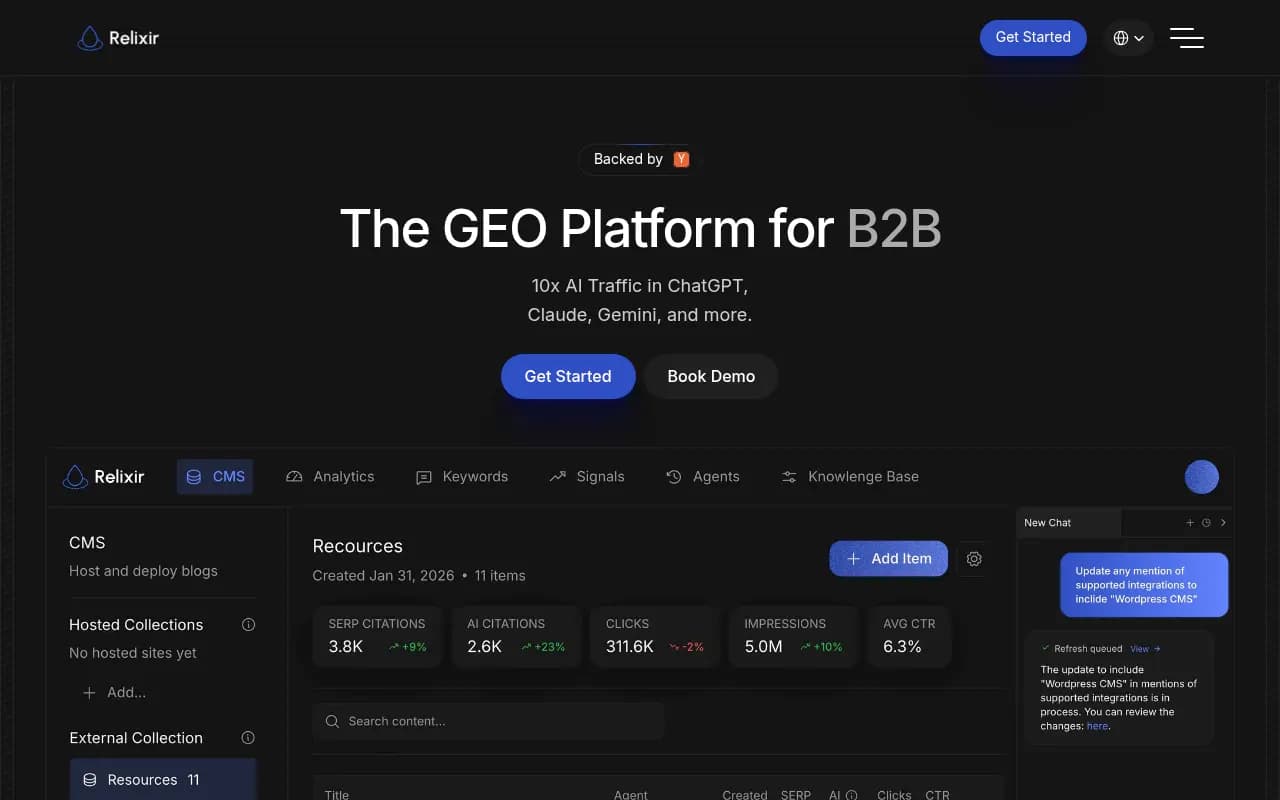
Relixir takes a step beyond pure monitoring by adding AI content generation. The idea is sound: you see which prompts your competitors rank for that you don't, and then you use Relixir's writing tools to create content targeting those gaps.
That's a meaningful improvement over Scrunch. The workflow makes more intuitive sense -- see the gap, fill the gap -- and having content generation built into the same platform reduces the friction of switching between tools.
The limitations show up in the details. Relixir's citation database is smaller, which means its recommendations about what content to create aren't grounded in the same volume of real AI response data. Prompt intelligence -- things like search volume estimates, difficulty scores, and how one query branches into sub-queries -- is thinner. And on the attribution side, connecting your content output to actual traffic and revenue is harder to do.
It's a better option than Scrunch if your team needs to produce content, not just track visibility. But it's still not a complete loop.
Promptwatch: the full optimization cycle
Promptwatch is built around a different premise. Instead of starting with "what can we monitor?" it starts with "what does a team actually need to improve AI visibility?" and works backward.

The core workflow has three stages:
Finding gaps. Promptwatch's Answer Gap Analysis shows exactly which prompts competitors appear in that you don't. Not vague topic areas -- specific questions and prompts, with data on why AI models are citing competitors and not you. You see the content your site is missing.
Creating content that gets cited. The built-in AI writing agent generates articles, listicles, and comparison pages grounded in 880M+ citations analyzed from real AI responses. This isn't generic SEO content -- it's engineered around what AI models actually cite. Persona targeting, prompt volume data, and competitor analysis all feed into what gets written.
Tracking whether it worked. Page-level tracking shows which of your pages are being cited, how often, and by which AI models. Traffic attribution connects that visibility to actual clicks and revenue -- via a code snippet, Google Search Console integration, or server log analysis.
A few capabilities that don't have obvious equivalents in Scrunch or Relixir:
- AI Crawler Logs: real-time logs of when ChatGPT, Claude, Perplexity, and other crawlers visit your site, which pages they read, and what errors they hit. This is how you find and fix indexing issues before they become visibility problems.
- Reddit and YouTube tracking: surfaces discussions that directly influence AI recommendations. Most tools ignore this channel entirely.
- ChatGPT Shopping tracking: monitors when your brand appears in ChatGPT's product recommendation carousels.
- Query fan-outs: shows how a single prompt branches into related sub-queries, so you can prioritize content that covers an entire topic cluster rather than one narrow question.
Promptwatch monitors 10 AI models: ChatGPT, Perplexity, Google AI Overviews, Google AI Mode, Claude, Gemini, Meta/Llama, DeepSeek, Grok, and Mistral.
Side-by-side comparison
| Feature | Scrunch | Relixir | Promptwatch |
|---|---|---|---|
| Prompt monitoring | Yes | Yes | Yes |
| Share of voice tracking | Yes | Yes | Yes |
| Competitor analysis | Yes | Yes | Yes |
| Content gap analysis | No | Basic | Yes (Answer Gap Analysis) |
| AI content generation | No | Yes | Yes (citation-grounded) |
| Citation database size | Not disclosed | Not disclosed | 880M+ citations |
| AI crawler logs | No | No | Yes |
| Traffic attribution | No | Limited | Yes (snippet, GSC, server logs) |
| Reddit/YouTube tracking | No | No | Yes |
| ChatGPT Shopping tracking | No | No | Yes |
| Prompt volume + difficulty | No | No | Yes |
| Query fan-outs | No | No | Yes |
| Number of AI models tracked | Limited | Limited | 10 |
| Multi-language/region | Limited | Limited | Yes |
| Pricing starts at | Not public | Not public | $99/mo |
| Free trial | Yes | Yes | Yes |
Which approach wins?
The honest answer is: it depends on where your team is in the GEO journey.
If you're just starting out and need to report upward
Scrunch is a reasonable entry point. It's relatively easy to set up, the dashboards are presentable, and it answers the basic question of "are we visible in AI search?" If your primary goal right now is getting leadership bought in on GEO as a discipline, a monitoring-only tool can serve that purpose.
Just know that you'll hit a ceiling quickly. Once leadership asks "what are we doing to improve this?" you'll need more.
If you need to produce content but don't have a full GEO stack
Relixir is worth considering. The combination of monitoring and content generation in one platform is genuinely useful, and it's a step up from stitching together a tracker and a separate writing tool. For smaller teams with limited resources, the integrated workflow has real value.
The trade-off is depth. Relixir's data isn't as rich, and the attribution story is weaker. You'll be creating content with less certainty about whether it's the right content, and you'll have a harder time proving it worked.
If you need to actually move the needle and show ROI
Promptwatch is the strongest option in this comparison. The combination of Answer Gap Analysis, citation-grounded content generation, crawler logs, and traffic attribution creates a closed loop that the other two platforms can't match.
The fact that it's been rated as a "Leader" across all categories in a 2026 comparison of 12 GEO platforms isn't surprising when you look at the feature set. Most competitors, including Scrunch, stop at step one of the optimization cycle. Promptwatch is built to take you through all three.
Pricing is also more transparent: Essential at $99/mo (1 site, 50 prompts, 5 articles), Professional at $249/mo (2 sites, 150 prompts, 15 articles, plus crawler logs and local tracking), and Business at $579/mo (5 sites, 350 prompts, 30 articles). Agency and enterprise pricing is available on request.
The broader question: monitoring vs optimization
This comparison points to something bigger than just three tools. The GEO market is splitting into two camps, and choosing the wrong camp has real consequences.
Monitoring-only platforms are useful for awareness. They tell you the score. But in 2026, most serious marketing teams already know they have an AI visibility problem. What they need is a way to fix it systematically -- and to prove the fix worked.
The teams winning at GEO right now aren't the ones with the best dashboards. They're the ones who have figured out the content-creation-to-citation loop: what topics to write about, how to write them so AI models actually cite them, and how to measure whether the investment paid off.
That loop requires more than monitoring. It requires data on what AI models cite, tools to create content grounded in that data, and attribution to close the feedback cycle. Scrunch doesn't offer that. Relixir gets partway there. Promptwatch is the most complete version of it available right now.
A note on other tools worth knowing
If you're evaluating the broader GEO landscape beyond these three, a few other platforms are worth a look depending on your needs:
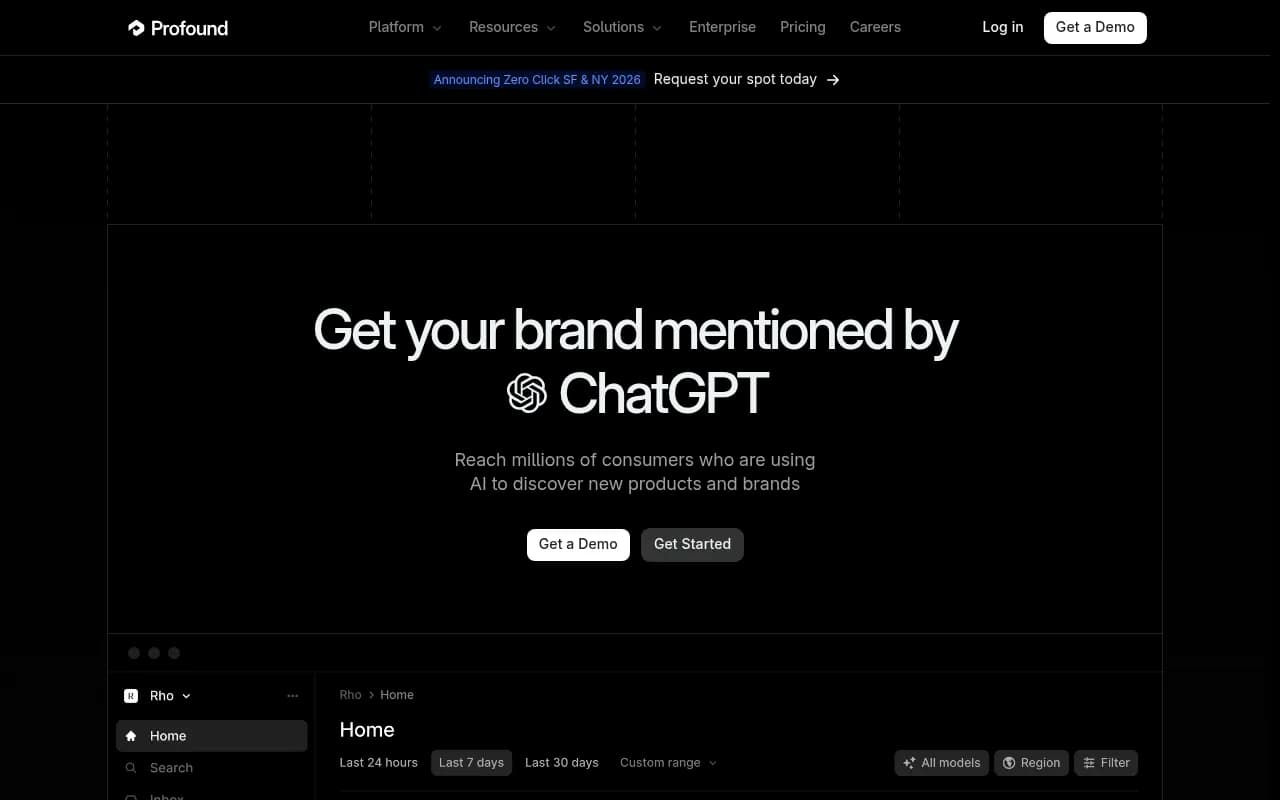
Profound has a strong feature set for enterprise teams that need deep monitoring data, though it comes at a higher price point and lacks Reddit tracking and ChatGPT Shopping monitoring.

Otterly.AI is a lightweight, affordable monitoring option -- good for small teams or agencies that need basic tracking without a lot of overhead. Like Scrunch, it doesn't extend into content optimization.

AthenaHQ is monitoring-focused and works well for teams that need clean dashboards, but it doesn't have content generation or optimization capabilities.
Bottom line
Scrunch tells you where you stand. Relixir helps you create content to improve your standing. Promptwatch does both -- and then tells you whether it worked, right down to the revenue impact.
For teams that are serious about GEO as a growth channel in 2026, the monitoring-only approach isn't enough anymore. The question isn't whether to track AI visibility -- it's whether your tools can help you do something about what you find.