Key takeaways
- All five platforms offer AI search monitoring, but they differ dramatically in what they do after showing you the data
- Scrunch AI (now part of Sitecore) has the broadest feature set among the five, but its pricing reflects that
- AthenaHQ and Search Party are monitoring-first tools -- useful for reporting, limited for optimization
- Rankscale is newer and leans into content scaling, which makes it interesting for agencies with high content volume
- Conductor is an enterprise SEO platform that has added AI visibility features, not the other way around
- If your agency needs to both track and fix AI visibility gaps, you'll want a platform that closes the loop -- not just one that surfaces data
The AI visibility platform market has exploded in the past 18 months. Every week there's a new tool claiming to be the definitive solution for tracking how brands show up in ChatGPT, Perplexity, Google AI Overviews, and the rest. For agencies, this creates a real problem: you need to evaluate these tools quickly, recommend the right one to clients, and actually deliver results -- not just dashboards.
This comparison covers five platforms that come up repeatedly in agency conversations: Scrunch AI, Search Party, AthenaHQ, Rankscale, and Conductor. I've tried to cut through the vendor positioning and focus on what each tool actually does well, where it falls short, and who it's genuinely suited for.
What agencies actually need from an AI visibility platform
Before diving into the tools, it's worth being clear about what "good" looks like for an agency context specifically. Consumer brands can get away with a single-brand dashboard. Agencies can't.
The things that matter most:
- Multi-client management without paying per-seat for every account
- White-label reporting or at least exportable data
- Monitoring across the major LLMs (ChatGPT, Perplexity, Google AI Overviews, Claude, Gemini at minimum)
- Prompt tracking with enough volume to be statistically meaningful
- Some path from "here's the gap" to "here's how to fix it" -- pure monitoring tools leave agencies doing all the heavy lifting
- Pricing that scales reasonably as you add clients
With that frame in mind, here's how the five platforms stack up.
Scrunch AI
Scrunch has been around since 2023, which makes it one of the older players in this space. In 2026 it was acquired by Sitecore, which is either reassuring (enterprise backing, long-term investment) or a yellow flag (acquisition often slows product velocity), depending on your perspective.
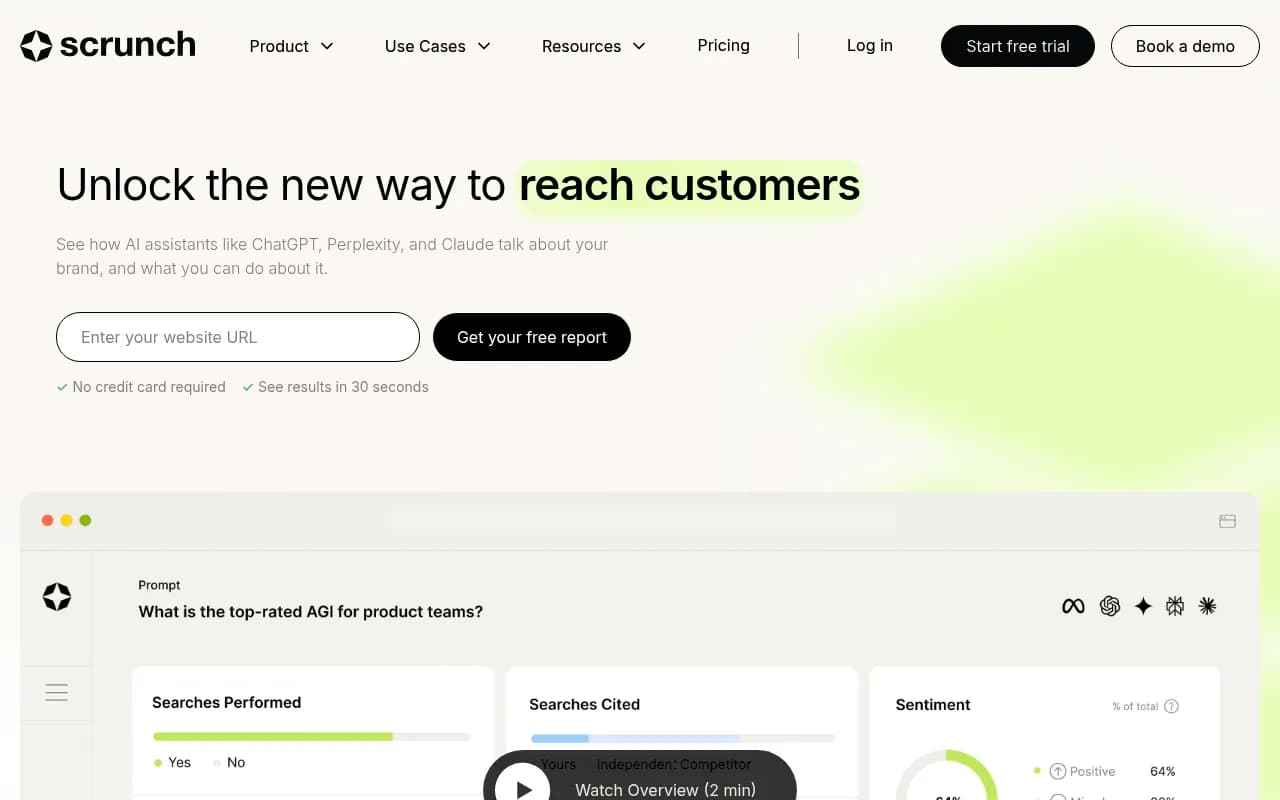
The platform covers monitoring across ChatGPT, Perplexity, Google AI Overviews, and Copilot. It has a dedicated shopping module for tracking product-level AI visibility, which is genuinely useful for e-commerce clients. The "Agent Traffic" feature shows AI crawler activity on your site -- which pages bots are reading, how often, and whether they're encountering errors. That's a meaningful capability most monitoring-only tools don't have.
Where Scrunch gets complicated is the agency use case. The platform has enterprise and agency tiers, but the pricing isn't publicly listed, which means you're going into a sales conversation before you know if it fits your budget. For smaller agencies managing 10-20 clients, that's friction.
The Sitecore acquisition also means Scrunch is increasingly positioned as part of a broader content management ecosystem. If your agency already uses Sitecore, that's potentially a nice integration. If you don't, you're paying for capabilities you'll never use.
Best for: Mid-to-large agencies with e-commerce clients, or those already in the Sitecore ecosystem.
Search Party
Search Party occupies an interesting position. It describes itself as an "AI implementation partner" rather than purely a monitoring tool, which is honest -- it's more of a consulting and automation service than a self-serve SaaS platform.
Search Party
For agencies, this can be either a feature or a bug. If you want a tool your team can log into and run independently, Search Party may not fit that model. If you want a partner that helps build custom AI workflows and automation systems alongside visibility tracking, it's worth a conversation.
On the pure monitoring side, Search Party tracks AI mentions across the major models and provides competitive benchmarking. The prompt metrics are less granular than some competitors -- you won't get the kind of per-prompt volume and difficulty scoring that helps you prioritize which gaps to close first.
The agency-oriented positioning means reporting features are reasonably well developed. But the lack of content optimization capabilities means you're still doing the "fix it" work yourself after the platform tells you what's wrong.
Best for: Agencies that want a strategic partner relationship rather than a self-serve tool, particularly those building custom AI automation workflows for clients.
AthenaHQ
AthenaHQ tracks brand visibility across eight or more AI search engines and has built a reputation for clean, reliable monitoring data. The interface is straightforward, which agencies tend to appreciate when onboarding new clients.
The competitive heatmap feature -- showing how your brand compares to competitors across different LLMs -- is one of the better implementations of this concept in the market. It gives you a clear visual story to bring to client meetings.
The honest limitation: AthenaHQ is monitoring-first, optimization-second. It shows you where you're invisible. It doesn't generate content to fix that invisibility, doesn't produce content briefs grounded in prompt data, and doesn't have the crawler log depth that helps you understand why AI models aren't citing your pages. You get the diagnosis without much of the treatment.
For agencies that have strong in-house content teams and just need the data layer, that's fine. For agencies that need to deliver end-to-end AI visibility improvement, you'll be stitching AthenaHQ together with other tools.
Best for: Agencies with strong content capabilities in-house that need reliable monitoring data and clean client-facing reporting.
Rankscale
Rankscale is newer to the market and takes a different angle: it focuses on scaling AI visibility through content, rather than just tracking it.
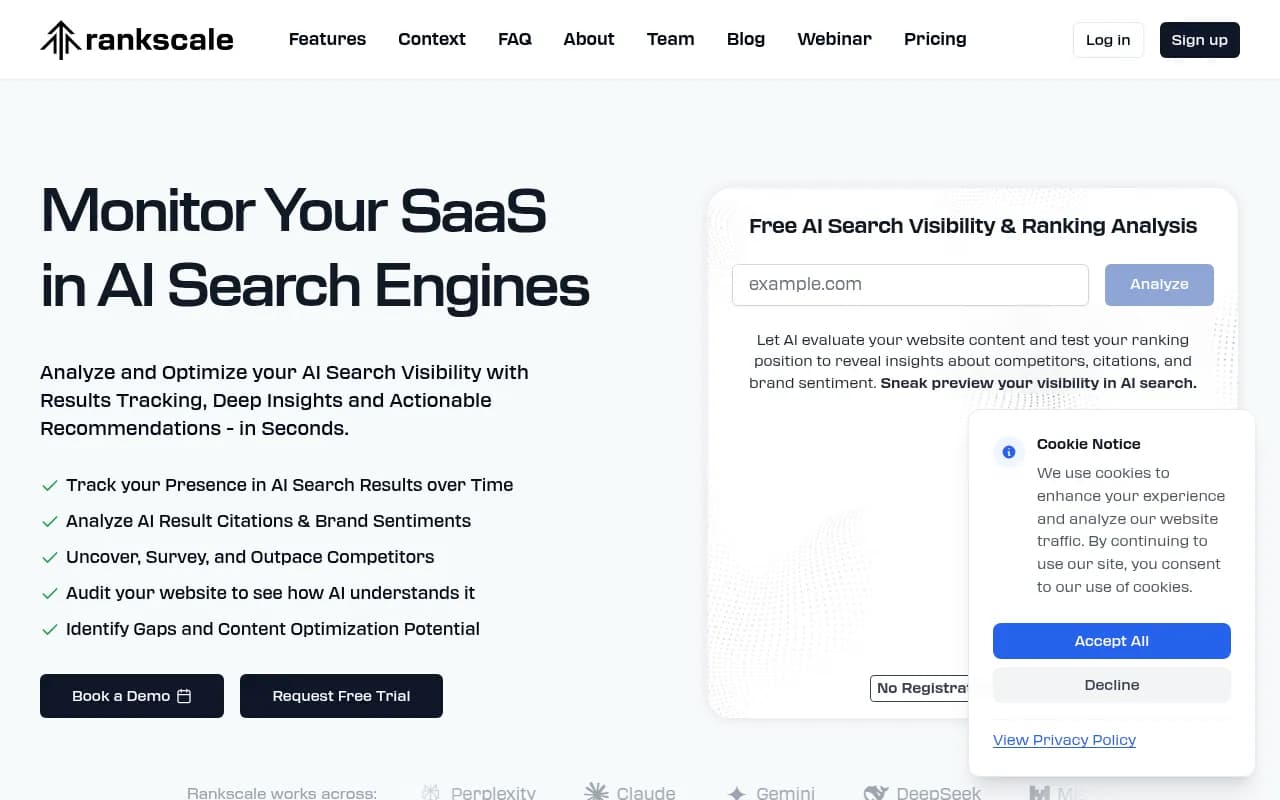
The platform combines visibility monitoring with content generation features designed to close the gaps it identifies. This is the right instinct -- the monitoring-only approach leaves agencies doing too much manual work. Whether Rankscale's execution matches the ambition depends on your specific use case.
For agencies managing clients with large content programs, the scaling angle is appealing. The platform is designed to handle volume, which matters when you're trying to move the needle across dozens of topic clusters simultaneously.
The trade-off is depth. Rankscale's monitoring coverage across LLMs is narrower than Scrunch or AthenaHQ, and the prompt intelligence features (volume estimates, difficulty scoring, query fan-outs) are less developed. You can generate content at scale, but you're doing so with less granular data about which prompts are actually worth targeting.
Best for: Agencies running high-volume content programs for clients in competitive categories, where speed and scale matter more than deep prompt-level analytics.
Conductor
Conductor is the outlier in this comparison. It's an enterprise SEO platform that has added AI search visibility features -- the product started life as a traditional rank tracking and content intelligence tool, and AI visibility is a more recent addition.
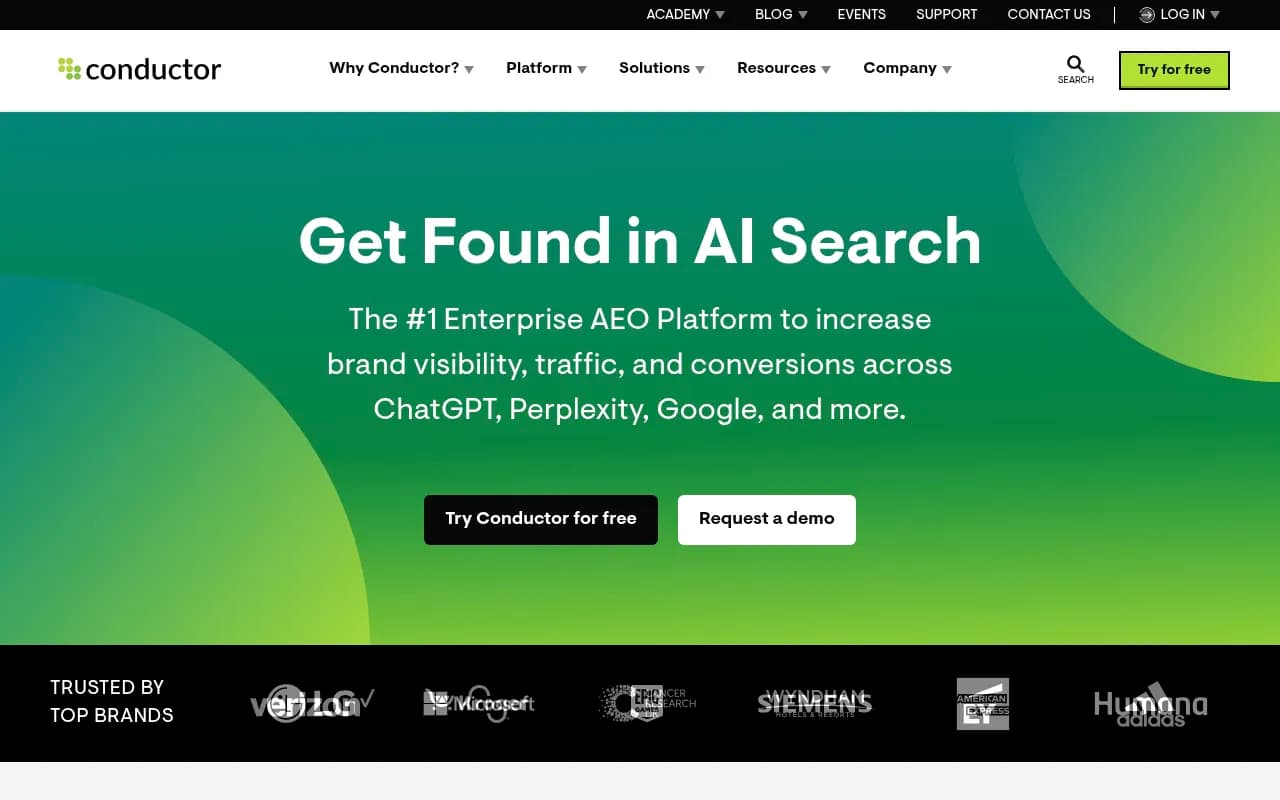
That history shows in the product. The traditional SEO capabilities (rank tracking, content optimization, technical SEO) are mature and well-developed. The AI visibility layer is functional but doesn't have the depth of a purpose-built GEO platform. You're not going to get granular LLM-specific citation analysis or real-time AI crawler logs from Conductor the way you would from a tool built specifically for this problem.
Where Conductor shines is integration. If your agency clients are already using Conductor for SEO, adding AI visibility tracking without switching platforms has real value. The reporting infrastructure is enterprise-grade, and the workflow integrations with content teams are solid.
The pricing is enterprise-level, which means it's probably not the right call for agencies with smaller clients or tighter margins.
Best for: Agencies already using Conductor for SEO who want to add AI visibility without introducing another vendor, particularly for large enterprise clients.
Head-to-head comparison
| Feature | Scrunch AI | Search Party | AthenaHQ | Rankscale | Conductor |
|---|---|---|---|---|---|
| LLMs monitored | ChatGPT, Perplexity, Google AIO, Copilot | Major LLMs | 8+ AI search engines | Select LLMs | Select LLMs |
| Content optimization | Yes (with Sitecore) | No | Limited | Yes (content scaling focus) | Yes (SEO-focused) |
| AI crawler logs | Yes | No | No | No | No |
| Prompt volume/difficulty | Limited | No | No | Limited | No |
| Shopping/product tracking | Yes | No | No | No | No |
| White-label reporting | Agency tier | Limited | Yes | Limited | Yes |
| Multi-client management | Agency tier | Yes | Yes | Yes | Yes |
| Public pricing | No | No | No | No | No |
| Best for | E-commerce, Sitecore users | Strategic partnerships | Data-focused agencies | High-volume content | Enterprise SEO clients |
The gap none of them fully close
Here's the honest observation after looking at all five: most of them are better at showing you the problem than helping you solve it.
Monitoring is table stakes in 2026. Every platform on this list can tell you that your client is invisible for a given prompt. The harder question is: what do you do about it? Which prompts should you prioritize? What content is missing? How do you know if the content you create actually gets picked up by AI models?
Agencies that are serious about delivering AI visibility results -- not just reporting on it -- need a platform that closes the loop between gap identification, content creation, and outcome tracking. That's a harder problem, and it's one most monitoring-first tools haven't fully solved.
Promptwatch is one platform that's built specifically around that loop: Answer Gap Analysis shows which prompts competitors rank for but you don't, Content Agents generate articles grounded in real prompt data, and page-level tracking shows when AI models start citing the new content. It's worth looking at if you're evaluating this category seriously.

How to choose
The right platform depends less on feature lists and more on where your agency's actual bottleneck is.
If your bottleneck is data quality and client reporting, AthenaHQ or Scrunch AI are the strongest options. Both have reliable monitoring and reasonably mature reporting infrastructure.
If your bottleneck is content production at scale, Rankscale's approach is worth exploring, with the caveat that you'll want to validate the prompt intelligence depth before committing.
If your clients are already in the Conductor ecosystem, adding AI visibility there is the path of least resistance. Just go in with realistic expectations about how deep the LLM-specific data goes.
If you want a strategic partner rather than a self-serve tool, Search Party's model might fit -- but clarify upfront what "implementation partner" means in practice and what the ongoing engagement looks like.
And if you need the full loop -- monitoring, gap analysis, content generation, and outcome tracking -- none of the five platforms in this comparison fully delivers that end-to-end. You'll want to look at platforms built specifically around optimization, not just tracking.
A few questions worth asking any vendor
Before signing a contract with any AI visibility platform, push on these:
- How do you capture AI responses -- API calls or real user interface monitoring? (This matters because user-facing answers can differ from API outputs, especially for shopping recommendations and local results.)
- What's your prompt refresh frequency? Daily? Weekly? How stale can the data get?
- Can I see AI crawler logs for my client's site, or just the citation data?
- How does pricing scale as I add clients? Is there a per-client fee or a prompt-pool model?
- What does the content optimization workflow actually look like -- is it AI-generated briefs, full articles, or just recommendations?
- How do you attribute AI visibility to actual traffic and revenue?
The vendors who answer these questions specifically and confidently are the ones worth spending more time with. The ones who pivot to demo requests without answering are telling you something.
Bottom line
Scrunch AI, Search Party, AthenaHQ, Rankscale, and Conductor are all legitimate tools with real use cases. None of them is obviously the wrong choice for every agency. But the category is moving fast, and the platforms that will matter most in 12 months are the ones that go beyond monitoring to actually help agencies improve their clients' AI visibility -- not just measure it.
Pick the tool that matches where your agency is today, but keep an eye on whether it's evolving toward that optimization capability. The agencies that figure out the full loop first will have a meaningful advantage.