Key takeaways
- Most enterprise AI visibility platforms are strong at monitoring but weak at helping you actually fix your visibility gaps -- the distinction matters enormously for ROI.
- Profound is the most established enterprise option with deep analytics and SOC 2 certification, but it sits at a higher price point and leans heavily toward reporting.
- Evertune and Relixir both offer solid GEO feature sets, with Relixir adding content generation to the mix.
- Bluefish is a capable niche player but lacks several features that larger teams will eventually need.
- Promptwatch is the only platform in this comparison that covers the full loop: gap analysis, AI-native content generation, crawler logs, and traffic attribution in one place.
Why this comparison matters in 2026
The AI search market has matured fast. A year ago, most brands were still asking "should we care about ChatGPT visibility?" Now the question is "which platform do we buy to manage it?" That shift has produced a crowded vendor landscape where every tool claims to be the definitive GEO solution.
The problem is that "AI visibility platform" means very different things depending on who's selling it. Some tools track brand mentions across LLMs and call it a day. Others go further -- analyzing why you appear, what content gaps are costing you citations, and how to close those gaps with new content. The gap between these two categories is where enterprise ROI actually lives.
This comparison focuses on five platforms that regularly come up in enterprise shortlists: Profound, Evertune, Relixir, Bluefish, and Promptwatch. We're evaluating them on three dimensions that matter to marketing and SEO teams: monitoring depth, optimization capability, and ROI potential.

The platforms at a glance
Before getting into the detail, here's a side-by-side snapshot of where each platform sits.
| Feature | Profound | Evertune | Relixir | Bluefish | Promptwatch |
|---|---|---|---|---|---|
| AI model coverage | 10+ | 8+ | 6+ | 6+ | 10+ |
| Prompt tracking | Yes | Yes | Yes | Yes | Yes |
| Competitor heatmaps | Yes | Yes | Partial | Partial | Yes |
| Content gap analysis | Partial | Partial | Yes | No | Yes |
| AI content generation | No | No | Yes | No | Yes |
| Crawler logs / agent analytics | No | No | No | No | Yes |
| Reddit & YouTube insights | No | No | No | No | Yes |
| ChatGPT Shopping tracking | No | No | No | No | Yes |
| Traffic attribution | Partial | No | No | No | Yes |
| SOC 2 certified | Yes | Unknown | No | No | Yes |
| Starting price (approx.) | ~$500/mo | ~$400/mo | ~$300/mo | ~$200/mo | $99/mo |
| Free trial | Yes | Yes | Yes | Yes | Yes |
This table already tells a story. Profound and Promptwatch have the broadest feature sets, but they approach the problem from different angles. Profound is built around enterprise governance and deep analytics. Promptwatch is built around the full optimization loop -- find gaps, create content, track results.
Profound: enterprise depth, monitoring-first
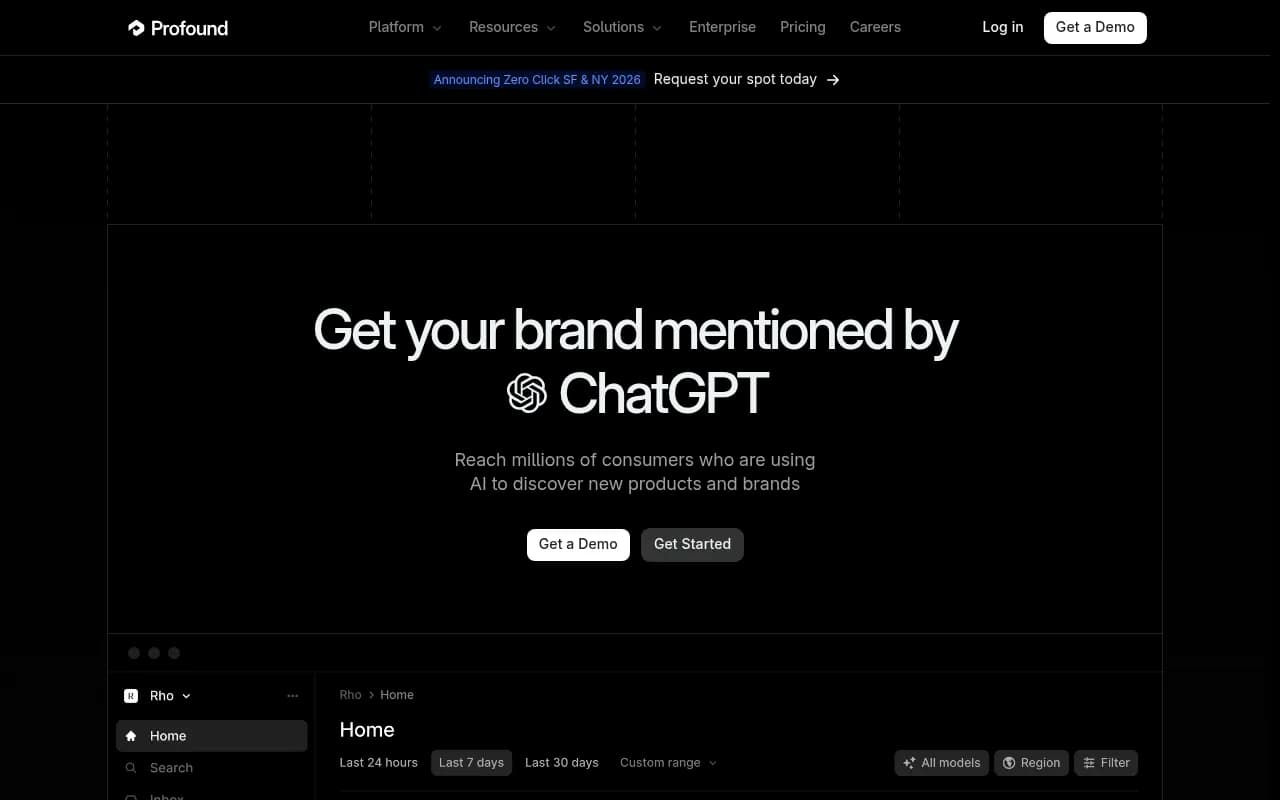
Profound has earned its reputation as the go-to platform for enterprise teams that need rigorous, defensible data. It monitors brand visibility across 10+ AI engines, provides detailed "why did we appear?" analysis, and comes with SOC 2 Type II certification -- which matters a lot when you're dealing with enterprise procurement and security reviews.
The platform's strength is analytical depth. You can drill into specific prompts, see which sources AI models are citing, and track sentiment around your brand mentions. For teams that need to present AI visibility data to a CMO or board, Profound gives you the kind of structured reporting that holds up to scrutiny.
Where Profound falls short is on the action side. It's excellent at telling you what's happening and why, but it doesn't help you fix it. There's no content generation, no AI-native content briefs grounded in real prompt data, and no crawler logs showing how AI agents are actually crawling your site. You get a very clear picture of the problem -- and then you're on your own to solve it.
Pricing starts around $500/month for meaningful enterprise usage, which puts it in a tier where you'd expect the full optimization stack. The fact that you still need separate tools for content creation and technical GEO is a real limitation at that price point.
Best for: Large enterprises with dedicated analytics teams who need audit-grade data and governance features, and who have separate content teams to act on the insights.
Evertune: strong GEO insights, Fortune 500 focus
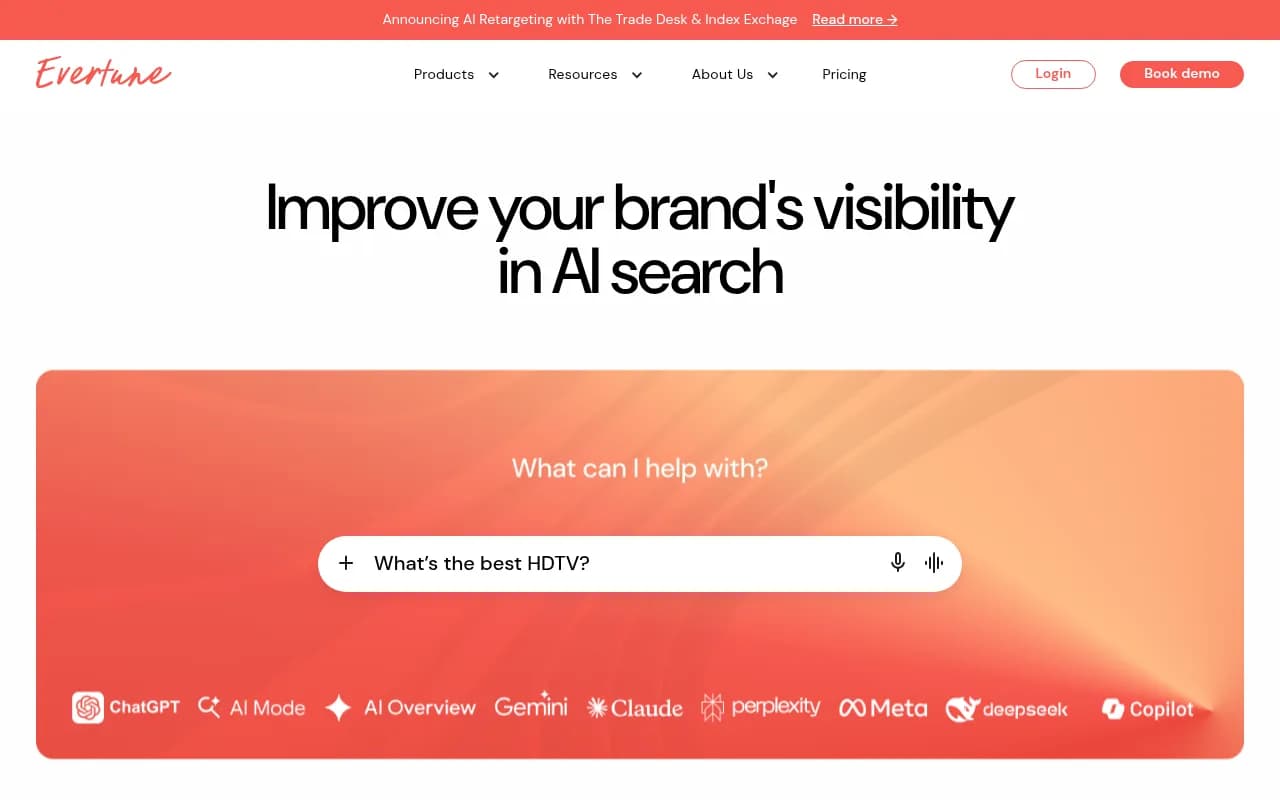
Evertune positions itself as an AI visibility platform specifically for larger brands, and its feature set reflects that. It covers 8+ AI models, tracks brand mentions with competitive context, and provides GEO insights that go beyond basic citation counting. The platform has been adopted by some Fortune 500 brands, which speaks to its credibility in the enterprise space.
What Evertune does well is the competitive layer. Its brand monitoring shows not just whether you appear in AI responses, but how you compare to competitors across different prompt categories. That's genuinely useful for teams trying to prioritize where to focus their GEO efforts.
The limitation is similar to Profound's: Evertune is primarily a monitoring and insights platform. It surfaces the data but doesn't close the loop with content generation or technical optimization tools. If your team has strong content capabilities and just needs better intelligence to direct them, Evertune works well. If you need the platform to help you actually create the content that will improve your visibility, you'll hit a wall.
Pricing is roughly in the $400/month range for team plans, scaling up for enterprise.
Best for: Marketing and brand teams at large companies who want competitive GEO intelligence and can act on insights independently.
Relixir: the content-generation entrant
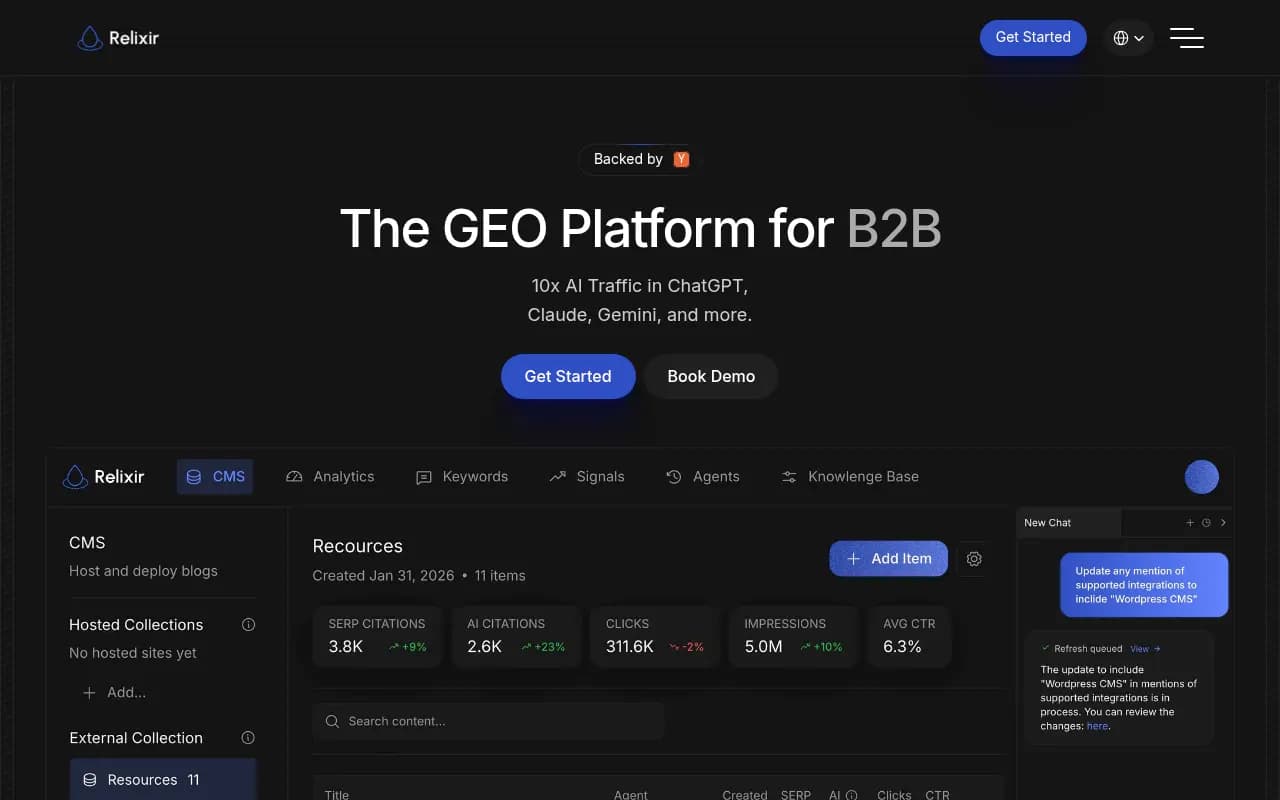
Relixir is the most interesting of the challenger platforms because it's one of the few that attempts to bridge monitoring and content creation. The platform tracks brand visibility across AI models, identifies content gaps, and offers AI content generation to help you fill them. That's a more complete workflow than most competitors offer.
In practice, Relixir's content generation is useful but not as deeply grounded in real prompt data as you'd want for serious GEO work. The gap analysis is solid for identifying where competitors are visible and you're not, but the content output doesn't always reflect the specific angles and question formats that AI models are actually rewarding with citations.
Relixir also covers fewer AI models than Profound or Promptwatch (around 6+), which matters if your audience is spread across ChatGPT, Perplexity, Gemini, and Claude -- which most enterprise audiences are.
Pricing is more accessible, starting around $300/month, which makes it a reasonable option for mid-market teams that want to move beyond pure monitoring without committing to a full enterprise platform.
Best for: Mid-market teams that want a combined monitoring and content workflow and are willing to trade some depth for a more integrated experience.
Bluefish: capable but limited at scale
Bluefish is a GEO platform that covers the basics well: brand monitoring across AI models, competitor tracking, and some citation analysis. For smaller teams or brands just getting started with AI visibility, it's a reasonable entry point.
The challenge with Bluefish at the enterprise level is what's missing. There's no content gap analysis, no content generation, no crawler logs, and limited attribution capabilities. A comparison between Profound and Bluefish published in 2026 noted that Profound's analytics depth and SOC 2 certification make it the stronger choice for enterprise use cases -- and that gap is real.
Bluefish also covers fewer AI models than the top-tier platforms, which becomes a problem as AI search diversifies. If a significant portion of your audience is using Grok, DeepSeek, or Copilot alongside ChatGPT and Perplexity, you need coverage across all of them.
Pricing starts lower than the other platforms here, around $200/month, which reflects the more limited feature set.
Best for: Smaller brands or teams in the early stages of GEO who need basic monitoring and don't yet need the full optimization stack.
Promptwatch: the full optimization loop

Promptwatch takes a different approach to the problem. Where most platforms in this comparison are built around monitoring -- showing you data and leaving you to figure out what to do -- Promptwatch is built around a closed loop: find gaps, create content, track results.
The gap analysis is genuinely useful. It shows you exactly which prompts competitors are visible for that you're not, down to the specific questions and topics AI models want answered. That's not just a list of keywords; it's a map of the content your site is missing.
The content generation layer is where Promptwatch separates itself from the field. Content Agents generate articles, listicles, and comparisons grounded in real prompt data, citation patterns, and competitor analysis. The output is designed to answer the specific gaps AI models are exposing -- not generic SEO filler. This is the piece that most competitors, including Profound and Evertune, simply don't have.
Then there's the crawler log data. Promptwatch tracks AI crawlers (ChatGPT, Claude, Perplexity, and others) hitting your site in real time -- which pages they read, errors they encounter, and when pages move from crawl to citation. Most platforms have no visibility into this layer at all. It's the difference between knowing you're not being cited and knowing why.
Other features that matter at the enterprise level: Reddit and YouTube insights (which AI models actually use as sources), ChatGPT Shopping tracking, multi-language and multi-region monitoring, and traffic attribution that connects AI visibility to actual revenue. Promptwatch also integrates with Cloudflare, Fastly, Vercel, and Google Search Console for low-latency data.
Pricing starts at $99/month for the Essential tier (1 site, 50 prompts, 5 articles), $249/month for Professional (2 sites, 150 prompts, 15 articles, crawler logs), and $579/month for Business (5 sites, 350 prompts, 30 articles). Enterprise and agency pricing is custom. That's significantly more accessible than Profound or Evertune for comparable or greater functionality.
Best for: Marketing teams, SEO teams, and agencies that want to move from visibility tracking to actual optimization -- and need the content generation and technical GEO tools to do it.
ROI comparison: where does the value actually come from?
This is the question that matters most for enterprise buyers, and it's where the platforms diverge most sharply.
Monitoring-only platforms (Profound, Evertune, Bluefish) generate value by improving decision-making. You know where you're invisible, you can prioritize which prompts to target, and you can report progress to stakeholders. That's real value, but it's indirect. The actual improvement in visibility still depends on your team's ability to create the right content and fix the right technical issues.
Platforms with content generation (Relixir, Promptwatch) can generate more direct ROI because they close the loop. You identify a gap, generate content designed to fill it, publish it, and track whether AI models start citing it. The timeline from insight to impact is shorter, and the dependency on separate content workflows is reduced.
Promptwatch adds another layer with its crawler log data. Understanding why AI models aren't citing your pages -- whether it's a crawl error, a content gap, or a competitor's stronger answer -- lets you fix the right thing instead of guessing. That's a meaningful accelerant for teams trying to improve visibility quickly.
For enterprise teams evaluating ROI, the honest question is: what's the cost of having great data but no clear path to acting on it? If your team has the bandwidth and capability to turn monitoring insights into content and technical fixes independently, Profound or Evertune might be sufficient. If you want the platform to do more of that work, Promptwatch is the stronger choice.
Which platform should you choose?
There's no single right answer here -- it depends on your team's size, existing capabilities, and what you're trying to accomplish.
If you're a large enterprise with a dedicated analytics function, strong content teams, and a need for audit-grade governance, Profound is the most defensible choice. The SOC 2 certification and depth of analysis are hard to match.
If you're a large brand that wants competitive GEO intelligence and has the content capability to act on it, Evertune is worth a serious look.
If you're a mid-market team that wants monitoring and content generation in one platform and can accept some trade-offs on depth, Relixir is a reasonable middle ground.
If you're early in your GEO journey and need basic monitoring without a large budget commitment, Bluefish gets you started.
If you want the complete picture -- monitoring, gap analysis, content generation, crawler logs, and traffic attribution -- and you want it in one platform without paying enterprise prices for each piece separately, Promptwatch is the strongest option in this comparison. It's the only platform here that covers the full optimization loop, and it does so at a price point that makes sense for teams of almost any size.
The AI search landscape is moving fast. The brands that will win aren't the ones with the best dashboards -- they're the ones that can identify gaps and fill them faster than their competitors. That's what separates a monitoring tool from an optimization platform.