Key takeaways
- Scrunch was acquired by Sitecore in 2026, meaning its standalone product roadmap is now uncertain for teams not on enterprise Sitecore contracts.
- The core capabilities Scrunch offered -- brand monitoring, citation tracking, agent traffic analysis, and AI shopping insights -- can all be replaced with tools available today.
- Most Scrunch alternatives fall into two camps: monitoring-only dashboards and full optimization platforms. Know which one you actually need before switching.
- Rebuilding your stack takes less time than you think. With the right tool, you can have prompts configured and baseline data flowing within 48 hours.
- If you want to go beyond monitoring and actually improve your AI visibility, look for a platform with content gap analysis and content generation built in -- not just a tracker.
What actually happened with Scrunch
If you've visited scrunch.com recently, you've seen the banner: "Scrunch is now a Sitecore company."
That's an acquisition, not a shutdown -- but for most teams using Scrunch as a standalone AI visibility tool, the practical effect is similar. Sitecore is an enterprise CMS platform. Its acquisition of Scrunch was about folding AI search capabilities into a broader content management play, not about continuing to serve independent marketing teams and agencies at Scrunch's original price points.
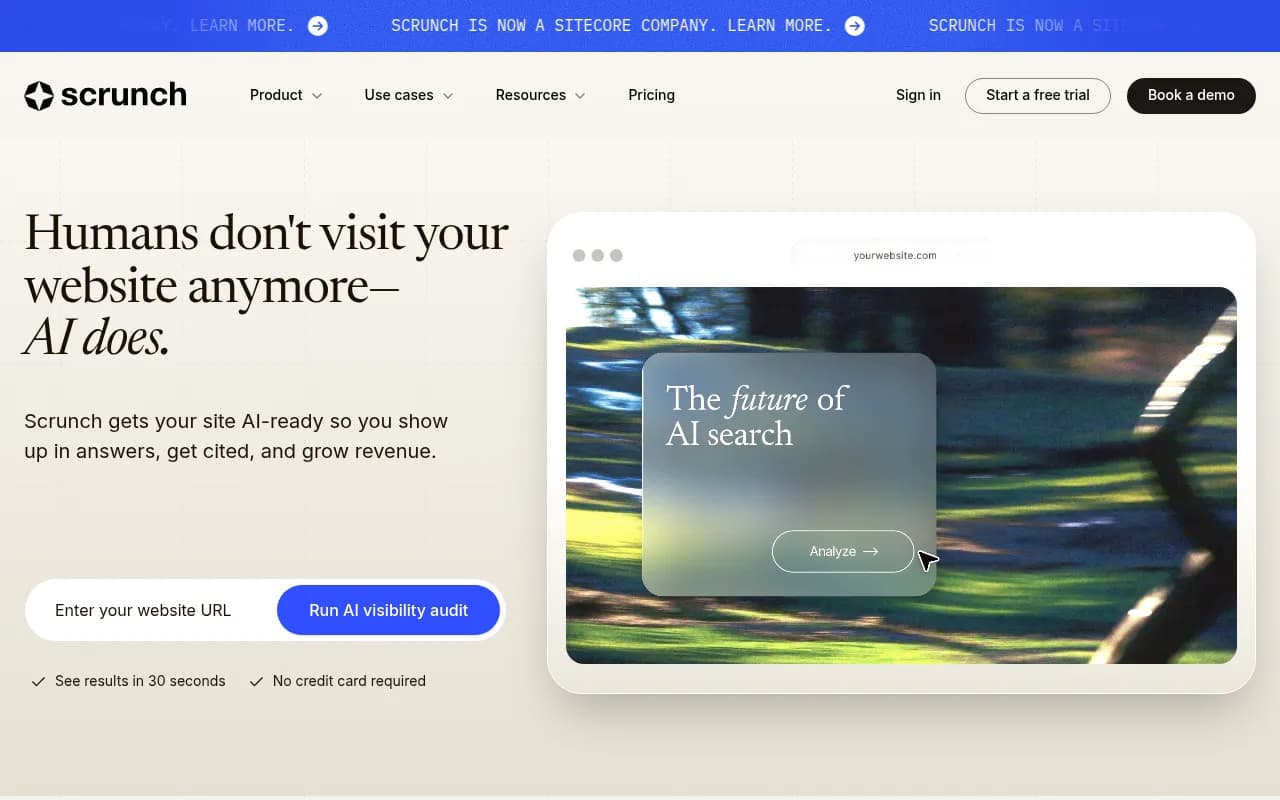
What Scrunch offered was genuinely useful: brand monitoring across AI engines, citation tracking, agent traffic analysis (understanding which AI crawlers were hitting your site and how), an AI shopping visibility layer, and some site-map tooling that showed how AI models were consuming your content. For teams that had built workflows around those features, the acquisition creates real uncertainty about pricing, product direction, and long-term access.
So this guide is for you if you're in that position -- you used Scrunch, you're not sure what happens next, and you need to figure out your AI visibility stack before your data goes dark.
Step 1: Audit what you were actually using
Before you start evaluating replacements, spend an hour documenting what Scrunch was doing for you. Most teams used only a subset of its features, and knowing which ones matters will save you from over-buying a replacement.
Ask yourself:
- Were you primarily tracking brand mentions and citations across AI engines like ChatGPT, Perplexity, and Gemini?
- Were you using the agent traffic feature to understand which AI crawlers were visiting your site?
- Did you rely on the shopping visibility layer for product-level tracking?
- Were you using the insights/recommendations feature to get optimization suggestions?
- Did you have prompts configured for competitor monitoring?
Write down the answers. The reason this matters: a lot of the tools in this space are monitoring-only. They'll show you a visibility score and a list of citations, but they won't tell you what to do about it. If Scrunch's insights and recommendations were core to your workflow, you need a replacement that goes further than a dashboard.
Step 2: Understand the replacement landscape
The AI visibility tool market has grown fast. There are now roughly 30+ tools claiming to track brand visibility in AI search. They're not all equivalent. Here's how to think about the categories:
Monitoring-only tools
These track how often your brand appears in AI responses, which models cite you, and sometimes which competitors are outperforming you. Good for awareness, weak on action.
Examples: Otterly.AI, Peec.ai, LLM Pulse, Trakkr.ai


Monitoring + optimization platforms
These go further -- they show you what's missing, help you understand why competitors are getting cited instead of you, and give you tools to fix it. This is where the real value is in 2026.
Examples: Promptwatch, Profound, Scrunch AI (the legacy product), ZipTie

Enterprise platforms
These are typically part of a larger SEO or content suite, with AI visibility as one module among many. Useful if you're already in their ecosystem; overkill if you just need AI tracking.
Examples: Semrush, Ahrefs Brand Radar, BrightEdge, seoClarity
Step 3: Match your needs to a replacement
Here's a comparison of the most relevant Scrunch alternatives for 2026, mapped to the features Scrunch offered:
| Feature | Promptwatch | Profound | Otterly.AI | ZipTie | SE Visible |
|---|---|---|---|---|---|
| Brand monitoring (ChatGPT, Gemini, Perplexity, etc.) | 10 models | Multiple | Multiple | Multiple | 5+ models |
| Citation tracking | Yes | Yes | Yes | Yes | Yes |
| AI crawler / agent logs | Yes | No | No | No | No |
| Content gap analysis | Yes | Yes | No | Partial | No |
| Content generation | Yes | No | No | No | No |
| ChatGPT Shopping tracking | Yes | No | No | No | No |
| Reddit & YouTube insights | Yes | No | No | No | No |
| Prompt volume & difficulty scoring | Yes | Partial | No | No | No |
| Starting price | $99/mo | Higher | Lower | Lower | Part of SE Ranking |
The honest takeaway from this table: if you want a direct feature-for-feature replacement for what Scrunch offered, Promptwatch is the closest match -- and it goes further in several areas Scrunch didn't cover, like AI crawler logs and content generation.
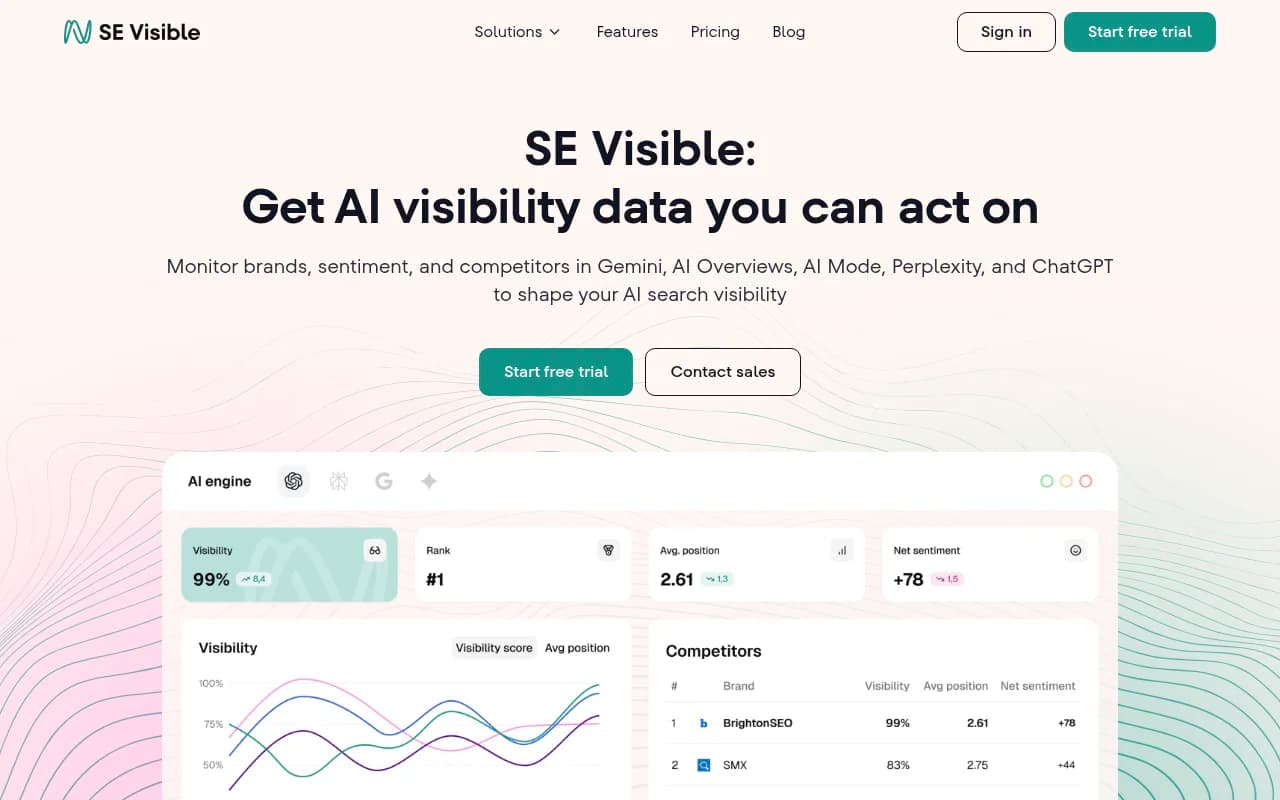
If budget is the primary constraint and you just need basic citation monitoring to maintain visibility into your brand mentions, Otterly.AI or SE Visible are reasonable starting points. You'll outgrow them if you want to actually improve your rankings, but they'll keep the lights on.
Step 4: Rebuild your prompt library
This is the part most teams skip, and it's a mistake. Your prompt library -- the set of queries you track across AI engines -- is the foundation of everything else. If you had prompts configured in Scrunch, export whatever data you can before access changes. Then rebuild.
A good prompt library for AI visibility tracking has three layers:
Brand prompts: Direct queries about your company. "What is [brand]?", "Is [brand] a good option for [use case]?", "How does [brand] compare to [competitor]?" These tell you your baseline visibility and sentiment.
Category prompts: Queries about your product category where you want to appear. "Best [product type] for [audience]", "How to choose a [product]", "What should I look for in a [service]?" These reveal where you're missing from AI recommendations entirely.
Competitor prompts: Queries where your competitors are currently being recommended. This is where the gap analysis gets interesting -- if ChatGPT recommends three competitors and not you for a specific query, that's a content problem you can fix.
Most platforms let you import prompts in bulk via CSV. Start with 20-30 prompts, get baseline data flowing, then expand. Don't try to track 200 prompts on day one -- you'll drown in data before you understand what you're looking at.
Step 5: Get your crawler data back
One thing Scrunch offered that most competitors don't is agent traffic analysis -- the ability to see which AI crawlers (GPTBot, ClaudeBot, PerplexityBot, etc.) were hitting your site, which pages they were reading, and how frequently they returned.
This data matters because it tells you whether AI engines are even aware of your content. A page that never gets crawled by GPTBot will never be cited by ChatGPT. If you were using Scrunch's agent traffic feature, you need to replace it.
Your options:
- Promptwatch's AI Crawler Logs: Real-time logs of AI crawler activity, including which pages they read, errors they hit, and the timeline from crawl to citation. This is the most complete implementation I've seen in the market.
- Cloudflare logs: If you're on Cloudflare, you can filter your access logs for known AI crawler user agents. It's manual and requires some setup, but it's free.
- Server logs: Same principle -- filter for GPTBot, ClaudeBot, PerplexityBot, Amazonbot, etc. Your DevOps team can set this up in a few hours.
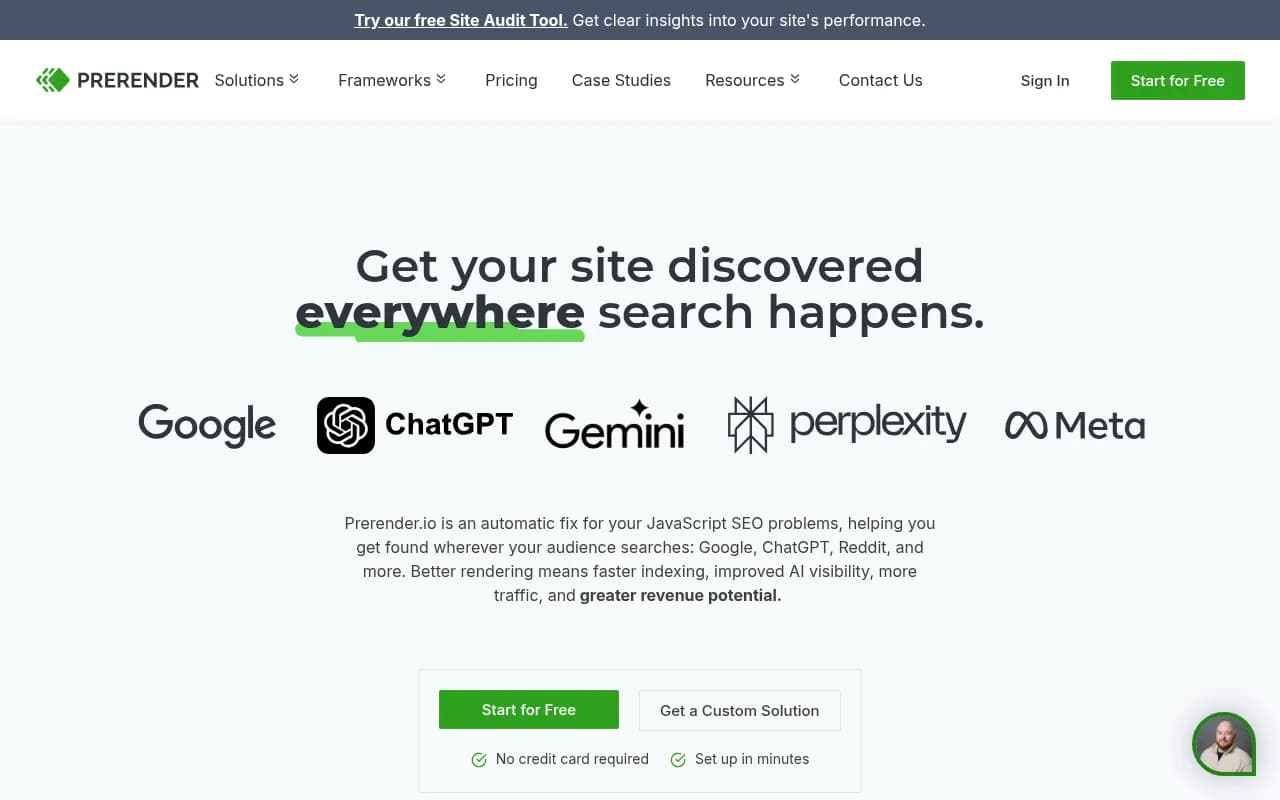
- Prerender.io: Primarily a rendering tool, but it surfaces some AI crawler data as a side effect.
If you're not technical and you want this data without any setup work, Promptwatch's crawler logs are the fastest path. The Professional plan ($249/mo) includes them.
Step 6: Replace the content optimization layer
Here's where most Scrunch users will feel the biggest gap. Scrunch's "Insights" feature gave optimization recommendations -- it told you what to change on your site to improve AI visibility. That's harder to replace with a monitoring-only tool.
The question to ask is: what do you do when you find a gap? When you discover that ChatGPT recommends three competitors for a query you should be winning, what's your next step?
If your answer is "write content to fill that gap," you need a platform that helps you do that efficiently. Generic AI writing tools (Jasper, Copy.ai) can produce content, but they don't know which specific questions AI models are asking or which angles are getting competitors cited. That's a different problem.
Promptwatch solves this with what it calls the Answer Gap Analysis -- it shows you the specific prompts where competitors are visible and you're not, then generates content briefs and full articles grounded in that prompt data. The content isn't generic; it's engineered around the exact questions AI models are already answering with your competitors' content.
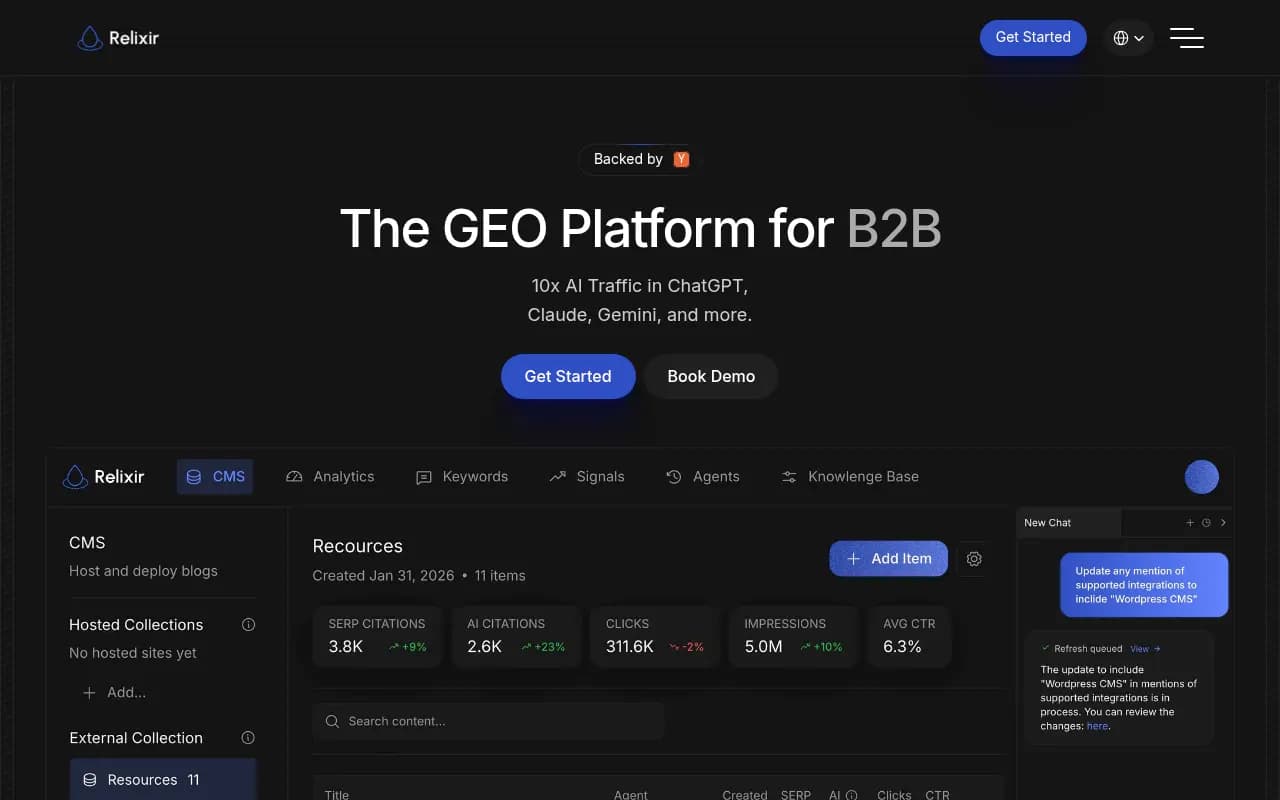
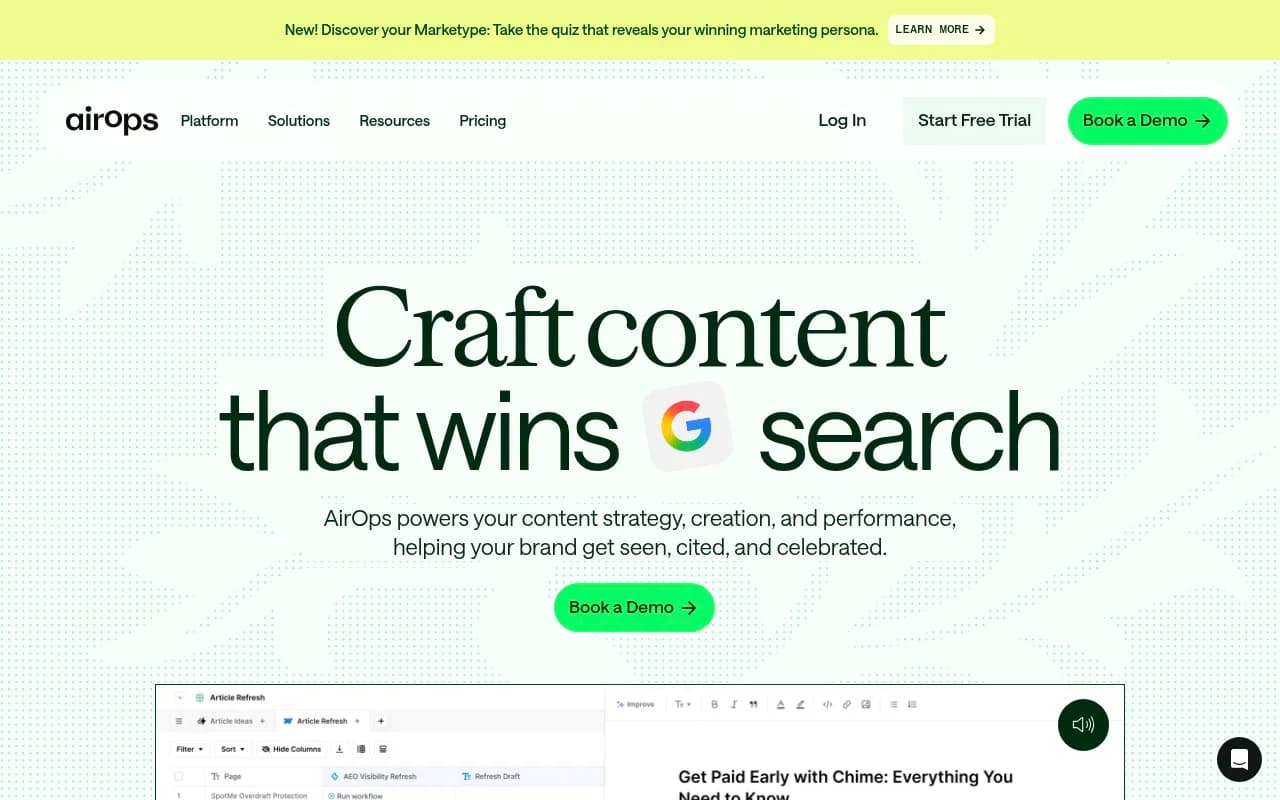
For teams that want to handle content creation separately, tools like Relixir and AirOps offer AI content workflows that can be pointed at visibility gaps.
Step 7: Set up your reporting baseline
Before your Scrunch data goes stale, document your current state. Screenshot your visibility scores, export any citation data you can access, and note which prompts were performing well vs. poorly. This becomes your baseline for measuring progress in your new tool.
Once you're set up in a replacement platform, give it 2-3 weeks before drawing conclusions. AI visibility data has some inherent variability -- models update, responses change, and a single week of data can be misleading. What you want to see over 30-60 days is a trend line, not a snapshot.
For agencies managing multiple clients, this transition is also a good moment to standardize your reporting. Tools like Promptwatch have Looker Studio integration and an API, which means you can pipe visibility data into whatever reporting infrastructure you already use.
The one-week rebuild plan
If you want a concrete timeline, here's how to do this in five working days:
Day 1: Audit your Scrunch usage. Export all data you can access. Document your prompt library and which features you relied on most.
Day 2: Sign up for trials of 1-2 replacement tools. Based on the comparison table above, Promptwatch covers the most ground. Start a free trial and configure your first 20-30 prompts.
Day 3: Set up crawler log monitoring. Either through your new platform or via server/Cloudflare logs. Verify that AI crawlers are being tracked.
Day 4: Run your first gap analysis. Look at which prompts your competitors are winning that you're not. Identify the top 3-5 content gaps worth addressing.
Day 5: Create your first piece of content targeting a specific gap. Publish it. Set a reminder to check citation data in 2-3 weeks.
That's it. You're not fully migrated on day 5, but you have data flowing, gaps identified, and a content response in motion. The rest is iteration.
What to watch out for when switching
A few things that catch teams off guard during this kind of migration:
Prompt parity isn't automatic. The visibility scores you see in a new tool won't match what Scrunch showed you. Different tools sample differently, query at different frequencies, and weight models differently. Don't expect apples-to-apples comparisons -- establish a new baseline and measure from there.
Model coverage varies. Scrunch tracked a solid range of AI engines. Before committing to a replacement, verify it covers the models your audience actually uses. If your customers are heavy Perplexity users, a tool that only tracks ChatGPT and Gemini is going to miss a lot.
"Insights" quality differs a lot. Some tools generate optimization recommendations that are genuinely useful; others produce generic advice that amounts to "publish more content." Test the quality of recommendations before you rely on them.
Agent traffic data is rare. Most monitoring tools don't offer this. If it was part of your workflow, make sure your replacement explicitly supports it -- don't assume.
Bottom line
Scrunch's acquisition by Sitecore isn't necessarily the end of the product, but it's a signal that the standalone tool's future is tied to Sitecore's enterprise roadmap. For most independent teams and agencies, that's enough reason to start evaluating alternatives now rather than waiting to see what happens.
The good news: the replacement options in 2026 are genuinely better than what existed when Scrunch launched. The market has matured. You can get monitoring, gap analysis, content generation, and crawler logs in a single platform -- something that wasn't possible two years ago.
The key decision is whether you want a monitoring tool or an optimization platform. If you just want to know where you stand, there are cheap options that will do the job. If you want to actually improve your AI visibility -- and connect that improvement to revenue -- you need something that closes the loop from insight to content to citation.
That's the difference worth paying for.