Key takeaways
- Ranketta's own customer logos and the "1200+ e-commerce brands" claim on its site suggest an e-commerce-led product, even though it has a B2B SaaS landing page. That is worth checking against your needs before you commit.
- B2B SaaS buyers ask AI for shortlists: "best CRM for small teams", "X alternatives", "A vs B". Any tool you pick must track those prompt types with competitors named.
- Promptwatch's data shows ChatGPT cites vendor sites and docs about three times as often as review sites for software prompts, so your own pages matter more than most teams assume.
- Test every tool on the same prompt panel (category, alternatives, comparison, pricing, integrations) before paying. Scores from different tools often disagree.
- I did not verify pricing for any tool here. Check each vendor's pricing page before shortlisting.
Why Ranketta may not be the right fit for B2B SaaS
Ranketta is a real product with a decent feature set: prompt research ranked by demand, a site audit, a content studio, MCP connectivity, Looker Studio integration and AI traffic attribution. It also claims 4.9/5 on G2. Nothing wrong there.
The question is fit. Its homepage says "Trusted by 1200+ e-commerce brands" and the logos are retailers and consumer brands (Rossmann, Sconto, O2). Dageno's comparison of Ranketta alternatives describes it as strongest for e-commerce and D2C teams that need product-level visibility and catalog enrichment. That is a different job from getting a SaaS product named when someone asks ChatGPT for a project management tool.
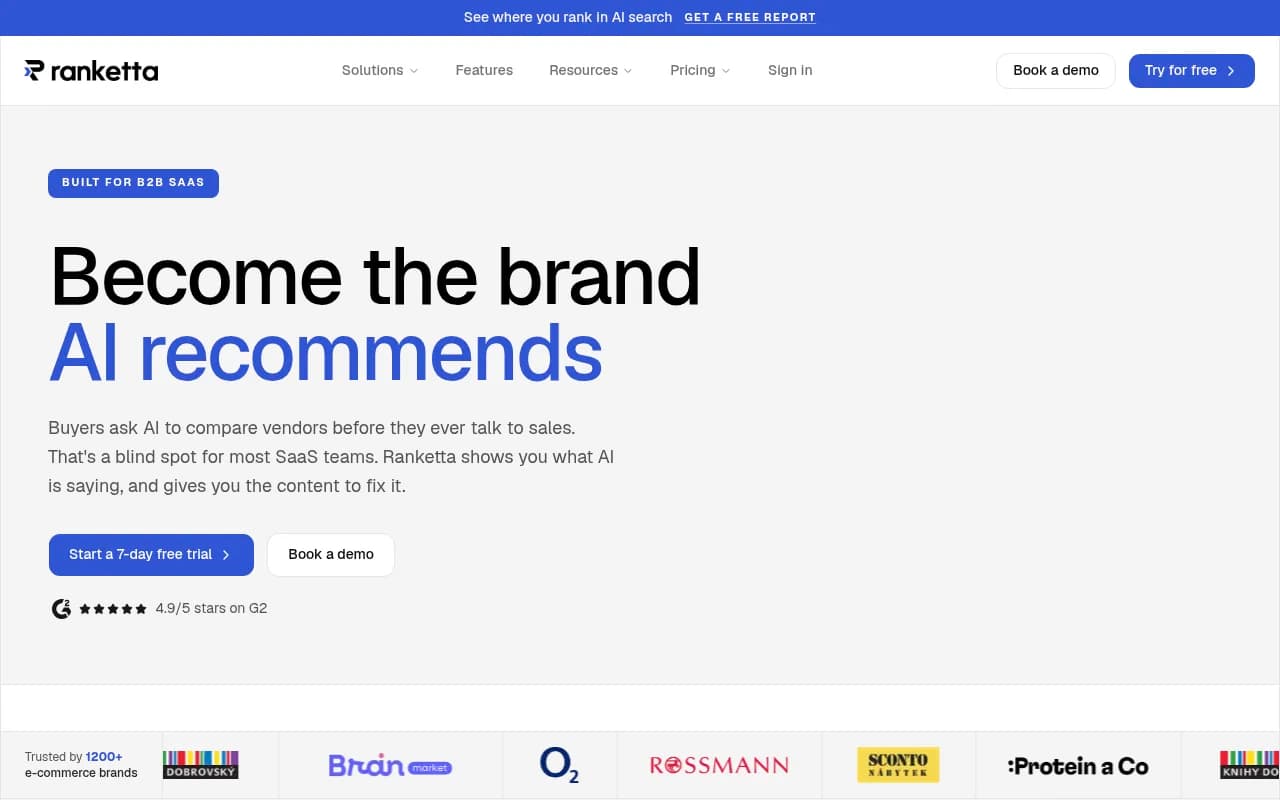
To be fair, Ranketta does have a B2B SaaS page, and its comparison table against Profound, Semrush, Ahrefs and Peec AI is the vendor's own claim, not independent testing. I would not dismiss it. I would just run it through the same test as everything else below.
What B2B SaaS buyers actually ask AI
Before comparing tools, write down the prompts. A SaaS buyer typically asks AI for a shortlist before opening a review site or your pricing page. The prompt types that matter:
| Prompt type | Template | Example |
|---|---|---|
| Category | best [category] for [segment] | best CRM for small agencies |
| Alternatives | [competitor] alternatives | Asana alternatives for small teams |
| Comparison | [A] vs [B] | Acme vs Asana for marketing teams |
| Pricing | [product] pricing for [segment] | HubSpot pricing for startups |
| Integrations | does [product] integrate with [tool] | does Acme integrate with Salesforce |
| Branded | is [product] good for [use case] | is HubSpot good for startups |
Write them the way a buyer would type them, including segment and use case. Short keywords produce misleading results.
What ChatGPT cites for those prompts
Promptwatch Data's ChatGPT citation share by content type report (Sep 28 to Oct 4, 2026) shows what gets cited:
- Commercial prompts like "best CRM for small businesses" cite product pages 26.0% of the time, landing pages 20.6%, listicles 15.0% and comparisons 7.9%. Those four types make up almost 70% of commercial citations.
- Branded prompts cite reviews at 5.6%, more than three times their overall share.
- Comparison pages are 5.9% of citations overall but 7.9% on commercial prompts, so publishing your own is worth it.
For software specifically, Promptwatch's software citation report (same week) puts GitHub first at 1.2%, then learn.microsoft.com at 0.98% and G2 at 0.73%. Docs and help centers earn 2.64% and vendor sites 2.01%, against 1.57% for review sites and analysts like G2, Gartner and Capterra. Vendor sites and docs together earn roughly three times the review-site share. So your own site is the main citation source, and public, crawlable documentation is part of your visibility strategy.
One caveat on fan-outs: Promptwatch's query fanout report says a prompt can trigger 3 to 8+ searches, but its own charts show averages between 1 and 2 queries per response. Treat the charted figures as the real ones. The practical advice still holds: write headings that read like short search queries and cover "X vs Y", pricing and alternatives on focused pages.
What to look for in a Ranketta alternative
A few criteria separate tools that work for SaaS from ones that don't:
- Category and alternatives prompt tracking, not only brand-name monitoring.
- Competitors named in every prompt, with share of voice per competitor.
- Citation sources: which pages (G2, Capterra, Reddit, comparison posts) the answer leaned on.
- Prompt clusters, so you can see "alternatives" separately from "pricing".
- Multi-language and multi-region support if you sell internationally.
- A path from insight to action: content gaps, briefs, publishing.
- Attribution: do AI visits turn into pipeline, and can data reach your BI or CRM stack?
The fifth and last points are where most tools fall down. Plenty of dashboards report a score. Fewer help you fix the page or prove revenue.
The shortlist
Promptwatch: monitoring plus the fix
Promptwatch is the one I would test first for a B2B SaaS team that wants to act on the data, not just watch it. It tracks ChatGPT, Google AI Overviews, AI Mode, Gemini, Perplexity, Copilot and others through their real interfaces, so the answers match what buyers see. Prompt volumes and difficulty scores help you pick which comparison and alternatives prompts are worth chasing, and query fan-outs show the actual searches the model runs.
From there it traces which of your pages get cited, shows content gaps against the prompts AI answers, and its Content Agent can write and publish pages to WordPress, Webflow or Framer. IP-verified AI crawler logs tell you whether a page is an access problem or a content problem, and visitor analytics measure the AI traffic and conversions that result. It also tracks Reddit, YouTube and LinkedIn citations, which matters if G2 and Reddit threads drive your category answers.

Pricing per Promptwatch's site: Essential $95/mo (50 prompts), Professional $245/mo (150 prompts), Business $579/mo (350 prompts, Content Agent, faster tracking, state and city tracking). A 7-day free trial is available on monthly billing, and there is a free AI visibility report. Confirm at promptwatch.com/pricing. If you are evaluating against the vendor-claimed Ranketta table, the 2026 GEO platform comparison is a useful second opinion, and head-to-head pages like Promptwatch vs Profound go deeper.
Profound: enterprise monitoring
Profound is the name that comes up first in most B2B SaaS roundups, including the Reddit thread that lists it at number one. It has strong monitoring and suits larger budgets. Its weakness compared with action-oriented platforms is that it stops at the dashboard for most teams.

Peec AI: lean prompt tracking
Peec AI is a straightforward monitoring tool. Good if you want clean visibility numbers and competitor benchmarks without the extras. You will need other tools for crawler logs, content production and traffic attribution.

Semrush: AI tracking next to your SEO data
If your team already lives in Semrush, its AI Visibility toolkit gives you prompt research with topic volume and difficulty, competitor research and an AI Visibility Score in the same place as keyword data. The tradeoff is depth: suite add-ons tend to have fixed prompt sets and thinner AI-specific data.
Dageno AI: a cross-industry GEO workflow
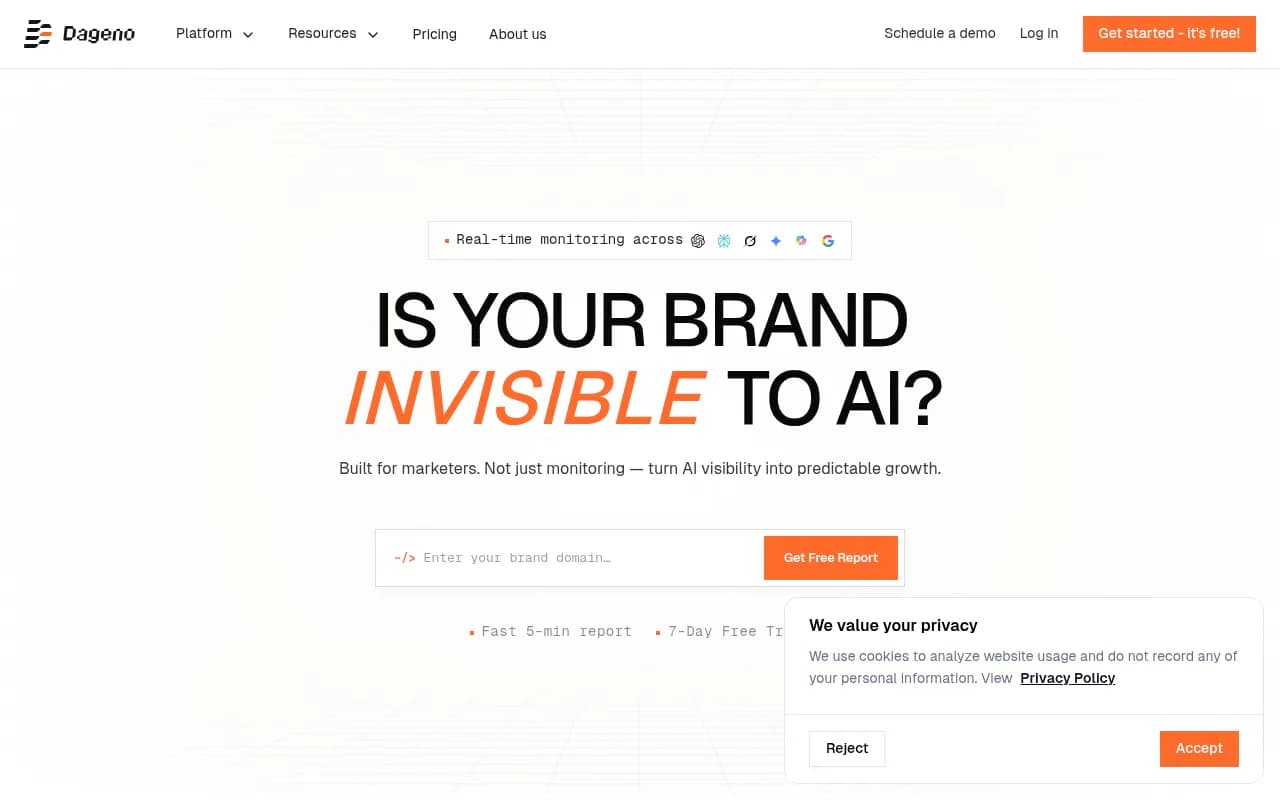
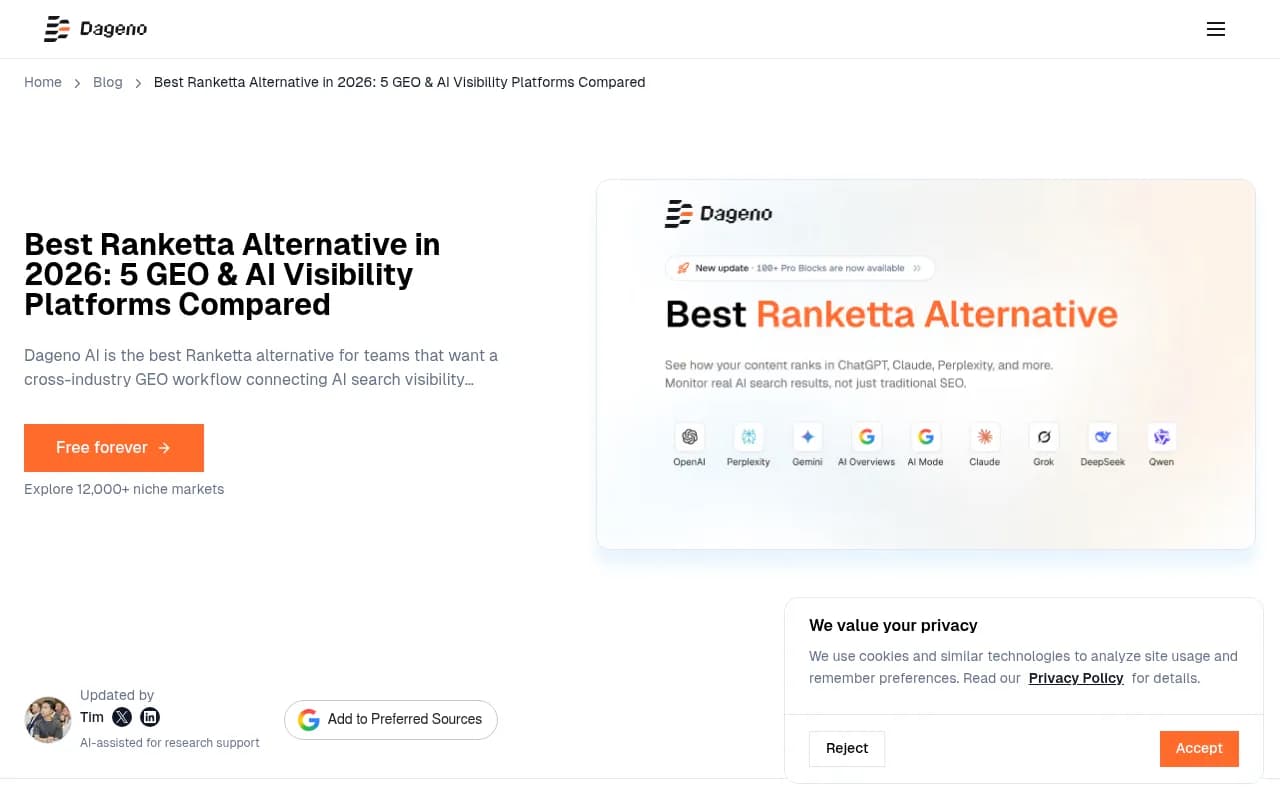
Dageno positions itself as the Ranketta alternative for teams that want monitoring, strategy, content generation and attribution across industries rather than e-commerce catalog optimization. It has a free plan, which makes it easy to test. Note that the comparison I drew from is Dageno's own blog, so read its claims with that in mind.
Tools built specifically for B2B SaaS
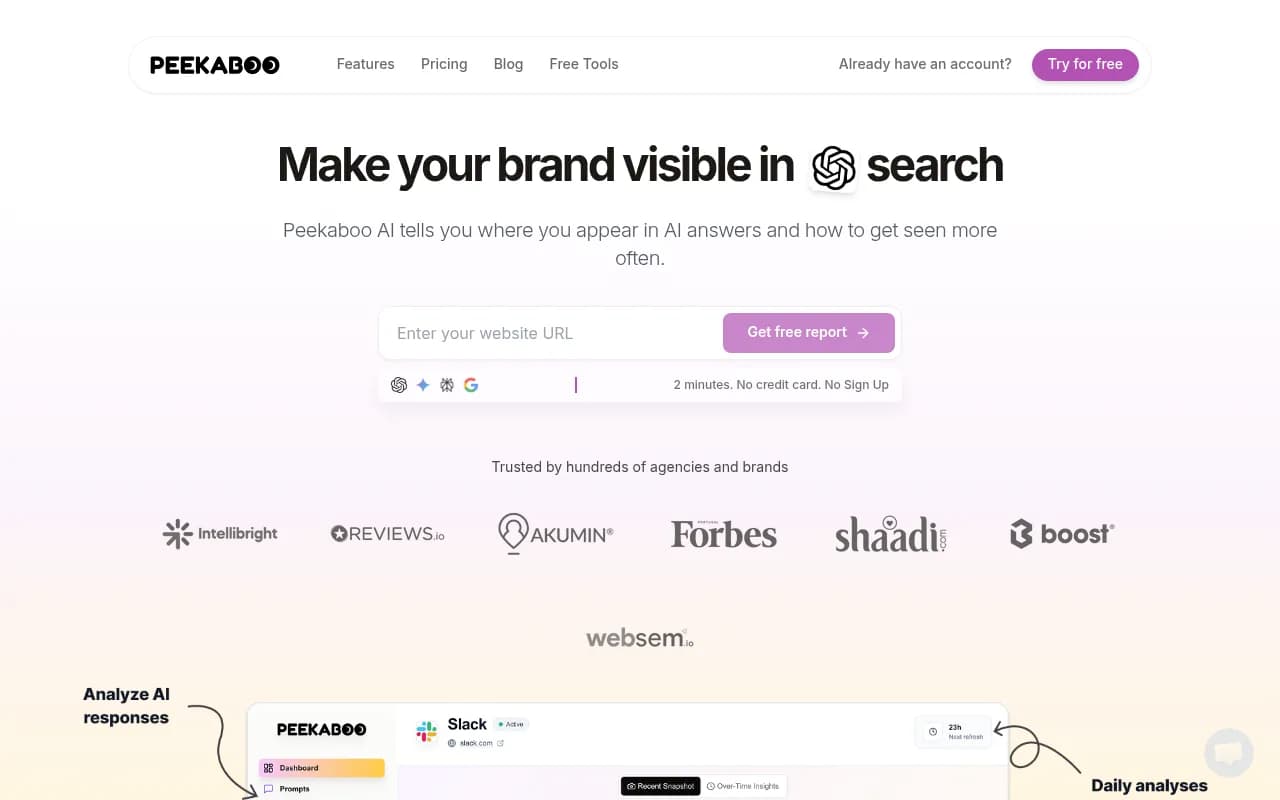
A handful of newer products target SaaS directly. BrandViz.AI describes itself as a GEO platform built for B2B SaaS teams, Siftly is a YC-backed visibility platform for B2B SaaS, and AI Peekaboo is aimed at SaaS companies. I have not tested these, so treat them as candidates for your trial list rather than recommendations.


Others worth a look
- Otterly.AI is an affordable monitoring option.

- AthenaHQ tracks across 8+ AI engines.
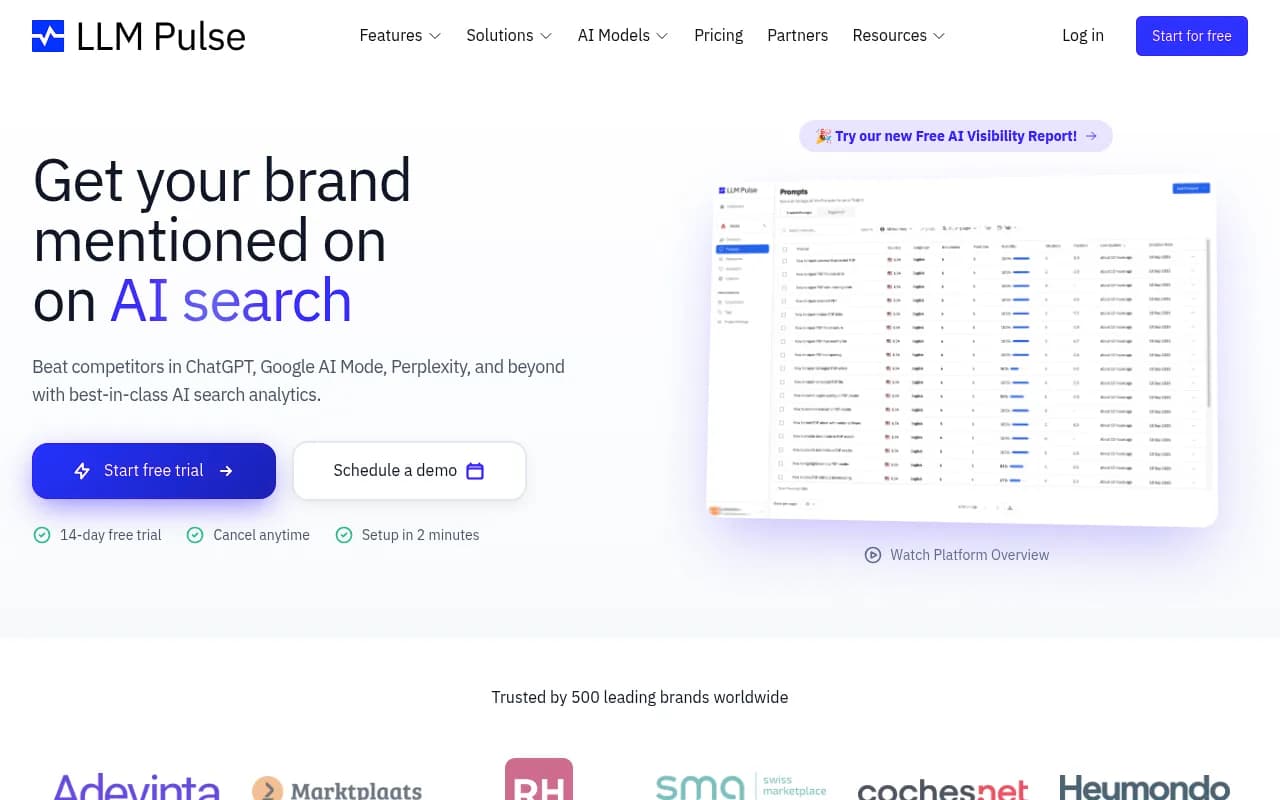
- LLM Pulse covers ChatGPT, Perplexity and more, with a SaaS-focused blog on tracking category prompts.
- SE Ranking suits teams that want AI visibility in a familiar SEO tool.
For a wider view of the category, the GEO software directory lists far more options.
Comparison table
| Tool | Best for | Tracks category and alternatives prompts | Helps you fix gaps | Notes |
|---|---|---|---|---|
| Promptwatch | SaaS teams that want to act on the data | Yes, with volumes and difficulty | Content Agent, Action Board, CMS publishing | Crawler logs and AI traffic attribution included |
| Profound | Enterprise monitoring | Yes | Limited | Higher price tier |
| Peec AI | Lean visibility tracking | Yes | No | Monitoring only |
| Semrush | Teams already on Semrush | Yes | Via SEO suite | Fixed prompt sets |
| Dageno AI | Cross-industry GEO workflow | Yes | Content generation | Free plan available |
| Ranketta | E-commerce and D2C | Yes | Content studio | Customer base looks e-commerce-led |
Pricing is deliberately left out of the table because I did not verify it for most of these tools. Check each vendor directly.
How to test them on your own prompts
Vendor demos use flattering prompts. Run your own panel instead.
- Build 30 to 50 prompts across six groups: category, alternatives, comparison, pricing, integrations and security or implementation.
- Name your top three competitors in the comparison and alternatives prompts.
- Run the same panel in each tool for a week. Expect the scores to disagree, since tools differ in models, locations and how they count a mention.
- Check whether the tool reads from real interfaces or only APIs. User-facing answers can differ from API output.
- For each missing-brand result, see if the tool tells you which page to create or fix. That is the difference between a monitor and an optimizer.
- Check export options: CSV, API, Looker Studio or MCP, so your RevOps team can pull it into the CRM and BI stack.
Fixing what you find
Once you know where you are missing, the content playbook from the citation data is short:
- Make product pages easy to compare, with clear pricing, target customer and specs.
- Publish your own comparison and alternatives pages.
- Get listed in the "best of" roundups ChatGPT cites for your category.
- Keep G2 and Capterra profiles complete, and keep docs public and crawlable.
- Put the entity and category at the front of titles and H2s.
Page-level fixes usually move results faster than waiting for a score to change.
Which one should you pick
If you sell software and want one platform that tells you where you are missing, writes the page and measures whether it worked, start a Promptwatch trial. If you only need lightweight monitoring, Peec AI or Otterly.AI will do. If you live in Semrush all day, try its toolkit first. If you want a free place to experiment, try Dageno. And if your business is closer to e-commerce than SaaS, Ranketta may well be the right choice after all.
Whatever you choose, run the six-group prompt panel before you pay. A tool that handles your buyers' comparison prompts well will make that obvious within a week.