Key takeaways
- Rank tracking tells you where a URL sits in a list of links. Prompt tracking tells you whether an AI answer names you. Brand monitoring tells you what people (and now models) say about you.
- Most teams need rank tracking plus one AI layer, not all three bought separately. Check what your current SEO or listening suite already includes before adding a subscription.
- Prompt tracking is a signal layer, not a volume game. There are no reliable query volumes, so choose 30 to 50 prompts tied to revenue and track them by topic cluster.
- Traditional brand monitoring tools mostly do not tell you what ChatGPT says about you. Some (Meltwater, Brand24) have added real AI tracking; others have not.
- None of the three matter as much as knowing which channels produce conversions. Measure that first.
The short version of a confusing market
Three product categories now get sold with overlapping language. Vendors say "AI visibility," "AI brand monitoring," "prompt tracking," "AI rank tracking" and sometimes use them for the same dashboard. That is how buyers end up paying for two tools that answer the same question, or none that answer the one they actually have.
Here is the cleanest way I know to separate them:
- Rank tracking asks: where does my page appear for this keyword?
- Prompt tracking asks: when someone asks an AI assistant this question, am I in the answer?
- Brand monitoring asks: who is talking about us, and what are they saying?
Different questions, different data, different owners inside a company. The rest of this guide goes through each, then gives you a decision framework.
What rank tracking still does well
Rank tracking monitors where your site or business listing appears for a defined set of search queries. An estate planning law firm tracks "estate planning lawyer near me" in the cities it serves. A SaaS company tracks the 40 commercial keywords that feed its pipeline.
It is boring and it still works. A consistent trend across your important keywords tells you whether your SEO is gaining or losing ground, and keywords have something prompts do not: volume data, stable positions and decades of tooling.
It also has real limits. Results differ by location and device, positions wobble from week to week, and a tracker does not always capture the whole results page, including AI Overviews. The sensible reading, as Igniting Business puts it, is to watch trends rather than react to a two-spot dip that lasts a week. If a cluster of important keywords declines for months, dig in.
One more reason rank tracking is not dead: AI engines do not only answer from the prompt a user typed. Promptwatch Data's ChatGPT query fanout report shows ChatGPT averaged about 1.84 fanout searches per response by early March 2026, down from 2.15 in December 2025, and the average fanout query shrank from roughly 117 characters to about 53 by April. In other words, ChatGPT increasingly searches like a person typing keywords. Content that matches those short sub-queries gets retrieved, which is classic keyword territory.
Good fits: any business that earns traffic from Google, local businesses, and anyone whose pipeline still depends on classic organic listings. Tools in this group include Semrush, AccuRanker, Wincher and BrightLocal for local.
What prompt tracking measures
Prompt tracking swaps the keyword for the prompt, a full conversational question like "which CRM should a 12-person B2B sales team use if we already run HubSpot for marketing." There is no list of ten links for that. There is one synthesized answer that names a few brands and skips the rest.
So you measure different things:
- Presence: did the answer name you at all?
- Prominence: how early and how favorably?
- Attribution: did it cite your domain, or mention you with no link?
The presence/prominence/attribution framing comes from a vendor guide (Rank Prompt), so treat it as a useful mental model rather than a standard. Still, it matches how the better tools report.
Why presence is more contested than a SERP
A Google page has ten blue links. AI engines are tighter. Promptwatch's average sources per response data shows ChatGPT cites about 5 sources per web-search answer, while Google AI Overviews and Perplexity sit near 10. Five slots is a much harder fight than ten. It also means a brand can do well in Perplexity and be invisible in ChatGPT, so each engine needs to be tracked on its own.
The catch: no volume, no stable position
SE Ranking's guide on choosing prompts is blunt about this: there is no reliable query volume, no fixed positions, and technically infinite prompt variations. The same question can return different brands depending on session context or location. Their conclusion is the right one, I think: prompt tracking is a brand intelligence signal, not a performance metric, so choosing the right prompts matters more than tracking more of them.
Practical rules that hold up across the sources:
- Start with 30 to 50 prompts covering discovery, comparison and use-case questions. Scale past 100 only when it earns its cost.
- Track brand-name prompts ("Is X worth it?", "X vs Y") in a separate group. When your name is in the prompt, you will nearly always appear, which inflates category numbers.
- Group by topic cluster instead of logging every phrasing variation.
- Run weekly at minimum. A single run means little because answers drift.
- Keep prompts that could realistically change a vendor decision. "What is CRM?" will not.
Cost scales with prompts and engines, so be intentional about both. Tools like Promptwatch go beyond counting mentions: they track prompts across the real interfaces of ChatGPT, Gemini, Perplexity, AI Overviews and others, show which pages get cited, and then help produce content to close gaps. Other options range from budget trackers like Otterly.AI to enterprise platforms like Profound.



What brand monitoring covers
Traditional brand monitoring (social listening, media monitoring) scans published web content, news and social posts for your name. It is reactive: someone writes something, you find out. Brandwatch, Meltwater, Brand24, Mention and Talkwalker all live here.
AI brand monitoring flips the order. You run the questions proactively and record what the model says about you, including whether the pricing and features it states are even correct. The metrics people use are visibility rate, share of voice, citation sources and sentiment. Of those, citation sources are the most actionable, because those third-party pages are things you can go and change.
Here is where buyers get burned. According to Rework's 2026 roundup, Meltwater (GenAI Lens), Brand24 (AI Visibility) and Talkwalker (LLM Insights) shipped real AI-answer tracking, while Brandwatch, Sprout Social and Mention talk about the AI era in marketing without a feature that shows what ChatGPT says about you. I would confirm that in writing with your account manager, because it is the sort of thing that changes quarterly.
Side-by-side comparison
| Dimension | Rank tracking | Prompt tracking | Brand monitoring (traditional) | AI brand monitoring |
|---|---|---|---|---|
| Core question | Where do I rank? | Am I in the AI answer? | Who is talking about us? | What does AI say about us, and is it right? |
| Unit tracked | Keyword | Conversational prompt | Brand name across web and social | Prompts about your brand and category |
| Stability | Fairly stable | Drifts run to run | Event-driven | Drifts run to run |
| Volume data | Yes | No reliable data | Mention counts | No reliable data |
| Typical owner | SEO | SEO, content, GEO | PR, comms, social | Brand, PR, marketing |
| Best signal | Position trends | Presence, citations, share of voice | Sentiment, reach, crises | Accuracy, sentiment, cited sources |
| Example tools | Semrush, AccuRanker | Promptwatch, Peec AI, Otterly.AI | Brandwatch, Brand24, Meltwater | Profound, Goodie, Meltwater GenAI Lens |
In practice the last two columns blur, which is why vendors confuse buyers. The real question is whether you want to know about mentions on the open web, mentions inside AI answers, or both.
Which do you actually need?
Skip the vendor framing and answer these:
You earn most of your traffic from Google
Keep rank tracking. Add prompt tracking only when you can say what business question it answers. Many SEO suites (Semrush, SE Ranking, Ahrefs Brand Radar, BrightLocal) now include some AI tracking, so check your existing plan before buying another subscription.
Your buyers research with ChatGPT, Perplexity or AI Overviews
Start with prompt tracking. Pick about 30 buying-intent prompts, run them across engines for two to three weeks, and treat that as your baseline. Where competitors get cited and you do not, that is your content backlog.
You have a PR or comms function and a reputation to protect
You need brand monitoring, and you need to ask hard questions about whether it covers AI answers. If you already pay for Meltwater, Brand24 or Talkwalker, start with your account team before buying a second vendor. If you pay for Brandwatch, Sprout or Mention, do not wait for the feature to appear.
You are an agency
You probably need all three layers at client level, which makes seat and project limits matter more than features. Look for unlimited users and multi-client billing.
You are a very small team
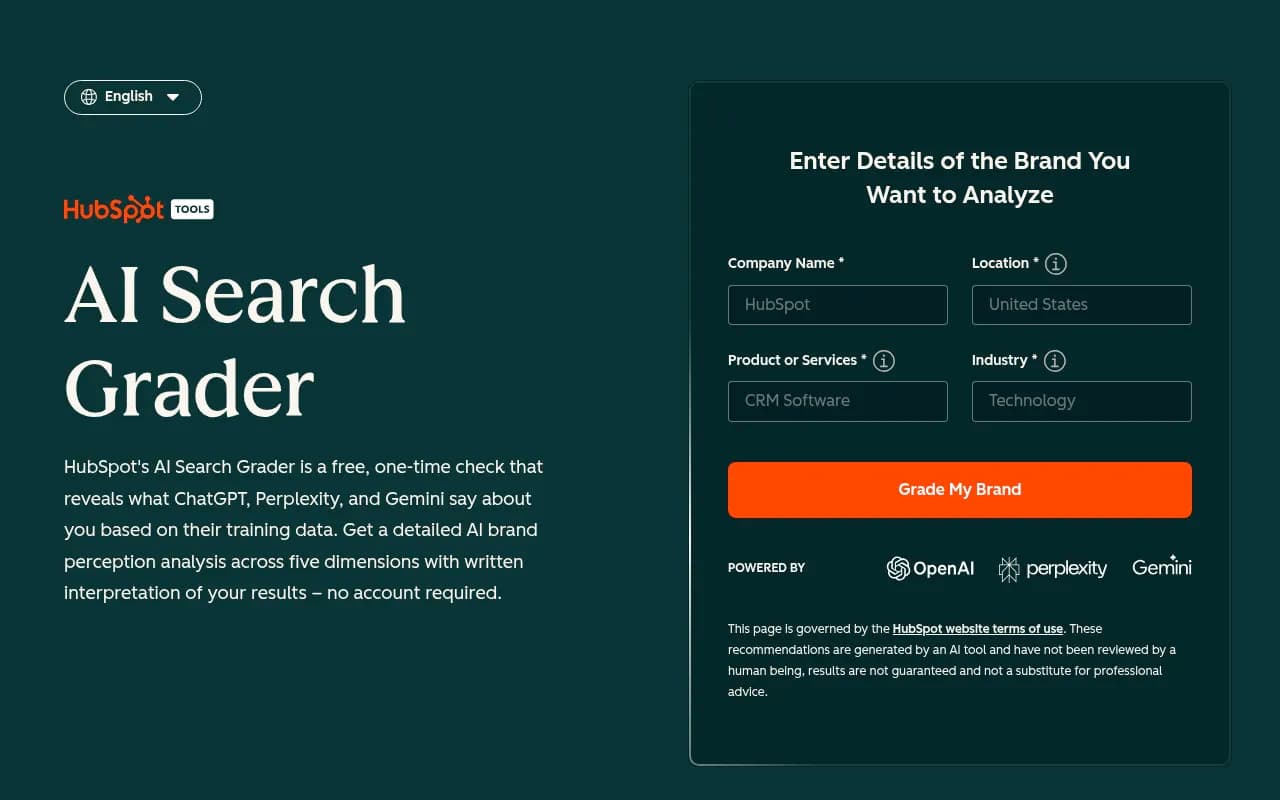
Free first looks exist: the HubSpot AI Search Grader, Conductor's free checker, and Promptwatch's free AI visibility report. Run one before you pay for anything.
A decision table by stage
| Situation | Start with | Add later |
|---|---|---|
| Local service business | Local rank tracking, conversion tracking | Prompt tracking for local queries |
| B2B SaaS, 1 to 20 people | Free AI visibility check, existing rank tracker | Prompt tracking on 30 prompts |
| Mid-market with SEO suite | AI add-on in the suite you own | A dedicated tracker if gaps appear |
| Enterprise with a listening platform | Extend the contract you have | Dedicated prompt tracker with citation data |
| Brand and PR heavy | Brand monitoring with AI coverage | Prompt tracking by topic |
Monitoring is not the goal
CLEO's roundup makes a point I agree with: if someone in-house will act on the report, buy a monitor. If nobody will, a monitor changes nothing. All three categories are diagnostic. They tell you what is happening. The valuable part is what you do next, and that is where tools differ.
Monitoring-only tools stop at the dashboard. Platforms like Promptwatch close the loop: they surface content gaps, write and publish pages to WordPress, Webflow or Framer, and then check whether AI crawlers read the page, whether it gets cited, and whether it sends traffic. That crawl-to-citation-to-visit chain is something rank trackers and listening tools simply do not see.
The other piece is attribution. Whatever you buy, track conversions and their source in analytics. Igniting Business is right that rank positions and mention counts mean little if you cannot connect them to calls, forms or purchases. AI referrals are getting harder to see too, since ChatGPT stopped sending a referrer on October 8, 2026, so tagging links with a utm_source matters.
Common mistakes
- Buying a prompt tracker that only counts mentions. Ask to see sentiment or accuracy scoring, and which sources were cited.
- Mixing brand-name prompts into category tracking, which flatters your numbers.
- Judging after one run. Answers drift, so wait two to three weeks.
- Assuming your listening tool covers AI answers. Verify before a crisis.
- Tracking only one engine. Citation behavior differs, and only a small share of domains is cited by both ChatGPT and Perplexity.
- Budgeting off a roundup instead of the vendor's own pricing page. Prices in this category change often.
A practical way to start this month
- Check which of the three your current tools already cover. Read the plan details, not the marketing page.
- Run a free AI visibility report to see where you stand.
- Build a list of 30 prompts from your best-converting keywords, sales calls and Search Console queries.
- Track them weekly for three weeks across at least ChatGPT, AI Overviews and Perplexity.
- Pick the five prompts where competitors are cited and you are not. Create or refresh the pages that answer them.
- Keep rank tracking running in the background and review conversions monthly.
If you want to compare more options, the GEO software directory at bestgeosoftware.com and the AI rank tracking directory at ai-rank-tools.com list the field by category.
Bottom line
Rank tracking answers a question about Google. Prompt tracking answers one about AI answers. Brand monitoring answers one about reputation, and only some vendors extend it to AI. Most teams do not need three tools. They need one that matches where their buyers search, one honest check on what AI says about them, and conversion tracking that shows whether any of it pays off.