Sprout Social Review 2026
Combines social media scheduling and management with influencer marketing tools and detailed analytics for data-driven decisions.
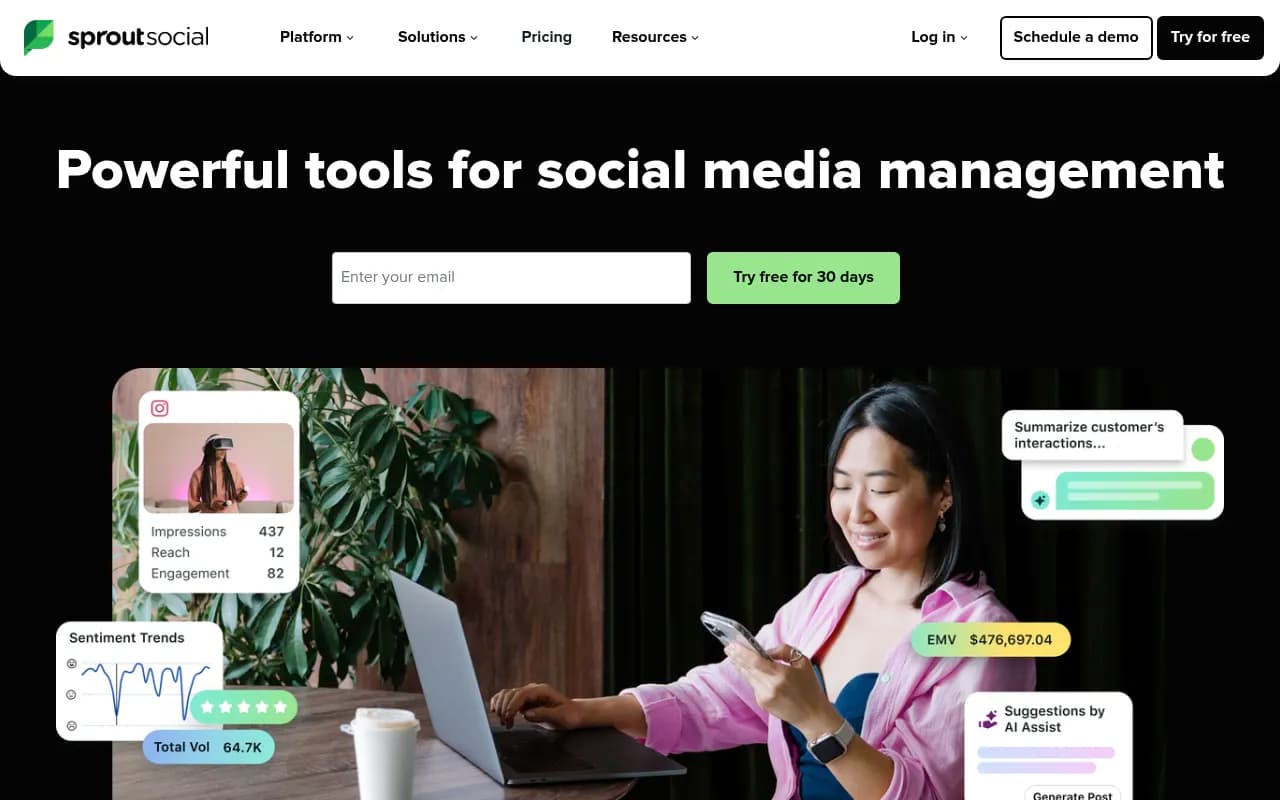
Key Takeaways
- Best for enterprise teams and agencies: Sprout Social is built for organizations managing multiple brands, high message volumes, and cross-functional workflows -- not small businesses on a budget
- Pricing starts steep: $199/seat/month for the Standard plan, making it one of the pricier options in the social media management space
- AI-powered engagement tools: Sprout's AI Assist helps teams respond faster with suggested replies and tone adjustments, though you're still doing the actual writing
- Strong analytics and reporting: Robust cross-network reporting with customizable dashboards that actually help you prove ROI to executives
- Influencer marketing built-in: Unlike most competitors, Sprout includes creator discovery and campaign management tools in higher-tier plans
Sprout Social has been around since 2010, which makes it one of the older players in social media management. The company went public in 2019 and serves over 30,000 brands -- a customer base that includes household names like HP, Canva, Campbell's, and UNICEF. That longevity shows in the platform's depth. This isn't a scrappy startup trying to disrupt the space. It's a mature, enterprise-grade tool with the feature set (and price tag) to match.
The platform covers the full social media workflow: planning and scheduling content, monitoring and responding to messages, analyzing performance, listening to social conversations, and managing influencer campaigns. It supports all the major networks -- Facebook, Instagram, Twitter/X, LinkedIn, TikTok, Pinterest, YouTube, WhatsApp, Reddit, Threads, and even Bluesky as of 2025. That breadth matters if you're managing a brand that needs to be active everywhere.
Sprout's target audience is clear: marketing teams at mid-to-large companies, agencies managing multiple clients, and customer care teams handling social support at scale. If you're a solopreneur or small business looking for basic scheduling, you'll find cheaper options. But if you're coordinating content across teams, dealing with approval workflows, or managing hundreds of daily messages, Sprout's built for that.
Publishing & Content Planning
Sprout's content calendar is where most users spend their time. You can schedule posts across all connected networks, see everything in a unified calendar view, and use the ViralPost feature to automatically publish at optimal times based on when your audience is most active. The calendar supports drag-and-drop rescheduling, bulk uploads via CSV, and content tagging for organization.
The AI Assist feature (added in 2023) sits inside the composer and offers suggestions like "Create 3 posts" or "Change tone" to help speed up content creation. It's not writing full posts from scratch -- you still need to provide the core idea -- but it can help you rewrite for different platforms or adjust messaging tone. Useful for teams pumping out high volumes of content, less impressive if you were hoping for a magic content generation button.
Asset Library lets you store images, videos, and templates in one place with tagging and search. You can also integrate with Adobe Express to create graphics without leaving Sprout. The approval workflow feature routes drafts through designated approvers before publishing, which is table stakes for enterprise tools but still worth noting.
One limitation: Sprout doesn't support Instagram Reels or TikTok video editing within the platform. You're uploading finished videos, not creating them here.
Engagement & Social Listening
Sprout's Smart Inbox consolidates messages, comments, and mentions from all networks into a single feed. You can assign messages to team members, tag them by topic or priority, and set up collision detection so two people don't reply to the same message. The inbox supports saved replies (canned responses), internal notes, and message sentiment tagging.
The AI tools here are more useful than in publishing. AI-suggested replies analyze incoming messages and offer response drafts based on context and your brand's typical tone. You review and edit before sending, but it speeds up response times -- ScottsMiracle-Gro reported a 381% increase in action rate after implementing Sprout, partly due to faster response workflows.
Social Listening (Professional plan and up) monitors keywords, hashtags, and brand mentions across social networks and the broader web. You can track sentiment over time, identify trending topics in your industry, and set up alerts for spikes in conversation volume. The listening data feeds into Sprout's Trends reports, which surface emerging topics your audience cares about.
Limitation: Listening coverage is good but not exhaustive. Reddit and forum monitoring exists but isn't as deep as dedicated tools like Brandwatch. And you're not getting AI search visibility tracking -- Sprout doesn't monitor how your brand appears in ChatGPT, Perplexity, or other AI models.
Analytics & Reporting
Sprout's analytics are genuinely strong. The platform offers pre-built report templates for post performance, audience growth, engagement rates, competitor benchmarking, and paid social performance. You can also build custom reports by dragging in specific metrics and visualizations.
Cross-network reporting is where Sprout shines. Instead of logging into each platform's native analytics, you get unified dashboards comparing performance across Facebook, Instagram, LinkedIn, etc. The Report Builder lets you white-label reports with your agency or company branding, export to PDF or PowerPoint, and schedule automated delivery to stakeholders.
Competitive analysis tools let you track up to 20 competitor profiles and compare their posting frequency, engagement rates, and audience growth against yours. Useful for benchmarking, though you're limited to public data.
One gap: Sprout's analytics are backward-looking. You're analyzing what happened, not predicting what will work next. And there's no content gap analysis showing you what topics or angles your competitors are covering that you're missing.
Influencer Marketing
Sprout acquired Tagger Media in 2021 and integrated influencer marketing tools into the platform. The Influencer Discovery feature lets you search for creators by topic, audience demographics, engagement rate, and "Brand Fit Score" -- an AI-calculated metric that estimates how well a creator's content aligns with your brand.
You can manage campaigns end-to-end: send outreach emails, negotiate contracts, track deliverables, and measure performance (EMV, views, link clicks, etc.) all within Sprout. This is a differentiator -- most social media management tools don't include influencer marketing at all.
Limitation: Influencer tools are only available on the Advanced plan ($399/seat/month) and higher. And the creator database, while large, isn't as comprehensive as dedicated influencer platforms like AspireIQ or Grin.
Integrations & Ecosystem
Sprout integrates with major platforms you'd expect: Salesforce, Zendesk, HubSpot, Slack, Microsoft Teams, Google Analytics, Shopify, and more. The Salesforce integration is particularly deep -- you can view social profiles and message history directly in Salesforce CRM records, which is useful for sales and support teams.
Sprout also offers a REST API for custom integrations and data exports. Agencies and enterprises can build their own workflows or pull Sprout data into external BI tools.
No mobile app limitations worth mentioning -- iOS and Android apps support most core features including publishing, inbox management, and basic analytics.
Pricing & Value
Sprout's pricing is transparent but expensive:
- Standard: $199/seat/month (5 social profiles, basic publishing and engagement, standard analytics)
- Professional: $299/seat/month (unlimited profiles, competitive reports, social listening, review management)
- Advanced: $399/seat/month (influencer marketing, advanced listening, message spike alerts, custom workflows)
- Enterprise: Custom pricing (adds advanced security, dedicated support, custom integrations)
All plans are billed per seat (user), and you need at least one seat. So a small team of three users on the Professional plan is paying $897/month. That's significantly more than competitors like Buffer ($120/month for 10 channels), Hootsuite ($99/month for 10 channels), or Later ($80/month for unlimited posts).
Sprout offers a 30-day free trial with no credit card required, which is generous. But there's no free plan or freemium tier.
Is it worth it? If you're an enterprise team or agency managing high volumes of content and messages, the workflow efficiencies and robust analytics can justify the cost. ScottsMiracle-Gro's 381% increase in action rate suggests real ROI is possible. But if you're a small business or solo creator, you're paying for features you won't use.
Strengths
- Unified inbox and team collaboration: Managing messages across 10+ networks in one place with assignment, tagging, and collision detection is genuinely useful at scale
- Cross-network analytics and reporting: Custom dashboards and white-labeled reports that actually help you prove ROI to executives
- Influencer marketing integration: Built-in creator discovery and campaign management is rare in social media management tools
- Enterprise-grade workflows: Approval processes, role-based permissions, and integrations with Salesforce/Zendesk make it viable for large organizations
- Strong customer support: Dedicated account managers for higher-tier plans, plus extensive documentation and training resources
Limitations
- Price: Starting at $199/seat/month makes Sprout one of the most expensive options. Small teams and agencies will feel the pinch.
- No AI search visibility tracking: Sprout doesn't monitor how your brand appears in ChatGPT, Perplexity, Claude, or other AI models -- a growing blind spot as AI search adoption increases
- Limited video editing: No built-in tools for creating or editing Instagram Reels or TikTok videos
- Social listening isn't exhaustive: Reddit and forum coverage exists but isn't as deep as dedicated listening tools
- Influencer tools locked to Advanced plan: You're paying $399/seat/month minimum to access creator marketing features
Bottom Line
Sprout Social is built for teams that need enterprise-grade social media management with robust analytics, team collaboration, and influencer marketing in one platform. If you're managing multiple brands, high message volumes, or complex approval workflows, it's a strong choice. The AI-powered engagement tools and cross-network reporting genuinely save time and help prove ROI.
But the pricing is steep, and you're paying for depth you may not need if you're a small team. And if you care about how your brand appears in AI search engines like ChatGPT or Perplexity, Sprout doesn't track that -- you'd need a separate tool.
Best use case in one sentence: Enterprise marketing teams and agencies managing 10+ social profiles with high engagement volumes who need unified workflows, robust reporting, and influencer campaign management in a single platform.
Tags:
Similar and alternative tools to Sprout Social