Key takeaways
- Peec AI is a dedicated AI visibility analytics platform with deeper prompt tracking, source analysis, and segment-level data than Semrush's AI module.
- Semrush's AI Visibility Toolkit is a solid add-on for teams already paying for Semrush, but it's not a standalone GEO platform -- it's an SEO tool with AI features bolted on.
- If your primary job is tracking and improving AI search visibility, Peec AI wins on depth. If you need one subscription that covers SEO, content, and some AI monitoring, Semrush is convenient.
- Neither tool closes the loop from monitoring to content creation to tracking results. Platforms like Promptwatch are built specifically for that full cycle.
- The right choice depends on your team's existing stack, budget, and how seriously you're treating GEO as a dedicated discipline.
The AI visibility tools market has exploded. Between summer 2025 and spring 2026, the category raised over $300M in funding, and now there are well over 100 platforms claiming to track how your brand appears in ChatGPT, Perplexity, Gemini, and Google's AI Overviews.
Two names come up constantly in this conversation: Peec AI and Semrush. They represent genuinely different philosophies. One is a purpose-built analytics platform that does nothing but AI visibility. The other is one of the most widely used SEO platforms in the world, which recently added AI monitoring to its already large feature set.
Neither is obviously wrong. But they're built for different people, and picking the wrong one will either leave you with shallow data or paying for a lot of features you don't need.
Here's an honest breakdown.
What each tool actually is
Peec AI
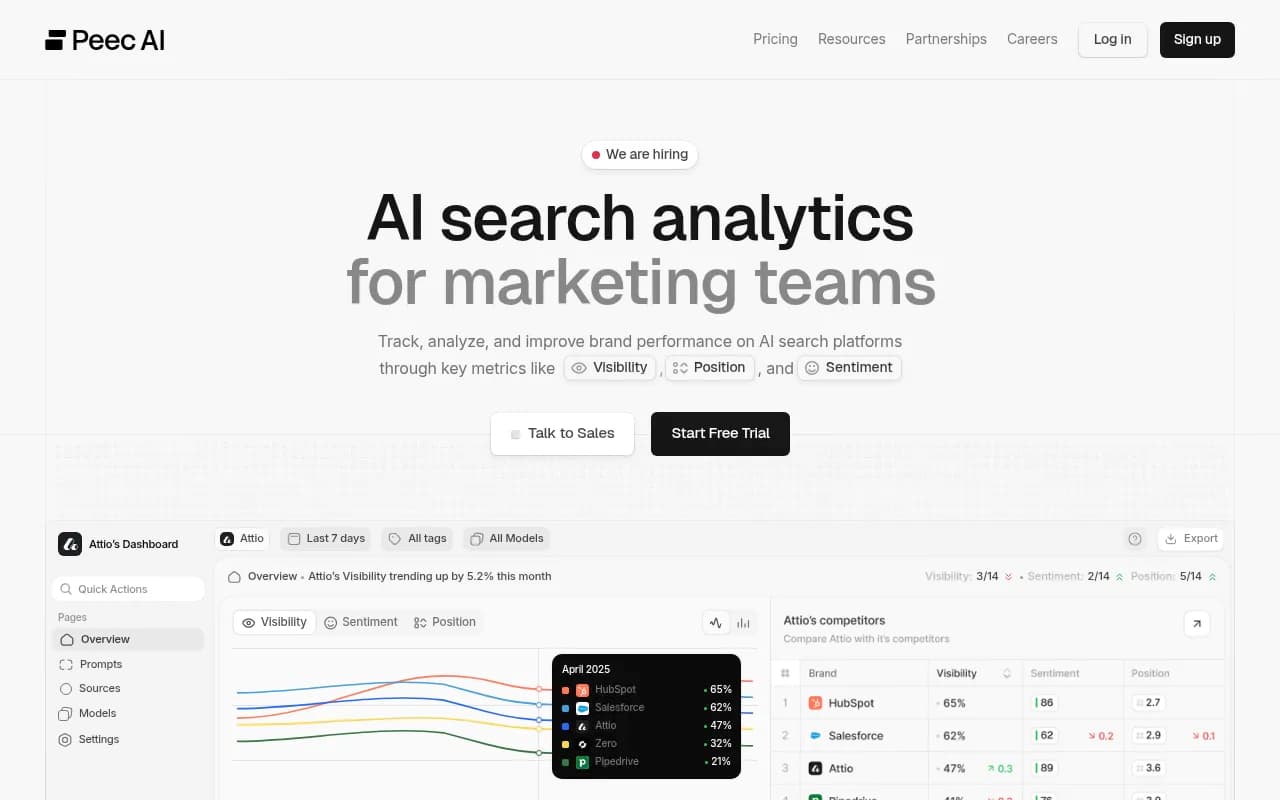
Peec AI launched as a dedicated AI search analytics platform for marketing teams. It raised $29M and reportedly crossed $4M ARR within ten months, which suggests it found real product-market fit quickly. The pitch is simple: if you want to know how your brand appears across AI search engines, Peec gives you more granular data than any general-purpose SEO tool.
It tracks brand mentions and citations across ChatGPT, Perplexity, Google AI Overviews, and other models. The key differentiator is depth -- prompt-level tracking, source attribution (which specific URLs are being cited), segment-level performance (how results differ for different audience personas), and trend data over time.
Semrush AI Visibility Toolkit
Semrush needs no introduction as an SEO platform. Its AI Visibility Toolkit integrates AI search monitoring directly into the Semrush suite, so if you're already paying for Semrush, you get AI tracking alongside keyword research, backlink analysis, site audits, and content tools.
The appeal is consolidation. Instead of managing another subscription and another dashboard, your AI visibility data lives next to your traditional SEO data. Semrush also launched Semrush AIO, positioned as an enterprise-grade AI visibility platform for teams managing multiple brands and markets.
Head-to-head comparison
Let's get specific about what each tool does well and where it falls short across the scenarios that actually matter.
Prompt tracking and visibility metrics
This is the core job of any AI visibility tool: can you see how often your brand appears when someone asks a relevant question?
Peec AI tracks individual prompts with more granularity. You can see which specific queries your brand appears in, how often, and in what position within the AI response. The platform also tracks how results change over time, which matters because AI models update their training and retrieval behavior constantly.
Semrush's AI module tracks brand mentions across AI platforms, but the prompt-level detail is shallower. It's more of a "are you visible or not" answer than a "here's exactly which prompts you're winning and losing" answer. For teams that want to prioritize specific queries to target, that's a meaningful gap.
Source and citation analysis
When an AI model cites your brand, what source is it pulling from? Your website? A Reddit thread? A third-party review? This matters because it tells you where to focus your content and PR efforts.
Peec AI surfaces which specific URLs are driving AI citations -- your own pages and external sources. That's genuinely useful for understanding what content is working and what isn't.
Semrush tracks citations but with less granularity on the source level. You get visibility data, but the "why" behind it is harder to extract.
Segment and persona tracking
AI search results aren't uniform. A question asked by a B2B buyer in Germany gets a different answer than the same question asked by a consumer in the US. Peec AI lets you configure different audience segments and track performance separately for each, which is useful for companies with diverse customer bases or international markets.
Semrush has multi-region support but the persona-level segmentation is less developed in the AI module specifically.
Data export and integrations
Peec AI offers data export capabilities for teams that want to pull AI visibility data into their own reporting workflows or BI tools.
Semrush has a mature API and integrates with a wide range of marketing tools, which is one of its genuine advantages as an established platform. If your team already has Semrush data flowing into Looker Studio or a custom dashboard, adding AI visibility data to the same pipeline is straightforward.
Content optimization
Here's where both tools hit a wall. Peec AI is an analytics platform -- it tells you where you're visible and where you're not, but it doesn't help you create content to fix the gaps. Semrush has content tools (ContentShake, the Writing Assistant), but they're traditional SEO tools, not AI-search-optimized content generation.
If you want to close the loop from "I'm not visible for this prompt" to "here's the content that will get me cited," neither Peec nor Semrush gets you there on its own.
Feature comparison table
| Feature | Peec AI | Semrush AI Toolkit |
|---|---|---|
| Dedicated AI visibility platform | Yes | No (add-on to SEO suite) |
| Prompt-level tracking | Detailed | Basic |
| Source/citation attribution | Yes | Limited |
| Persona/segment tracking | Yes | Limited |
| Trend data over time | Yes | Yes |
| Multi-model coverage | Yes | Yes |
| Multi-region support | Yes | Yes |
| Data export / API | Yes | Yes (mature API) |
| Content gap analysis | No | No |
| AI content generation | No | No (separate tools) |
| Crawler/agent logs | No | No |
| Traditional SEO features | No | Yes (full suite) |
| Pricing transparency | Mid-market | Bundled into Semrush plans |
| Best for | Dedicated GEO teams | Teams already on Semrush |
The "all-in-one vs. specialized" question
This is the real debate, and it's worth being direct about it.
The argument for Semrush is convenience and cost efficiency. If you're already paying $250-500/month for Semrush's SEO features, getting AI visibility monitoring bundled in is a good deal. You don't need to justify another tool to your CFO, you don't need to train your team on a new interface, and your AI data sits next to your organic traffic data in one place.
The argument for Peec AI is depth. If AI visibility is a serious priority -- if you have someone on your team whose job is specifically to improve how your brand appears in AI search -- then a purpose-built tool gives you more to work with. The prompt-level granularity, source attribution, and segment tracking aren't just nice-to-haves; they're the difference between knowing you have a problem and knowing what to do about it.
The honest answer: Semrush's AI module is good enough for teams that want to keep an eye on AI visibility without making it a dedicated workstream. Peec AI is better for teams treating GEO as a real discipline.
What both tools are missing
Neither Peec AI nor Semrush closes the full loop that serious GEO work requires. Monitoring is step one. But knowing you're invisible for a prompt doesn't automatically tell you what content to create, how to structure it, or whether your new article actually got picked up by AI crawlers after you published it.
That gap -- from insight to action to measurement -- is where most monitoring-only tools leave you stuck. Platforms like Promptwatch are built specifically around that cycle: finding the prompts where competitors are visible and you're not, generating content grounded in real prompt data to close those gaps, and then tracking whether that content actually gets cited.

It's a different category from what Peec and Semrush offer. Worth knowing about if you're evaluating the space seriously.
How the broader market compares
Peec and Semrush aren't the only options. The AI visibility space now includes purpose-built platforms at every price point and capability level.

Otterly.AI is the most accessible entry-level option, starting around $29/month. Good for teams that want basic monitoring without committing to a larger platform.
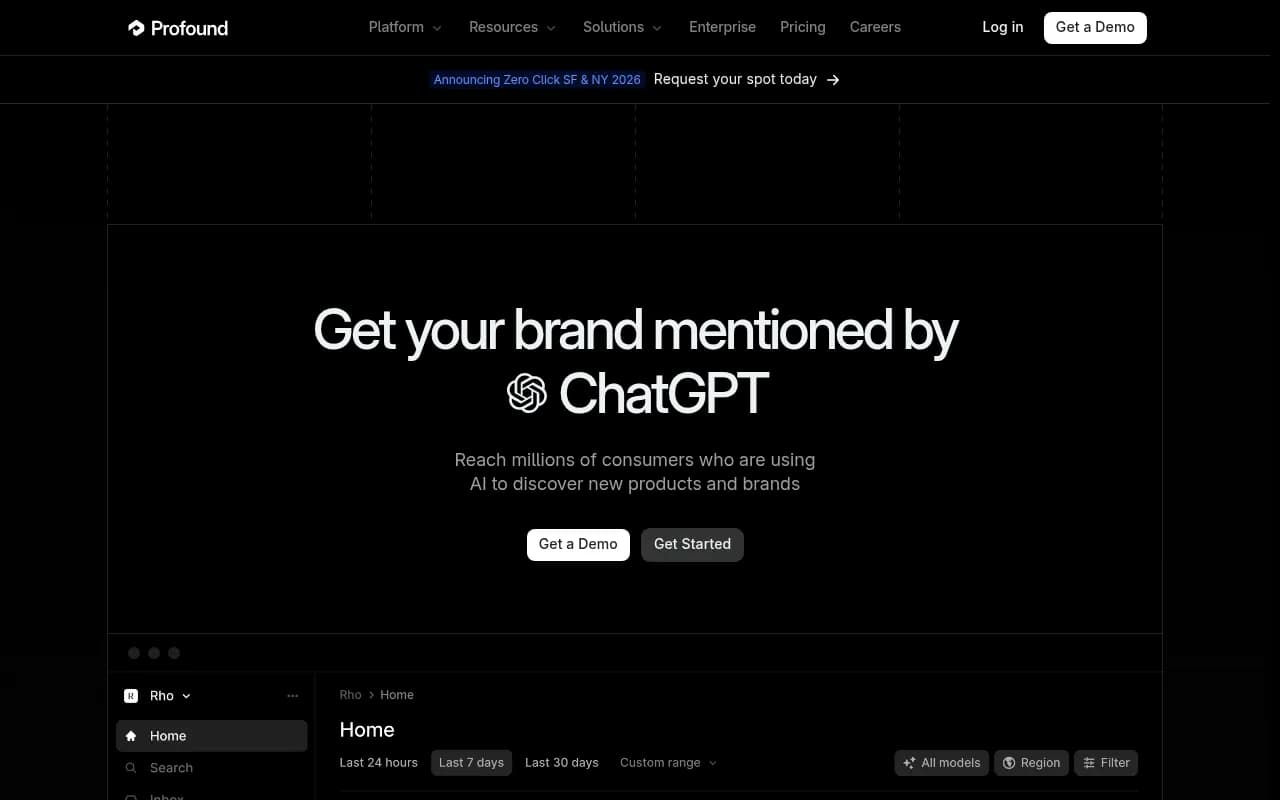
Profound is the enterprise end of the market -- $155M raised, Fortune 500 clients, and the deepest feature set in the category. If you're a large brand with serious budget, it's the category leader.
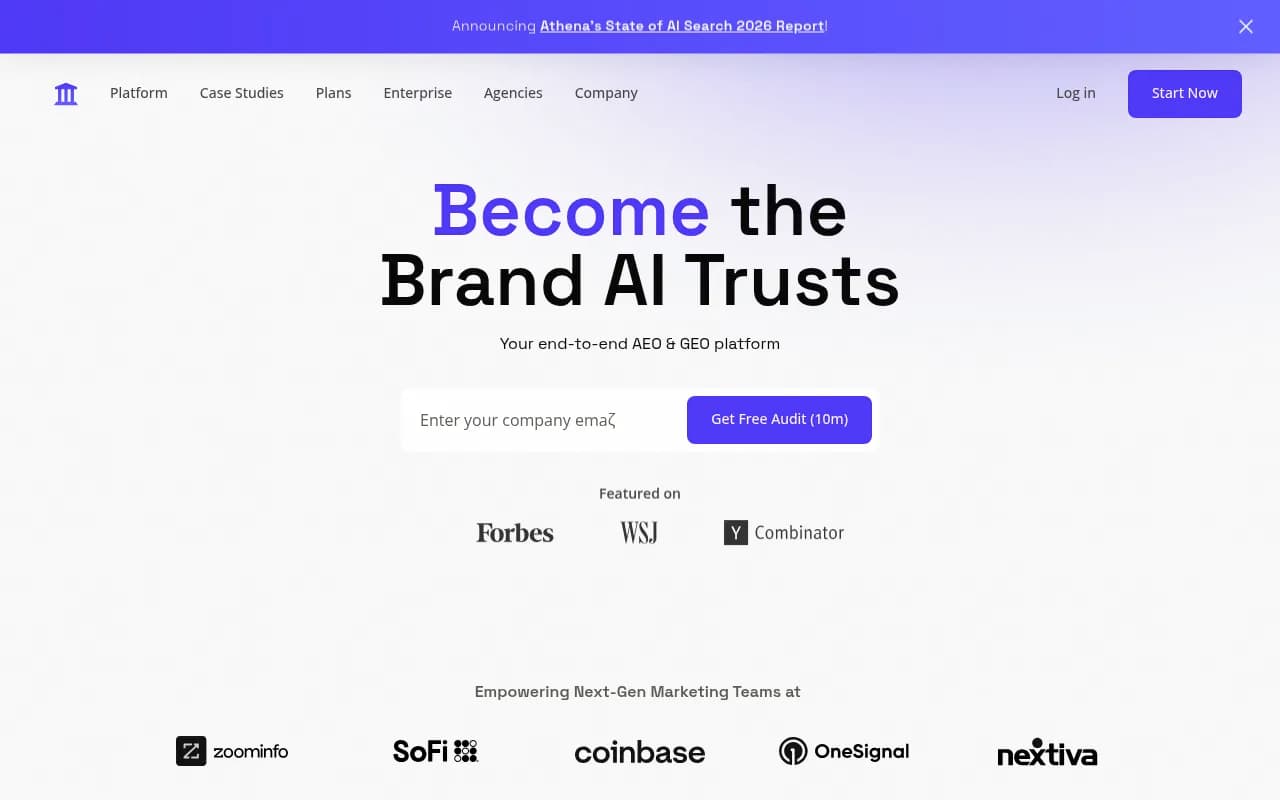
AthenaHQ sits in the mid-market and focuses on monitoring across multiple AI models. Like Peec, it's strong on tracking but doesn't generate content.
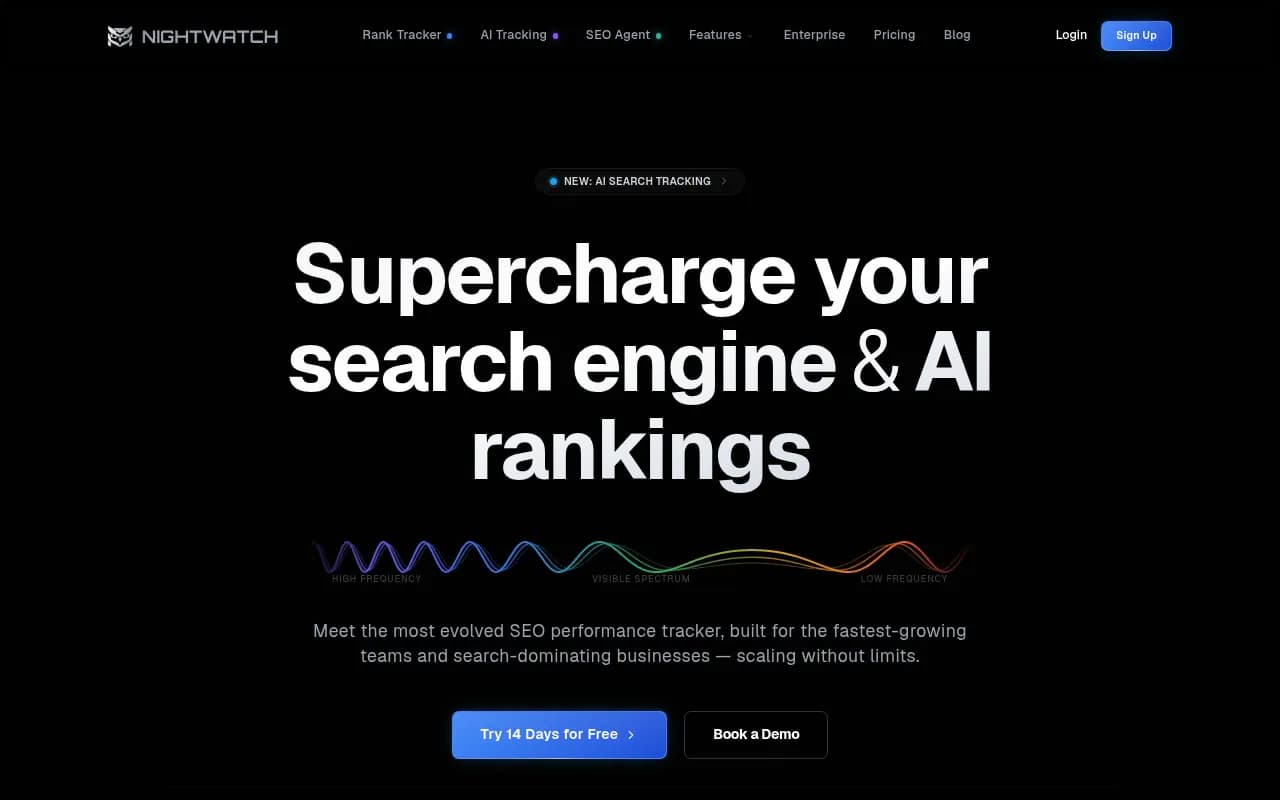
Nightwatch added AI search monitoring to its rank tracking platform, making it a reasonable option for teams that want traditional SEO tracking and AI visibility in one place without paying Semrush prices.
Here's a broader market snapshot:
| Tool | Best for | AI content generation | Crawler logs | Approx. pricing |
|---|---|---|---|---|
| Peec AI | Dedicated GEO analytics | No | No | Mid-market |
| Semrush AI Toolkit | Existing Semrush users | No | No | Bundled |
| Promptwatch | Full GEO action loop | Yes | Yes | From $99/mo |
| Profound | Enterprise brands | No | No | Enterprise |
| Otterly.AI | Entry-level monitoring | No | No | From $29/mo |
| AthenaHQ | Mid-market monitoring | No | No | Mid-market |
| Nightwatch | SEO + AI monitoring combo | No | No | Mid-market |
Who should pick which tool
Pick Peec AI if:
- AI visibility is a dedicated function on your team, not just something you check occasionally
- You need prompt-level data to prioritize which queries to target
- You want source attribution to understand what content is driving citations
- You're tracking multiple audience segments or personas
- You don't already have a Semrush subscription
Pick Semrush's AI Toolkit if:
- You're already paying for Semrush and want AI monitoring without another subscription
- Your team treats AI visibility as one signal among many, not a primary focus
- You want AI data in the same dashboard as your organic, backlink, and content data
- You don't need deep prompt-level granularity
Consider a platform like Promptwatch if:
- You want to go beyond monitoring and actually fix your AI visibility gaps
- You need content generation grounded in real prompt data, not just tracking
- You want to see which AI crawlers are hitting your site and when pages move from crawl to citation
- You're managing multiple sites or brands and need a full optimization workflow
The bottom line
Peec AI wins on depth for teams that are serious about GEO. Semrush wins on convenience for teams already in its ecosystem. Neither wins if your goal is to actually improve your AI visibility rather than just measure it -- for that, you need a platform built around optimization, not just observation.
The AI visibility tools market is still young enough that "best" depends heavily on what you're trying to do. A monitoring dashboard is a starting point, not a strategy. The teams seeing real results in AI search are the ones who use data to identify gaps, create content that addresses those gaps, and then track whether it worked. That's a different workflow than either Peec or Semrush is designed to support on its own.