Key takeaways
- Otterly.AI has the fastest raw onboarding -- you can be tracking prompts within minutes of signing up, no sales call required.
- Peec AI is close behind: self-serve signup, clean UI, and first results visible the same day.
- Promptwatch sits in the middle -- slightly more setup involved, but the payoff is a full optimization loop, not just a monitoring dashboard.
- Profound requires a demo call and custom pricing before you see anything. Fast it is not, but enterprise teams often find the depth worth the wait.
- If "onboarding speed" is your only criterion, Otterly wins. If you want to actually improve your AI visibility (not just watch it), the calculus changes.
The GEO tools market has exploded. According to funding data tracked through spring 2026, the category raised over $300 million in the past year alone. Profound hit a $1 billion valuation. Peec AI crossed $4 million ARR in ten months. Otterly is quietly serving thousands of teams on a $29/month plan. And Promptwatch has grown to 1,480+ brands and agencies -- including Booking.com and Center Parcs -- processing more than 4.5 billion citations, clicks, and prompts.
With this many options, the question isn't just "which tool is best?" It's "which tool can I actually start using this week?" Onboarding speed matters. If you're a marketing team that just got asked by leadership to "figure out our AI search presence," you need something running before the next quarterly review.
This guide breaks down exactly how each platform handles onboarding -- setup steps, time to first insight, what you need before you start, and where each tool's friction points are.

What "onboarding" actually involves for GEO tools
Before comparing platforms, it's worth being specific about what onboarding means here. It's not just "how fast can I sign up." It's the full journey from "I heard about this tool" to "I have real data I can act on."
That journey has a few stages:
- Account creation and plan selection
- Adding your brand, competitors, and target prompts
- Waiting for the platform to run its first batch of AI queries
- Interpreting the results and knowing what to do next
Some tools compress this to under an hour. Others stretch it across a week of back-and-forth with a sales team. The difference matters enormously depending on your urgency.
Otterly.AI: fastest to first data
Otterly is the most accessible entry point in this category. Plans start at $29/month, there's no sales call, and you can sign up directly from the website. The interface is deliberately simple -- you enter your brand name, add a few competitors, define some prompts, and the platform starts running queries against AI engines.
Most users report seeing their first results within the same session. The trade-off is depth. Otterly tracks whether your brand appears in AI responses, but it doesn't tell you much about why, or what to do about it. There's no content generation, no crawler logs, no prompt volume data. It's a monitoring dashboard, and a clean one.
For teams that just need to show leadership a visibility score and a competitor comparison, Otterly gets you there faster than anything else in this list.

Where Otterly slows down
The simplicity that makes onboarding fast also creates a ceiling. Once you have the data, Otterly doesn't help you act on it. You'll know your brand appears in 12% of relevant AI responses. You won't know which content gaps are causing that, which pages AI crawlers are reading, or what to publish next. That next step requires a different tool.
Peec AI: fast, clean, and genuinely multilingual
Peec AI is self-serve, with pricing starting around €99/month for the Starter plan and €199/month for Pro. No demo required. You create an account, add your domain and competitors, configure your prompts, and you're running.
The interface is well-designed and the setup flow is intuitive. Most teams get their first meaningful data within a few hours of signing up, sometimes less. Peec's headline differentiator is multilingual support -- 115+ languages across 10 AI engines -- which is genuinely useful for global brands that need to track visibility in German, Japanese, or Portuguese without paying extra.
The Pro plan covers four base AI engines (ChatGPT, Perplexity, Google AI Overviews, DeepSeek). Claude, Gemini, and Google AI Mode are enterprise add-ons with custom pricing. You're also capped at 100 prompts and 9,000 AI answers per month on Pro, which is enough for smaller teams but can feel tight for larger campaigns.

Where Peec AI slows down
Like Otterly, Peec is monitoring-focused. There's no content creation tooling, no site audit functionality, no shopping visibility tracking. The onboarding is fast, but the platform's scope is intentionally narrow. If your team wants to move from "we know our visibility score" to "we're publishing content that improves it," Peec doesn't bridge that gap.
Promptwatch: slightly more setup, significantly more capability
Promptwatch's onboarding is self-serve -- plans start at $99/month for Essential, $249/month for Professional, and $579/month for Business. There's a free trial. You don't need a sales call to get started.
The setup takes a bit longer than Otterly or Peec, mainly because there's more to configure. You're not just entering a brand name; you're setting up prompt tracking, competitor comparisons, persona targeting, and (on Professional and above) connecting your site for crawler log data via Cloudflare, Fastly, Vercel, server logs, or a tracking snippet. That connection step is optional for basic monitoring but important if you want the full picture.
First results typically arrive within a few hours of setup. The platform runs prompts across 10 AI models -- ChatGPT, Perplexity, Google AI Overviews, Google AI Mode, Claude, Gemini, Meta/Llama, DeepSeek, Grok, Mistral, and Copilot -- and starts populating your dashboard with visibility scores, citation data, and competitor heatmaps.
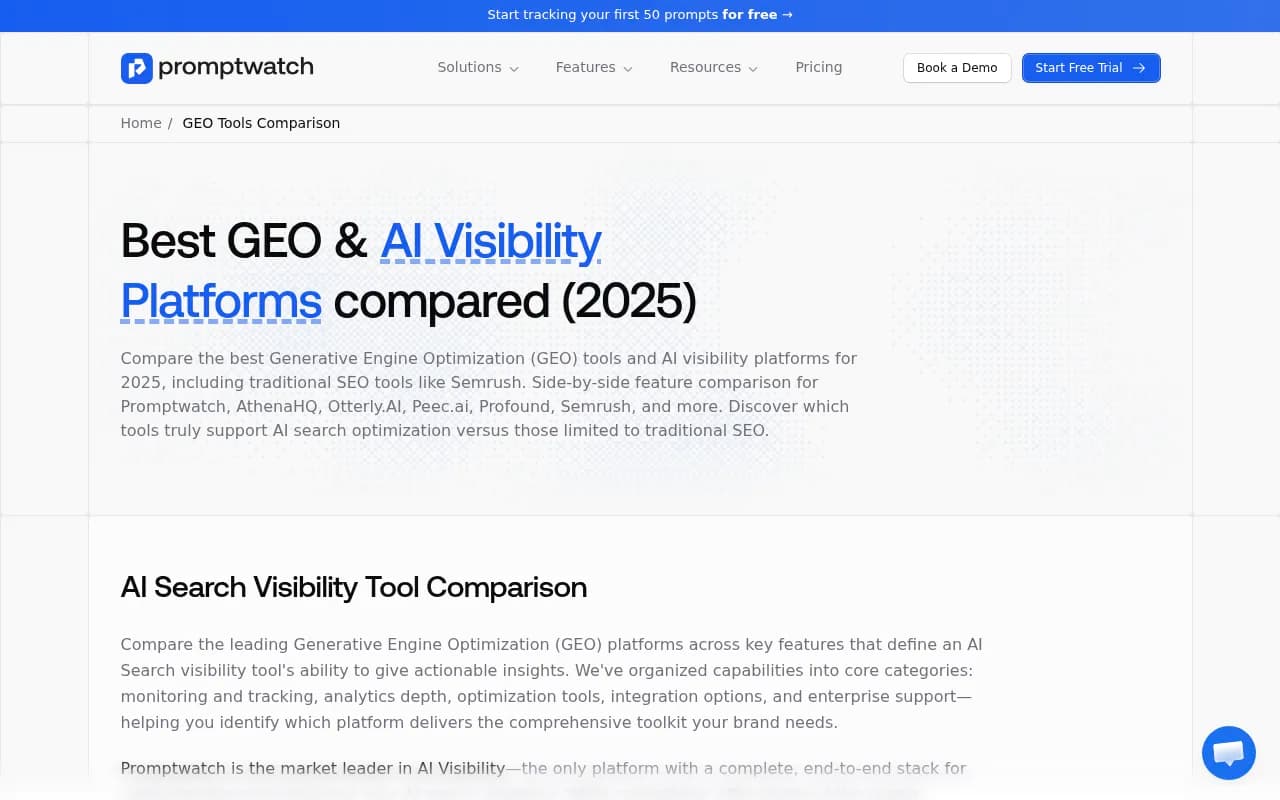
Where Promptwatch differs from Otterly and Peec is what happens after you have the data. The Answer Gap Analysis shows you exactly which prompts your competitors rank for that you don't. Content Agents then generate articles, listicles, and briefs built around those gaps -- not generic content, but pieces engineered around the specific questions AI models are already being asked. Then you track whether those new pages get crawled and cited.
That loop -- find gaps, create content, track results -- is what makes Promptwatch an optimization platform rather than a monitoring tool. The onboarding takes an extra hour or two compared to Otterly. Whether that's worth it depends on what you're trying to accomplish.
Where Promptwatch slows down
The site integration step (connecting via Cloudflare, Vercel, or server logs) can take time if your infrastructure team needs to be involved. On the Essential plan, you're limited to 50 prompts and 5 articles per month, which is fine for getting started but may feel restrictive for larger campaigns. And the platform's depth means there's a learning curve -- you'll get more out of it after a week of use than on day one.
Profound: powerful, but plan for a week, not a day
Profound is the enterprise leader in this category -- $155 million raised, a $1 billion valuation, Fortune 500 clients. The platform is genuinely impressive in terms of depth. But onboarding is not its strength.
To get started with Profound, you need to book a demo. There's no self-serve signup, no public pricing on the website, and no free trial you can access without talking to sales first. The pricing reportedly starts around $499/month based on third-party comparisons, but you won't see a number until you've had a conversation.
For enterprise teams with a procurement process, this is normal. For a marketing manager who wants to start tracking AI visibility this week, it's a blocker.
Once you're through the sales process, Profound's onboarding is thorough -- you get a dedicated setup session, and the platform's data quality is strong. But the time from "I want to try this" to "I have data" is measured in days to weeks, not hours.
Where Profound makes sense despite the friction
If you're at a Fortune 500 company, need enterprise SLAs, and have a procurement team that handles vendor onboarding anyway, Profound's process is unremarkable. The friction that would stop a startup cold is just normal enterprise buying for a large organization. The platform's depth -- particularly for competitive intelligence and share-of-voice analysis -- is hard to match.
Head-to-head comparison
| Otterly.AI | Peec AI | Promptwatch | Profound | |
|---|---|---|---|---|
| Self-serve signup | Yes | Yes | Yes | No (demo required) |
| Free trial | Yes | Yes | Yes | No |
| Starting price | $29/mo | ~€99/mo | $99/mo | ~$499/mo (custom) |
| Time to first data | Under 1 hour | 1-3 hours | 2-4 hours | Days to weeks |
| AI models covered | 5+ | 4 (base), more on enterprise | 10 | Multiple (enterprise) |
| Prompt limit (entry plan) | Limited | 100 prompts | 50 prompts | Custom |
| Content generation | No | No | Yes | No |
| Crawler / agent logs | No | No | Yes (Professional+) | No |
| Multilingual | Limited | 115+ languages | Yes | Yes |
| Answer gap analysis | No | No | Yes | Limited |
| ChatGPT Shopping tracking | No | No | Yes | No |
| Reddit / YouTube insights | No | No | Yes | No |
| Best for | Quick monitoring, small teams | Mid-market, global brands | Teams that want to optimize, not just monitor | Enterprise, Fortune 500 |
Which platform should you choose?
The honest answer depends on what you're optimizing for.
If you need data today and your goal is a basic visibility report, Otterly is the right call. It's cheap, fast, and does exactly what it says. Don't overthink it.
If you're a global brand that needs multilingual coverage and a clean self-serve experience, Peec AI is worth a look. The 115-language support is a real differentiator, and the interface is genuinely well-built.
If you want to actually move the needle on your AI visibility -- not just measure it -- Promptwatch is the more complete option. The extra setup time pays off quickly once you're running Answer Gap Analysis and using Content Agents to publish targeted content. The fact that you can see which AI crawlers are hitting your pages, which content is getting cited, and connect that back to traffic and revenue is something Otterly and Peec simply don't offer.
If you're at an enterprise with a six-figure marketing budget and need deep competitive intelligence with dedicated support, Profound is worth the demo call.
A note on what "fast onboarding" actually gets you
There's a version of this question that's worth pushing back on slightly. Onboarding speed matters, but it's not the same as time-to-value.
Otterly can get you a dashboard in 20 minutes. But if that dashboard shows you that your brand appears in 8% of relevant AI responses and you have no idea what to do with that number, the fast onboarding didn't actually help you.
The tools that take longer to set up -- particularly Promptwatch -- tend to take longer because they're doing more. Connecting your site for crawler logs, setting up persona targeting, configuring content agents: these steps take time because they're building the infrastructure for ongoing optimization, not just a one-time report.
So the real question isn't "which tool onboards fastest?" It's "which tool gets me to a place where I can take action fastest?" Those are different questions with different answers.
For pure speed: Otterly. For speed plus actionability: Promptwatch. For enterprise depth with patience: Profound. For global multilingual coverage: Peec AI.
Getting started
All four platforms offer some form of free access or trial:
- Otterly.AI: free tier available, paid plans from $29/month
- Peec AI: free trial, paid plans from ~€99/month
- Promptwatch: free trial, paid plans from $99/month (Essential), $249/month (Professional)
- Profound: demo required, pricing custom
If you're starting from zero and want to understand your AI visibility quickly, the practical advice is: sign up for Otterly or Peec today to get a baseline reading, then evaluate whether Promptwatch's optimization capabilities are worth the upgrade once you understand what you're working with.
The monitoring data will tell you where you stand. The optimization tools will tell you what to do about it.