Key takeaways
- Omnia, Otterly.AI, and Peec AI are all legitimate AI visibility monitoring tools with different strengths -- Omnia leans into citation intelligence, Otterly.AI offers location-specific audits at a low price point, and Peec AI has the cleanest UX of the three.
- All three share the same fundamental limitation: they show you where your brand is invisible in AI search, but don't help you do anything about it.
- The monitoring-only model works fine if you have a separate content team and strategy -- but most marketing teams don't, which means insights pile up without action.
- If you need to close the loop from "we're not being cited" to "we fixed it and here's the traffic," you'll need a platform that includes content gap analysis, content generation, and traffic attribution.
- Promptwatch is the only platform rated as a "Leader" across all categories in a 2026 comparison of 12 GEO platforms, largely because it covers the full action loop rather than stopping at monitoring.
The AI search visibility category has exploded in 2026. There are now dozens of tools claiming to track your brand across ChatGPT, Perplexity, Claude, Gemini, and Google AI Overviews. Most of them do roughly the same thing: run prompts, check if your brand appears, and show you a dashboard.
Omnia, Otterly.AI, and Peec AI are three of the more popular options in this category. They're all purpose-built for AI visibility (not SEO tools with AI features bolted on), they're all reasonably priced, and they all have genuine users who like them. This guide compares them honestly -- what each one does well, where each one falls short, and what the category as a whole is still missing.
What each tool actually does
Before getting into the comparison, it's worth being clear about what these tools are designed to do. All three are monitoring platforms. You connect your brand, set up prompts relevant to your industry, and they track how often your brand appears in AI-generated responses across a set of models.
That's genuinely useful. If you don't know whether ChatGPT is recommending you, you can't improve it. Monitoring is the necessary first step.
The question is whether it's enough.
Omnia
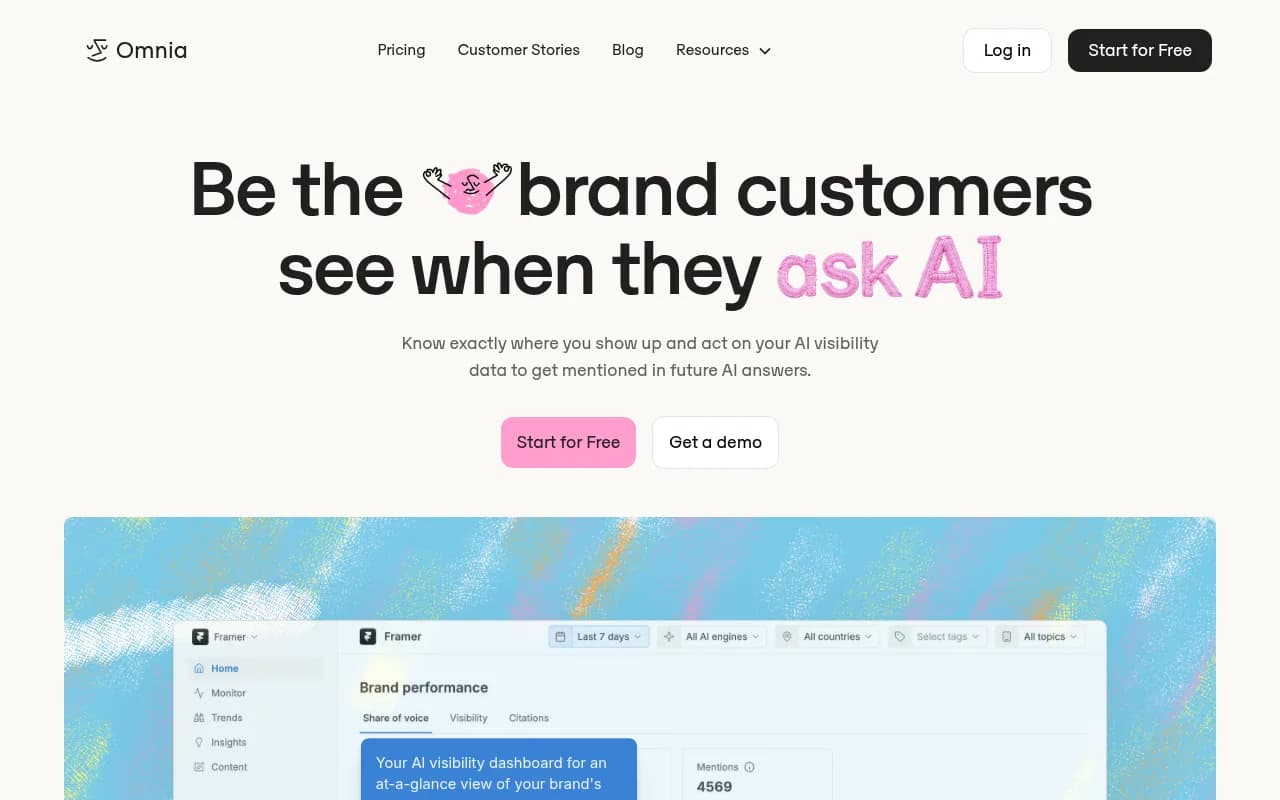
Omnia is a purpose-built AI visibility platform that tracks brand presence across ChatGPT, Perplexity, Google AI Overviews, and Google AI Mode. Its positioning is around citation intelligence -- not just "did your brand appear" but which sources AI models are citing when they answer questions in your category.
That's a meaningful distinction. Knowing that Perplexity is citing a competitor's blog post (rather than yours) gives you something actionable to work with, at least in theory. Omnia surfaces that kind of source-level data, which puts it a step above tools that only report mention rates.
The platform also tracks share of voice across competitors, which is useful for benchmarking. If your brand appears in 12% of relevant AI responses and a competitor appears in 34%, you have a concrete gap to close.
What Omnia doesn't do is tell you how to close it. The citation data shows you what's being cited -- but generating the content that would get cited instead is outside the platform's scope.
Otterly.AI
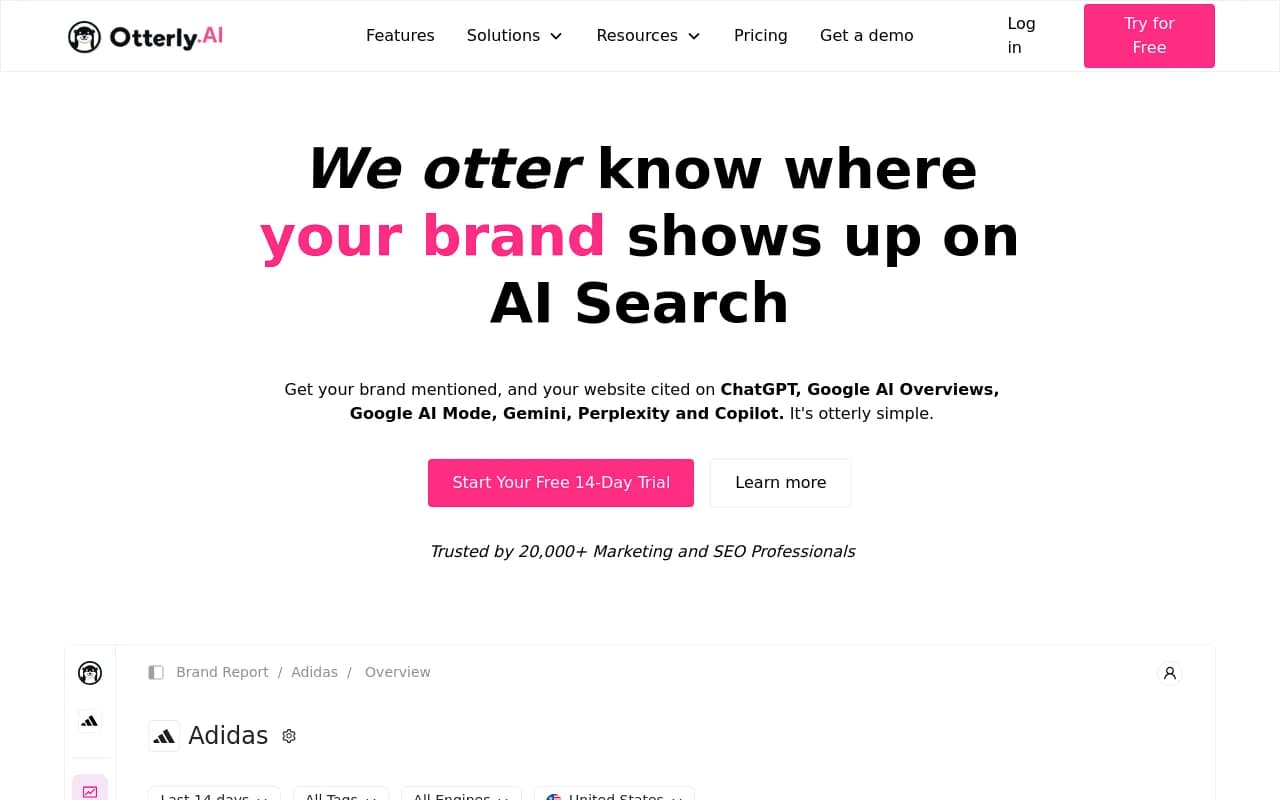
Otterly.AI is the most affordable of the three, starting at $29/month. It covers four base AI models and has a particular focus on location-specific GEO audits -- useful for brands that care about how AI search results vary by geography.
The low price point makes it popular with smaller teams and agencies that want to add AI visibility tracking without a significant budget commitment. It's a reasonable entry point into the category.
The trade-off is depth. At $29/month, you're getting basic monitoring with limited prompt volume and model coverage. There's no content optimization layer, no crawler log access, and no traffic attribution. For teams just getting started with AI visibility, that's fine. For teams trying to actually move the needle, it tends to become a limitation quickly.
Peec AI
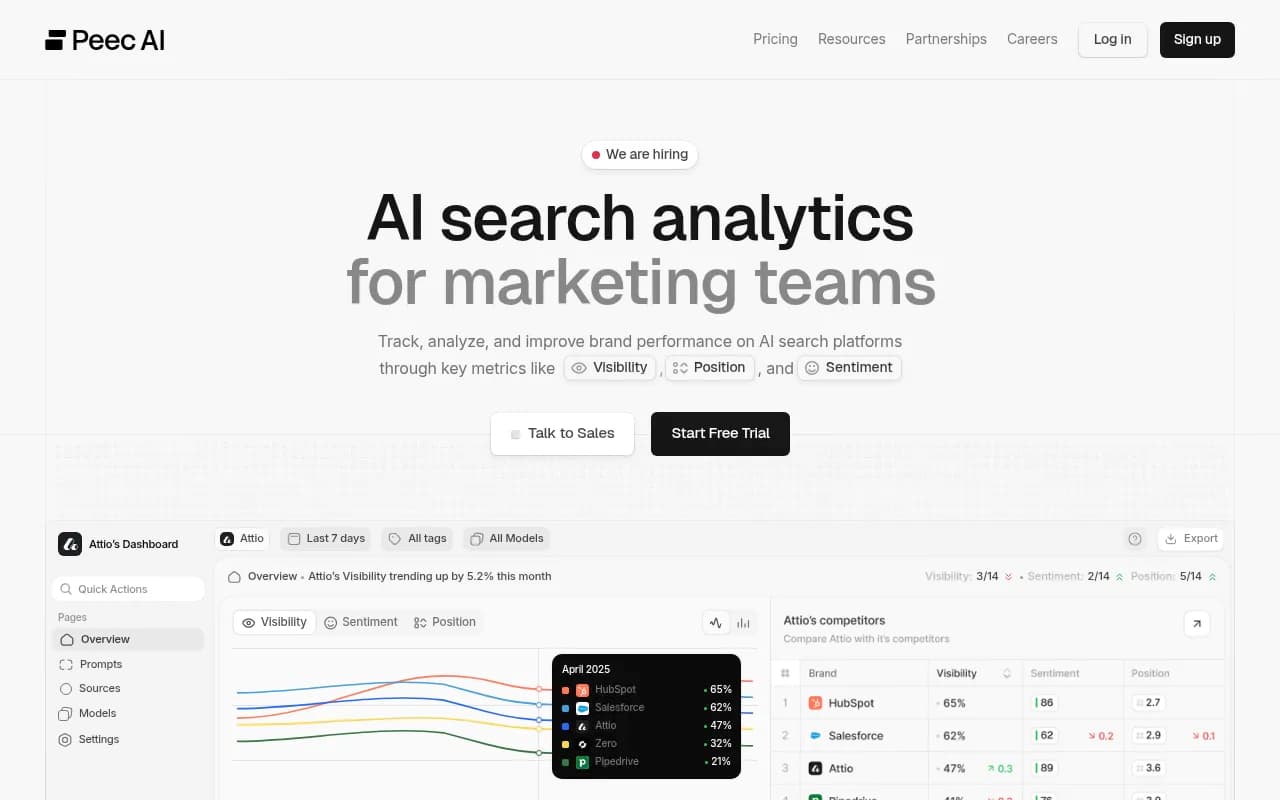
Peec AI tracks up to 10 AI models and starts at around €85/month. It's consistently described as having the best UX of the three -- clean, intuitive, and easy to get into without a steep learning curve.
A Reddit thread from April 2026 in r/Agentic_SEO put it plainly: "Peec AI is a solid tool. It is really intuitive and easy to use. Probably one of the easiest to get into." That's a real advantage if you're trying to get a team to actually use a tool rather than ignore it.
Peec AI covers a solid range of models and gives you share of voice data, competitor comparisons, and prompt-level tracking. The UX genuinely is good.
The limitation, again, is that it's monitoring-only. Multiple independent reviews in 2026 describe it as "a monitoring-only platform with no content optimization." The data is clean and accessible -- but what you do with it is entirely up to you.
Side-by-side comparison
| Feature | Omnia | Otterly.AI | Peec AI |
|---|---|---|---|
| AI models tracked | ChatGPT, Perplexity, Google AI Overviews, AI Mode | 4 base models | Up to 10 |
| Starting price | Not publicly listed | $29/mo | €85/mo |
| Share of voice tracking | Yes | Limited | Yes |
| Citation/source analysis | Yes (strength) | Basic | Basic |
| Location-specific tracking | Limited | Yes (strength) | Limited |
| Competitor benchmarking | Yes | Basic | Yes |
| UX quality | Good | Good | Excellent |
| Content gap analysis | No | No | No |
| Content generation | No | No | No |
| AI crawler logs | No | No | No |
| Traffic attribution | No | No | No |
| Reddit/YouTube tracking | No | No | No |
| ChatGPT Shopping tracking | No | No | No |
The pattern is consistent. All three do monitoring reasonably well. None of them help you act on what they find.
The shared blind spot: monitoring without action
Here's the practical problem with monitoring-only tools. You log in, you see that your brand appears in 8% of relevant AI responses while your top competitor appears in 31%. You have a share of voice gap. Now what?
The tool has done its job. It's shown you the gap. But closing it requires:
- Knowing which specific prompts you're losing on
- Understanding why (what content the AI is citing instead of you)
- Creating content that addresses those gaps
- Publishing it somewhere AI models will actually find and cite it
- Tracking whether it worked
Monitoring-only tools cover step one and partially step two. Steps three through five are entirely outside their scope. That means every insight becomes a manual project: brief a writer, figure out the angle, publish, wait, check back in the monitoring tool weeks later to see if anything changed.
For teams with dedicated SEO or content functions, this workflow is manageable. For everyone else, it's where insights go to die.
This isn't a criticism unique to these three tools -- it's a category-wide limitation. Most AI visibility platforms launched as monitoring dashboards because that was the fastest thing to build. The harder problem is building the action layer on top.
What the action layer actually looks like
The gap between "here's your visibility data" and "here's how to improve it" is where most teams get stuck. A few platforms have started building into this space.
The most complete version of the action loop works like this:
- Answer Gap Analysis shows you which prompts competitors rank for that you don't -- not just that a gap exists, but the specific content your site is missing
- A built-in content agent generates articles, listicles, and comparisons grounded in real citation data, not generic SEO filler
- Page-level tracking shows which pages are being cited by which AI models and how often
- Traffic attribution (via a code snippet, GSC integration, or server log analysis) connects AI visibility to actual revenue
That's the difference between a monitoring dashboard and an optimization platform. The monitoring tells you where you are. The optimization platform helps you get somewhere better.
Promptwatch is the clearest example of this in the current market -- it covers all 10 major AI models, includes AI crawler logs (which show you exactly which pages AI bots are reading and how often), and has a content generation agent trained on 880M+ citations.

Who should use each tool
These tools aren't bad -- they're just scoped differently. The right choice depends on what you actually need.
Omnia is worth considering if:
- Citation intelligence is your primary use case (you want to know which sources AI models are citing in your category)
- You're tracking a small number of prompts and want clean source-level data
- You have a content team that can take citation insights and act on them independently
Otterly.AI is worth considering if:
- Budget is genuinely constrained and you need basic monitoring for under $30/month
- Location-specific AI search tracking matters for your business (local brands, multi-region companies)
- You're just starting out and want to understand the category before committing to a more expensive platform
Peec AI is worth considering if:
- UX and ease of adoption are priorities -- it's the most intuitive of the three
- You need broad model coverage (up to 10 models) without a steep learning curve
- You have a team that will actually use a clean dashboard and can handle the "what do we do now" question separately
When to look beyond monitoring-only tools
If any of these situations apply to you, a monitoring-only tool probably isn't enough:
- You don't have a dedicated SEO or content team to act on the data
- You've been using an AI visibility tool for 3+ months and your visibility scores haven't improved
- You want to connect AI visibility to revenue, not just mention rates
- You're an agency that needs to show clients results, not just reports
- You're tracking competitors and want to know specifically what content is driving their AI citations
The broader category of AI visibility platforms has matured enough in 2026 that "we track your brand" is table stakes. The differentiator now is what happens after you see the data.
Other tools worth knowing about
If you're evaluating beyond these three, a few other platforms are worth a look depending on your needs.
For enterprise teams with larger budgets, Profound has strong prompt research capabilities and covers up to 10 models.
For agencies specifically, Search Party has agency-oriented features, though it has limited prompt metrics compared to full-stack platforms.
Search Party
For teams that want something in between monitoring and full optimization, Scrunch AI offers some optimization features alongside tracking.
For a broader view of the category, the 2026 landscape now includes 12+ purpose-built GEO platforms. The ones that have moved beyond pure monitoring -- adding content gap analysis, content generation, and traffic attribution -- are pulling ahead of the ones that haven't.
The bottom line
Omnia, Otterly.AI, and Peec AI are all legitimate tools that do what they say they do. Omnia has the strongest citation intelligence. Otterly.AI has the lowest entry price and good location tracking. Peec AI has the best UX. None of them will help you create content that closes the gaps they find.
That's not necessarily a dealbreaker -- it depends on your team's capacity to act on monitoring data independently. But if you're buying an AI visibility tool expecting it to improve your AI visibility (rather than just measure it), you'll hit a ceiling with any of these three.
The category is moving toward platforms that cover the full loop: find the gap, generate the content, track the result. That's where the real value is, and it's increasingly where the market is going.