Key takeaways
- Meteoria.ai, Scrunch, and Peec AI are all legitimate AI visibility monitoring tools, but they stop at showing you data -- none offer content gap analysis, AI content generation, or meaningful optimization workflows
- Peec AI is the simplest of the three: clean UX, three core metrics, easy onboarding -- but limited engine coverage and no actionable insights
- Scrunch sits in the mid-market tier with a broader feature set and an "AXP" agent experience layer, but still lacks content creation and crawler log access
- The monitoring-only model has a real ceiling: knowing you're invisible doesn't help if the tool won't tell you what to write or help you write it
- If you need to actually improve your AI visibility -- not just track it -- you need a platform built around the full optimization loop, not just the dashboard
What we're actually comparing here
This isn't a "best AI visibility tools" roundup. It's a focused look at three tools that occupy a similar position in the market: they monitor how your brand appears in AI search engines, they give you dashboards and metrics, and they leave the rest to you.
That's a legitimate product category. Not every team needs an all-in-one platform. Some just want clean data before they decide what to do next.
But it's worth being clear about what you're getting -- and what you're not -- before you commit to any of them.
Meteoria.ai, Scrunch, and Peec AI are all worth considering if monitoring is your primary goal. They differ in coverage, UX, pricing philosophy, and depth. Let's go through each one honestly.
Peec AI: the simplest entry point
Peec AI is probably the easiest tool in this category to get started with. The interface is clean, the onboarding is fast, and the core product is deliberately simple: three metrics (Visibility, Position, and Sentiment) tracked across a handful of AI engines.

According to a Reddit thread from April 2026 reviewing AI search platforms, Peec AI is "really intuitive and easy to use. Probably one of the easiest to get into." The UX praise is consistent across reviews. If your team is new to AI visibility monitoring and just wants something that works without a steep learning curve, Peec AI delivers that.
The tradeoffs are real, though. Zapier's 2026 roundup of AI visibility tools noted that Peec AI is "notably lacking actionable insights, trend data, and AI crawler visibility insights" and currently only tracks a limited set of engines. For teams that need coverage across ChatGPT, Claude, Perplexity, Gemini, Grok, and others simultaneously, that's a meaningful gap.
The three-metric model (Visibility, Position, Sentiment) is clean but thin. You can see that your brand is mentioned, roughly where in the response, and whether the sentiment is positive or negative. What you can't see is which specific content is driving those mentions, which prompts your competitors are winning that you're not, or what you should publish next to close the gap.
Peec AI is a good fit for: small teams or solo marketers who want a low-friction way to start tracking AI mentions without committing to a complex platform.
It's a poor fit for: anyone who needs to act on the data, report across many engines, or understand the "why" behind their visibility scores.
Scrunch: the mid-market option with more depth
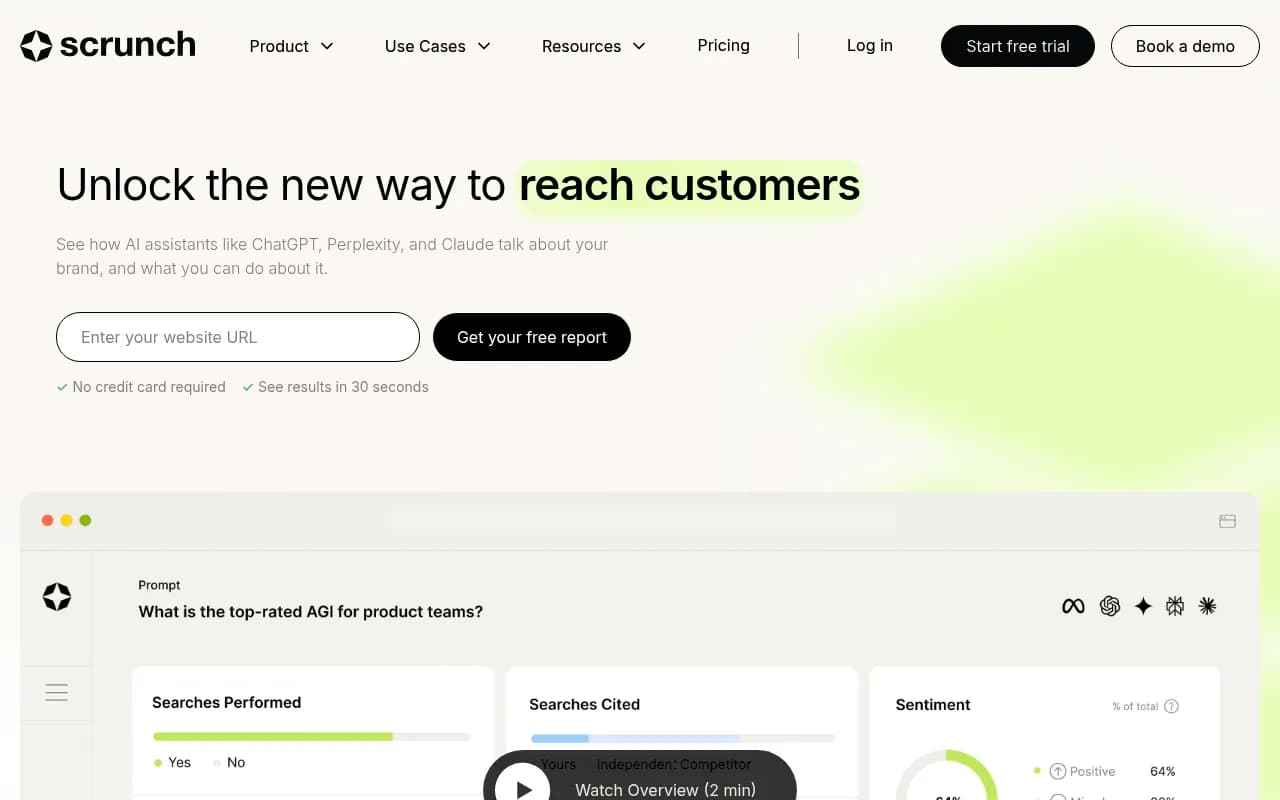
Scrunch sits a tier above Peec AI in terms of feature breadth. It covers more AI engines, offers more detailed reporting, and has what it calls an "AXP" (agent experience) layer -- essentially a way to understand how AI assistants are experiencing and representing your brand.
The positioning is squarely mid-market. Vismore's 2026 comparison of AI search optimization tools describes Scrunch as suited for "mid-market monitoring + AXP agent experience layer," which is a fair summary. It's more capable than a basic tracker but doesn't cross into optimization territory.
Where Scrunch does well: the reporting is more granular than Peec AI, the engine coverage is broader, and the product feels more mature for teams that need to present AI visibility data to stakeholders. If you're running a marketing team and need to show leadership a dashboard that covers multiple AI platforms with some trend data, Scrunch can do that.
Where it falls short: like Peec AI, Scrunch is fundamentally a monitoring tool. There's no content gap analysis, no built-in content generation, no AI crawler logs showing which of your pages the models are actually reading, and no prompt volume data to help you prioritize. You get a picture of where you stand. The question of what to do about it is yours to figure out.
Pricing for Scrunch sits in the mid-range for this category. It's not the cheapest option, but it's not enterprise-tier either -- which makes it a reasonable choice for growing teams that have outgrown basic trackers but aren't ready for a full GEO platform.
Scrunch is a good fit for: mid-market marketing teams that need cleaner, more detailed monitoring than entry-level tools and can handle the optimization work separately.
It's a poor fit for: teams that need to close the loop between "we're invisible here" and "here's the content we published to fix it."
Meteoria.ai: the newer entrant
Meteoria.ai is a newer player in the AI visibility monitoring space. It tracks brand mentions and citations across AI search engines and positions itself as a straightforward monitoring solution for brands that want to understand their AI search presence.
The product is less extensively reviewed than Peec AI or Scrunch at this point, which reflects its relative newness rather than any specific quality issue. Early users tend to highlight the clean interface and the focus on citation tracking -- knowing which sources AI models are pulling from when they mention (or don't mention) your brand.
Like the other two tools in this comparison, Meteoria.ai sits firmly in the monitoring category. It shows you what's happening. It doesn't help you change it.
For teams evaluating Meteoria.ai specifically, the key questions to ask during any trial are: which AI engines does it cover, does it offer any prompt-level data (volumes, difficulty, competitor visibility by prompt), and what does the export/reporting workflow look like for your team's needs.
Comparing the three side by side
| Feature | Peec AI | Scrunch | Meteoria.ai |
|---|---|---|---|
| AI engine coverage | Limited (3-4 engines) | Broader (5+ engines) | Moderate |
| Core metrics | Visibility, Position, Sentiment | More granular reporting | Citation tracking focus |
| UX complexity | Very simple | Moderate | Simple |
| Prompt-level data | No | Limited | No |
| Content gap analysis | No | No | No |
| AI content generation | No | No | No |
| AI crawler logs | No | No | No |
| Reddit/YouTube tracking | No | No | No |
| Competitor heatmaps | Basic | Basic | No |
| Traffic attribution | No | No | No |
| Best for | Beginners, small teams | Mid-market teams | Early-stage monitoring |
| Pricing tier | Budget-friendly | Mid-range | Early-stage |
The pattern is consistent across all three: solid monitoring, no optimization.
The real problem with monitoring-only tools
Here's the thing that doesn't get said enough in these comparisons: knowing you're invisible in AI search is only useful if you know what to do about it.
Most teams that invest in an AI visibility tool aren't doing it out of curiosity. They're doing it because AI search is eating into their traffic, their leads, or their brand awareness, and they need to fix it. A dashboard that confirms the problem -- without helping you solve it -- is better than nothing, but not by much.
The monitoring-only model has a real ceiling. You can see that ChatGPT doesn't mention you when users ask about your category. You can see that a competitor is getting cited in 70% of relevant responses while you're at 12%. What you can't see, in any of these three tools, is:
- Which specific prompts your competitor is winning that you're not
- What content on their site is driving those citations
- What you should write to compete for those prompts
- Whether AI crawlers are even reading your existing pages
That last point matters more than most people realize. If GPTBot or ClaudeBot isn't crawling your content, no amount of optimization will help. You need to know what's happening at the crawl level before you can fix anything else.

What a full optimization loop actually looks like
The tools that go beyond monitoring -- and there aren't many -- work in a cycle: find the gaps, create content to fill them, track whether it worked.
Promptwatch is the clearest example of this in practice. Where Peec AI shows you a sentiment score and Scrunch shows you a visibility trend, Promptwatch's Answer Gap Analysis shows you the specific prompts your competitors are visible for that you're not -- with volume estimates and difficulty scores so you can prioritize. Then the built-in AI writing agent generates content engineered to get cited by AI models, grounded in 880M+ citations analyzed. Then page-level tracking shows whether the new content is actually being picked up.

That's a meaningfully different product category, even if it's often listed alongside monitoring tools in roundups.
Other platforms worth knowing about in the broader space:


The distinction that matters: Otterly.AI and AthenaHQ are also primarily monitoring tools. Profound has a strong feature set but sits at a higher price point. Promptwatch is the only platform in the 2026 comparison of 12 GEO tools rated as a "Leader" across all categories -- specifically because it closes the loop between monitoring and action.
How to choose between these three
If you're deciding between Meteoria.ai, Scrunch, and Peec AI specifically, the decision mostly comes down to team size, budget, and how much reporting complexity you need.
Choose Peec AI if you're just getting started, you want something you can set up in an afternoon, and you're okay with limited engine coverage while you figure out your AI visibility strategy. It's the lowest-friction entry point in this comparison.
Choose Scrunch if you need more reporting depth, broader engine coverage, and a product that can grow with a mid-market marketing team. It's a more mature product for teams that need to present visibility data to stakeholders regularly.
Choose Meteoria.ai if you specifically want citation-focused tracking and are evaluating newer tools that may evolve quickly. Worth trialing alongside one of the others to compare.
Choose none of the above if your actual goal is to improve your AI visibility, not just measure it. In that case, you need a platform with content gap analysis, content generation, and crawler log access -- which none of these three provide.
A note on the broader market
The AI visibility tool market in 2026 has a lot of monitoring-only products. That's partly because monitoring is easier to build than optimization, and partly because the category is still young enough that many teams are in the "figure out where we stand" phase rather than the "actively improving our position" phase.
That's changing. As AI search continues to absorb more of the discovery layer -- ChatGPT at 2.5 billion prompts per day, Perplexity growing fast, Google AI Overviews now appearing on the majority of commercial queries -- the teams that are just monitoring are going to fall further behind the ones that are actively optimizing.
The monitoring-only tools in this comparison are useful starting points. But if you're serious about AI search visibility as a channel, you'll eventually need to move beyond them.
The question is whether you want to make that move now or after your competitors have already built a six-month head start in AI citations.
Bottom line
Peec AI, Scrunch, and Meteoria.ai are all legitimate tools for what they do. They track your brand in AI search, show you where you stand, and give you data to work with. If that's all you need right now, any of the three will serve you.
But be clear-eyed about the ceiling. None of them will tell you what content to create, help you create it, show you which of your pages AI crawlers are reading, or connect your visibility scores to actual traffic and revenue. For that, you need a platform built around the full optimization loop -- not just the monitoring dashboard.