Key takeaways
- Monitoring-only GEO tools show you where you're invisible in AI search -- but they stop there, leaving you to figure out the fix on your own.
- All-in-one platforms like Relixir combine tracking with content generation and optimization, closing the loop between insight and action.
- Neither Meteoria.ai nor Relixir is a household name yet, which makes this comparison a useful proxy for the broader debate: is data alone enough, or do you need an execution layer?
- The GEO market in 2026 is splitting into two camps: dashboards that inform and platforms that act. The gap between them is widening fast.
- If your team has the bandwidth to translate monitoring data into content strategy, a lighter tool can work. If you don't, you'll pay for that gap in missed citations.
The real question behind this comparison
Before getting into features and pricing, it's worth naming what's actually being debated here. The Meteoria.ai vs Relixir question isn't really about two specific products -- it's about a strategic choice every marketing team faces right now: do you buy a monitoring tool and build your own optimization workflow around it, or do you invest in a platform that handles both?
This matters because the GEO category is still young enough that most tools are still figuring out their lane. Some started as rank trackers and bolted on AI monitoring. Others were built from scratch to optimize for AI citation. And a few are trying to do everything at once. Knowing which philosophy a tool was built around tells you a lot about where it'll fall short.
What GEO tools actually need to do in 2026
AI search has changed the visibility game in a specific way: your content either gets cited in an AI-generated answer or it doesn't. There's no page two. There's no "ranking 11th but still getting clicks." You're either in the answer or you're not.
That binary reality means the job of a GEO tool has two distinct phases:
- Figure out which prompts your competitors are appearing for that you're not
- Create content that makes AI models want to cite you for those prompts
Most tools on the market handle phase one reasonably well. Phase two is where the field thins out dramatically.
A monitoring-only tool gives you a dashboard showing your share of voice across ChatGPT, Perplexity, Claude, and others. You can see which prompts trigger competitor mentions and which ones leave you out. That's genuinely useful data. But then what? You still need someone to analyze the gaps, decide what content to create, write it, publish it, and track whether it worked. That's a lot of steps between "insight" and "result."
An all-in-one platform tries to compress that chain. You see the gap, you generate the content, you track the improvement. Fewer handoffs, faster iteration.
Meteoria.ai: the monitoring-first approach
Meteoria.ai sits in the monitoring camp. The core product is built around tracking brand visibility across AI search engines -- which prompts mention you, how often, in what context, and how you compare to competitors. It's a clean, focused tool that does what it promises.
The appeal of this approach is simplicity. You're not paying for features you might not use, and the data is presented without a lot of noise. Teams that already have strong content operations -- writers, strategists, a clear editorial calendar -- can take monitoring data and run with it. For them, a lightweight tracker is all they need.
The limitation is equally clear. If you pull up a gap report and see that three competitors are being cited for "best project management software for remote teams" and you're not, the tool has done its job. But now you need to figure out: what content do I create? How do I structure it so AI models actually cite it? Which model should I prioritize? How do I know if the content worked?
Monitoring tools don't answer those questions. They hand you the problem and wish you luck.
Relixir: the all-in-one bet
Relixir takes the opposite approach. It's built as an end-to-end GEO platform -- tracking visibility, identifying content gaps, generating AI-optimized content, and measuring the impact of that content on citation rates.
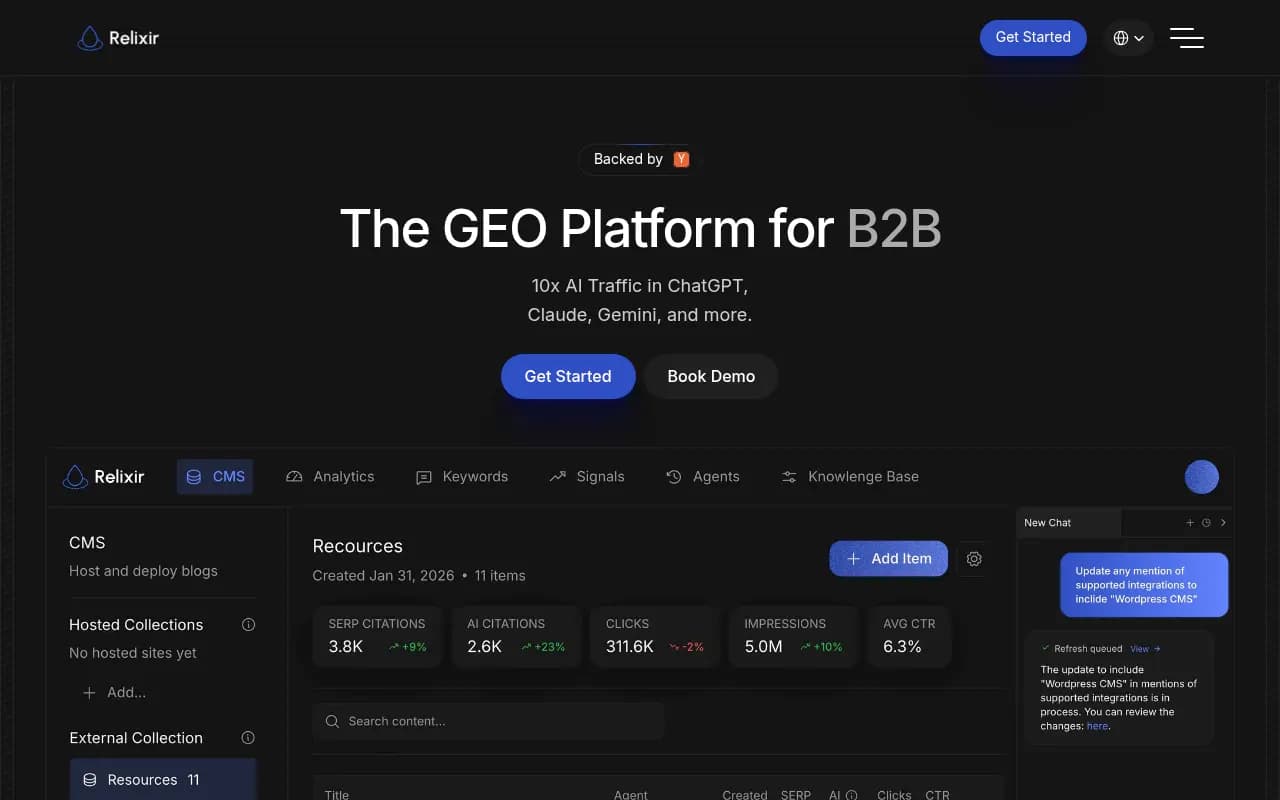
The pitch is that you shouldn't have to stitch together a monitoring tool, a content brief tool, an AI writing assistant, and a separate analytics layer. Relixir tries to be all of those things in one workflow.
This is a meaningful advantage if it works. The biggest friction in GEO right now isn't understanding that you have gaps -- it's doing something about them quickly enough to matter. AI models update their training data and crawl patterns constantly. A gap you identify today might be winnable this month and saturated next month. Speed matters.
The risk with all-in-one platforms is that they can be mediocre at several things instead of excellent at one. Content generated by a GEO platform's built-in AI writer might not be as good as what a dedicated content team produces. The monitoring might not be as granular as a specialist tracker. You're making a bet that "good enough at everything" beats "excellent at one thing."
Head-to-head comparison
| Dimension | Meteoria.ai | Relixir |
|---|---|---|
| Core philosophy | Monitoring-first | All-in-one GEO |
| AI model coverage | Multiple LLMs | Multiple LLMs |
| Content gap analysis | Basic | Yes |
| AI content generation | No | Yes |
| Citation tracking | Yes | Yes |
| Competitor benchmarking | Yes | Yes |
| Traffic attribution | Limited | Yes |
| Best for | Teams with strong content ops | Teams that need end-to-end execution |
| Pricing model | Subscription | Subscription |
The table makes the tradeoff obvious. If you have a content team that can act on monitoring data, Meteoria.ai's focused approach is defensible. If you need the platform to carry more of the execution weight, Relixir's all-in-one model is the better fit.
The broader market context
It's worth zooming out for a second, because Meteoria.ai and Relixir are competing in a market that's getting crowded fast. The GEO tool space in 2026 has dozens of players, and the monitoring-vs-optimization divide runs through almost all of them.
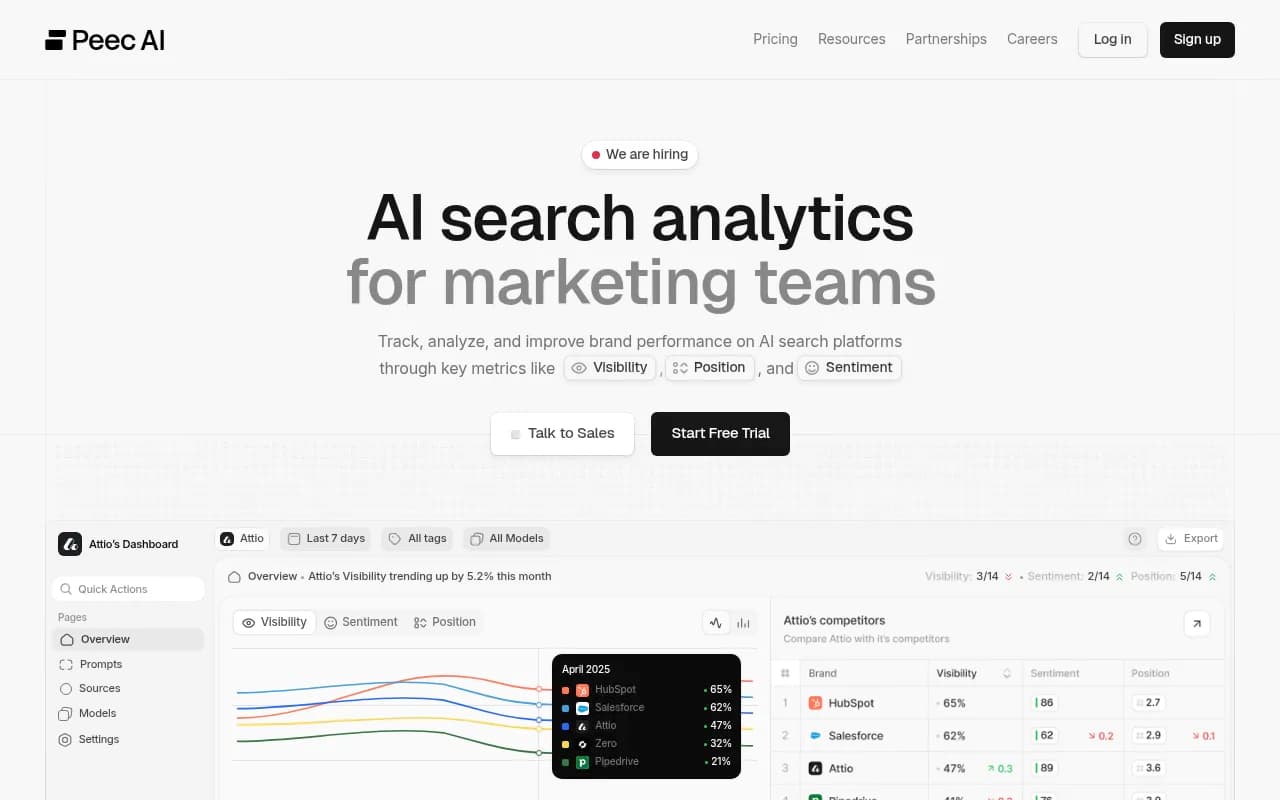
On the monitoring side, you have tools like Otterly.AI and Peec AI -- lightweight, affordable, good for teams that just want to know where they stand.

On the all-in-one side, the field is more interesting. Relixir is one option, but it's competing with platforms that have been building out their optimization layers for longer.

The honest assessment of the all-in-one category is that most platforms are still better at monitoring than optimization. The content generation features are often bolted on rather than native to the workflow. That's changing, but it's worth asking any vendor: how many of your customers actually use the content generation features, and what results are they seeing?
What actually moves the needle
Here's what the data from the broader GEO market suggests about what separates tools that improve citations from tools that just report on them.
The platforms that consistently show citation improvement share a few traits. They analyze not just whether you're mentioned, but which specific pages are being cited and why. They look at the sources AI models pull from -- not just your own site, but Reddit threads, YouTube videos, third-party reviews -- and help you influence those too. And they connect visibility data to actual traffic and revenue, so you can see whether getting cited in ChatGPT actually drives business outcomes.
Most monitoring-only tools stop at "you were mentioned X times." The better platforms tell you which page got cited, what the prompt was, how the citation compares to last month, and what you should do next.
Promptwatch is one of the platforms that's built this full loop -- from gap analysis to content generation to traffic attribution -- and it's worth understanding as a benchmark for what the category can look like at its best.

The reason it's worth mentioning here is that it illustrates what "all-in-one" actually means when it's done well. It's not just bundling features -- it's building a workflow where each step feeds the next. Gap analysis informs content creation. Content creation feeds citation tracking. Citation tracking connects to revenue attribution. That's the loop that makes the all-in-one model genuinely superior to monitoring alone.
Which approach wins?
The honest answer is: it depends on your team's execution capacity, not on which approach is philosophically superior.
Monitoring-only tools win when:
- You have a dedicated content team that can act on gap data quickly
- You already have a content workflow and just need better signal
- You're budget-constrained and can't afford a full platform
- You want to start simple and add complexity later
All-in-one platforms win when:
- Your team is small and needs the platform to carry execution weight
- You want to move from insight to published content in days, not weeks
- You're competing in a fast-moving category where speed matters
- You need to show ROI from GEO investment and need attribution built in
For most marketing teams in 2026, the all-in-one approach has the edge -- not because monitoring is useless, but because the bottleneck is almost never "we don't know where we're invisible." The bottleneck is "we know, but we can't create content fast enough to fix it."
A tool that shows you the gap and then helps you close it is worth more than a tool that shows you the gap and hands you a to-do list.
Practical recommendations
If you're evaluating Meteoria.ai specifically, the right question to ask is: does my team have the bandwidth to turn monitoring data into content and track the results manually? If yes, it's a reasonable choice. If no, you'll end up with a dashboard you check occasionally and a gap that doesn't close.
If you're evaluating Relixir, ask to see actual examples of content generated by the platform and the citation improvements that followed. All-in-one tools live or die on whether the execution layer actually works, not just whether it exists.
And if you're open to looking beyond these two, the GEO platform market has matured enough in 2026 that there are several options worth comparing side by side. The tools that have invested most heavily in the optimization layer -- not just the monitoring layer -- are the ones consistently showing up in case studies with real citation lift.
The monitoring-vs-all-in-one debate will probably resolve itself over the next 12-18 months as the market consolidates. The monitoring-only players will either add optimization features or get squeezed by platforms that already have them. For now, the choice comes down to what your team can realistically execute -- and being honest about that is more important than picking the "best" tool on paper.