Key takeaways
- Otterly.AI is one of the cheapest entry points into AI visibility tracking, starting at $29/month, but covers only 4 AI models and offers no content optimization features
- Meteoria.ai targets a similar budget segment with basic brand monitoring across LLMs, but lacks the depth needed for serious GEO work
- Both tools are monitoring-only dashboards -- they show you where you're invisible but don't help you fix it
- If you're serious about improving your AI search presence (not just watching it), you'll quickly outgrow both tools
- For teams that need to act on visibility data -- not just collect it -- platforms like Promptwatch offer content gap analysis and AI content generation alongside tracking
The AI visibility tool market has exploded in 2026. There are now dozens of platforms promising to tell you how your brand shows up in ChatGPT, Perplexity, Claude, and Google AI Overviews. Most of them are fine for what they are. The question is whether "fine" is enough for your situation.
Meteoria.ai and Otterly.AI sit at the budget end of this market. Both are designed for smaller teams or individuals who want to dip their toes into AI search monitoring without committing to enterprise pricing. That's a legitimate use case. But there are real tradeoffs, and they're worth understanding before you sign up.
This comparison covers what each tool actually does, where they fall short, and whether either one is genuinely worth your money in 2026.
What these tools are trying to do
Before getting into the specifics, it helps to understand what "AI visibility" actually means in practice.
When someone types a question into ChatGPT or Perplexity, the AI generates an answer. That answer might mention your brand, cite your website, recommend your product -- or ignore you entirely in favor of a competitor. AI visibility tools track this. They run queries across multiple AI models, record the responses, and tell you how often you appear, in what context, and who's beating you.
The category is genuinely useful. Traditional SEO tools don't capture this. Your Google Search Console data tells you nothing about whether ChatGPT is recommending your competitors instead of you.
Meteoria.ai and Otterly.AI both do this basic job. The differences are in depth, model coverage, and -- critically -- what you can do with the data.
Otterly.AI: the cheapest seat at the table
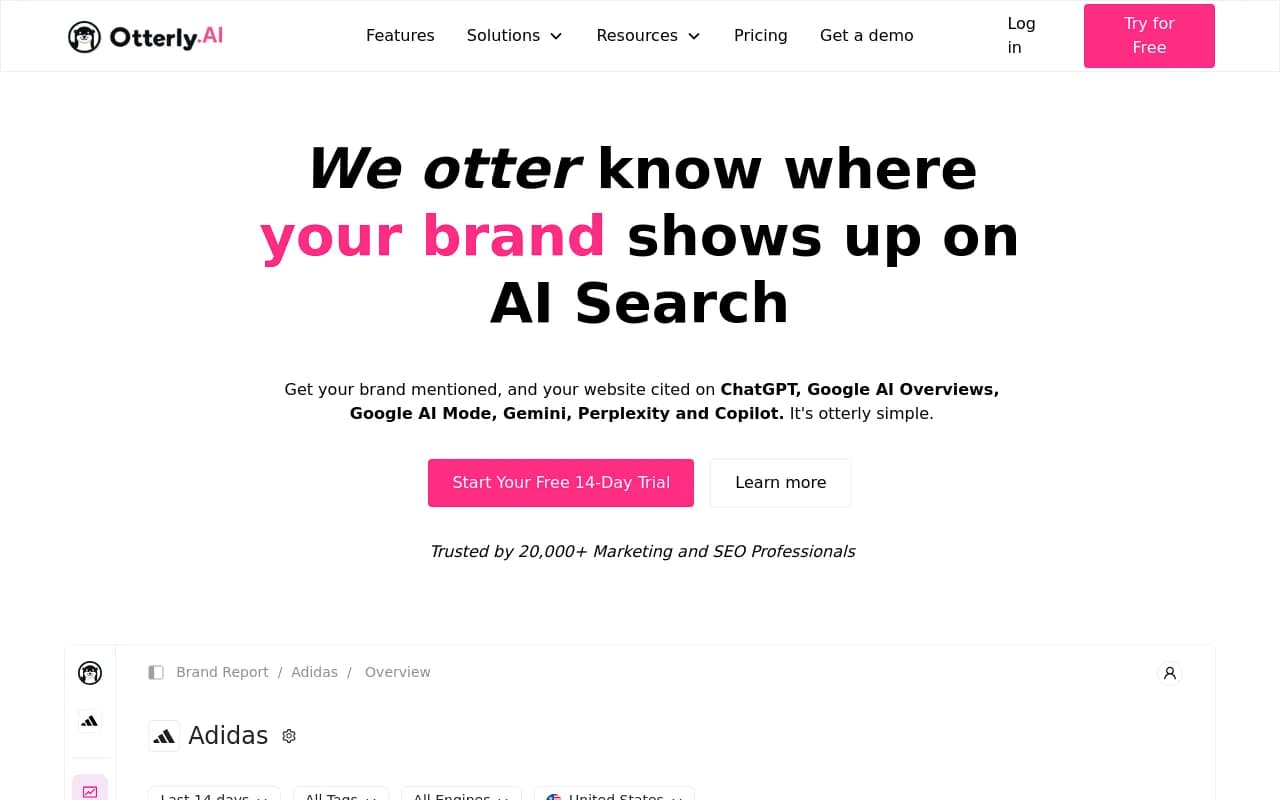
Otterly.AI has positioned itself as the lowest-cost entry point in the AI visibility space. At $29/month for the Lite plan, it's genuinely accessible. The tool tracks brand mentions across 4 AI models at the base tier, gives you share-of-voice metrics, and shows you how competitors are appearing in AI responses.
For someone who just wants to know "am I showing up in AI search at all?" -- Otterly.AI answers that question. The interface is clean, setup is fast, and you don't need to be a data analyst to understand the output.
But the limitations are real. Four models is a narrow view of the AI search landscape in 2026. ChatGPT, Perplexity, Claude, and Gemini are the obvious ones, but Grok, DeepSeek, Copilot, and Meta AI are all driving meaningful traffic in specific verticals. If your audience uses any of those, you're flying blind.
More importantly, Otterly.AI is a monitoring tool. It shows you data. It doesn't tell you what to do about it, doesn't help you identify which content gaps are causing you to miss out, and doesn't generate anything to fix the problem. You get a dashboard. What happens next is entirely up to you.
That's not a criticism exactly -- it's just what the tool is. The question is whether that's enough for your needs.
Meteoria.ai: similar territory, different packaging
Meteoria.ai operates in the same budget segment. It's built around the idea that smaller brands and solo marketers should be able to track their AI search presence without paying enterprise prices, and that's a fair premise.
The feature set is broadly comparable to Otterly.AI: brand mention tracking across a selection of LLMs, some competitor comparison, and basic reporting. The interface leans toward simplicity, which works well if you're new to AI visibility and don't want to be overwhelmed.
Where Meteoria.ai differs slightly is in how it presents data. Some users find the reporting more intuitive for quick weekly check-ins. But the underlying limitation is the same: it's a monitoring dashboard. There's no content gap analysis, no prompt intelligence, no crawler logs showing which pages AI models are actually reading on your site.
Neither tool has published detailed information about their citation databases or the methodology behind their visibility scores, which makes it harder to evaluate how accurate the data actually is. For a $29-50/month tool, that's understandable. For making real business decisions, it's worth keeping in mind.
Head-to-head comparison
| Feature | Meteoria.ai | Otterly.AI |
|---|---|---|
| Starting price | ~$49/month | $29/month |
| AI models tracked | 4-6 | 4 (base), more on higher tiers |
| Brand mention tracking | Yes | Yes |
| Competitor comparison | Basic | Basic |
| Share of voice | Yes | Yes |
| Content gap analysis | No | No |
| AI content generation | No | No |
| Crawler logs | No | No |
| Prompt volume/difficulty | No | No |
| Reddit/YouTube tracking | No | No |
| Traffic attribution | No | No |
| Free trial | Yes | Yes |
| Best for | Solo marketers, small brands | Budget-conscious teams, beginners |
The table tells the story pretty clearly. Both tools cover the basics. Neither goes beyond monitoring.
The real question: monitoring vs. optimization
Here's the thing that often gets lost in budget tool comparisons: knowing you're invisible doesn't make you visible.
If Otterly.AI or Meteoria.ai tells you that your competitors are showing up in ChatGPT responses and you're not, that's useful information. But then what? You still need to figure out which specific prompts they're winning, what content is getting them cited, and what you'd need to create to compete. Neither tool helps with any of that.
This is the core gap in the budget AI visibility segment. Most tools in this price range are built to answer "how am I doing?" They're not built to answer "what do I do about it?"
For teams that just want a pulse check -- maybe you're an agency giving clients a monthly snapshot, or a small brand that wants to know if AI search is worth investing in -- that's fine. Monitoring-only tools serve that purpose.
But if you're actually trying to improve your AI search visibility, you'll hit the ceiling of these tools quickly. You'll find yourself manually researching which content gaps to fill, guessing at what AI models want to cite, and having no way to measure whether your content changes are working.
Promptwatch is built around closing exactly that loop -- find the gaps, create content engineered to get cited, then track whether it's working. It's a different price point, but it's doing a fundamentally different job.

Who should actually use Otterly.AI
Otterly.AI makes sense in a few specific situations:
- You're completely new to AI visibility and want to understand the basics before committing to a more powerful tool
- You're an agency that needs a cheap way to show clients their AI search presence as part of a broader report
- Your brand is in a low-competition niche where basic monitoring is genuinely sufficient
- You have a tight budget and need something rather than nothing
The $29/month price point is hard to argue with for pure curiosity. If you just want to see whether your brand shows up in AI responses at all, Otterly.AI will answer that question without making you think too hard about it.
Who should actually use Meteoria.ai
Meteoria.ai fits a similar profile. It's worth considering if:
- You prefer a slightly different reporting style than Otterly.AI offers
- You're tracking a small number of brands and don't need deep prompt intelligence
- You want a simple weekly dashboard without a steep learning curve
The honest answer is that the choice between Meteoria.ai and Otterly.AI comes down to personal preference more than meaningful feature differences. They're solving the same problem in roughly the same way.
What you're missing at the budget tier
To understand the gap, it's worth looking at what more capable platforms actually offer. This isn't about upselling -- it's about knowing what "complete" AI visibility work looks like.

A full AI visibility workflow involves more than tracking mentions. You need to know which prompts your competitors are winning that you're not -- that's answer gap analysis. You need to understand which pages on your site AI models are actually crawling and citing. You need prompt volume data so you can prioritize which gaps are worth filling. And you need a way to create content that's actually engineered to get cited, not just generic blog posts.
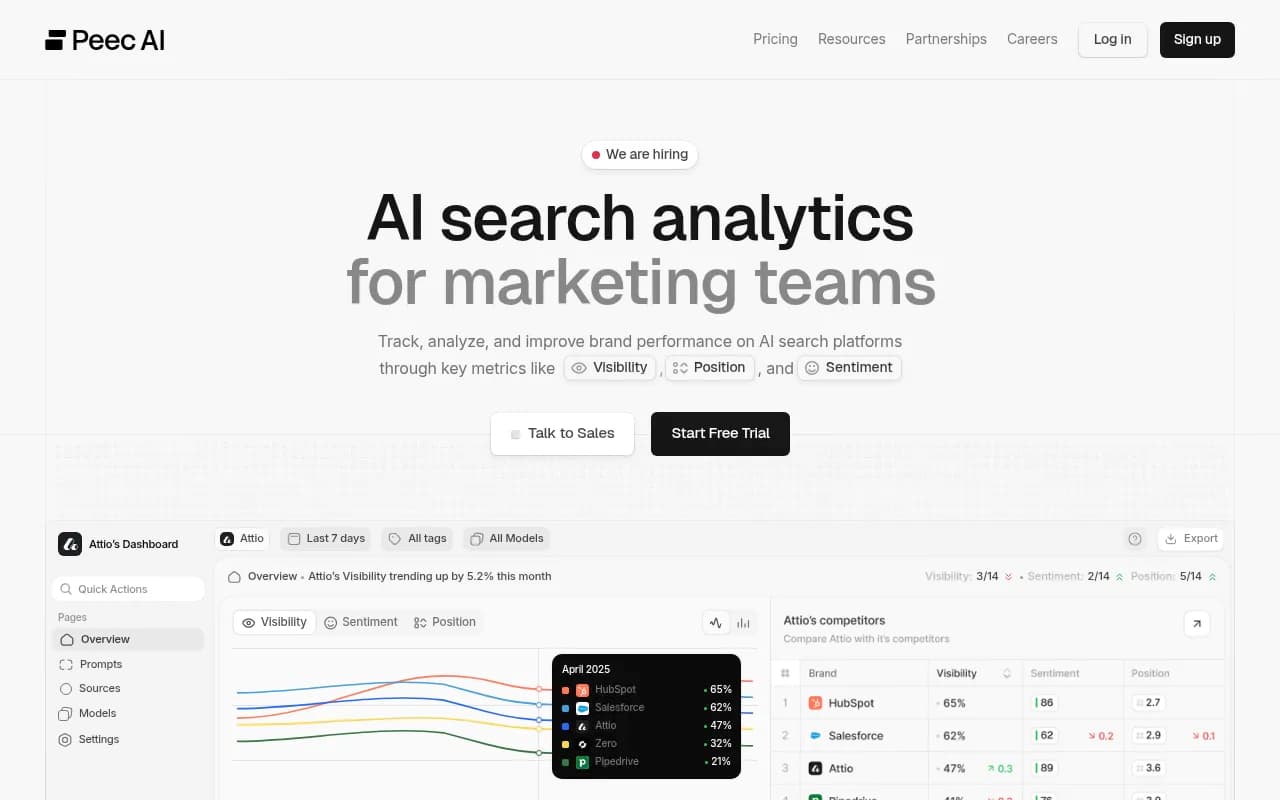
Tools like Profound handle enterprise-scale prompt research well. Peec AI offers flexible model selection. And Promptwatch covers the full cycle from gap identification through content creation to traffic attribution -- including things like AI crawler logs, Reddit and YouTube citation tracking, and ChatGPT Shopping monitoring that most tools don't touch.
The point isn't that budget tools are bad. It's that they're incomplete by design. If your goal is to actually move the needle on AI visibility, you need tools that help you act, not just observe.
A note on the broader market
The AI visibility tool market in 2026 is crowded and moving fast. New tools are launching constantly, and pricing is shifting as the category matures. A few things worth knowing:
According to KIME's April 2026 comparison of 9 platforms, Otterly.AI has the lowest entry price in the category at $29/month. ChatGPT now accounts for roughly 20% of global search traffic, and AI-referred visits convert at 3-9x the rate of traditional Google organic traffic across multiple studies. That context matters when you're deciding how much to invest in this category.
The tools that will matter most aren't necessarily the cheapest or the most feature-rich -- they're the ones that fit how your team actually works. A monitoring dashboard is fine if someone on your team is going to do the analysis and content work manually. If no one has bandwidth for that, you need a tool that does more of the heavy lifting.
The verdict
Both Meteoria.ai and Otterly.AI are legitimate tools for what they are. If you're starting from zero and want to understand your AI search presence without spending much, either will work. Otterly.AI has a slight edge on price transparency and is more widely referenced in third-party comparisons, which suggests a larger user base and more community knowledge to draw on.
But "worth it" depends entirely on what you're trying to accomplish. For pure monitoring on a tight budget, yes -- either tool is worth the entry price. For actually improving your AI search visibility, both tools will leave you doing most of the hard work yourself.
The AI visibility category is still young enough that many teams are in the "just want to see what's happening" phase. That's fine. But as AI search becomes a more significant traffic source, the tools that help you act on data -- not just collect it -- will become the ones that matter.
If you're already past the curiosity phase and want to actually move your visibility scores, it's worth looking at what a full optimization platform can do before settling for a monitoring dashboard.