Key takeaways
- All three platforms — Meteoria.ai, AthenaHQ, and Peec AI — are primarily monitoring tools. They show you where you're invisible in AI search; they don't reliably fix it.
- AthenaHQ covers the most AI models (8+) and has the most ambitious optimization features, but its autonomous "ACE" agent is still maturing and its pricing reflects enterprise ambitions.
- Peec AI is the most accessible entry point, with a clean interface and an "Actions" feature that translates data into a to-do list — though execution still happens elsewhere.
- Meteoria.ai is the least documented of the three, with limited public information about model coverage, pricing, and actual optimization capabilities.
- If you need to move beyond monitoring to actually improving your AI search visibility, none of these three fully close the loop on their own.
The AI search visibility category has exploded in 2026. Dozens of platforms now claim to track how your brand appears in ChatGPT, Perplexity, Claude, and Google AI Overviews. Most of them do roughly the same thing: run prompts, scrape responses, count mentions, and show you a dashboard.
The harder question is what happens after you see the data. That's where the real differences emerge — and where a lot of these tools quietly disappoint.
This guide focuses on three platforms that frequently come up in the same breath: Meteoria.ai, AthenaHQ, and Peec AI. We're going to be direct about what each one actually does, where the gaps are, and who each one is genuinely suited for.
What "monitoring-only" actually means
Before getting into the comparisons, it's worth being clear about the category label. A monitoring-only platform does the following well:
- Tracks your brand mentions across AI models
- Shows share of voice vs. competitors
- Surfaces which prompts you appear in (and which you don't)
- Reports citation sources
What it doesn't do is help you create content that fills the gaps, optimize existing pages to get cited more often, or connect AI visibility data to actual revenue. That distinction matters enormously if your goal is to grow AI search visibility rather than just measure it.
With that framing in place, here's how the three platforms stack up.
Meteoria.ai
Meteoria.ai positions itself as an AI brand monitoring tool, but it's one of the harder platforms to evaluate objectively because public documentation is thin. There's no detailed pricing page, limited coverage in independent reviews, and almost no user-generated content discussing real-world results.
From what's available, Meteoria.ai appears to focus on brand mention tracking across a handful of AI models, with basic share-of-voice reporting. It seems aimed at smaller teams or individuals who want a lightweight way to check whether their brand is showing up in AI responses.
The honest assessment: if you're considering Meteoria.ai, you should ask the vendor directly about which models they cover, how frequently prompts are re-run, and whether there's any path from data to action. The lack of public transparency on these questions is itself a signal.
AthenaHQ
AthenaHQ is the most feature-rich of the three, and it's the one most aggressively positioning itself as more than a monitoring tool. Its marketing centers on the "Athena Citation Engine" (ACE), described as an autonomous agent that identifies content gaps, drafts optimizations, and executes multi-step workflows.
What AthenaHQ does well
Model coverage is genuinely broad. AthenaHQ tracks 8+ LLMs including ChatGPT, Gemini, Claude, and Copilot — which matters because AI search is fragmented. A brand that's visible in Perplexity but invisible in Google AI Overviews has a real problem, and you need cross-model data to see it.
The platform also has native integrations with Shopify and Google Analytics, which is one of the few attempts in this category to connect AI visibility to revenue. Most competitors stop at "your brand was mentioned X times." AthenaHQ at least tries to answer "and what did that drive?"
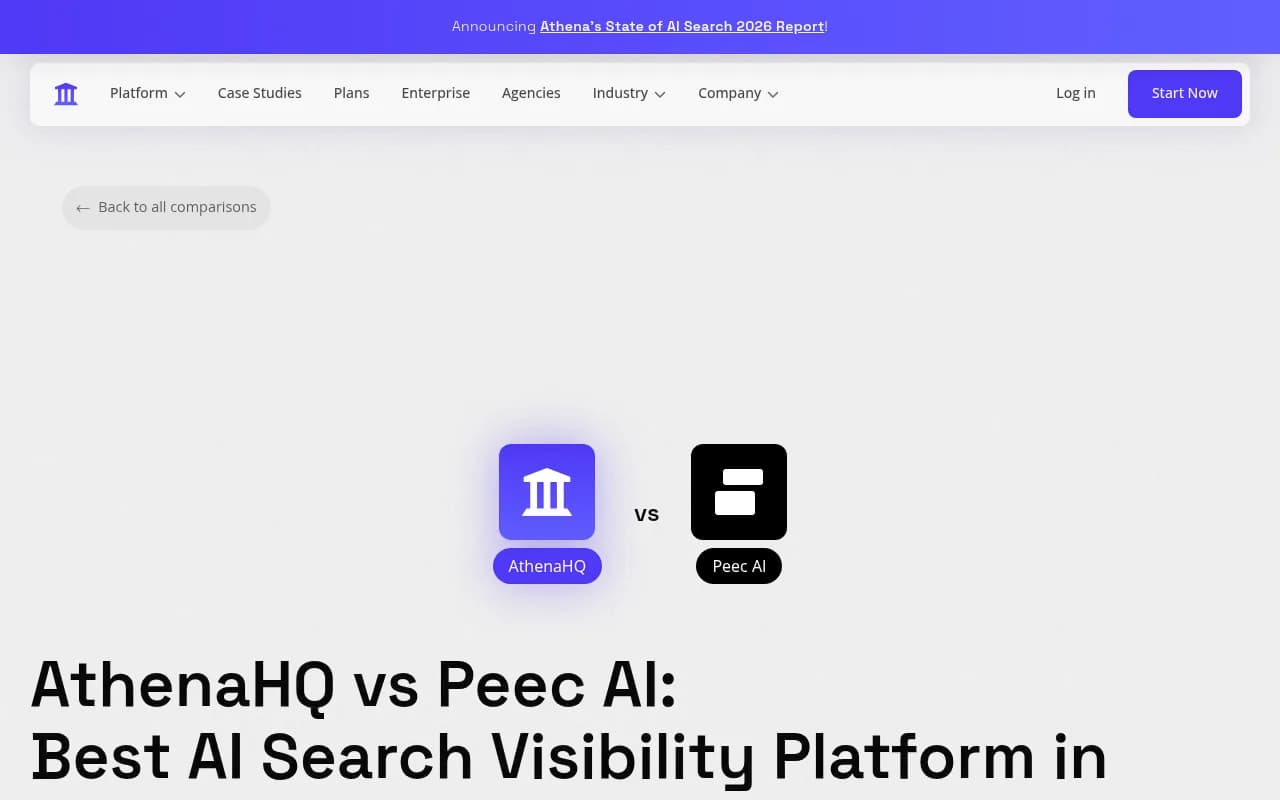
AthenaHQ's own comparison data (from a 30-day test against Peec AI) claims a +45% increase in AI answer share for AthenaHQ users vs. 8% for Peec AI users. That's a significant claim, and it comes from AthenaHQ's own marketing page — so treat it as directional rather than gospel. But the underlying point that active optimization outperforms passive monitoring is sound.
Where AthenaHQ falls short
The ACE agent is ambitious, but "autonomous" is doing a lot of work in that description. Based on user reports and independent reviews, the content generation capabilities are still maturing. The platform is better at identifying gaps than filling them with publication-ready content.
Pricing is also a real barrier. AthenaHQ targets enterprise and mid-market brands, and its pricing reflects that. If you're a small business or a solo marketer, you'll likely find the cost hard to justify before you've seen ROI from AI search.
Peec AI
Peec AI is the most approachable of the three. It has clear pricing, a clean interface, and a feature called "Actions" that's genuinely useful: it takes your visibility data and turns it into a prioritized list of things to fix. That's a small but meaningful step beyond a raw dashboard.

What Peec AI does well
The Actions feature deserves credit. Most monitoring tools hand you data and leave you to figure out what to do with it. Peec AI at least attempts to bridge that gap by surfacing specific recommendations. It won't write the content for you, but it tells you what to write about.
Model coverage is more limited than AthenaHQ — three core platforms by default, with add-ons available for broader tracking. For teams just getting started with AI visibility, that's probably enough. You don't need to track 10 models on day one.
The platform is also more transparent about what it is. It doesn't oversell its optimization capabilities, which makes it easier to set realistic expectations.
Where Peec AI falls short
The Actions feature is a to-do list, not an execution engine. You still need to go somewhere else to create content, publish it, and track whether it moved the needle. That's a meaningful gap if you want a closed loop.
Revenue attribution is absent. Like most tools in this category, Peec AI can tell you your brand appeared in X% of responses, but it can't tell you what that meant for traffic or conversions.
Side-by-side comparison
| Feature | Meteoria.ai | AthenaHQ | Peec AI |
|---|---|---|---|
| AI models covered | Unknown/limited | 8+ (ChatGPT, Gemini, Claude, Copilot, etc.) | 3 core + add-ons |
| Brand mention tracking | Yes | Yes | Yes |
| Share of voice reporting | Basic | Yes | Yes |
| Competitor tracking | Unknown | Yes | Yes |
| Content gap analysis | No | Yes (ACE agent) | Partial (Actions feature) |
| Content generation | No | Yes (maturing) | No |
| Revenue attribution | No | Yes (Shopify + GA) | No |
| Crawler/indexing insights | No | Unknown | No |
| Pricing transparency | Low | Low (enterprise-focused) | Medium |
| Best for | Unknown | Mid-market to enterprise | SMBs and agencies getting started |
The monitoring gap problem
Here's the uncomfortable truth about this entire category: knowing you're invisible in AI search is not the same as becoming visible. All three platforms help with the former. None of them fully solve the latter.
This is the core limitation of monitoring-only tools. You can see that competitors are getting cited for "best project management software for remote teams" and you're not. But the platform won't generate a well-researched article on that topic, get it published, track whether AI crawlers indexed it, and then show you whether your citation rate improved.
That full loop — find the gap, create the content, track the result — is what separates a monitoring dashboard from an optimization platform.
If that distinction matters to you (and it should), it's worth looking at platforms built around the complete cycle. Promptwatch is one example: it combines answer gap analysis, an AI writing agent grounded in real citation data, and page-level tracking to connect content creation to visibility outcomes.

The point isn't that AthenaHQ or Peec AI are bad tools — they're not. But they're best understood as diagnostic instruments. They tell you what's wrong. What you do about it is largely up to you.
Who should use each platform
Meteoria.ai
Honestly, it's hard to recommend Meteoria.ai with confidence given the limited public information available. If you're evaluating it, request a demo and push hard on questions about model coverage, data freshness, and what optimization support actually looks like. The lack of transparency is a concern.
AthenaHQ
AthenaHQ makes the most sense for mid-market and enterprise brands that have the budget to invest in AI search and want a platform that at least attempts to close the loop between data and action. The Shopify and Google Analytics integrations are genuinely useful if you're in e-commerce or have a clear conversion funnel to measure. The ACE agent is worth watching as it matures.
If you're an agency managing multiple clients, the enterprise pricing model may be hard to absorb unless you can pass costs through.
Peec AI
Peec AI is the right starting point for teams that are new to AI visibility monitoring and want something functional without a steep learning curve or enterprise price tag. The Actions feature gives you enough direction to get started. Just go in knowing that you'll need other tools to actually execute on what it recommends.
What to look for beyond these three
The AI visibility tool landscape in 2026 is genuinely crowded. Beyond Meteoria.ai, AthenaHQ, and Peec AI, there are platforms worth knowing about depending on your specific needs.
For broader monitoring with Reddit and YouTube citation tracking (channels that directly influence AI recommendations), that's a capability most tools in this category skip entirely. For content generation grounded in actual citation data rather than generic SEO logic, that's a different capability again. And for connecting AI visibility to traffic and revenue through crawler logs and attribution, you're looking at a third distinct capability.
Very few platforms combine all three. The ones that do tend to be the ones worth paying for.
Some other tools worth exploring in this space:

The bottom line
Meteoria.ai, AthenaHQ, and Peec AI all occupy the same basic position in the market: they show you where you stand in AI search. AthenaHQ is the most ambitious and has the broadest model coverage. Peec AI is the most accessible and gives you the clearest path to next steps. Meteoria.ai is the hardest to evaluate and the hardest to recommend without more information.
None of them fully solve the problem of actually improving your AI visibility at scale. That's not a knock on any individual platform — it's an honest description of where the category is right now. The tools that will matter most over the next 12 months are the ones that move from "here's your dashboard" to "here's the content that will get you cited, and here's proof it worked."
If that's the standard you're holding your tools to, use these three as a starting point for evaluation, not an ending point.