Key takeaways
- Surfer SEO is the best fit for teams that need to produce content at volume -- its real-time NLP scoring, AI writing assistant, and keyword clustering make it the fastest path from brief to published article.
- Clearscope wins on simplicity and data quality. Its content grading is clean, the Google Docs integration is seamless, and teams that prioritize editorial quality over speed tend to prefer it.
- MarketMuse is the only tool of the three built around topical authority strategy -- it tells you what to write across an entire site, not just how to optimize a single page.
- None of these tools were designed with AI search (ChatGPT, Perplexity, Google AI Overviews) in mind. They optimize for traditional Google rankings, which overlaps with AI visibility but is not the same thing.
- If AI search visibility is a priority, you'll need a separate layer of tooling on top of whichever content optimizer you choose.
The content optimization tool market has matured fast. A few years ago, using any of these tools felt like a competitive advantage. Now they're table stakes -- most serious content teams use at least one. The real question in 2026 isn't "should I use a content optimizer?" but "which one actually fits how my team works, and does it help me show up in AI search?"
That last part is new. Google AI Overviews, ChatGPT, Perplexity, and Claude are now sending meaningful traffic. The way AI models select sources is different from how Google's traditional algorithm ranks pages, and the three tools we're comparing here -- Surfer SEO, Clearscope, and MarketMuse -- were all built before that shift happened. They've adapted to varying degrees, but none of them were designed ground-up for AI search.
That context matters for this comparison. Let's get into it.
What these tools actually do
All three tools work on the same basic principle: crawl the top-ranking pages for a target keyword, extract the semantic terms and structural patterns that correlate with high rankings, and score your content against those benchmarks as you write.
The difference is in what they do beyond that core function.
Surfer SEO leans into real-time optimization and scale. Clearscope leans into simplicity and editorial workflow. MarketMuse leans into content strategy and topical authority planning. These aren't just marketing angles -- they reflect genuine differences in how the products work and who they're built for.

Surfer SEO
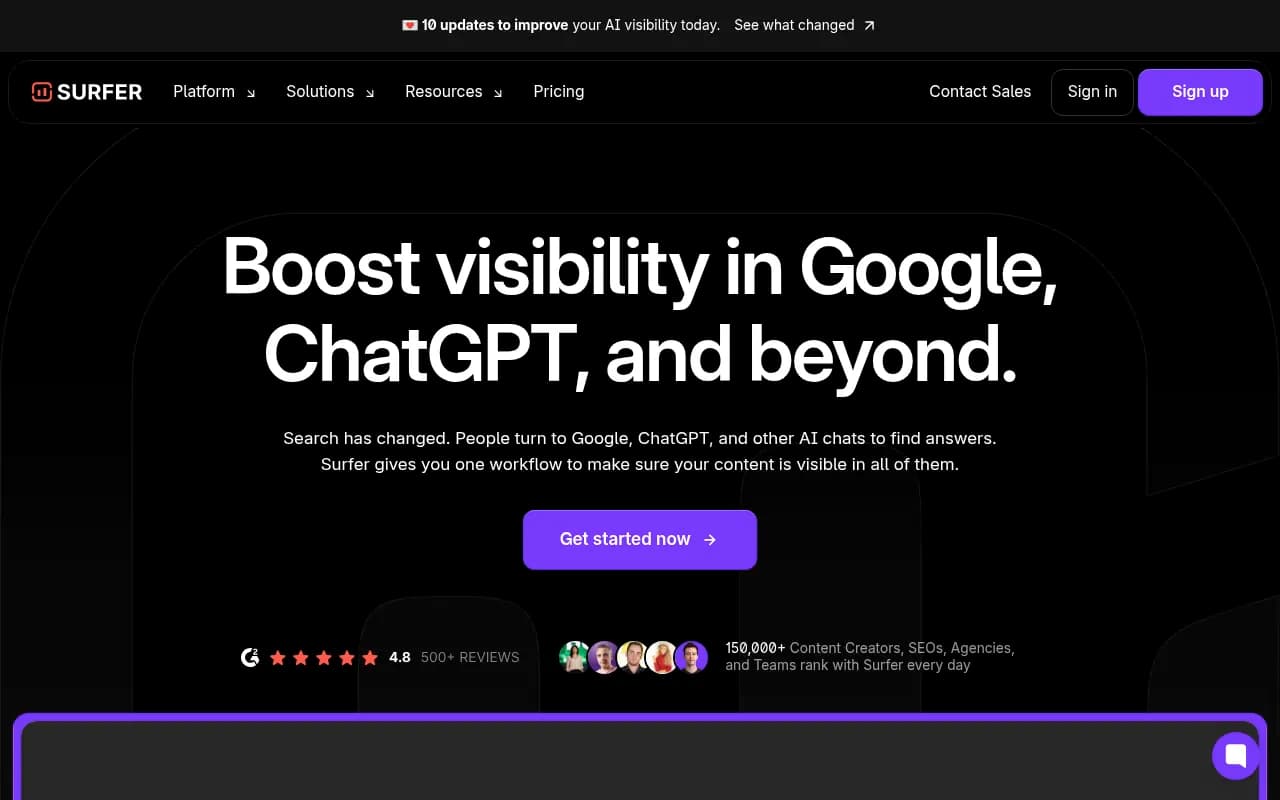
Surfer is the most widely used of the three, with over 150,000 users across agencies and in-house teams. Its Content Editor is the core product: you enter a keyword, it analyzes the top-ranking pages, and you get a real-time content score as you write. The score accounts for keyword usage, NLP terms, heading structure, word count, and image count.
What makes Surfer stand out is the depth of its NLP term suggestions. It surfaces more granular semantic terms than Clearscope or MarketMuse, which is useful when you're trying to cover a topic comprehensively without keyword stuffing. The keyword clustering feature is also genuinely good -- it groups related terms so you can plan topical coverage across multiple articles rather than optimizing each one in isolation.
Surfer AI, the built-in writing assistant, can generate a full optimized draft from a brief. It's not going to replace a skilled writer, but for teams producing high volumes of content, it meaningfully reduces time-to-draft.
The content audit tool is worth mentioning too. You can run existing pages through it and get specific recommendations for improvement -- which is useful if you're trying to lift rankings on older content rather than just creating new pages.
Pricing starts at $89/month, which is the most accessible entry point of the three for a full-featured plan.
Where Surfer falls short: the interface can feel overwhelming for writers who just want to know what to do. The score can also become a distraction -- teams sometimes chase a high number at the expense of writing something actually useful to readers. And while Surfer has added some AI features, it doesn't have a strong answer to the question of how to rank in AI search specifically.
Clearscope
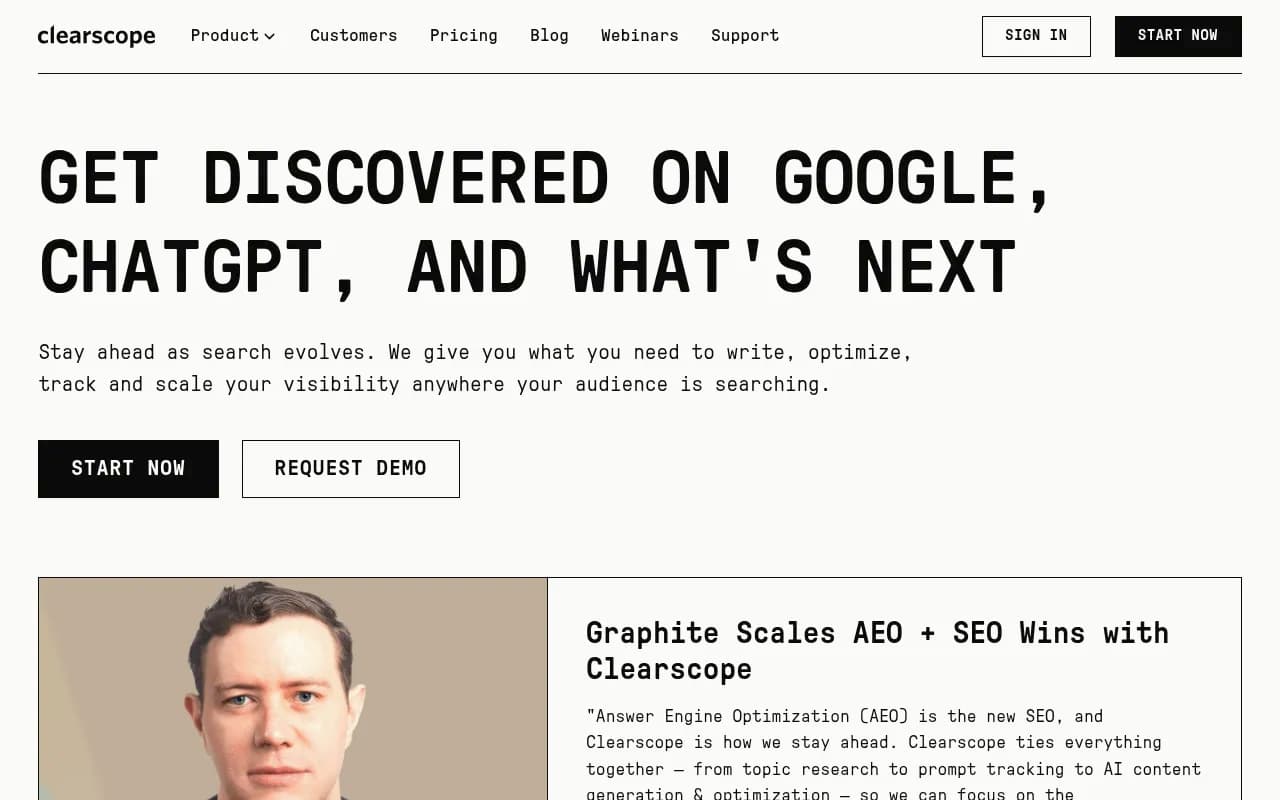
Clearscope takes a more restrained approach. The interface is clean, the content grading is straightforward (A+ down to F), and the Google Docs integration is genuinely seamless. Writers can work entirely in Google Docs with Clearscope running alongside -- no context switching, no copy-pasting into a separate editor.
The term suggestions are high quality. Clearscope uses IBM Watson NLP under the hood, and the output tends to be more precise than Surfer's, even if there are fewer terms. A Surfer-published study found its content score had a 26% correlation with rankings versus Clearscope's 17.5% -- but that number tells you more about how the scores are calculated than about which tool produces better content. Clearscope users tend to write more naturally and rely less on hitting a specific score.
What Clearscope doesn't have: content briefs, topical authority mapping, keyword clustering, content audits, or an AI writing assistant. It's a focused tool that does one thing well. If you need strategic planning or AI-assisted drafting, you'll need to look elsewhere or combine it with another tool.
Pricing starts at $189/month, which is the highest entry point of the three. For smaller teams or solo operators, that's a real barrier. For editorial teams at mid-size companies where content quality is the priority, it's usually worth it.
MarketMuse
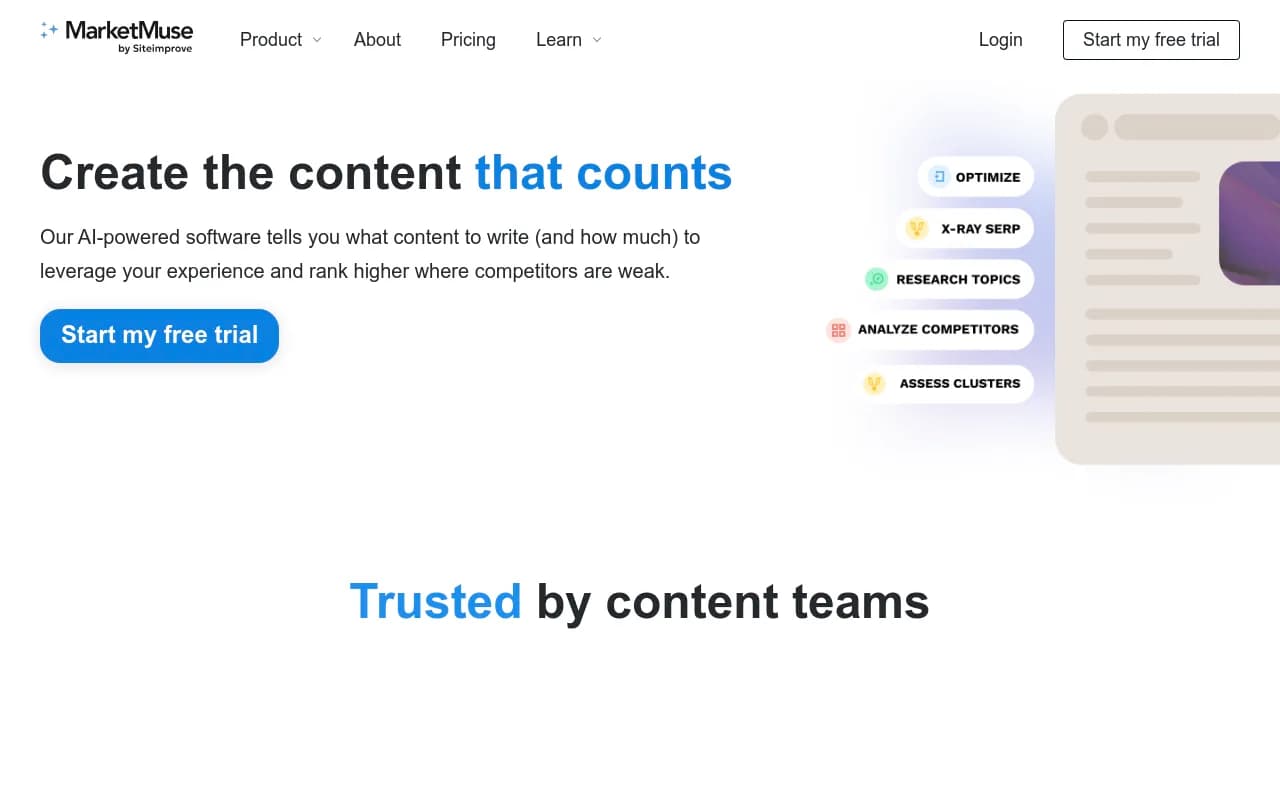
MarketMuse is the most strategically oriented of the three. Its core differentiator is topic modeling -- it analyzes your entire site's content against a topic area and tells you where your authority gaps are. Instead of just optimizing a single page, it helps you plan a content program.
The proprietary scoring system (Topic Authority, Content Score, Personalized Difficulty) gives you a picture of how your site compares to competitors for a given topic. This is genuinely useful for content strategy work -- deciding what to write next, where to invest, and which existing pages to update.
MarketMuse also has content briefs and a First Draft AI writing feature. The briefs are detailed and include competitive analysis, related topics, and recommended questions to answer. First Draft generates a full article outline or draft based on that brief.
The free plan is limited but lets you test the core functionality before committing. Paid plans start at $149/month.
Where MarketMuse struggles: the interface has a steeper learning curve than the other two, and the sheer volume of data it surfaces can be hard to act on without a dedicated content strategist. It's also less useful for individual article optimization than Surfer or Clearscope -- it's built for planning, not for real-time writing feedback.
Side-by-side comparison
| Surfer SEO | Clearscope | MarketMuse | |
|---|---|---|---|
| Best for | High-volume content production | Editorial quality and simplicity | Topical authority strategy |
| Starting price | $89/mo | $189/mo | Free (limited); $149/mo paid |
| Real-time content editor | Yes | Yes | Yes |
| NLP term suggestions | Advanced | High quality, fewer terms | Yes |
| AI writing assistant | Yes (Surfer AI) | No | Yes (First Draft) |
| Content briefs | Yes | No | Yes (detailed) |
| Topical authority mapping | No | No | Yes (strongest) |
| Content audit | Yes | No | Yes |
| Keyword clustering | Yes | No | Yes |
| Google Docs integration | Yes | Yes | No |
| WordPress plugin | Yes | Yes | No |
| Free trial | 7-day money back | No | Free plan |
| AI search optimization | Limited | Limited | Limited |
Which one should you pick?
The honest answer is that it depends on what your team actually does.
If you're an agency or in-house team producing a lot of content and you need writers to move fast, Surfer SEO is the practical choice. The real-time scoring, AI drafting, and keyword clustering give you the most complete workflow for volume production. The $89 entry point also makes it easier to justify.
If you have a smaller editorial team and content quality is the priority, Clearscope is worth the premium. The interface gets out of writers' way, the Google Docs integration is the best of any tool in this category, and the term suggestions are precise. You'll need to do your strategic planning elsewhere, but for the actual writing and editing phase, Clearscope is the cleanest experience.
If you're a content strategist or SEO lead trying to build topical authority across a site, MarketMuse is the only tool here that gives you a real framework for that. It's not a great standalone writing tool, but as a planning layer it's strong. Many teams use it alongside Surfer or Clearscope -- MarketMuse for strategy, the other tool for execution.
The AI search problem none of them fully solve
Here's the thing that's easy to miss in a comparison like this: these tools optimize for traditional Google rankings. That's still valuable -- Google is still the dominant search engine. But AI search is growing fast, and the way ChatGPT, Perplexity, Google AI Overviews, and Claude select sources is different from how Google's ranking algorithm works.
AI models don't just look at keyword coverage and content scores. They look at whether your content directly and clearly answers specific questions, whether your site is cited by other authoritative sources, whether your brand appears in the right contexts across the web, and whether AI crawlers can actually access and understand your pages.
None of Surfer, Clearscope, or MarketMuse track any of this. They can help you write content that's more likely to rank in traditional search -- and better-ranking content does tend to get cited more by AI models -- but that's an indirect relationship, not a direct one.
If AI search visibility is a real priority for your business, you'll want a dedicated tool alongside your content optimizer. Promptwatch is built specifically for this -- it tracks how your brand appears across ChatGPT, Perplexity, Google AI Overviews, Claude, Gemini, and others, shows you which prompts competitors are visible for that you're not, and has content generation tools built around closing those gaps.

The workflow that makes sense for most teams in 2026: use Surfer, Clearscope, or MarketMuse to write content that ranks in traditional search, then use a GEO platform to track and improve how that content performs in AI search specifically.
A few alternatives worth knowing about
If none of the three main tools quite fit, there are some other options worth considering.
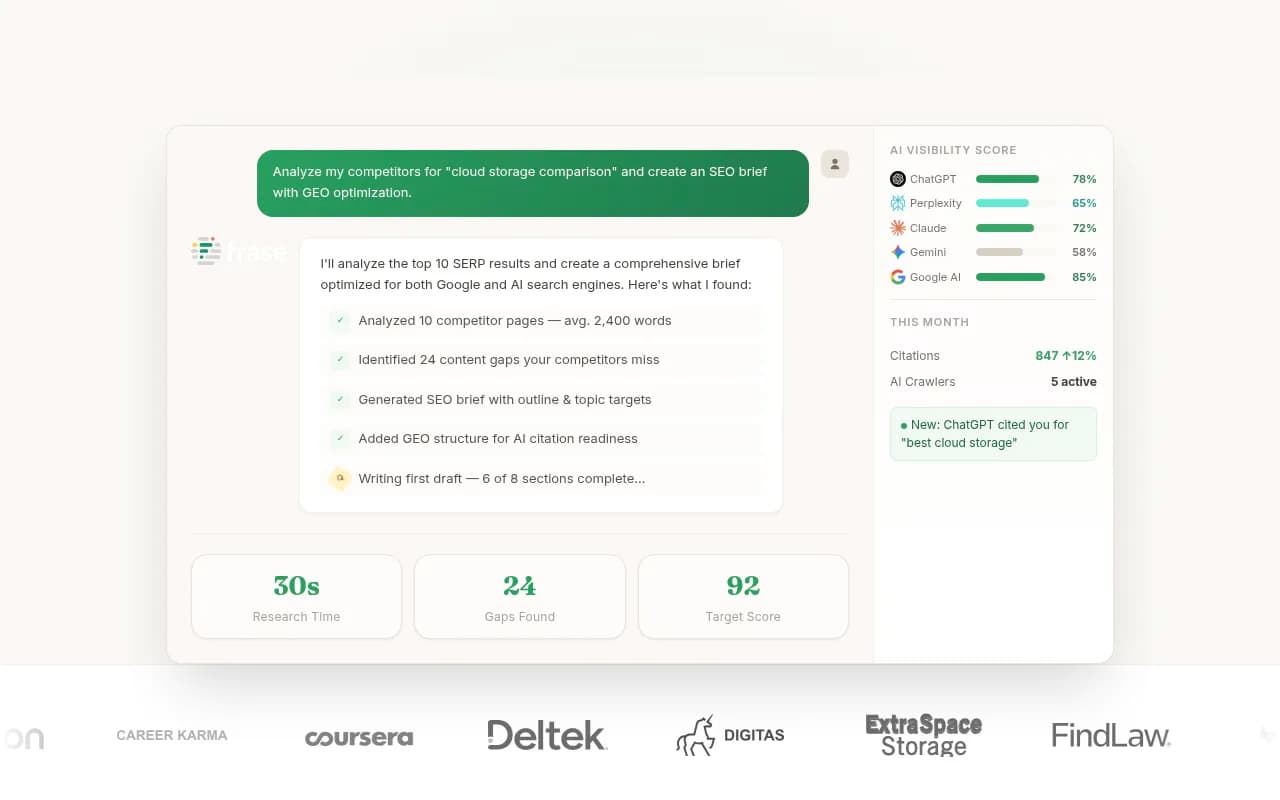
Frase is worth a look if you need strong content briefs and AI writing at a lower price point ($15/month entry). It's less polished than Surfer or Clearscope but covers a lot of the same ground.
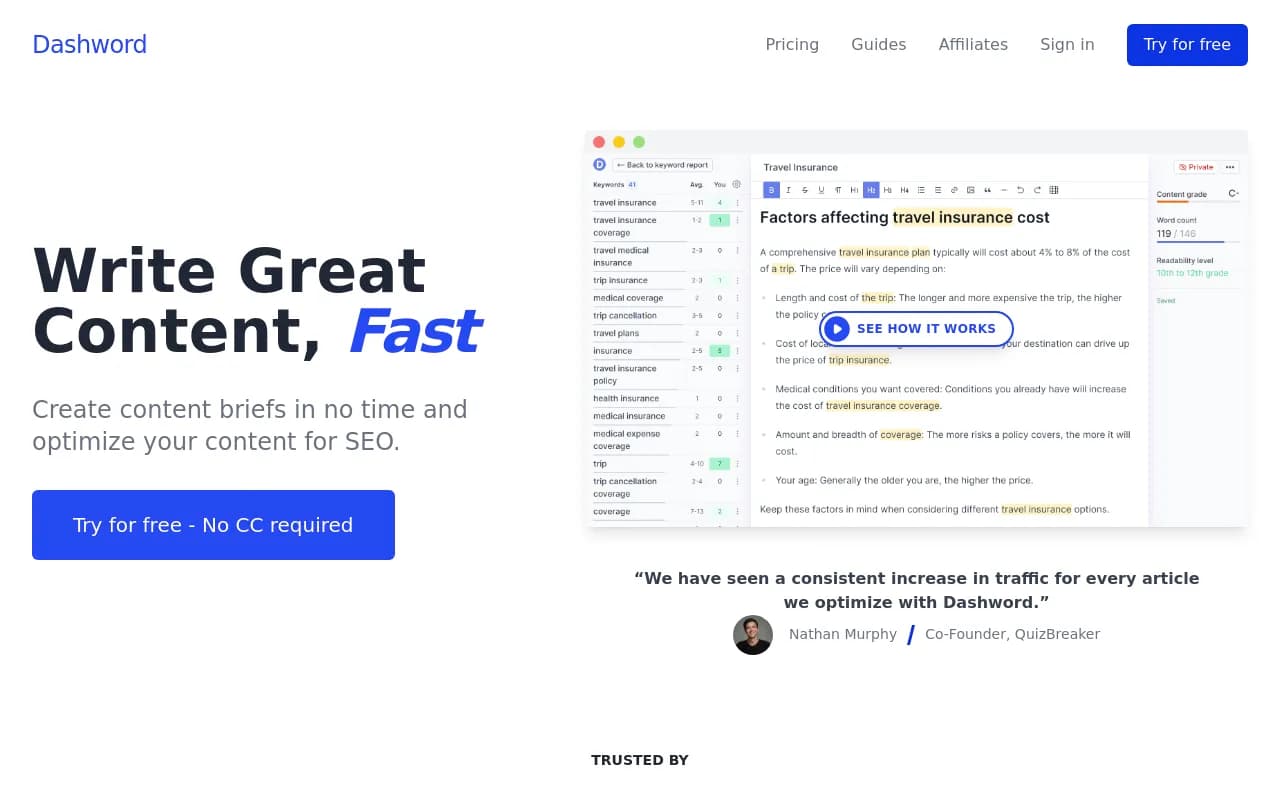
Dashword is a simpler, more affordable alternative to Clearscope that works well for smaller teams or freelancers who don't need the full feature set.
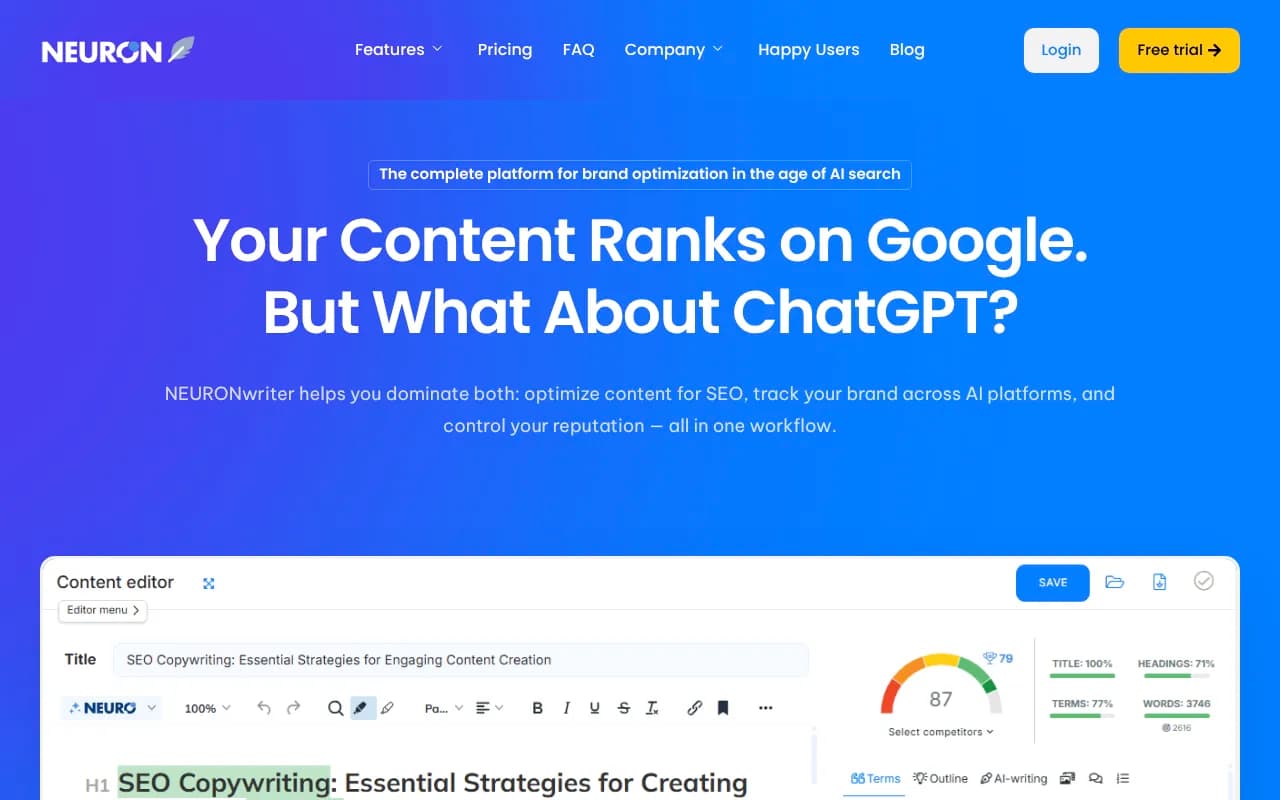
NeuronWriter offers solid NLP-based optimization with a one-time lifetime deal option that appeals to budget-conscious teams.
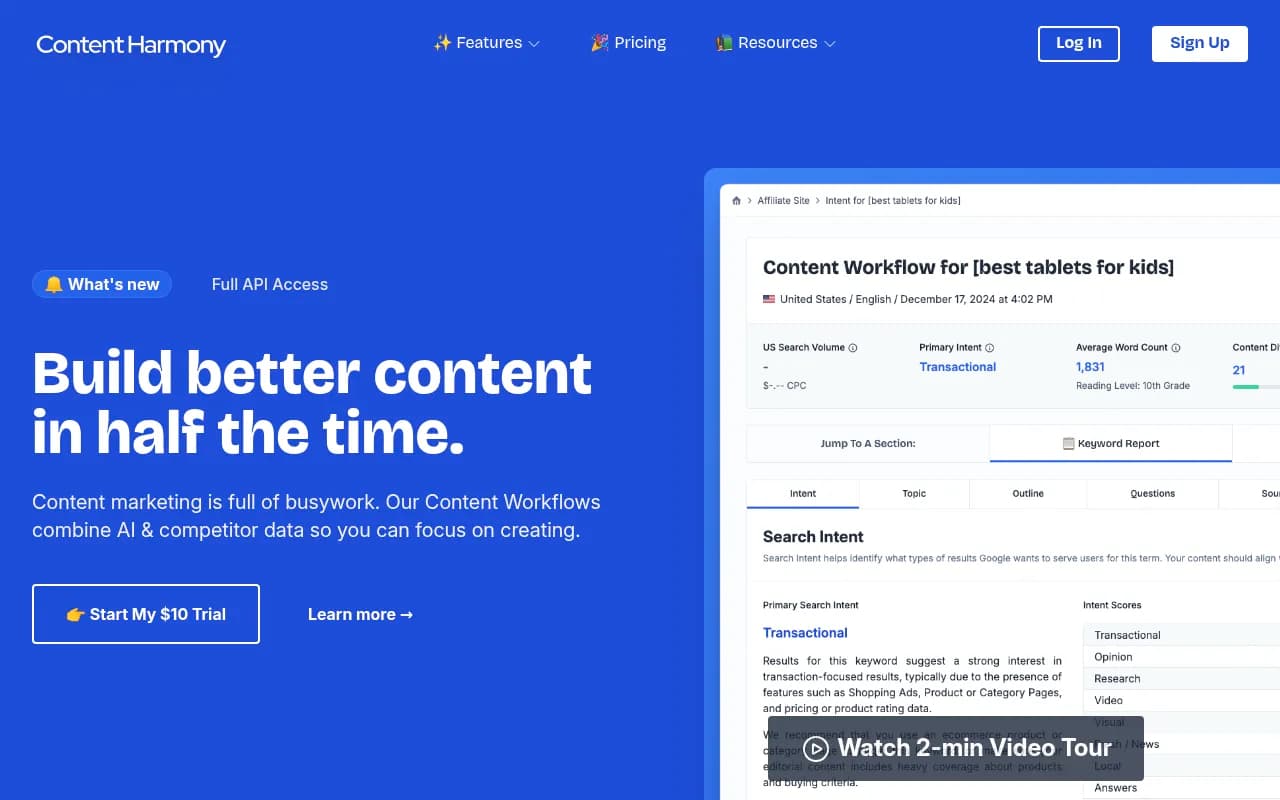
Content Harmony is strong on the brief side -- if your bottleneck is research and brief creation rather than real-time optimization, it's worth testing.
Scalenut combines keyword research, content briefs, and a content editor in one platform, which can reduce the number of tools you need.

The bottom line
Surfer SEO, Clearscope, and MarketMuse are all genuinely useful tools. They're not interchangeable, and the "best" one is entirely dependent on what your team needs.
Surfer for volume and speed. Clearscope for editorial quality. MarketMuse for strategy and topical planning.
What none of them do is tell you how your content is performing in AI search, which prompts your competitors are winning that you're not, or how to fix your AI visibility gaps. For that, you need a different category of tool entirely -- and in 2026, that's not optional anymore.