Key takeaways
- Rankscale is the most flexible tracker of the three: nine-plus engines, hourly to monthly scheduling, and a credit model that starts at $99/mo on the Pro plan (check the pricing page for the yearly-only Essentials tier).
- Gauge sells volume: $599/mo for 600 prompts and 54,000 answers a month, about a penny per answer by its own math, with a content engine bundled in.
- InSpace.io is not really a prompt tracker. It is a content production service (NOVA) priced by pages per month, starting at $1,000.
- Prompts, answers and credits are different units. Convert everything to cost per answer before you compare quotes.
- If you want tracking plus a way to fix what it finds, check whether the tool publishes, not just measures.
Why this comparison is trickier than it looks
These three names show up on the same shortlists, but they are not the same kind of product. Two of them (Gauge and Rankscale) are prompt-level trackers. The third (InSpace.io) is mainly a content automation service with some AI visibility monitoring attached.
That matters because most comparison posts line up price columns as if "prompts" meant the same thing everywhere. They do not. Gauge counts answers (one response from one platform on one day). Rankscale counts credits (roughly 4 answers per credit on Pro). InSpace.io counts pages. If you compare the headline numbers directly, you will pick wrong.
A caveat on sources: several of the comparisons floating around are written by vendors, including Gauge's own comparison pages. Where I cite a vendor's claim, I say so. A few third-party posts are also stale, for example the $19 Rankscale entry price and the "weekly refresh" claim, which no longer match the current pricing page.

What "prompt-level tracking" actually means
Prompt-level tracking means you define a set of questions your buyers might ask ("best CRM for small agencies"), run them on a schedule against AI engines, and log whether your brand is mentioned, where, with what sentiment, and which sources get cited.
Two things make the data noisy. First, the engines behave differently. According to Promptwatch Data on average sources per response, ChatGPT cites about 5 sources per web-search answer, Google AI Overviews about 10, and Perplexity almost exactly 10 every day, while Copilot's average swung from under 2 to nearly 17 within weeks. A visibility change can be the engine, not your content.
Second, the prompt the user types is not what the engine searches. Promptwatch's ChatGPT query fanout data shows average fanout dropping from about 2.15 searches per response in early December to about 1.84 by early March, with average query length falling from roughly 117 characters to the high 80s, then about 53 from April. Tools that log only the typed prompt miss that layer. Rankscale lists query fanout as a feature on every plan, which is a point in its favor.
Rankscale: the flexible tracker
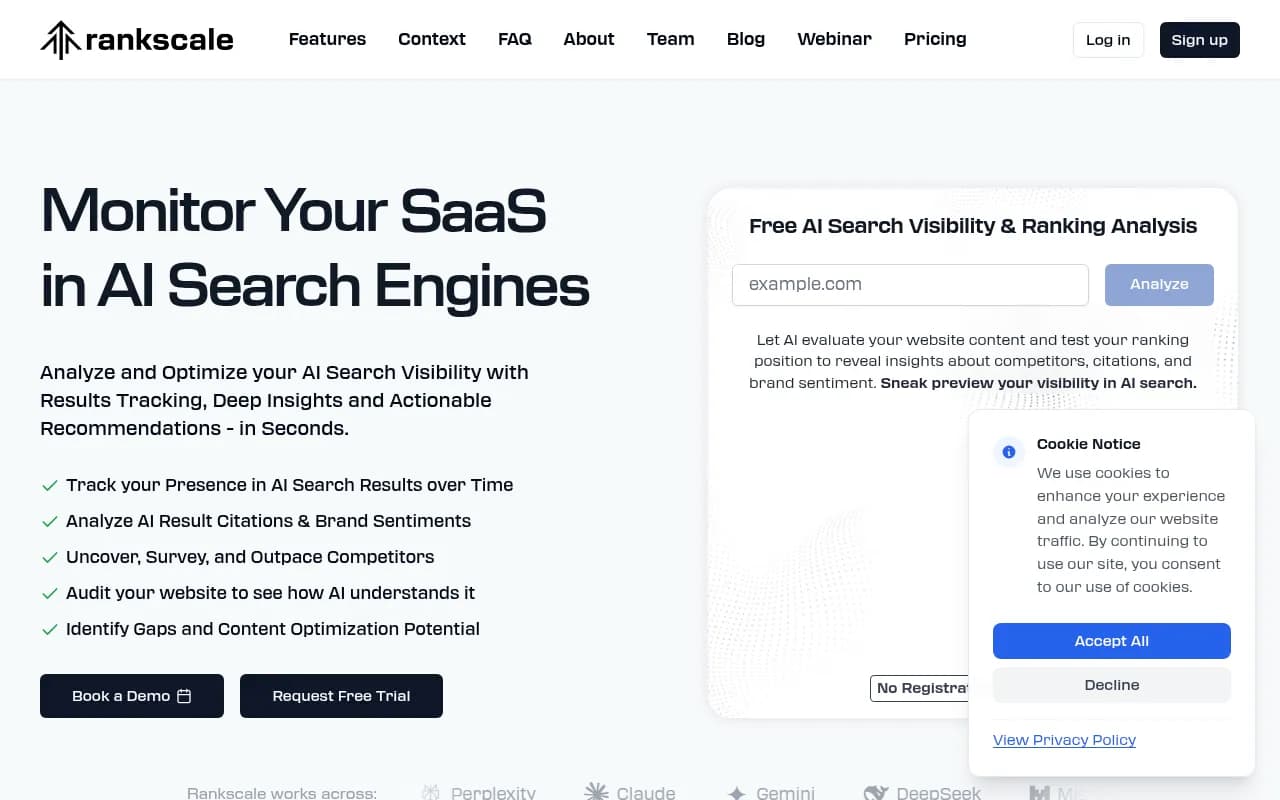
Rankscale is a credit-based AI visibility platform. You can create unlimited search terms, but running them burns credits. On Pro, 1,200 credits a month covers up to about 4,800 answers.
Plans
| Plan | Monthly | Yearly (per month) | Credits | Answers up to | Brand dashboards |
|---|---|---|---|---|---|
| Pro | $99 | $84 | 1,200 | 4,800 | 10 |
| Pro+ | $229 | $195 | 3,000 | 12,000 | 25 |
| Growth | $385 | $327 | 5,500 | 22,000 | 50 |
| Enterprise | $780 | $663 | 12,000 | 48,000 | 100 |
Growth is the agency plan, adds white-label options, and is marked most popular. Pro+ adds REST API access. There is also a yearly-only Essentials tier with fewer features (no sentiment, custom dashboards, local results, AI visits or shopping analysis). Its price did not show up in what I could verify, so check the pricing page before quoting the cheap numbers you see elsewhere.
Strengths
- Engine coverage is wide: ChatGPT, Perplexity, Google AI Mode, AI Overviews, Gemini, DeepSeek, Mistral, Claude and Copilot, with Grok in Coalition Technologies' testing and Meta's Muse Spark mentioned as a recent addition.
- Scheduling runs from hourly to monthly, with all regions, and unused credits roll over (up to 2x on Pro and Pro+, 3x on Growth and Enterprise).
- Citation analysis, competitor benchmarking and prompt research on all plans.
- Independent evidence: Coalition Technologies reported near-100% mention and citation detection accuracy across roughly 2,700 prompt pulls.
Weaknesses
Credit math forces rationing. Omnia's critique is that tracking 50 prompts weekly across several engines burns credits quickly, so teams check fewer prompts and refresh less often. Coalition also noted setup takes more planning than simpler tools. And Omnia's main complaint, that Rankscale shows where you stand but not what to do about it, is fair for a monitor-first product, though that comes from a competitor.
Gauge: volume pricing with content built in
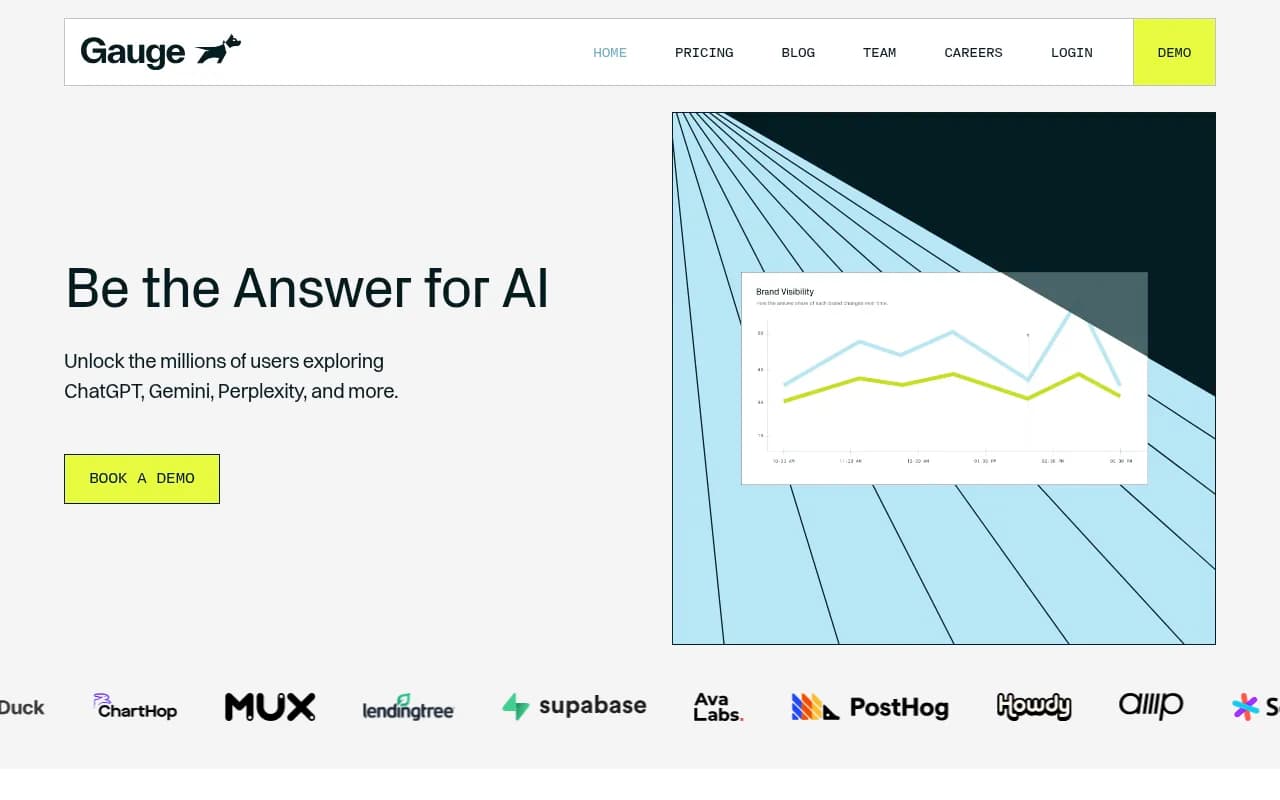
Gauge's pricing is easier to read because the unit is the answer, not an abstract credit.
- Growth: $599/mo, 600 prompts, 54,000 answers a month, daily refresh.
- Unlimited domains and competitors, a single location, 3 seats, email and Slack support.
- Sentiment analysis, exports, and a content engine that produces 18 publish-ready articles a month.
- Enterprise is custom, adding custom prompts, locations, seats and recurring strategy sessions.
- Gauge Agents come with 1,000 free credits that never expire.
Gauge says it costs about a penny per answer, and the math checks out: $599 divided by 54,000 is about $0.011. Its own comparison pages claim $11.09 per 1,000 answers versus $21 for Profound. Treat those as marketing, but the calculation method is transparent.
The platform count problem
Gauge's pages disagree with each other. The pricing page lists 6 core platforms, with optional Claude and Grok tracking through your own API keys. The FAQ says Growth runs prompts "across 3 platforms", and the 600 x 3 x 30 = 54,000 math only works with 3. I would ask Gauge in writing which engines your plan includes before signing.
Who it fits
Teams that want daily data on a lot of prompts and a bundled content engine, and that are fine with a single location. The $599 entry point is steep if you only need 50 prompts.
InSpace.io: a content service, not a tracker
InSpace.io's NOVA platform is an SEO and GEO content automation offering. Its blog says it combines SEO and GEO workflows and monitors AI visibility and citations for a defined set of prompts. But I found no published prompt counts, engine list, refresh rate or per-prompt pricing, so tracking depth is unverified.
| Plan | List price | Output | Notes |
|---|---|---|---|
| Stratosphere | $1,000/mo | 10 pages | Long-tail, question-focused articles |
| Milky Way (most popular) | $1,700/mo | 20 pages | Category hubs, conversion-focused service pages |
| Universe | $3,000/mo | 40 pages | Location-based landing pages, dedicated strategist |
| Multiverse | from $6,900/mo | Custom | 4+ countries, local SEO and GEO per market |
Discounts stack: 10% for paying yearly upfront, 20% for a two-year commitment, up to 30% for two years paid upfront. At the deepest discount the first three tiers drop to $700, $1,190 and $2,100 a month.
Do not compare InSpace.io to Rankscale on price per prompt. They solve different problems. InSpace.io is closer to hiring a content team that also watches AI visibility. If you already know what content you need and want measurement, it is the wrong purchase. If you want pages produced and are willing to trust the vendor's tracking, it is a reasonable one.
Side-by-side comparison
| InSpace.io | Gauge | Rankscale | |
|---|---|---|---|
| Core product | Content production with GEO monitoring | Prompt tracking plus content engine | Prompt tracking and analytics |
| Entry price | $1,000/mo list (10 pages) | $599/mo | $99/mo (Pro) |
| Pricing unit | Pages | Answers | Credits (about 4 answers each on Pro) |
| Published prompt limits | None found | 600 prompts, 54,000 answers | Unlimited terms, limited by credits |
| Refresh | Not published | Daily | Hourly to monthly |
| Engines | Not published | 3 or 6 core (verify), plus Claude and Grok via your keys | 9+ listed |
| Content creation | Core offering | 18 articles/mo on Growth | Not the focus |
| Best for | Teams outsourcing content | Volume trackers wanting content too | Hands-on SEOs and agencies |
Normalizing the cost per answer
Here is the only fair way to compare the two trackers.
- Gauge Growth: about $0.011 per answer ($599 / 54,000).
- Rankscale Pro monthly: $99 / 4,800 is about $0.021 per answer. Pro billed yearly ($84) is about $0.0175.
- Rankscale Enterprise: $780 / 48,000 is about $0.016 per answer.
- InSpace.io: not calculable, because the unit is pages.
So Gauge is cheaper per answer at scale, but Rankscale gets you started for a sixth of the monthly bill and covers more verified engines. If you only need 50 prompts, Gauge's minimum commitment is wasted money. For context, other trackers are priced differently again: Rankability's 40-tool study puts Otterly at $29 for 15 prompts and $189 for 100 prompts, and lists Promptwatch at $95/mo for 50 prompts daily.
Which should you pick
- You are an agency or in-house SEO who wants deep drill-down and many engines: Rankscale.
- You track hundreds of prompts daily and want articles produced alongside: Gauge, after confirming engine count.
- You want an outsourced content program with GEO in mind and do not need a dashboard: InSpace.io.
- You mostly want to fix visibility gaps, not just watch them: look beyond all three.
When a tracker is not enough
All three stop short of a full loop of finding gaps, writing, publishing and then checking whether the page got crawled and cited. Promptwatch is built around that loop, with crawler logs, visitor analytics and a Content Agent that publishes to your CMS.

To see more options, the GEO software directory at bestgeosoftware.com lists dozens of trackers, and Peec AI, Otterly.AI and Profound are the usual next names on a shortlist.



Questions to ask before you buy
- How is the unit defined (prompt, answer, credit, page)? Ask for the monthly answer count.
- Which engines are on my plan, and do they run on the real UI or an API?
- What is the refresh frequency, and can I change it?
- Does it track fanout queries or only the typed prompt?
- What happens when I run out of credits or answers?
- Can I export raw prompt and citation data?
Run a one-month trial on a fixed set of 30 to 50 prompts, and compare the output against a manual spot check in ChatGPT. Differences in detection accuracy show up fast.