Key takeaways
- InSpace.io and Promptwatch aren't direct substitutes. InSpace is a managed, output-priced content engine (NOVA) that researches, writes, and publishes pages. Promptwatch is a measurement-first AI visibility platform whose agents act on the gaps it finds.
- InSpace prices by pages per month ($1,000 to $3,000 list for the three standard tiers). Promptwatch prices by prompts, responses, and features, starting at $95 a month.
- InSpace's public pages show no prompt-level tracking, named AI-engine coverage, crawler logs, or conversion analytics. Its AI-citation figures appear in marketing visuals, and I couldn't confirm how they are measured.
- Promptwatch's data says product and landing pages earn about 39% of ChatGPT citations, so fixing existing pages often beats publishing more articles.
- If you want a done-for-you content pipeline, look at InSpace. If you need to know why you aren't cited and prove that a fix worked, start with Promptwatch.
Why this comparison is slightly awkward
People search for "InSpace.io vs Promptwatch" as if they were two flavors of the same product. They aren't. I'd rather say that up front than pretend there's a neat feature-for-feature matchup.
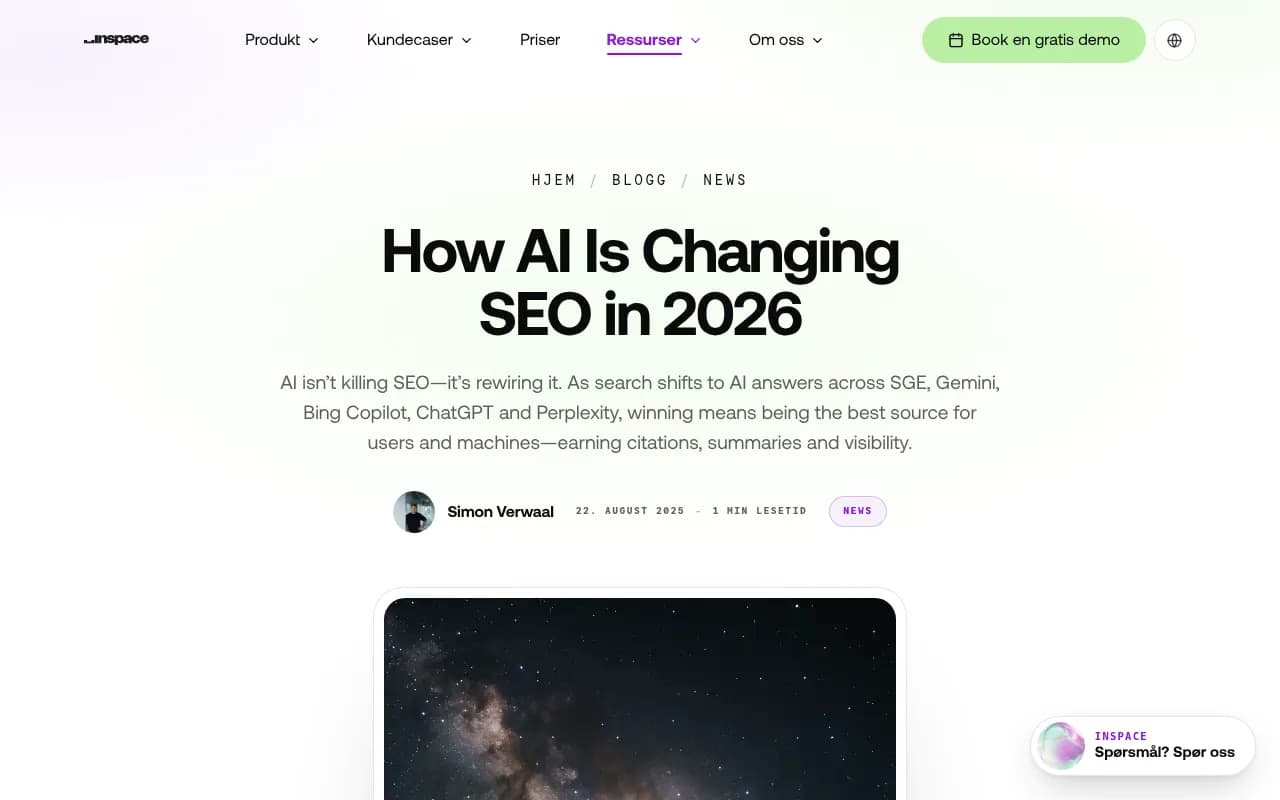
InSpace sells NOVA, which it calls autonomous AI software for SEO and GEO. It researches keywords, writes pages, publishes into your CMS, and keeps improving them, with humans checking every page, according to the InSpace NOVA product page. You buy output.
Promptwatch starts from the opposite end. It watches what AI engines actually say about you, shows where they get their information, and then uses agents to write and publish content against the gaps. You buy visibility into a channel, plus tools to act on it.
So the real question isn't which one has more features. It's whether your bottleneck is producing content or understanding why AI engines ignore the content you already have.
What InSpace.io (NOVA) does
InSpace describes the loop as find, choose the page, improve, measure, re-optimize. For each keyword, NOVA decides between several moves: optimize an existing page, strengthen it, consolidate pages, prevent cannibalization, add internal links, or build a new page. I like that last point. A tool that sometimes says "don't write a new page" is rarer than it should be.
The GEO approach
InSpace says there is no separate GEO tool and no second workflow. NOVA writes one page meant to perform in Google and in AI answers from ChatGPT, Perplexity, and Gemini. It's multi-local, with strategy per market and language. Another InSpace blog post claims NOVA automates up to 80 percent of the GEO workload for SMBs.
That's a reasonable philosophy. Well-structured, entity-rich pages do tend to serve both channels. But it's also a claim that depends on measurement, and that's where the public material gets thin.
Pricing
InSpace charges by content output, quoted in USD, with a discount of up to 30% for paying two years upfront (InSpace pricing).
| Plan | Pages per month | List price per month | Lowest discounted price | Extras |
|---|---|---|---|---|
| Stratosphere | 10 | $1,000 | $700 | Long-tail and question articles |
| Milky Way (most popular) | 20 | $1,700 | $1,190 | Category hubs, service pages |
| Universe | 40 | $3,000 | $2,100 | Location pages, dedicated strategist |
| Multiverse | Custom | From $6,900 | Not listed | Built for 4+ countries |
Pricing isn't tied to prompts tracked or AI engines monitored. That's consistent with what it is: a content production service with software on top.
Claimed results, and how to read them
InSpace reports 500+ active customers, 37,856 pages built and optimized, and 32 countries. Case examples include DevTalent at +1,582%, SolidBuild at +1,497%, and ExteriorWash at +961%. The homepage dashboard shows "312 AI citations", and one testimonial mentions 1,340 AI citations.
These are vendor-selected. The metrics and time frames aren't specified on the pages I reviewed, and most of the growth numbers look like organic traffic, not AI-specific measurement. I'm not saying they're false. I'm saying you can't use them to predict your own outcome.
What I couldn't find
The public pages list no prompt-level tracking, no named AI-engine coverage, and no crawler-log or conversion analytics. Maybe NOVA has these internally. I couldn't confirm it, so ask for a demo and press on exactly how AI visibility is measured before you sign a long contract.
What Promptwatch does
Promptwatch is an AI search visibility and Generative Engine Optimization platform. It tracks how brands appear in ChatGPT, Google AI Overviews, Google AI Mode, Gemini, Perplexity, Copilot, Claude, Meta AI, and more, using the real user interfaces rather than only APIs. That matters because user-facing answers and citations can differ from API output.

The useful part is what sits behind the tracking:
- IP-verified AI crawler logs showing when GPTBot, ClaudeBot, PerplexityBot and others visit, what they read, and where they hit errors.
- Citation analytics, including Reddit, YouTube, and LinkedIn sources that mention you.
- Visitor analytics that attribute real traffic and conversions from AI platforms.
- Prompt volumes, difficulty scores, and query fan-outs so you know which prompts are worth chasing.
- Content gap analysis, a Content Agent that writes and publishes to Webflow, Framer, or WordPress, and an Action Board that turns findings into a prioritized to-do list.
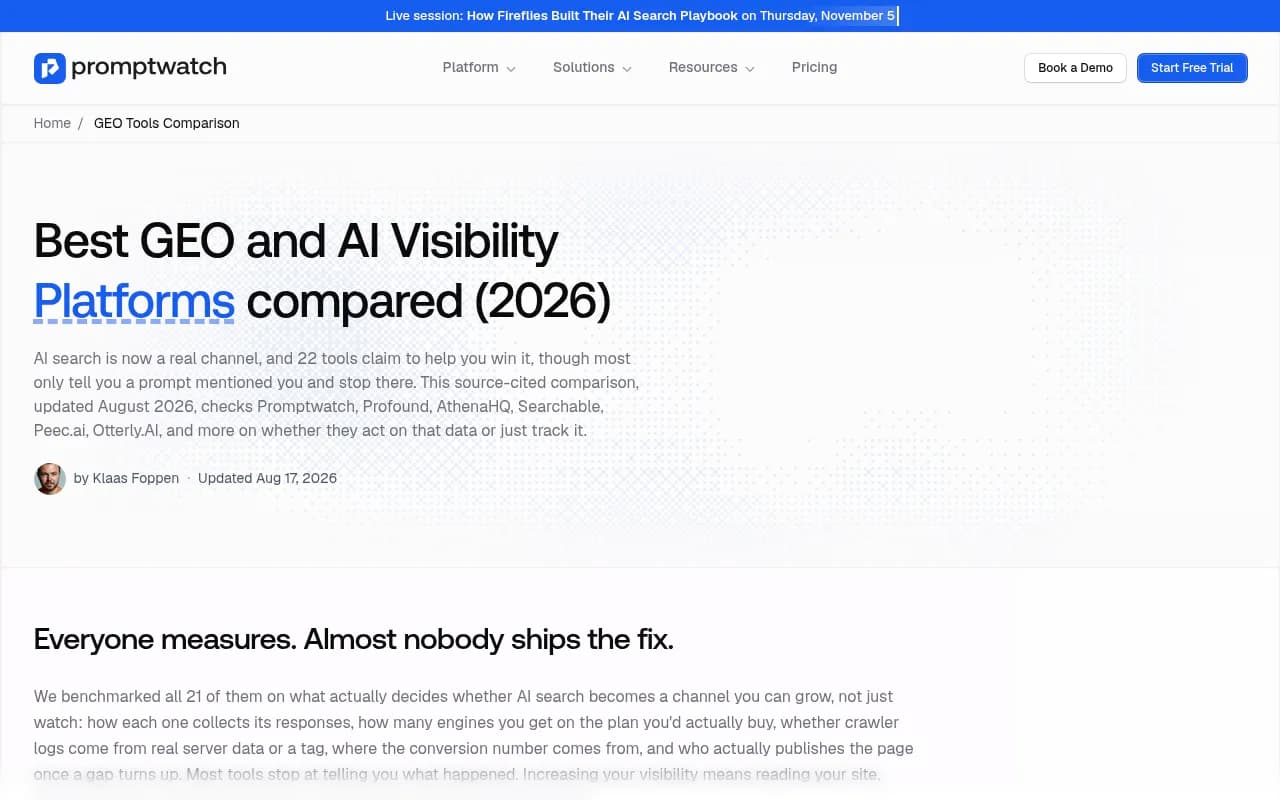
A useful sanity check on that claim: Promptwatch's 2026 comparison of 22 GEO platforms positions it as the one that ties tracking to crawler logs, conversion tracking, and a content gap index built from your own crawled pages. That's Promptwatch grading its own work, so treat it as a vendor view. Lebesgue's independent-ish review, which recommends itself for ecommerce, still praised Promptwatch's clean dashboard and source visuals.
Pricing
Pricing is in USD per month. Confirm current numbers at promptwatch.com/pricing, since there are monthly and annual toggles and a 7-day free trial on Essential and Professional.
| Plan | Price per month | Projects | Prompts | Responses | Notable features |
|---|---|---|---|---|---|
| Essential | $95 | 1 | 50 | 6,000 | Agent Chat, country tracking, MCP and API |
| Professional | $245 | 2 | 150 | 18,000 | Content writing and refresh, Knowledge Base, crawler analytics |
| Business (most popular) | $579 | 5 | 350 | 42,000 | Content Agent, state and city tracking, Shopping Insights, Ads Radar, audit logs |
| Enterprise | Custom | Multiple | Custom | Custom | SSO, dedicated success manager, managed content workflows |
Head-to-head comparison
| Dimension | InSpace.io (NOVA) | Promptwatch |
|---|---|---|
| Core model | Managed content engine priced by pages | Visibility platform with agents, priced by prompts and responses |
| Starting price | $1,000 per month list (10 pages) | $95 per month |
| Prompt-level AI tracking | Not shown publicly | Yes, on real AI interfaces |
| Named AI-engine coverage | ChatGPT, Perplexity, Gemini mentioned in copy | 10+ live engines plus API models |
| Crawler logs | Not shown publicly | IP-verified logs |
| AI traffic and conversion analytics | Not shown publicly | Visitor analytics |
| Content creation | Core product, done for you | Content Agent (Business and Enterprise), Content Creation and Refresh on Professional |
| CMS publishing | Yes, into your CMS | Webflow, Framer, WordPress |
| Closing the loop | Re-optimizes pages, measurement method unclear | Tracks crawls, citations, and AI traffic per published page, then raises new actions |
| Best for | Teams that want content shipped without managing it | Teams that need to diagnose and prove AI visibility results |
What the citation data says about where to spend effort
The strongest argument for diagnosing before producing comes from how ChatGPT actually cites. In Promptwatch's report on which content types ChatGPT cites, covering Sep 28 to Oct 4, 2026, product pages were the most cited type at 22.4% of classified citations. Landing pages came next at 16.8%. Together that's about 39% of citations going to pages that describe what a company sells.
The rest was editorial: listicles at 13.6%, how-tos at 8.7%, docs at 7.5%, general articles at 6.1%, comparisons at 5.9%, and news at 5.7%. Commercial prompts skewed even harder toward product and landing pages, at 26.0% and 20.6%.
Why does this matter for an InSpace comparison? A lot of NOVA's described output is long-tail articles, question pages, and category hubs. Those can work. But if the prompts that matter to your revenue are commercial, the data suggests your product and landing pages are doing most of the citation work, and no amount of blog volume fixes a weak product page. NOVA's optimize-existing option overlaps with this, which is a point in its favor. Without visible measurement, though, you won't know whether it chose well.
There's a durability angle too. Promptwatch's content half-life report found that landing pages and docs stayed cited longest among pages ChatGPT cited on July 6, 2026, while news lost half its pages within 36 days. A strategy that leans on volume of fresh, article-style content is working against that decay curve.
Where each one wins
Choose InSpace if
- You have budget and no appetite for running an SEO program yourself.
- Your main goal is more organic pages in several countries and languages, with GEO treated as a byproduct.
- You're comfortable with a content-volume pricing model and a human-reviewed workflow.
Choose Promptwatch if
- You need to see which prompts you're missing, which competitors get cited, and which sources AI trusts.
- You want to know whether AI crawlers can even read your site. Crawl errors are an invisible reason pages never get cited.
- You need to tie AI visibility to traffic and conversions for a CMO or client.
- You want agents that write and publish against specific gaps, then get checked by the same system.
Using both
This isn't crazy. A reasonable setup: run measurement in Promptwatch, feed its gap analysis and Action Board into whatever content production you use, including a managed service, and check results through citations and crawler data. The risk with doing content-only is the one I keep coming back to. You can publish 20 pages a month and have no idea whether any of them show up in ChatGPT.
Pitfalls to watch with either approach
- Self-reported results. Ask InSpace which metric, which period, and which engines sit behind any case study number. Ask any vendor the same.
- Thin content at scale. Raising page counts without strong source material and facts can produce pages that look fine and earn nothing.
- Measuring only mentions. A mention without a citation to your own domain often points to a content or crawlability problem, not a reputation one.
- Ignoring decay. News-style content fades quickly, so schedule refreshes for the pages that matter.
How to decide in a week
- Run a free scan of how ChatGPT, Gemini, and Perplexity describe your brand. Promptwatch has a free AI Visibility Report that needs no login.
- List your 20 highest-value commercial prompts and note which pages should answer them.
- Check crawler access. If AI bots can't read your key pages, no content plan helps.
- Ask InSpace for a demo that shows AI-specific measurement, not just a traffic chart.
- Start Promptwatch's trial on Essential or Professional and see whether the gap analysis matches your instincts.
If you want to browse more options in the category, the GEO software directory lists other platforms worth comparing.
Bottom line
InSpace is a content production service with GEO in its pitch. Promptwatch is an AI visibility platform with content agents attached. If your problem is output, InSpace is a plausible answer. If your problem is that you don't know why AI engines skip you, buying more pages first is a gamble. For most teams I'd start with measurement, fix the product and landing pages the data points to, then decide how much new content you actually need.