Key takeaways
- InSpace.io is not a like-for-like competitor. Its NOVA platform is priced by pages published per month ($700 to $6,900+), and I could not verify any prompt tracking or share-of-voice features.
- LLM Pulse is the cheaper, simpler tracker: about $48 to $58/month for 50 prompts, 5 engines on every plan, and a 14-day trial.
- Qwairy covers more engines (up to 18) and has more modules for crawler analytics and AI revenue, but it runs on credits, so "unlimited prompts" is really a budget.
- Both trackers gate white label to Enterprise. Small agencies should check that before buying.
- Verify prices on the live pages. Qwairy's pricing differs between its own site and third-party reviews, which suggests a recent repackaging.
The short answer
If you want to measure AI visibility, pick between LLM Pulse and Qwairy. If you want someone to produce and publish GEO-optimized pages for you, InSpace is the only one of the three built for that, and it costs 10 to 30 times as much as the entry plans of the others.
Calling all three "mid-tier visibility tools" is a stretch. I'll say that up front because most comparison posts blur it. They are different kinds of product, and the right choice depends on whether your bottleneck is knowing where you stand or shipping the content that changes it.
What each tool actually is
InSpace.io
InSpace sells an AI SEO platform and service called NOVA. Per its pricing page, NOVA handles content production and publishing with GEO optimization. Plans are priced by pages per month, not by prompts tracked.
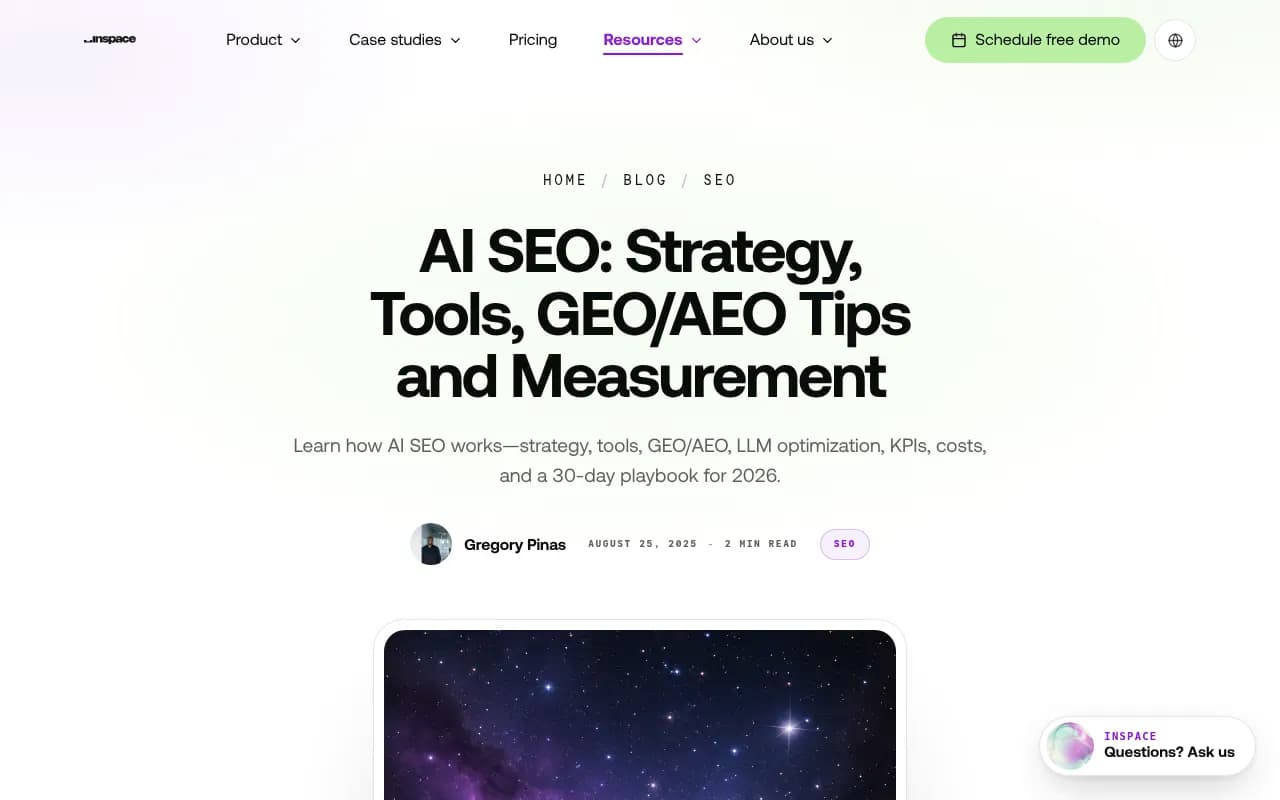
The pricing page does not mention prompt tracking, share of voice, or a list of engines monitored. It also offers free tools (a Tech Scan and an ROI Calculator). I found no independent reviews, so anything beyond what InSpace publishes about itself is unverified.
LLM Pulse
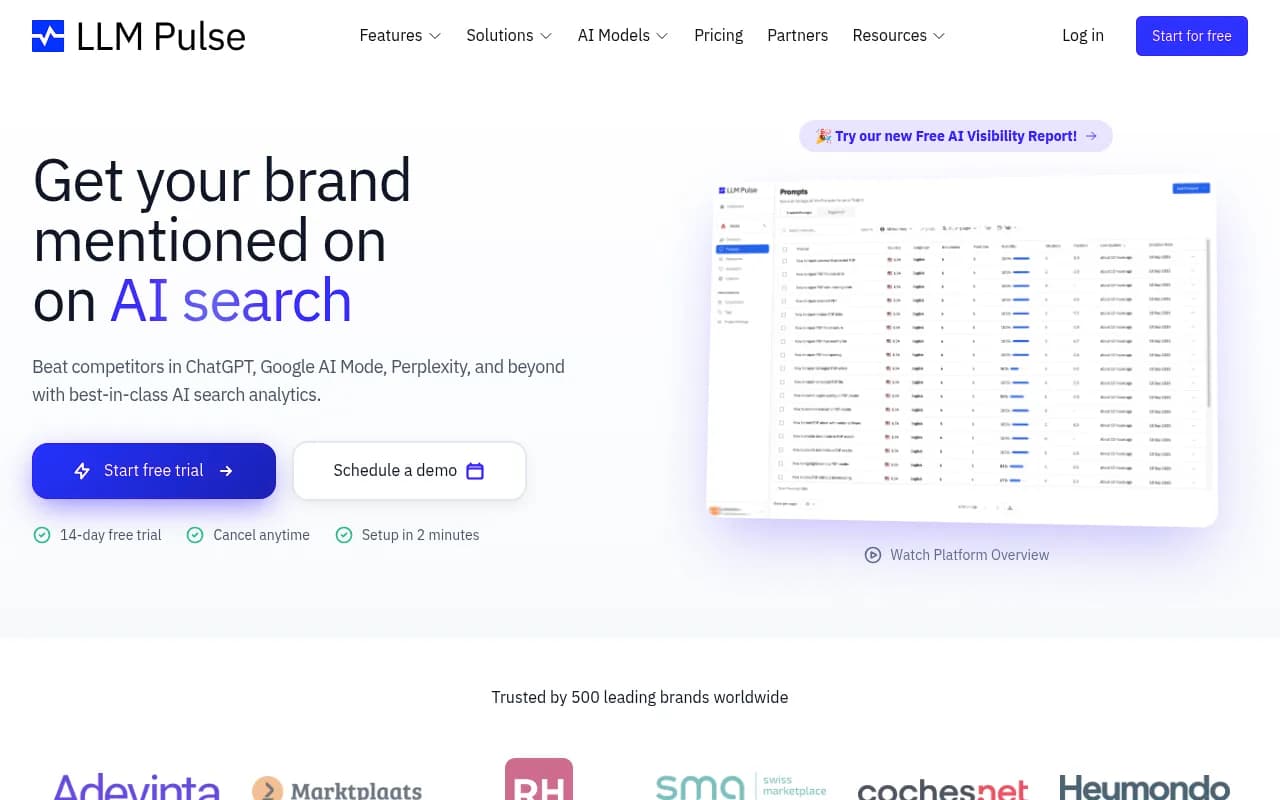
LLM Pulse is a straightforward AI visibility tracker. Every plan covers five engines: ChatGPT, Perplexity, Gemini, Google AI Mode and AI Overviews. You get share of voice, mentions and citations, URL-level citation data, and recommendations. Higher tiers add sentiment, Owned Media tracking, AI traffic analytics and a GEO testing feature.
Qwairy
Qwairy positions itself as a GEO platform with a wider module set: a Cockpit with a GEO Matrix, a Source Explorer, sentiment and perception analysis, an Action Center, a Content Studio, site diagnostics, and a measurement layer that pulls in Search Console, Bing Webmaster Tools, referrer analytics, AI Crawler Analytics and AI Revenue.

Pricing compared
InSpace list prices are before discounts. Stacked discounts of 10%, 20% and 30% on longer terms take up to 30% off.
| Tool | Plan | Monthly price | What you get |
|---|---|---|---|
| InSpace | Stratosphere | $1,000 list ($700 max discount) | 10 pages/month |
| InSpace | Milky Way | $1,700 list ($1,190) | 20 pages/month |
| InSpace | Universe | $3,000 list ($2,100) | 40 pages/month, dedicated strategist |
| InSpace | Multiverse | From $6,900 | 4+ countries, local SEO and GEO per market |
| LLM Pulse | Starter | $58 ($48 annual) | 50 prompts, 1 project |
| LLM Pulse | Growth | $116 ($97 annual) | 150 prompts, 2 projects |
| LLM Pulse | Scale | $351 ($292 annual) | 450 prompts, 5 projects |
| Qwairy | Starter | $89 ($74 annual) | 1 workspace, 2,500 credits |
| Qwairy | Growth | $229 ($190 annual) | 2 workspaces, 10,000 credits |
| Qwairy | Business | $519 ($432 annual) | 5 workspaces, 30,000 credits |
Two caveats. LLM Pulse shows USD amounts marked approximate, converted from EUR, and its meta description says from EUR 49/month. The page also seems to show a higher daily-tracking view (roughly $93, $175 and $526), though the scrape was cut off, so confirm on the live page. Qwairy's meta description says from EUR 79/month, and its older plan structure (still quoted in a third-party review from October 2026) had smaller credit allowances and more workspaces.
The Qwairy credit trap
This is the part I'd read twice before buying. Qwairy lists prompts as unlimited on paid plans, but volume is controlled by credits. One credit is spent per prompt, per core engine, per run.
So Starter's 2,500 monthly credits cover roughly 190 prompts on 3 engines checked weekly, or about 27 prompts checked daily. When credits hit zero, new analyses pause. Unused credits roll over while you stay subscribed, and credit packs start at EUR 109 excluding VAT. Analysis and content generation also draw from the same pool.
LLM Pulse is simpler to forecast: you buy a prompt count, and weekly versus daily tracking is a toggle. The tradeoff is a harder ceiling on prompts (50, 150, 450).
Qwairy offers a pricing calculator. Use it before you commit, with your real prompt list and your real cadence.
Engine coverage and data quality
LLM Pulse tracks five engines on every plan. Claude, Copilot, Grok, DeepSeek, Naver, Baidu, Meta AI and Alexa for Shopping are described as paid add-ons, but that description comes from LLM Pulse's own blog, so treat it as vendor-sourced.
Qwairy lists 18 engines and model families. ChatGPT, Claude and Gemini are monitored through both the UI and the API. AI Overviews, AI Mode, Perplexity, Copilot, Grok, Meta AI, Alexa for Shopping, Naver and Wenxin are UI-only. Muse Spark, Mistral, Qwen, Kimi, GLM and MiniMax are API-only. Sources conflict on whether API-only engines need Enterprise, so ask Qwairy directly.
Why the UI versus API distinction matters: UI monitoring is closer to what customers actually see, and API answers are cheaper but less representative. Check which mode each engine on your shortlist uses.
Per-engine tracking also matters because citation behavior differs sharply. Promptwatch Data's average-sources report shows ChatGPT cites about 5 sources per web-search answer, while AI Overviews and Perplexity cite about 10. Copilot swung from under 2 to nearly 17 sources within a few weeks before settling low. If a tracker blends engines into one number, a Copilot swing could look like something you caused.
A question to ask every vendor: fanouts
Promptwatch's ChatGPT query fanout data puts average fanouts per response at 2.15 in early December 2025 and about 1.84 by early March 2026, with a data gap before April. Average query length fell from about 117 characters to the high 80s, then lower. Tools that track fixed prompts only see the prompt, not the searches that actually get retrieved. Ask LLM Pulse and Qwairy whether they surface fanouts or only prompt-level answers. I could not confirm either way.
Features and integrations side by side
| Capability | InSpace | LLM Pulse | Qwairy |
|---|---|---|---|
| Prompt tracking | Not verified | Yes, 5 engines | Yes, up to 18 engines |
| Share of voice | Not verified | Yes | Yes (GEO Matrix) |
| Sentiment | Not verified | Growth and up | Analyze module |
| Content creation | Core product, by pages | GEO Writer from Starter | Content Studio |
| AI traffic attribution | Not verified | AI Traffic Analytics (Growth) | Referrer analytics, AI Revenue |
| AI crawler analytics | Not verified | Not listed | Business tier |
| API | Not listed | Scale | Growth |
| Looker Studio | Not listed | Scale | Business |
| MCP server | Not listed | All plans | All plans |
| White label | Not listed | Enterprise | Enterprise |
| Free trial | Free demo | 14 days | Free plan, 120 credits |
A few things stand out. Qwairy puts API access one tier earlier than LLM Pulse does, while LLM Pulse's entry plan is cheaper. Both offer an MCP server for ChatGPT, Claude and Cursor everywhere. Qwairy's crawler analytics is relevant given how much AI bot traffic is moving around; Promptwatch's AI crawler traffic data covers verified requests from OpenAI, Anthropic, Google, Perplexity and Mistral if you want context.
LLM Pulse's Growth-tier Owned Media tracking covers YouTube and Reddit. Worth knowing before you pay for it: Promptwatch Data found ChatGPT drew just 0.46% of citations from social platforms from Sep 28 to Oct 4, 2026, versus 12.2% for Google AI Overviews. That feature will matter more for AI Overviews than for ChatGPT. Likewise, Scale-tier ChatGPT Shopping and paid ads tracking lines up with Promptwatch's ChatGPT ads and shopping usage reports.
Agency considerations
Third-party lists often call LLM Pulse agency-friendly with white-label options. White label is Enterprise-only, so a small agency on Starter or Growth will not get it. Qwairy is the same: white-label platform and custom domain sit at Enterprise.
On multi-client capacity, LLM Pulse gives you 5 projects at Scale ($351/month). Qwairy gives 5 workspaces at Business ($519/month) and unlimited team members. Qwairy's list of customers includes TotalEnergies, BlaBlaCar, Nissan and Crédit Agricole. LLM Pulse cites Salesforce, Omnicom and Metricool among its logos and claims 7,000+ users. Both are vendor claims.
What is missing from this comparison
I could not find an independent hands-on benchmark of the three, any accuracy or consistency comparison of tracked answers, or any InSpace tracking capability. Review sites are thin too. A Citeme review dated October 2026 rates Qwairy 4.2/5, but Citeme is a direct competitor and disclosed it has not used the product. Qwairy's G2 page shows 51 reviews, with praise for API and MCP connectivity, but its listed prices are stale.
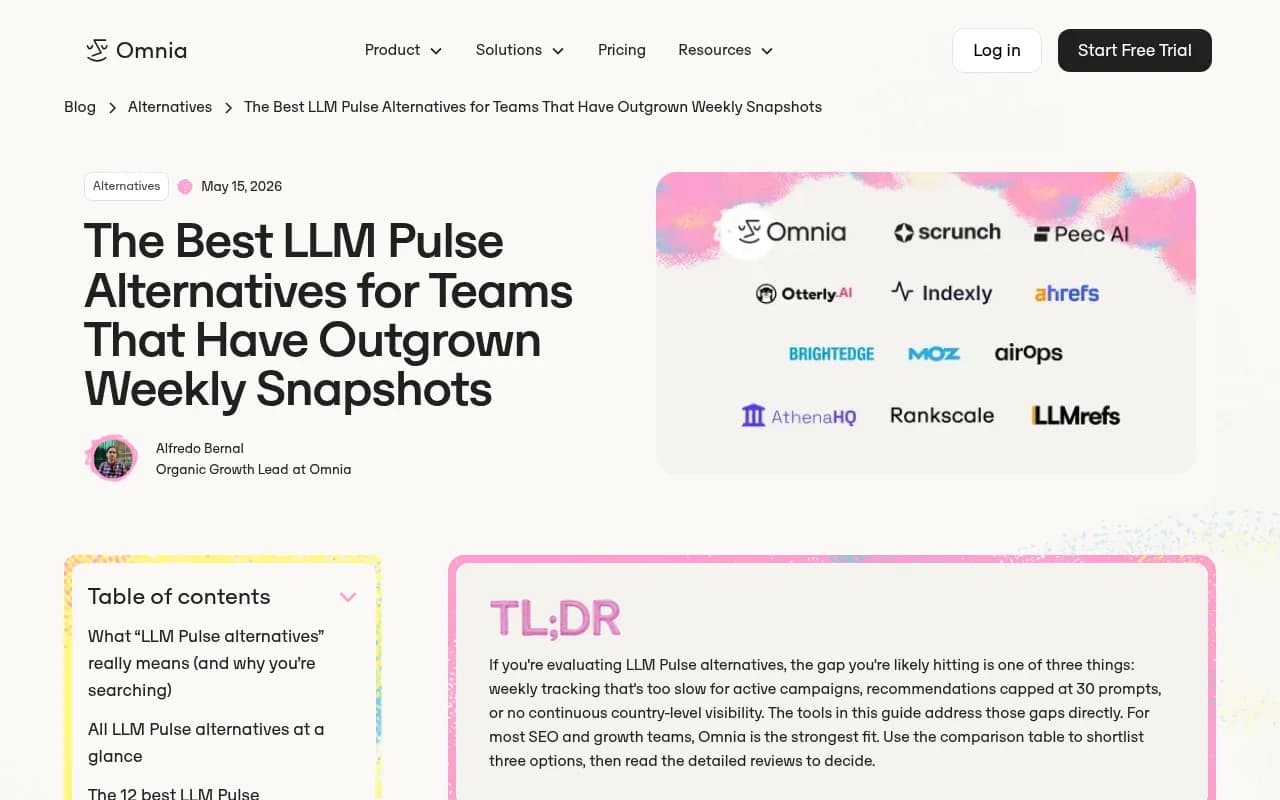
One competitor-sourced limitation worth checking: Omnia's roundup says LLM Pulse's recommendation engine analyzes up to 30 tracked prompts and 30 cited URLs at a time, and that tracking is weekly on every plan. LLM Pulse's pricing page now shows a weekly or daily toggle, so that may be outdated. Test it in the trial.
Which one wins
Pick LLM Pulse if you want the cheapest credible entry point, predictable pricing and five major engines, and you're fine with a prompt cap. It suits small in-house teams and solo consultants.
Pick Qwairy if you need broad engine coverage, multi-country monitoring (it lists 240+ countries and 45+ languages), crawler analytics, or measurement joined to Search Console and Bing data. Budget the credits carefully.
Pick InSpace if your real problem is output, not measurement. You'd still want a separate tracker to confirm the pages work, and I'd ask InSpace for a sample of reporting before signing a 1 or 2 year term.
For my money, between the two true trackers, LLM Pulse wins on clarity and Qwairy wins on depth. Neither is clearly better on accuracy, because nobody has published the test.
If none of these fit
Trackers that stop at dashboards leave you with the scoreboard but no plan. Promptwatch goes further by pairing real-UI prompt tracking with IP-verified AI crawler logs, an Action Board and a Content Agent that publishes to Webflow, Framer or WordPress, then checks whether the new pages get crawled and cited.

You can also browse the GEO software directory at bestgeosoftware.com for more options, or look at close competitors in the catalog such as Peec AI and Otterly.AI.


Before you buy: a checklist
- Confirm current pricing on each live page, especially Qwairy's credits and workspaces.
- Run your real prompt list through Qwairy's calculator at your intended cadence.
- Ask each vendor whether engines are tracked through the UI or the API.
- Ask whether fanout queries are surfaced.
- Check which tier unlocks the API, Looker Studio and white label.
- Use the free plan or 14-day trial to compare the same 20 prompts side by side.