Summary
- ChatGPT's retrieval process works in two phases: scraping (where Google returns candidate URLs) and reading (where the LLM extracts answers). Your content must survive both.
- The 7 core GEO ranking factors: structured data markup, clear headings and definitions, authoritative backlinks, semantic relevance, content freshness, E-E-A-T signals, and crawlability for AI bots.
- Unlike traditional SEO, GEO requires you to write for extraction -- direct answers, scannable lists, and data-rich content that AI models can cite without interpretation.
- Tools like Promptwatch show you exactly which prompts competitors rank for but you don't, then generate content engineered to close those gaps and get cited.
- Tracking is critical: monitor which pages get cited, by which models, and how often. Close the loop with traffic attribution to connect AI visibility to revenue.
ChatGPT is eating search traffic -- and most brands are invisible
By the end of 2024, ChatGPT's usage exceeded Bing. In 2026, it processes over 500 million searches monthly. People don't type "best project management software" into Google anymore -- they ask ChatGPT, Claude, or Perplexity. The AI gives them an answer. If your brand isn't in that answer, you don't exist.
This isn't a future trend. It's happening now. And the gap between brands that show up in AI search and those that don't is widening fast.
The shift from traditional search to AI search changes everything. Google shows 10 blue links. ChatGPT cites 3-5 sources in a conversational response. The competition is brutal. The opportunity is massive. And the rules are different.
This guide walks you through exactly how ChatGPT picks sources, the 7 ranking factors that matter most, and the step-by-step process to optimize your content for AI visibility in 2026.
How ChatGPT actually retrieves and ranks content
The two-phase retrieval process
ChatGPT doesn't work like Google. When someone types a prompt, the model doesn't just look up indexed pages. It runs a process called "query fanout" -- the LLM converts the user's natural language prompt into multiple specific search queries, then sends those queries to a search engine (primarily Google since September 2025, though it used to rely on Bing).
The retrieval happens in two critical phases:
Phase 1: Scraping. The search engine returns candidate URLs based on the fan-out queries. At this stage, the LLM has limited information: page titles, meta descriptions, URL slugs, and snippets. If your content doesn't signal relevance here, it gets discarded immediately. You're competing with thousands of other pages. The model picks 10-20 candidates to read.
Phase 2: Reading. The LLM crawls and reads the selected pages, analyzing the full text to extract answers. If your content is unstructured, buried under fluff, or written in vague marketing language, the model can't extract what it needs. It moves on to the next source.
This two-phase process means you need a dual optimization strategy: signal relevance to the search engine to get picked, then structure information clearly for the LLM to extract and cite.
Why traditional SEO tactics don't work for GEO
Traditional SEO optimizes for ranking in a list. You want to be in the top 10 results. GEO optimizes for citation. You want to be one of the 3-5 sources the AI model references in its answer.
The difference matters. Google rewards pages that match user intent and have strong backlink profiles. ChatGPT rewards pages that provide extractable, authoritative answers in a format the model can parse and cite. A page that ranks #1 in Google might not get cited by ChatGPT at all if the content is poorly structured or lacks clear definitions.
Here's what changes:
- Keyword density doesn't matter. Semantic relevance does. The model understands context and synonyms. It's looking for concepts, not exact-match phrases.
- Backlinks still matter, but differently. They signal authority to the search engine in phase one. But in phase two, the model cares more about how clearly you explain things.
- Content length is irrelevant. A 500-word page with a clear definition and structured data can outrank a 3,000-word guide if the guide buries the answer.
- User engagement signals (bounce rate, time on page) don't apply. The LLM reads the page, extracts the answer, and moves on. It doesn't care if humans stick around.
The core insight: GEO is about making your content machine-readable and citation-worthy. You're writing for an AI model that needs to extract facts, not a human who needs to be entertained.
The 7 core ranking factors for ChatGPT in 2026
1. Structured data and schema markup
ChatGPT can't see your page the way a human does. It sees HTML. Structured data (schema.org markup) tells the model what each piece of content represents: a product, a review, a FAQ, a how-to guide.
Pages with proper schema markup get cited more often because the model can extract information with confidence. A product page with Product schema (price, availability, reviews) is more likely to be cited than a page with the same information buried in paragraphs.
Priority schema types for GEO:
- FAQPage schema: Marks up Q&A content so the model can extract specific answers
- HowTo schema: Structures step-by-step instructions
- Product schema: Provides pricing, availability, and review data
- Article schema: Signals authoritative long-form content
- Organization schema: Establishes brand identity and trust signals
Implementing schema is technical but not complicated. Most CMS platforms (WordPress, Webflow, Shopify) have plugins or built-in tools. If you're on a custom stack, use Google's Structured Data Markup Helper to generate the JSON-LD code.
2. Clear headings and direct definitions
AI models scan for structure. They look for H2 and H3 headings to understand the page hierarchy, then extract content from the sections that match the user's query.
If your headings are vague ("Our Approach" or "Why Choose Us"), the model can't map them to a specific question. If your headings are specific ("What is project management software?" or "How to set up two-factor authentication"), the model knows exactly where to look.
The same principle applies to definitions. Start sections with a clear, direct answer. Don't bury the definition in the third paragraph. Put it first. The model reads top-to-bottom and extracts the first clear statement it finds.
Example of a bad structure:
"Project management tools have evolved significantly over the past decade. Many teams struggle with coordination and visibility. That's where modern solutions come in. These platforms help teams collaborate more effectively by providing..."
Example of a good structure:
"Project management software is a digital tool that helps teams plan, track, and collaborate on projects in one centralized workspace. Key features include task assignment, timeline visualization, file sharing, and progress tracking."
The second example gets cited. The first gets skipped.
3. Authoritative backlinks and domain trust
Backlinks still matter in GEO, but the mechanism is different. In traditional SEO, backlinks pass PageRank and help you rank higher in search results. In GEO, backlinks signal authority to the search engine during the scraping phase, which determines whether your page makes it into the candidate pool.
If your domain has strong backlinks from authoritative sites (think .edu, .gov, major publications, industry leaders), you're more likely to survive phase one. But once you're in phase two, the model evaluates content quality independently. A page from a low-authority domain with a perfect answer can beat a page from a high-authority domain with a vague answer.
Focus on:
- Earning links from authoritative domains in your niche (industry publications, research institutions, major blogs)
- Building topical authority by publishing comprehensive content clusters around core topics
- Getting cited in Wikipedia, Reddit, and Quora -- these sources carry weight with AI models
Don't waste time on low-quality link schemes. One link from a respected industry site is worth more than 100 links from random blogs.
4. Semantic relevance and topic coverage
ChatGPT doesn't match keywords. It understands meaning. When someone asks "What's the best CRM for small businesses?", the model looks for content that discusses CRM features, pricing, use cases, and comparisons -- not just pages that repeat the phrase "best CRM for small businesses" 20 times.
Semantic relevance means covering the topic comprehensively. If you're writing about project management software, you need to address:
- What it is (definition)
- Who it's for (use cases)
- Key features (task management, timelines, collaboration)
- How it compares to alternatives (spreadsheets, email, other tools)
- Pricing and availability
The model scans for these elements. If your page only covers one or two, it's not semantically complete. The model will cite a competitor that covers all of them.
Tools like Clearscope and Surfer SEO analyze top-ranking content and show you which topics and terms to include. But the real insight is simpler: answer every question a reader might have about the topic. Don't leave gaps.

5. Content freshness and update frequency
AI models favor recent content. When ChatGPT retrieves sources, it biases toward pages published or updated in the last 6-12 months. This makes sense -- the model wants to provide current information, not outdated advice.
If your content hasn't been updated since 2022, you're at a disadvantage. Even if the core information is still accurate, the model perceives it as stale.
The fix:
- Add a "Last updated" date at the top of every article
- Refresh content quarterly -- update stats, add new examples, revise outdated sections
- Publish new content regularly to signal that your site is active and maintained
You don't need to rewrite everything. Small updates work. Add a new section, update a statistic, embed a recent case study. The model notices.
6. E-E-A-T signals (Experience, Expertise, Authoritativeness, Trust)
Google's E-E-A-T framework (Experience, Expertise, Authoritativeness, Trustworthiness) applies to GEO as well. AI models look for signals that the content comes from a credible source.
Key E-E-A-T signals:
- Author bylines with credentials ("Written by John Smith, 10+ years in SaaS marketing")
- About pages that establish expertise (team bios, company background, industry recognition)
- Citations and references (link to studies, data sources, authoritative third-party content)
- Customer reviews and testimonials (social proof that real people use and trust your product)
- Security indicators (HTTPS, privacy policy, contact information)
These signals don't directly affect the model's ability to extract content, but they influence whether the model trusts the source enough to cite it. A page from an anonymous blog with no credentials is less likely to be cited than a page from a recognized industry expert.
7. Crawlability for AI bots
ChatGPT and other AI models use web crawlers to read your content. If your site blocks these crawlers (via robots.txt or server configuration), you're invisible to AI search.
Most sites don't intentionally block AI crawlers, but many accidentally do. Common issues:
- Blocking user agents like GPTBot, Claude-Web, or PerplexityBot in robots.txt
- Requiring JavaScript rendering for content to load (AI crawlers often don't execute JS)
- Serving different content to bots vs. humans (cloaking, which can get you penalized)
- Slow page load times (crawlers time out if pages take too long to load)
Check your robots.txt file. Make sure you're not blocking AI crawlers. If you're using a headless CMS or JavaScript framework, ensure your content is server-side rendered or pre-rendered for crawlers.
Tools like Promptwatch include AI crawler logs that show exactly which AI bots are hitting your site, which pages they're reading, and any errors they encounter. This visibility is critical -- if ChatGPT's crawler can't read your content, you won't get cited.

Step-by-step: How to optimize your content for ChatGPT
Step 1: Identify high-value prompts your competitors rank for
You can't optimize for every possible prompt. Start by identifying the prompts that matter most -- the ones your competitors rank for but you don't.
Traditional keyword research tools (Ahrefs, SEMrush) show you what people search for in Google. But GEO requires prompt research -- understanding what people ask AI models.
The best way to do this: use a GEO platform like Promptwatch to run competitor analysis. Enter your competitors' domains, and the platform shows you which prompts they get cited for across ChatGPT, Claude, Perplexity, and other AI models.
Look for:
- High-volume prompts (prompts that get asked frequently)
- Winnable prompts (prompts where you have domain authority but lack content)
- Prompts with clear intent ("How to..." or "What is..." queries that map to specific content types)
Once you have a list of target prompts, prioritize based on volume and difficulty. Focus on prompts where you can realistically compete -- don't try to rank for "best CRM" if you're a startup with no backlinks. Go after "best CRM for real estate agents" or "how to migrate from Salesforce to HubSpot."
Step 2: Analyze what's currently getting cited
Before you write, study the sources ChatGPT already cites for your target prompts. Run the prompts in ChatGPT, Claude, and Perplexity. Look at the sources they reference.
Ask:
- What format are these pages using? (Listicles? How-to guides? Comparison tables?)
- How are they structured? (Do they start with a definition? Use H2 headings for each section?)
- What depth of information do they provide? (Are they 500-word overviews or 3,000-word deep dives?)
- What schema markup are they using? (Check the page source or use a schema validator)
You're not copying these pages. You're reverse-engineering the pattern. The AI model is telling you what it considers citation-worthy. Match that pattern, then add unique value.
Step 3: Structure your content for extraction
Now write. But write differently than you would for traditional SEO.
GEO content structure:
- Start with a clear, direct definition or answer. First paragraph, first sentence. No fluff.
- Use descriptive H2 and H3 headings that match common questions ("What is X?" "How does X work?" "X vs. Y").
- Break information into scannable chunks. Short paragraphs (2-3 sentences). Bullet lists. Numbered steps.
- Include comparison tables when discussing multiple options. AI models love structured data they can extract.
- Embed data and statistics with clear attribution ("According to [Source], 67% of teams...").
- Add schema markup for the content type (FAQ, HowTo, Article).
Example outline for a "What is project management software?" article:
## What is project management software?
[Clear definition in first paragraph]

## Key features of project management software
- Task management
- Timeline visualization
- Collaboration tools
- Reporting and analytics

## Who uses project management software?
[Use cases by industry/team size]

## How project management software works
[Step-by-step explanation]

## Project management software vs. spreadsheets
[Comparison table]

## Top project management software options in 2026
[Brief list with tool embeds]

## How to choose project management software
[Decision framework]
This structure makes it easy for the model to extract any piece of information it needs. If someone asks "What is project management software?", the model pulls from section 1. If they ask "What are the key features?", it pulls from section 2. If they ask "Should I use software or spreadsheets?", it pulls from section 5.
Step 4: Optimize technical elements
Schema markup: Add FAQPage schema if your content includes Q&A sections. Add HowTo schema if you're writing a tutorial. Add Article schema for long-form guides. Use Google's Structured Data Markup Helper or a plugin like Yoast SEO (WordPress) or Schema App.
Meta tags: Write a clear, descriptive title tag (60 characters max) and meta description (150 characters max). These show up in the scraping phase and influence whether your page makes the candidate pool.
Internal linking: Link to related content on your site. This helps the model understand your site's topical structure and discover additional pages to cite.
Image optimization: Use descriptive alt text for images. AI models can't "see" images, but they read alt text. If you have a diagram or screenshot that supports your content, describe it clearly.
Page speed: Ensure your page loads in under 3 seconds. Slow pages get dropped by crawlers.
Step 5: Publish and monitor
Publish the content. Then track what happens.
Use a GEO platform like Promptwatch to monitor:
- Which prompts your page gets cited for (and which models cite it)
- How often it gets cited (citation frequency)
- Which specific sections get extracted (page-level tracking)
- Competitor movement (are competitors gaining or losing visibility for the same prompts?)
This feedback loop is critical. You're not guessing. You're seeing exactly what works and what doesn't. If your page isn't getting cited after 2-4 weeks, go back and revise. Add more structure. Clarify the definition. Embed more data.
If it is getting cited, double down. Write related content that targets adjacent prompts. Build a content cluster around the topic.
Common mistakes that kill your ChatGPT rankings
Writing for humans instead of extraction
The biggest mistake: writing content that sounds good to humans but is unstructured for machines. Long introductions, vague language, buried answers.
Example of human-optimized content:
"In today's fast-paced business environment, teams are increasingly turning to digital solutions to streamline their workflows and enhance collaboration. Project management software has emerged as a critical tool in this transformation, offering a wide range of features designed to meet the diverse needs of modern organizations."
This reads well. But an AI model can't extract a definition from it. There's no clear answer to "What is project management software?"
Example of extraction-optimized content:
"Project management software is a digital platform that helps teams plan, track, and execute projects by centralizing tasks, timelines, and communication in one workspace."
The second version gets cited. The first gets skipped.
Ignoring structured data
Most sites don't use schema markup. This is a massive missed opportunity. Structured data is the easiest, highest-leverage optimization you can make for GEO.
If you're not using schema, you're invisible to AI models in scenarios where structured data is the deciding factor. A competitor with proper FAQ schema will get cited over you, even if your content is better.
The fix is simple: implement schema. It takes 30 minutes per page. The ROI is enormous.
Blocking AI crawlers
Some sites block AI crawlers out of fear that AI models will "steal" their content. This is self-defeating. If you block the crawlers, you're invisible. You don't get cited. You don't get traffic.
The better strategy: let the crawlers in, optimize your content to get cited, and track the traffic you get from AI search. Tools like Promptwatch show you exactly how much traffic comes from AI referrals (via code snippet, Google Search Console integration, or server log analysis).
If you're getting cited and driving traffic, the ROI is positive. If you're not, the problem isn't the crawlers -- it's your content.
Focusing only on brand mentions
Many brands obsess over whether ChatGPT mentions their brand name. This is a vanity metric. What matters is whether you get cited for high-intent prompts that drive conversions.
If ChatGPT mentions your brand in response to "What is [YourBrand]?", that's nice. But it doesn't drive revenue. If ChatGPT cites your product comparison page in response to "best project management software for remote teams", that drives revenue.
Focus on ranking for prompts that match buyer intent, not just brand awareness.
Tools and platforms for GEO in 2026
GEO monitoring and optimization platforms
You can't optimize what you don't measure. GEO platforms track your visibility across AI models, show you which prompts you rank for, and help you identify content gaps.
Promptwatch is the market leader. It's the only platform rated as a "Leader" across all categories in a 2026 comparison of 12 GEO tools. The core difference: most competitors are monitoring-only dashboards that show you data but leave you stuck. Promptwatch is built around taking action.
The action loop:
- Find the gaps: Answer Gap Analysis shows exactly which prompts competitors are visible for but you're not. You see the specific content your website is missing.
- Create content that ranks in AI: The built-in AI writing agent generates articles, listicles, and comparisons grounded in real citation data (880M+ citations analyzed), prompt volumes, and competitor analysis.
- Track the results: See your visibility scores improve as AI models start citing your new content. Page-level tracking shows exactly which pages are being cited, how often, and by which models.
Other capabilities: AI crawler logs (real-time logs of ChatGPT, Claude, Perplexity crawlers hitting your site), prompt intelligence (volume estimates and difficulty scores), citation and source analysis, Reddit and YouTube insights, ChatGPT Shopping tracking, competitor heatmaps, multi-language and multi-region monitoring.
Pricing: Essential $99/mo (1 site, 50 prompts, 5 articles), Professional $249/mo (2 sites, 150 prompts, 15 articles, crawler logs), Business $579/mo (5 sites, 350 prompts, 30 articles). Free trial available.
Other GEO platforms worth considering:
Otterly.AI -- Affordable monitoring tool, but lacks content generation and optimization features. Good for basic tracking if you're on a tight budget.
Peec AI -- Multi-language support, monitoring-focused. No crawler logs or visitor analytics.
Search Party -- Agency-oriented, limited prompt metrics. No content gap analysis.
Search Party
Semrush -- Traditional SEO tool with basic AI search monitoring. Fixed prompts, no AI traffic attribution.
Ahrefs Brand Radar -- Brand monitoring in AI search. Fixed prompts, no content optimization.
Content optimization tools
Once you know which prompts to target, you need to create content that ranks. These tools help with research, writing, and optimization.
Clearscope -- AI-driven content optimization. Analyzes top-ranking content and shows you which topics and terms to include. Strong for semantic relevance.
Surfer SEO -- Content optimization platform with AI writing. Good for on-page SEO and GEO. Includes a content editor that scores your content in real-time.
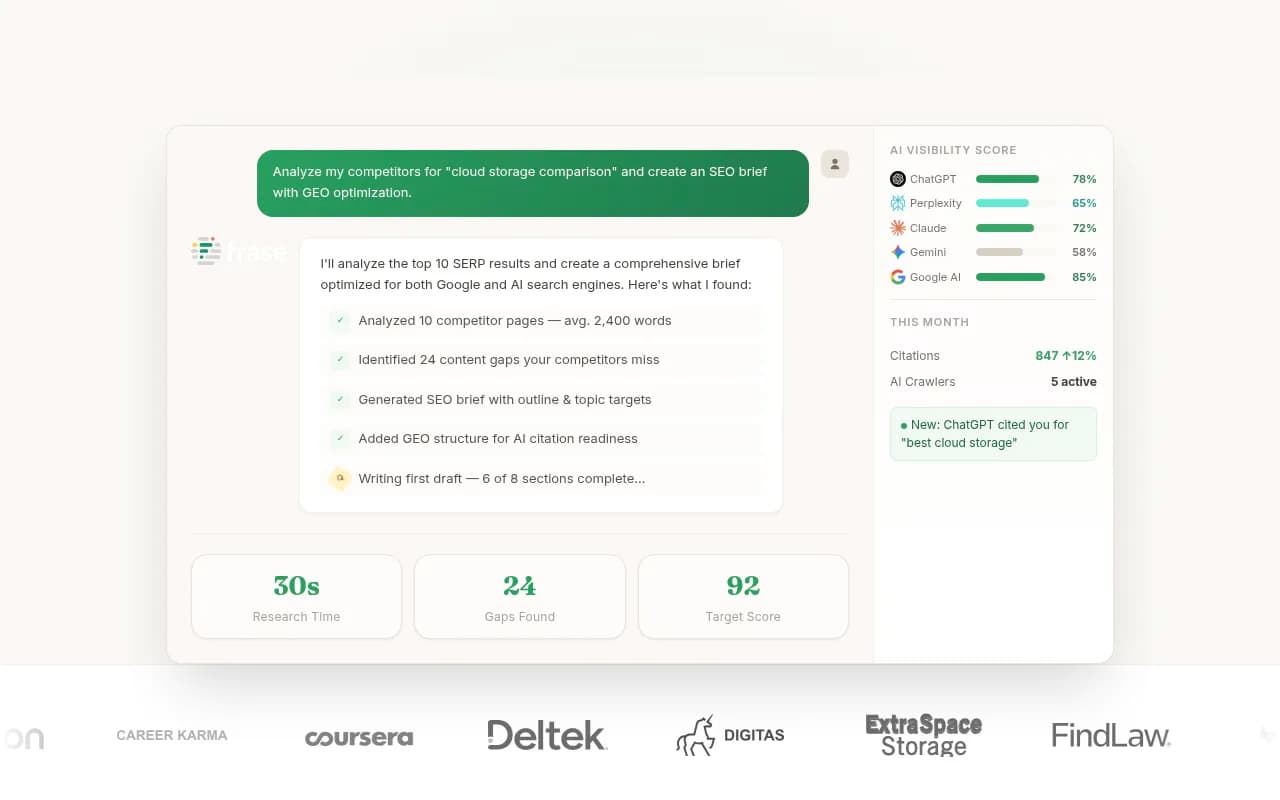
Frase -- AI content research and SEO optimization. Generates content briefs based on top-ranking pages. Useful for understanding what to cover.
Jasper AI -- AI writing assistant for long-form content. Good for generating first drafts quickly, but you'll need to edit for structure and clarity.
MarketMuse -- AI-powered content strategy. Shows what to write and how to optimize. Strong for content gap analysis.
Comparison: GEO platforms in 2026
| Platform | Monitoring | Content generation | Crawler logs | Pricing (starting) | Best for |
|---|---|---|---|---|---|
| Promptwatch | ✓ | ✓ | ✓ | $99/mo | End-to-end GEO (track, optimize, generate content) |
| Otterly.AI | ✓ | ✗ | ✗ | $49/mo | Budget monitoring |
| Peec AI | ✓ | ✗ | ✗ | Custom | Multi-language tracking |
| Search Party | ✓ | ✗ | ✗ | Custom | Agency reporting |
| Semrush | Basic | ✗ | ✗ | $139/mo | Traditional SEO + basic AI monitoring |
| Ahrefs Brand Radar | Basic | ✗ | ✗ | $129/mo | Brand mention tracking |
The future of AI search and GEO
AI search is still early. ChatGPT launched search in late 2024. Most brands don't have a GEO strategy yet. The window to gain an advantage is open, but it's closing.
What's coming:
More AI models, more fragmentation. ChatGPT, Claude, Gemini, Perplexity, Grok, DeepSeek, Meta AI, Copilot -- each model has its own retrieval logic and ranking factors. You'll need to optimize for multiple models, not just one.
AI shopping and product recommendations. ChatGPT already shows product carousels for shopping queries. This will expand. E-commerce brands need to optimize product pages for AI citations.
Deeper integration with traditional search. Google AI Overviews already blend traditional search results with AI-generated summaries. Expect more convergence. The line between SEO and GEO will blur.
Paid placement in AI search. Advertising in AI search is coming. ChatGPT is testing ads. Perplexity has ad placements. The organic/paid split that exists in Google will exist in AI search too.
Voice and multimodal search. People will ask AI models questions via voice (Siri, Alexa, Google Assistant). The same GEO principles apply, but the format changes. Optimize for spoken queries, not just typed ones.
The brands that win in AI search will be the ones that start now. Build the infrastructure (schema markup, structured content, crawler access). Track your visibility. Close the content gaps. Iterate.
This isn't a one-time project. It's an ongoing process. AI models update their algorithms. Competitors publish new content. Prompts evolve. You need to monitor, optimize, and adapt continuously.
The good news: the tools exist. The playbook is clear. The opportunity is massive. Most brands are still ignoring AI search. If you move now, you can dominate your category before the competition wakes up.
Start ranking in ChatGPT today
Here's your action plan:
-
Audit your current AI visibility. Sign up for a GEO platform like Promptwatch and run a baseline audit. See where you currently rank (or don't rank) across ChatGPT, Claude, Perplexity, and other models.
-
Identify your top 10 target prompts. Use competitor analysis to find high-value prompts you should rank for but don't. Prioritize based on volume and difficulty.
-
Optimize your top 5 existing pages. Add schema markup, restructure content for extraction, clarify definitions, embed comparison tables. These quick wins can get you cited within weeks.
-
Create 3 new pieces of content. Write articles, guides, or comparisons that target your priority prompts. Use the structure outlined in this guide. Publish and monitor.
-
Track and iterate. Check your visibility weekly. See what's working. Double down on content that gets cited. Revise content that doesn't.
AI search is the biggest shift in digital marketing since Google launched in 1998. The brands that adapt will thrive. The ones that ignore it will become invisible.
Start now. The window won't stay open forever.