Key takeaways
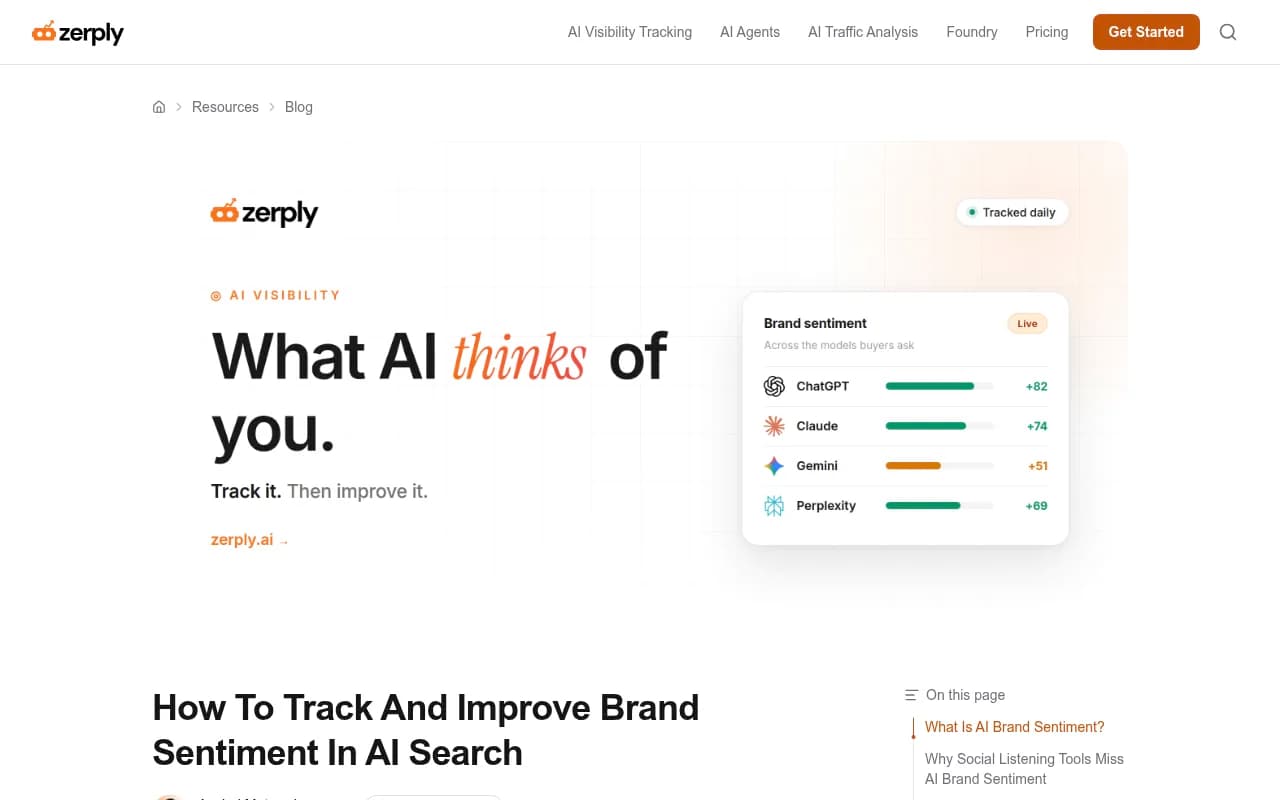
- AI sentiment is the tone and framing a model uses when it describes your brand. A mention is not a verdict, and "popular but expensive and complex" can hurt more than silence.
- Models build that tone from sources: your own pages, review sites, comparison articles, forums and social posts. Fix the sources and the answers follow.
- Branded prompts lean on product pages, landing pages and reviews, so your own site and your review profiles do most of the work.
- The plan below has three phases: audit (days 1-30), fix and publish (days 31-60), and distribute and measure (days 61-90).
- Expect slow movement. Retrieval-based answers can change in weeks, but claims learned from training data take much longer.
What AI sentiment actually is
AI brand sentiment is the consolidated characterization an assistant gives your brand when someone asks about it. It includes adjectives, caveats, comparisons and the claims it repeats. One buyer asks "is [your brand] good for small teams?" and gets a single synthesized answer. There is no feed to scroll and no thread to reply to.
That is why classic social listening misses the problem. Tools like Brand24 or Meltwater show you what people posted. They do not show you what ChatGPT concluded after reading all of it, plus a three-year-old comparison article and a stale review.
A useful mental model: sentiment in AI search is a lagging indicator of your source footprint. You cannot argue with the model. You can change what it reads.
Two more things worth separating before you start:
- Visibility is whether you appear. Sentiment is how you are described when you do. A brand can score well on one and badly on the other.
- Accuracy is a third problem. Sometimes the model is not negative, just wrong, repeating a limitation you fixed two releases ago. Wrong claims are usually the fastest wins.
What shapes the tone of an answer
Before planning, it helps to know where the tone comes from. Promptwatch Data looked at the content types ChatGPT cited between Sep 28 and Oct 4, 2026, and split them by prompt type. For branded prompts, like "is HubSpot good for startups", the mix looks different from the overall picture:
| Content type | Share of all ChatGPT citations | Share on branded prompts |
|---|---|---|
| Product pages | 22.4% | 23.3% |
| Landing pages | 16.8% | 22.8% |
| Reviews | 1.7% | 5.6% |
| Social posts | about 0.8% | 3.0% |
| FAQ pages | 3.3% | 4.8% |
| Press releases | lower | 2.1% |
Two takeaways. First, almost half of branded citations point at pages you control, so your own site is the biggest lever. Second, reviews are cited more than three times as often on branded prompts as they are overall. Small share, but it is the share that carries opinion.
The data above measures citation sources, not sentiment directly. It tells you where the opinions come from, not how positive they are. That is still the useful part.
The platform matters too. In Promptwatch's social citation data for Oct 11 to Nov 9, 2026, social platforms were 13.16% of Google AI Overviews citations, 1.94% of Perplexity's and 0.64% of ChatGPT's. YouTube alone was 6.71% of AI Overviews citations. So a bad YouTube review matters far more in Google than in ChatGPT, and a Reddit complaint matters more in Perplexity than you might expect.
Reddit in ChatGPT is a moving target. Promptwatch's report on Reddit citations showed reddit.com falling from a steady 3.83% share to about 0.52% in mid-August 2026, with the size of that drop flagged as provisional. The November data shows a partial recovery to 0.40%. Do not build your whole plan on forum sentiment for one engine.
Days 1-30: audit and baseline
The first month is diagnosis. Resist fixing anything until you know what is being said and where it comes from.
Week 1: build a sentiment prompt set
Write 30 to 60 prompts that a buyer would actually ask about your brand. Mix these types:
- Branded: "Is [brand] worth it?", "What are the downsides of [brand]?", "[brand] reviews"
- Comparison: "[brand] vs [competitor]", "alternatives to [brand]"
- Commercial: "best [category] for [use case]"
- Persona-specific: the same question phrased as a founder, a procurement lead, an engineer
Personas matter more than people expect. An answer that is warm toward enterprise buyers can be lukewarm toward startups, and you only see the gap if you ask both ways.
Run them by hand first in ChatGPT and Perplexity, Gemini and Google AI Overviews. Save the answers. This takes an afternoon and teaches you more than any dashboard will.
Perplexity
Week 2: extract claims, not scores
A single sentiment number hides the useful bit. Instead, pull out every individual claim the models make about you and put them in a spreadsheet with four columns: the claim, which engines say it, which source they cite, and whether it is true.
Group them into themes: pricing, features, support, reputation, ease of use. You will usually find that two or three claims account for most of the negative tone. A typical pattern: one outdated limitation, one pricing complaint, one comparison article that favors a competitor.
Doing this manually works for a first pass. For ongoing tracking, a platform helps. Promptwatch has a Brand Narrative feature that pulls the individual claims out of every tracked response, groups repeated ones, shows which models say them, and scores themes like pricing and support from 0 to 100 against competitors. Its Fact Check feature (on Business and above) lets you mark a claim inaccurate and then finds the pages on your site that state it.

There are plenty of other options for the monitoring side, and the directories at bestgeosoftware.com and ai-rank-tools.com are a decent way to browse them. A few that list sentiment explicitly in their pitch:
| Tool | Sentiment angle | Notes |
|---|---|---|
| Promptwatch | Brand Narrative claims, sentiment score per prompt, topic and competitor, Fact Check | Also covers citations, crawler logs and content creation |
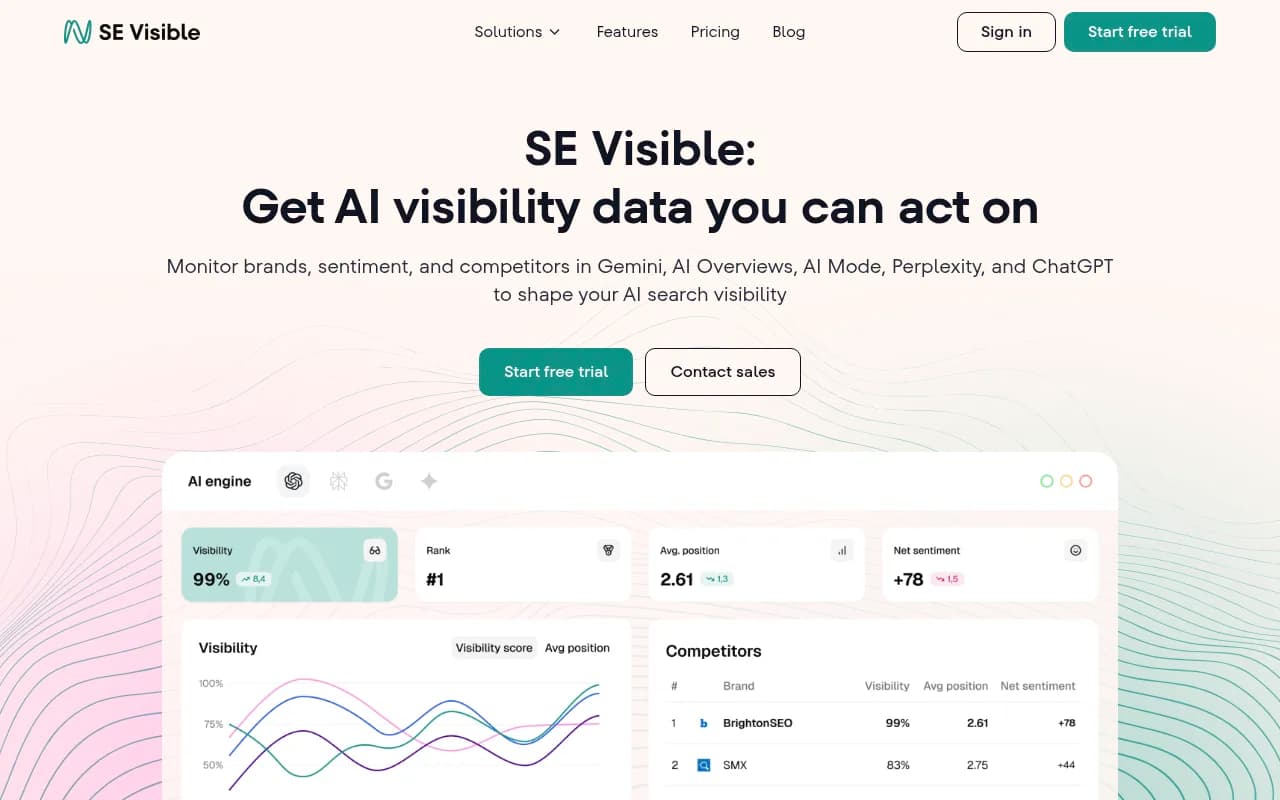
| SE Visible | Brand visibility and sentiment across AI search | From SE Ranking |
| Semrush | AI sentiment insights inside its AI Visibility Toolkit | Fits teams already living in Semrush |
| Similarweb | Sentiment analysis in its AI brand visibility tool | Strong if you already use it for market data |
| LLMClicks | Visibility tracking with hallucination detection | Useful for the accuracy problem |
I have not tested each of these side by side, so check pricing and current features on their own sites before committing.
Week 3: trace the sources
For each negative or wrong claim, find where it came from. Check the citations in the answer. Ask the model a follow-up: "what source says that?" Then sort sources into buckets:
- Your own pages (outdated pricing page, old blog post, a help doc describing a removed limitation)
- Review sites (G2, Capterra, Trustpilot)
- Third-party articles (listicles, comparisons, press)
- Community and social (Reddit threads, YouTube reviews, LinkedIn posts)
The split tells you what to do. If most of the damage comes from your own pages, you can fix it this month. If it comes from a competitor's comparison page, you need a different approach.
Also check whether AI crawlers can read your site at all. If they cannot reach your updated pages, they keep leaning on older third-party descriptions. Promptwatch's AI crawler logs show which bots hit which pages and where they fail, and the free Agentic Readiness Check gives a quick look at robots.txt and crawler access.
Week 4: set the baseline
Pick three numbers and record them:
- Share of answers where the negative claim appears
- Average position and tone in comparison prompts
- Share of citations that point at your own domain
Write them down with the date. In 90 days these are the only things that will tell you whether anything worked.
Days 31-60: fix and publish
Fix your own pages first
This is the cheapest win. Go through every page that states a claim you flagged as wrong or outdated. Update it, date it, and make the correction explicit. If a limitation was removed in a release, say so in plain words: "As of the March release, X is supported."
Then make the core pages answer the questions branded prompts ask. Promptwatch's data advice for branded prompts is to make the homepage, product pages and docs answer questions about pricing, features and who the product is for. Models quote what is easy to quote. A clear pricing table beats a "contact us" wall every time, because the model otherwise fills the gap with whatever a review site said.
Add a plain-language FAQ about your brand
FAQ pages are 4.8% of branded citations against 3.3% overall. Write one that addresses the exact uncomfortable questions from your audit: "Is [brand] expensive?", "Does [brand] work for small teams?", "What are the limitations?" Answer them honestly. A page that admits a real weakness and explains the context reads as credible, and models tend to reuse that framing rather than a competitor's harsher one.
Publish evidence, not adjectives
Saying you are trusted does nothing. What gets quoted is specific proof: case studies with numbers, benchmark data, customer counts, certifications, named customers. If AI keeps calling you "limited in scope", publish a page that lists exactly what you cover, with examples.
For teams who need volume here, content tools can speed up the drafting. Surfer SEO and Clearscope help with on-page optimization, and Promptwatch's Content Agent can plan, write and publish pages against the gaps it finds in prompts, with a review inbox so a human approves before anything goes live. Whatever you use, keep a person on the facts. Generic AI copy will not shift a narrative.

Fix the review layer
Reviews carry more weight on branded prompts than their raw share suggests. Do three things:
- Ask recently happy customers for detailed reviews on the sites your category uses. Detail matters because the model quotes specifics.
- Reply to old negative reviews, especially ones describing problems you solved. A dated reply saying "fixed in version 4" gives a model something to find.
- Claim and complete your profiles on G2, Capterra, Trustpilot or whatever dominates your niche.
Trustpilot and review-management platforms like Birdeye or Reputation.com can handle the collection side if you do not want to run it manually.
Days 61-90: distribute and measure
Go after third-party sources
Your own pages only cover part of the picture. For the third-party pages that drive negative framing, you have a few legitimate options:
- Contact the author of an outdated comparison or roundup with updated facts. Many will edit. Some will not answer. Move on.
- Pursue inclusion in "best of" lists that AI already cites in your category. Promptwatch's advice for commercial prompts is to get into those roundups and publish your own comparison pages, since comparisons and listicles together make up a large share of commercial citations.
- Offer data or expert quotes to publications that AI cites. Digital PR works here as it does in classic SEO.
Avoid fake reviews, astroturfed Reddit accounts and paid placements dressed up as editorial. They get caught, and a negative story about manipulation is much harder to fix than a mediocre review.
Pick channels by engine
The social data suggests where to spend effort:
| Engine | Where social influence is strongest | Priority |
|---|---|---|
| Google AI Overviews | YouTube (6.71%), Facebook, Reddit | Video reviews, demos, creator relationships |
| Perplexity | Reddit (0.82%), LinkedIn (0.66%) | Honest community presence, LinkedIn thought leadership |
| ChatGPT | Very little social, 0.64% overall | Own site, reviews, third-party articles |
These figures come from a 30-day window and the shares are small outside AI Overviews, so treat them as direction rather than precision.
Watch content half-life
Not all content stays cited. Promptwatch's half-life study tracked pages ChatGPT cited on July 6, 2026 for 90 days: landing pages and docs stayed cited longest, while news lost half its pages within 36 days. Practical meaning: a press release or news mention will not fix a narrative for long. Evergreen landing pages, docs and a maintained FAQ will.
Re-run and compare
At day 90, re-run the full prompt set and compare against your day 30 baseline. Look at:
- Did the specific negative claims drop in frequency?
- Did your own domain's share of citations rise?
- Did position and tone in comparison prompts improve?
- Did the engines that rely on retrieval move faster than those leaning on training data?
This is also where a tracking platform pays for itself. Promptwatch tracks sentiment per response by prompt, topic and competitor, with trends over time, and can follow a published page from crawl to citation to AI-referred visit, so you can tell whether a fix was read at all. It runs prompts daily on every plan, with a 7-day free trial on monthly billing at promptwatch.com/pricing. If you want a no-commitment look first, the free AI visibility report scans how ChatGPT, Gemini and Perplexity talk about your brand.
A realistic timeline
| Window | What you can expect |
|---|---|
| Weeks 1-4 | Baseline and a clear list of claims and sources. No change yet. |
| Weeks 5-8 | Corrections on your own pages get picked up by retrieval-based engines. Wrong claims start to fade first. |
| Weeks 9-12 | New reviews, FAQ and evidence pages start appearing in citations. Comparison framing shifts slowly. |
| After day 90 | Training-data impressions lag. Keep publishing and measuring monthly. |
I would be wary of anyone promising a sentiment turnaround in 30 days. Sometimes a single bad source gets removed and the tone flips overnight. More often it is a slow grind of replacing weak evidence with strong evidence.
Common mistakes
- Chasing one sentiment score and ignoring the claims behind it.
- Fixing the website but leaving the Trustpilot profile with unanswered one-star reviews.
- Treating all engines the same. ChatGPT, AI Overviews and Perplexity cite different mixes of sources.
- Writing defensive content. A page titled "Why people are wrong about us" reads badly to humans and models alike.
- Never rechecking. Models update, citations shift, and a claim you fixed can come back.
Where an agency fits
If you do not have the people to run this, an agency can take the audit, content and outreach work. 1001 SEO Media does this as part of its AI search and digital PR services, and uses Promptwatch for the measurement side. Plenty of teams run the whole plan in-house with two people and a good tracker, so it is a capacity question, not a necessity.
Your first week, concretely
Pick 30 buyer prompts, run them across four engines, and list every negative or wrong claim with its source. Do that before touching a single page. Everything in the next 80 days depends on knowing which three claims are costing you the most.