Key takeaways
- ChatGPT only attaches shopping features to a low single-digit share of web-search responses, so one-off snapshots mislead. Pick a tool that tracks daily and over time.
- GetMint covers many shopping surfaces (Alexa for Shopping, ChatGPT Shopping, AI Mode, Copilot, Perplexity). The alternatives below differ mostly on price, depth in ChatGPT Shopping, and whether they help you fix things.
- Product-level tracking (SKU, price shown, which retailer wins the card) matters more than brand-level mention counts for ecommerce.
- Promptwatch is the strongest pick if you want shopping tracking, crawler logs, AI traffic attribution, and content creation in one loop. Profound and Evertune suit enterprise budgets, Peec AI and Ranketta suit smaller teams.
- Whatever you choose, fix your product feed, schema markup, and price accuracy first. No tool compensates for bad product data.
Why ecommerce brands look beyond GetMint
GetMint is a reasonable product. Its AI Shopping module follows Alexa for Shopping, ChatGPT Shopping, Google AI Mode, AI Overviews, Copilot and Perplexity, and it turns losing prompt clusters into Content Studio briefs. If you sell mostly on Amazon and want multi-surface coverage, it deserves a look.
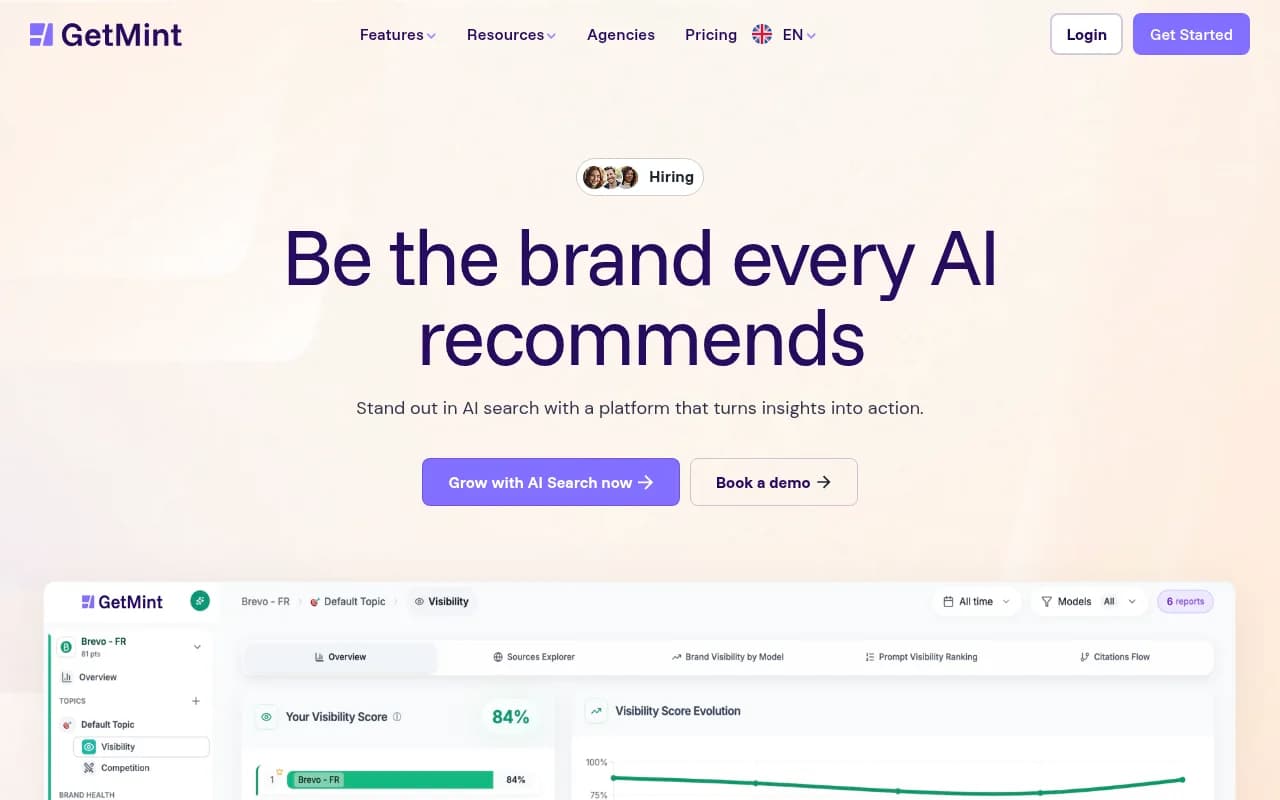
Still, teams end up shopping around for a few predictable reasons. They want deeper ChatGPT Shopping tracking, they want to see whether AI crawlers can even read their product pages, they need AI-referred revenue attribution, or the pricing and plan limits do not fit a large catalog. And honestly, a GetMint comparison page that ranks GetMint first (as its own blog does) is not a neutral source. So here is a more independent look.
How ChatGPT Shopping actually behaves
Before picking a tool, understand what you are measuring. Promptwatch's ChatGPT Shopping usage data shows that ChatGPT attaches shopping features (product cards, recommendations, price comparisons) to only a low single-digit percentage of web-search responses across all prompt types. On commercial and transactional prompts the trigger rate is far higher.
Two details matter for how you monitor:
- The rate moves in steps, not smoothly. In the window Promptwatch charted, it roughly doubled overnight in late May, then fell back weeks later. That looks like OpenAI tuning when cards appear.
- Shopping features can only appear when ChatGPT runs a web search, so the metric only counts responses with citations.
The practical lesson: a single prompt run tells you almost nothing. You need daily tracking, a prompt set weighted toward buying intent, and a record of which brands fill the cards when they do appear.
Ads add another wrinkle. Promptwatch Data on ChatGPT ads shows ads in an average of 20.1% of web-search responses between May 20 and August 17, 2026, with the past 7 days averaging 32.4% and a daily peak of 43.9%. If you sell products, the competitor sitting in that ad slot on your prompts matters as much as the organic card.
Product pages are also the most cited content type in ChatGPT, at 22.4% of citations from Sep 28 to Oct 4, 2026, according to Promptwatch's content type report. Your PDPs are the asset. Treat them that way.
What to look for in an ecommerce AI visibility tool
Skip the generic brand-mention scorecards. For a store, the useful questions are narrower:
- Does it track at the product or SKU level, not just brand level?
- Does it record the price the AI displays, and whether it matches yours?
- Does it show which retailer or merchant gets the checkout link?
- Does it track ads in AI answers on your prompts?
- Can it tell you whether AI crawlers reach your product pages at all?
- Does it connect visibility to traffic and conversions?
- Does it help you fix product data and content, or only report?
One more thing from the research: for ChatGPT, you most likely need a product feed to appear in shopping results. Check that before paying for any dashboard.
Comparison table
Pricing below is only what I can state with confidence. Verify everything on each vendor's site before buying.
| Tool | Shopping coverage | Product-level detail | Beyond tracking | Best for |
|---|---|---|---|---|
| Promptwatch | ChatGPT Shopping, Amazon Alexa products, Ads Radar, plus all major AI engines | Shopping cards, competitor alerts, uploaded catalog performance | Crawler logs, AI traffic attribution, Content Agent, Action Board | Brands that want to track and fix in one place |
| GetMint | Alexa for Shopping, ChatGPT Shopping, AI Mode, AI Overviews, Copilot, Perplexity | Product and prompt sets, retailer view | Content Studio briefs | Multi-surface, Amazon-heavy sellers |
| Profound | ChatGPT Shopping cards plus mentions across engines | SKU-level visibility, attribute accuracy, sentiment, checkout merchant | Agents that draft PDP fixes, crawler analytics | Enterprise budgets |
| Peec AI | ChatGPT Shopping | Daily SKU visibility, displayed price, gainers and losers | Prioritized actions, CSV/API/MCP export | Lean tracking teams |
| AthenaHQ | ChatGPT, Perplexity, Google AI | Product, category and brand level, category share of voice | Shopify catalog optimization, Action Center | Shopify merchants |
| Evertune | ChatGPT | Recommended products, price vs competitors | Content Studio, affiliate publisher lists | Large enterprise brands |
| Ranketta | ChatGPT shopping | Per-product tracking, citations | Feed and merchandising agent with confidence scores | Small teams on a budget |
The alternatives
Promptwatch
Promptwatch is the one I would put first for most ecommerce brands, and the reason is the loop rather than any single chart. Plenty of tools will tell you a competitor's blender fills the shopping card instead of yours. Promptwatch also shows the surrounding evidence and then helps you act on it.

On the shopping side, ChatGPT Shopping tracking covers which products ChatGPT recommends, which competitors it picks instead, and how your own uploaded catalog performs, filterable by model, date range, and monitor. It also covers Amazon Alexa product results. Ads Radar shows which advertisers bid on your prompts, their ad copy, and their landing pages. Both Shopping and Ads Radar start on the Business plan ($579/mo), so factor that in if you are comparing against cheaper trackers.
What separates it from a pure shopping tracker:
- AI crawler logs show, with IP-verified data, whether GPTBot, OAI-SearchBot, ChatGPT-User and others actually read your product pages and where they hit errors. If a PDP never gets crawled, no amount of copy tweaking helps.
- Visitor analytics attribute AI-referred traffic and conversions. This matters more now that ChatGPT stopped sending a referrer on October 8, 2026; an optional setting counts visits tagged utm_source=chatgpt.com as ChatGPT traffic.
- The Content Agent plans, writes, and publishes pages against your visibility gaps and pushes them to WordPress, Webflow, or Framer. Page Tracker then follows each page through crawls, citations, and clicks.
- Real-UI data rather than API outputs, which matters because shopping cards only show up in the actual interface.
- Local GEO/SEO targeting at exact coordinates, useful for "near me" product queries from store-based retailers.
It is used by 1,840+ brands and agencies, rated 4.7/5 on G2, and ISO/IEC 27001 certified. Crisp saw 2x higher conversion rates from AI traffic than from traditional channels (case study). TreeHouse grew AI search to roughly 25% of organic conversions by fixing crawler access and publishing proprietary data (case study). Those are not shopping-card stories exactly, but they show the measure-and-fix loop working.
Pricing starts at $95/mo (Essential), $245/mo (Professional), $579/mo (Business); confirm on promptwatch.com/pricing. There is a 7-day free trial on monthly billing, and a free AI visibility report if you want a quick look first. For a head-to-head with this comparison's subject, see Promptwatch vs GetMint.
Profound
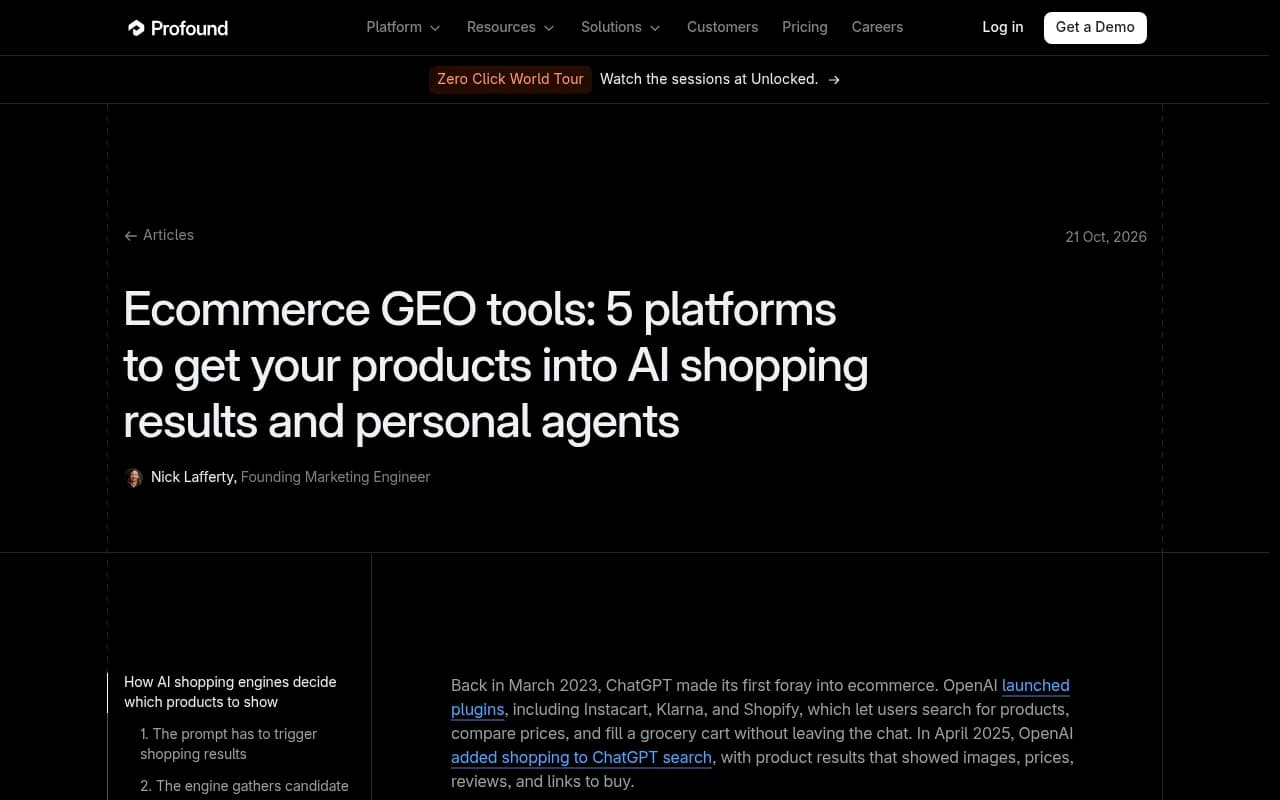
Profound is the enterprise name most people mention for ChatGPT Shopping depth. Per its own article on ecommerce GEO tools, it tracks product cards in ChatGPT Shopping, SKU-level visibility, whether the engine gets your product attributes right, description sentiment, and which merchants control the checkout link. It also has agents that draft PDP fixes and an analytics layer for AI crawler visits and AI-referred conversions.
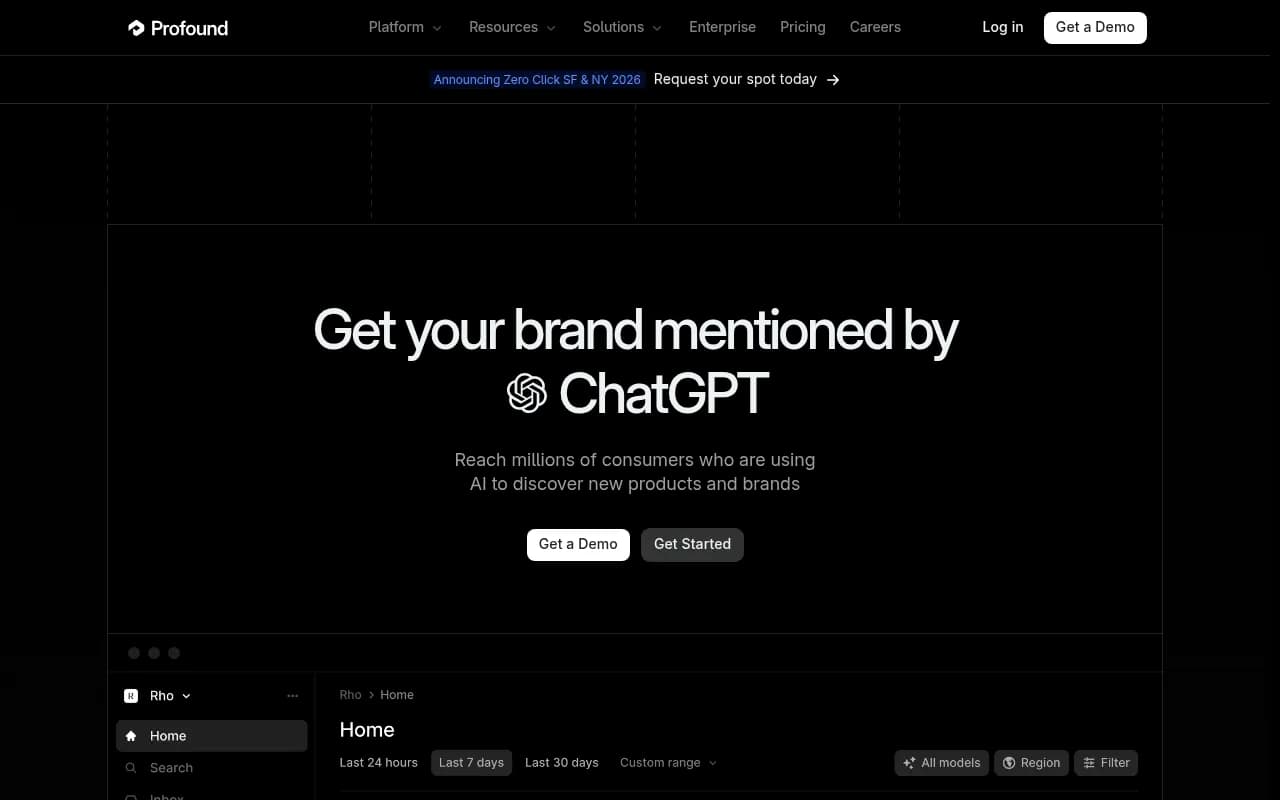
The trade-offs: higher price points, and no Reddit tracking or Shopping-style Ads Radar equivalent. If you are a large retailer with a team to run it, it is a serious option. For comparison, see Promptwatch vs Profound.
Peec AI
Peec AI tracks ChatGPT Shopping with daily SKU-level visibility and trend, the price the engine displays, and ranked gainers and losers. It also shows which retailers AI recommends most in your category and exports through CSV, Looker Studio, API, and MCP.

It is a clean tracker. What it lacks is crawler logs, visitor analytics, and content generation, so you will need other tools to act on what it finds. See Promptwatch vs Peec.
AthenaHQ
AthenaHQ reports recommendations at the product, category, and brand level, plus category share of voice, across your own site, Amazon, and other marketplaces. The Shopify catalog optimization is the draw for Shopify merchants, along with an Action Center and the Ask Athena copilot.

Note the catalog lists a separate tool with a similar name (athenago.com, an executive assistant service). Make sure you are looking at athenahq.ai.
Evertune
Evertune focuses on ChatGPT: which of your products it recommends, how often your category triggers shopping results, and your prices against competitors' as AI describes them. Content Studio blog posts and publisher lists sent to impact.com for affiliate campaigns are the unusual extras.
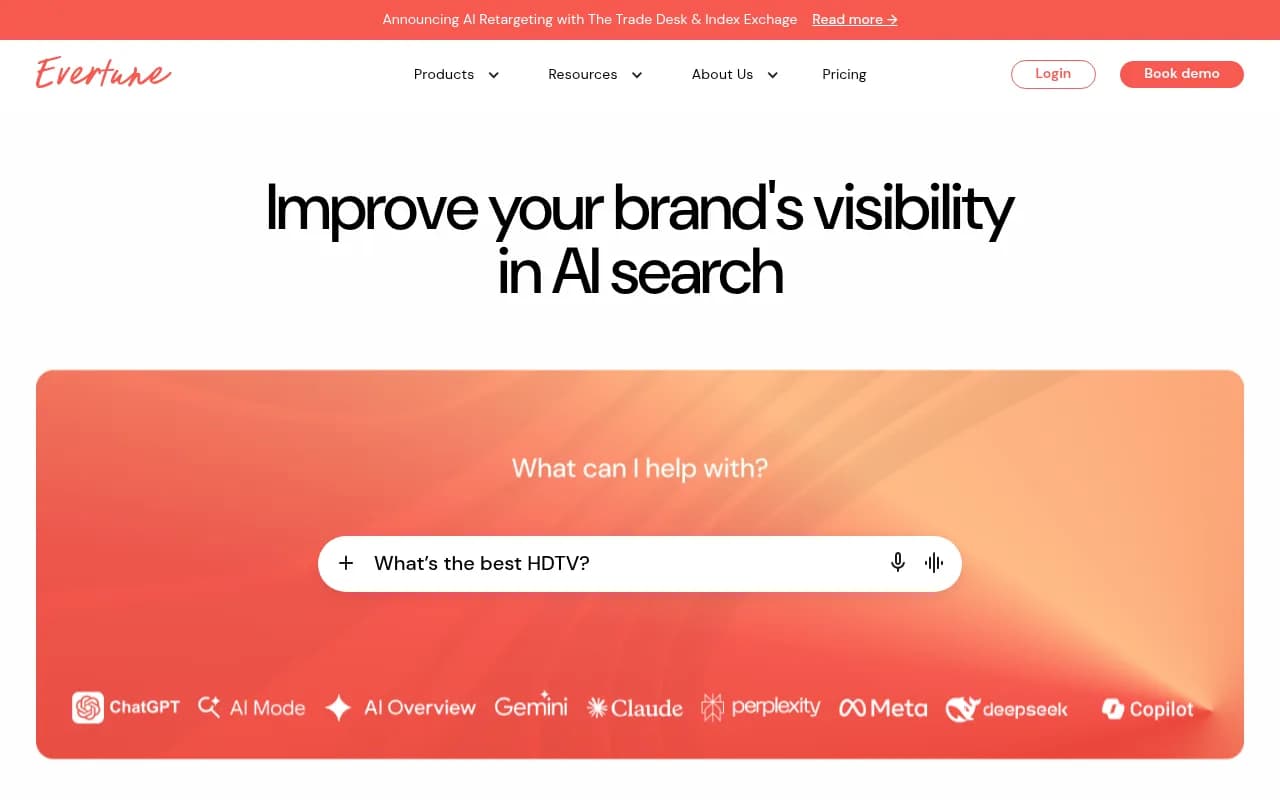
Enterprise-oriented, and ChatGPT-only in the coverage described, so check whether that fits where your shoppers are.
Ranketta
Ranketta pitches product-level tracking, an agent that rewrites titles, descriptions, and attributes (each fix carries a confidence score), and citation tracking for the domains AI cites in your category. It also has AI traffic attribution. I could not verify pricing, but its positioning is small teams.
It is not in our tools catalog, so no card here. Visit ranketta.com to evaluate it.
Goodie
Goodie sits in the Amazon-first camp alongside Stackline, per GetMint's own comparison. Described in the catalog as AI visibility with shopping assistant coverage, it is worth a look if most of your revenue runs through Amazon.
Which one fits your situation
| If you... | Consider |
|---|---|
| Want tracking, crawler diagnostics, attribution, and content creation in one platform | Promptwatch |
| Run an enterprise catalog and want agent-drafted PDP fixes | Profound |
| Only need a lean ChatGPT Shopping tracker | Peec AI |
| Sell on Shopify and want catalog optimization | AthenaHQ |
| Sell mostly on Amazon | Goodie, GetMint |
| Have a small team and tight budget | Ranketta, Peec AI |
Where you sell matters more than any feature list. Amazon-first brands and open-web brands need different things, and the tools lean one way or the other.
A practical setup, whichever tool you pick
1. Fix the foundation first
Complete Product schema markup, accurate prices and availability, and a clean merchant feed. Promptwatch's own shopping data recommends exactly this. If AI describes your product with the wrong price, the problem is usually upstream of any dashboard.
2. Build a prompt set around buying intent
Track commercial and transactional prompts your buyers actually use, not just brand queries. Mix in comparison prompts ("best X for Y under $Z") and category prompts. Query fan-outs help here: Promptwatch's fan-out data shows how many web searches ChatGPT triggers per response, and those sub-searches are what your product pages are really competing for. The free ChatGPT query fan-out generator is a cheap way to preview them.
3. Check crawler access
Before you rewrite a single description, confirm AI bots can read the page. The free Agentic Readiness Check and AI crawler URL inspector cover the basics. Crawler logs tell you the rest.
4. Track daily and watch for step changes
Because OpenAI tunes when cards appear, treat a sudden jump or drop in your category as a signal that a window opened or closed. Do not rewrite your catalog in response to one day of data.
5. Watch the ad slot and the citations
Note which advertisers win placements on your prompts, and which domains ChatGPT cites for your category. Retailers and marketplaces often outrank brands. Promptwatch's automotive data, for instance, shows Autotrader and Cars.com outranking every car brand in ChatGPT citations. Expect similar dynamics in many retail categories, and consider whether getting listed on those marketplaces is part of your plan.
What the research screenshots show
Profound's roundup is the most useful third-party reference for the product-level feature comparison, though keep in mind it is a vendor article:
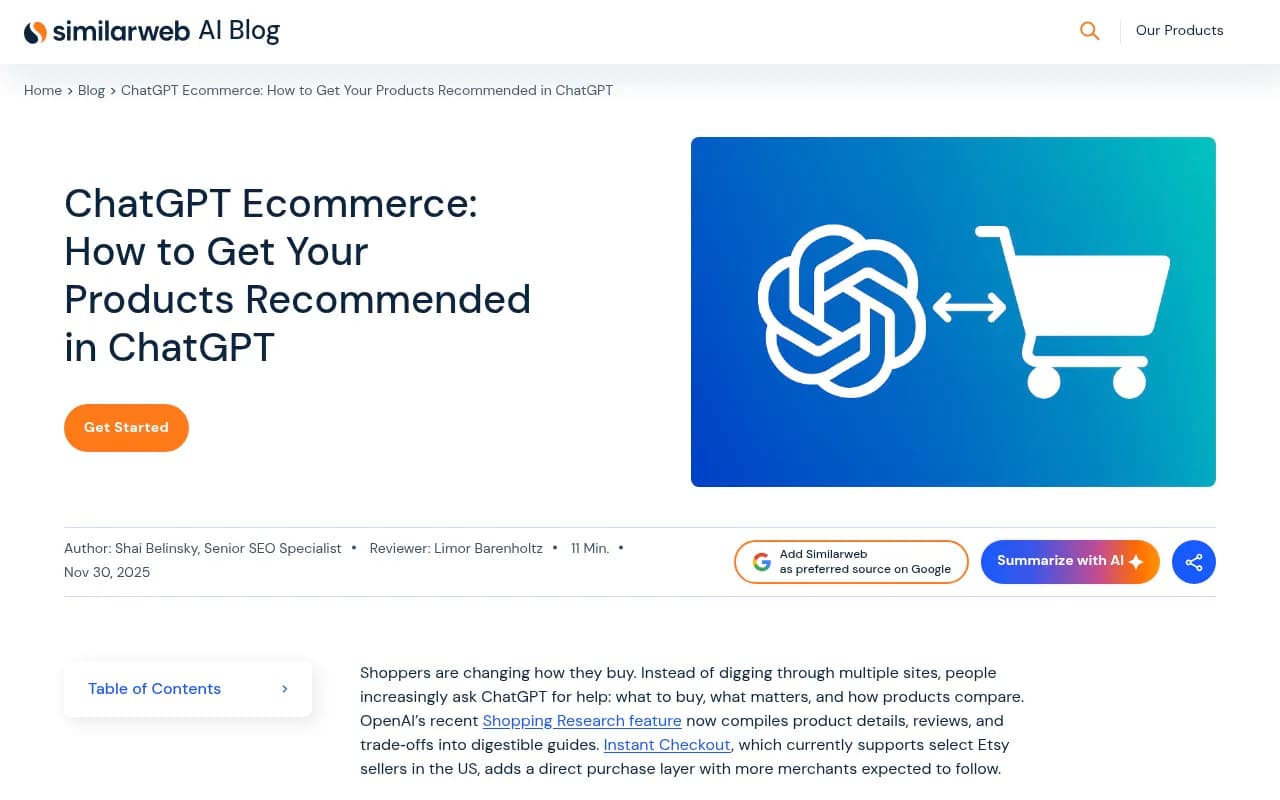
Similarweb's guide is a decent explainer on how ChatGPT's shopping research and instant checkout features affect everyday product recommendations too:
Where to look next
If you want to widen the shortlist beyond these seven, the GEO software directory at bestgeosoftware.com lists far more platforms, and Promptwatch's 2026 platform comparison goes through the major ones feature by feature.
Bottom line
GetMint is fine for multi-surface shopping tracking, especially if Amazon matters. But if your priority is ChatGPT Shopping and you want to go from "competitor fills the card" to "fixed page, crawled, cited, converting" without stitching three tools together, Promptwatch is the better fit. Profound and Evertune make sense at enterprise scale. Peec AI and Ranketta are the lean options. Start with a trial, run your top 50 buying-intent prompts for a couple of weeks, and judge each tool by whether it tells you what to fix, not by how good the chart looks.