Key takeaways
- In Promptwatch's cohort of pages ChatGPT cited on July 6, 2026, news is the only type with a clear 36-day half-life. Landing pages, docs, comparisons, and listicles likely last 90 days or more.
- Product pages, reviews, and how-to guides reach their half-life after 74 to 77 days. Product pages decay faster than most people expect.
- Profound's 11-day figure and Promptwatch's 74-plus-day figures are not in conflict. They measure different things: share of citations falling from a peak versus whether a page is ever cited again.
- Treat landing pages, docs, and comparisons as long-term assets. Use news and press for short bursts.
- Different engines decay differently, so one number never describes all of AI search.
The question behind the title
If ChatGPT cites your page today, how long until it stops? Everyone in GEO has heard some version of "citations last about four weeks." The number gets repeated a lot. It also depends heavily on what you count and which content type you are talking about.
The title of this guide mentions 36 days. I want to be precise about where that comes from: it is the news figure in Promptwatch's data. Other content types last a lot longer. Mixing that up is the most common mistake I see when people quote this research.

How the Promptwatch half-life study works
Promptwatch Data's report on content half-life in ChatGPT, published October 5, 2026, takes a simple approach. It collects every classified page ChatGPT cited on July 6, 2026 (day 0), then follows those pages through October 4, 2026, roughly 90 days.
For each content type, the line shows the share of day-0 pages that ChatGPT still cited on that day or later. A content type reaches its half-life where the line crosses 50%.
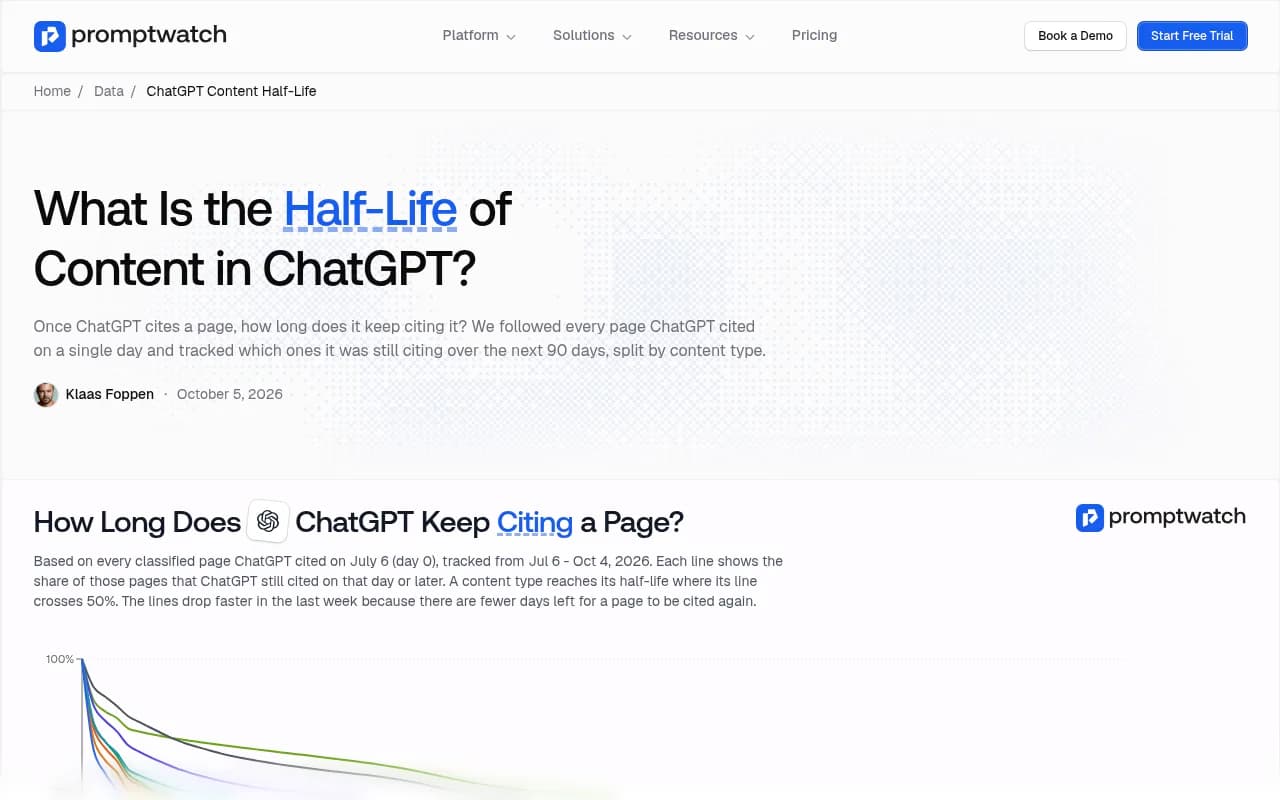
Two caveats before you read the numbers:
- It is a single cohort, the pages cited on July 6, not an average across many start dates.
- Lines drop faster in the last week because the window ends and pages have fewer days left to be cited again. Types that only cross 50% in that final week probably have a true half-life near or beyond 90 days.
Results by content type
| Content type | Still cited after 30 days | Still cited after 60 days | Half-life |
|---|---|---|---|
| Landing pages | 78% | 69% | Likely 90+ days |
| Docs | 76% | 67% | Likely 90+ days |
| Comparisons | 72% | 63% | Likely 90+ days |
| Listicles | n/a | 60% | Likely 90+ days |
| Product pages | n/a | about 55% | 74 to 77 days |
| Reviews | n/a | about 55% | 74 to 77 days |
| How-to guides | n/a | about 55% | 74 to 77 days |
| News | n/a | 41% | About 36 days |
Some details worth pulling out:
- Docs have the smallest drop right after day 0. ChatGPT cited 93% of them again later, against 77% of news pages.
- Almost a quarter of news pages are never cited again after day 0. Gone after a single appearance.
- Pricing pages are not their own category in the report. They are classified as landing or product pages, so read that as a hint rather than a measurement.
Why news falls so fast
News is tied to a moment. Once the moment passes, ChatGPT has fresher articles to pull from, and the old one has no reason to be retrieved. Nothing about the page got worse. The question it answered just stopped being asked.
That matches what Promptwatch's half-life data says about publishing strategy: use news and press coverage for short bursts of visibility, not as the foundation.
Product pages are the surprise
I expected product pages to behave like landing pages. They don't. After 60 days only about 55% are still cited, level with reviews and how-tos. That is awkward, because product pages are also the most cited content type in ChatGPT, at 22.4% of citations in the week of Sep 28 to Oct 4, 2026. Big share, middling staying power. Specs, availability, and prices change, and a stale product page is a weaker candidate to keep citing.
Why Profound says 11 days and Promptwatch says 74
Profound published a study on September 30, 2026 titled "The half-life of an AI citation is 11 days." It covered 883,000 pages across seven engines over twelve months. If you read both reports quickly, they look like they disagree. They don't.
The two reports answer different questions:
- Promptwatch measures survival: does ChatGPT ever cite this page again on or after a given day?
- Profound measures citation share decay: how fast does a page's share of citations fall to half of its own peak, and stay there?
A page can keep getting an occasional citation for months while its share collapses within two weeks of a spike. Both can be true at once. Survival is a generous metric. Share decay is a harsh one.
What Profound found
Profound's headline numbers are useful context:
- The median page loses half its citation share within 11 days of peaking.
- 78% of cited pages fall to half their peak within two weeks. The remaining 22% have a median half-life of 27 to 29 days.
- Pages cited by five or more engines are 5.5 times as likely as single-engine pages to still be above half their peak after eight weeks.
- Cross-engine correlations of decay timing run between 0.03 and 0.09. When a page fades on one engine tells you almost nothing about another.
Profound also grouped content into families:
| Content family | Includes | Median half-life | Above half-peak at day 56 |
|---|---|---|---|
| Choose | Comparisons, listicles, reviews | 29 days | 11.2% |
| Explain | Explainers, how-tos, docs, reference | 28 days | 10.2% |
| Sell | Product, pricing, company pages | 28 days | 9.8% |
| Report | News, announcements, research | 27 days | 7.0% |
The ordering agrees with Promptwatch on the main point: reporting content fades first. The other three families hold at 1.4 to 1.6 times its rate. The absolute gaps between families are small in Profound's data, though, so I would not over-read the ranking among the top three.
Other numbers floating around
There is no single half-life, and the research reflects that.
A literature roundup at info.link compares six datasets and finds half-lives from under one day to more than 17 weeks. Examples from it:
- GetMentions reran 2,398 identical queries daily for seven days. About 69% of a typical answer's cited domains changed overnight.
- SISTRIX resampled 82,619 prompts weekly for 17 weeks. Google AI Mode replaced 56% of cited domains each week and ChatGPT Search 74%.
- In the same SISTRIX data, a brand's own domain stayed cited all 17 weeks for 43% of brand queries.
Similarweb gives platform-level half-lives of 3.4 weeks for ChatGPT, 4.7 for AI Overviews, 4.6 for Gemini, and 5.8 for Perplexity. Treat these as one vendor's method, not a standard. The takeaway across all of them: the individual citation rotates, but a core of recurring sources sticks around.
What this means for your content plan
Build long-lived assets first
Landing pages, docs, and comparisons are the sturdy ones in Promptwatch's cohort. ChatGPT kept citing most of them for months. Keep prices, features, and positioning accurate, because a page that survives only helps if what it says is true.
Maintain product pages on a schedule
Assume product pages need upkeep. Check specs, availability, and prices regularly. A quarterly refresh is a reasonable floor, and faster if your catalog moves quickly.
Put real effort into comparisons and listicles
Both keep more than 60% of their citations after two months in Promptwatch's data. They also sit in Profound's "Choose" family, the longest-lived group there. If you only have budget for a few new pages, these are good bets.
Treat news as a spike, not an asset
Press releases and announcements are fine for a burst. Just don't count on them for steady visibility. Half of news pages are gone from ChatGPT's citations within about five weeks.
Don't rely on one engine
Profound found that decay timing barely correlates across engines. A page that fades in ChatGPT may hold in Claude, where a citation was 2.8 times as likely as in ChatGPT to still be relevant eight weeks later among pages that last beyond two weeks. Being cited broadly predicts lasting anywhere.
How to measure decay on your own pages
You can do a rough version yourself without waiting for a research report:
- Pick a set of pages that ChatGPT cited on a given date.
- Re-check which of them it still cites at 7, 30, and 60 days.
- Split the results by content type, as the reports do.
- Separately, look at whether AI crawlers are even reaching the page. A citation drop can be an access problem rather than a content problem.
Tools that track citations at the page level make this far less manual. Promptwatch's Page Tracker shows which prompts and responses cite a given URL, and its AI crawler logs separate a crawl failure from a content gap. Other options in the same space include Profound and Similarweb, which both publish decay-focused views.
If you are comparing platforms, the GEO software directory at bestgeosoftware.com lists more of them.
Quick reference: which content type for which goal
| Goal | Best content type | Why |
|---|---|---|
| Durable citations | Landing pages, docs | 76 to 78% still cited at 30 days |
| Competitive queries | Comparisons, listicles | 60%+ still cited at 60 days |
| Commercial queries | Product pages | Most cited type, but needs upkeep |
| Launch visibility | News, press | Fast burst, half gone in 36 days |
Limits of the data
Be honest about what these studies can and cannot say. Promptwatch's is one cohort from one day, and the longest-lived types are cut off by the 90-day window. Profound's covers seven engines but measures share decay, not survival. Third-party numbers vary by method, and one roundup rates the "four-week half-life" claim as overstated. Use the figures as direction, not as a schedule to the day.
The practical conclusion holds anyway. Put your durable effort into landing pages, docs, comparisons, and listicles, keep product pages current, and use news for spikes only.