Key takeaways
- A blended visibility score averages every buyer together, which can hide the segment where a competitor is winning.
- Persona stacking wraps a short buyer profile (role, situation, constraints, priorities) around each tracked prompt, so the AI engine answers as if that person asked.
- To measure it, run the same prompt set once per persona and compare visibility, share of voice, position, and citations between runs.
- A persona only matters if it changes the answer. Write it around constraints and priorities, not job titles alone.
- Persona tracking does not replicate one user's chat memory. It gives you a consistent, comparable view of how engines treat each buyer type.
Why one visibility number is not enough
Most AI visibility tracking runs prompts as an anonymous user. You get one number per prompt, averaged across models and runs. That answers "how visible are we in general?" A revenue team asks something narrower: visible to whom?
In B2B, the people researching a purchase rarely want the same thing. The engineer checks API limits, SOC 2, and migration effort. The department head checks seat pricing and time-to-value. The CFO checks total cost of ownership and whether the vendor will still exist in three years. Ask the same question, "what's the best tool for X," and the engine can weigh different criteria, run different searches, and name different brands.
A blended score flattens all of that. If you lead with technical evaluators and trail badly with budget owners, the average can look healthy while the person who approves the spend never hears your name.
The stakes go up because more of the journey now happens inside one chat, from discovery to decision. If research and the decision share a conversation, the persona in that conversation decides who makes the shortlist.
What persona prompting actually is
There are two different things people call "persona prompting," and mixing them up causes confusion.
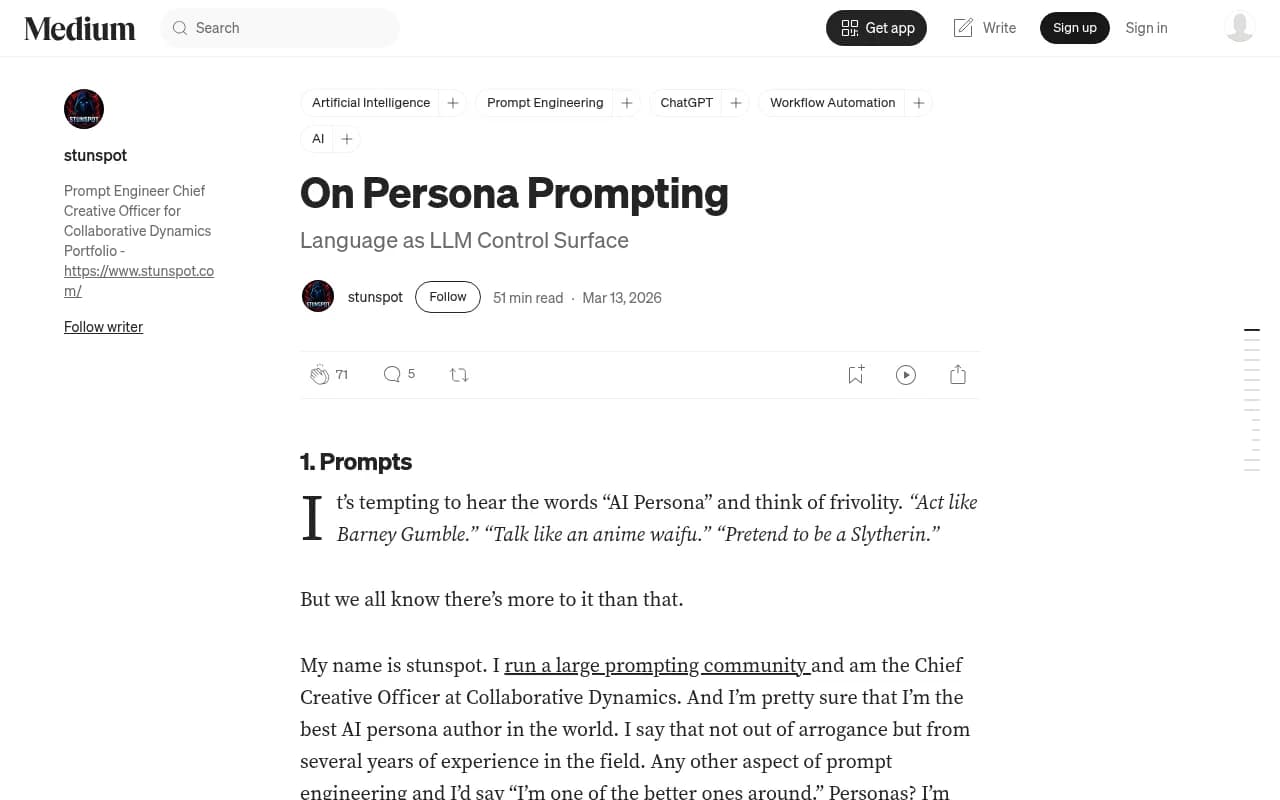
The first is the prompt-engineering technique: you tell a model to act as a senior marketer named Bob, and it shifts its tone and focus. stunspot's long write-up on persona prompting is a good read on this. His core idea is that a persona prompt tells the model how to behave in general rather than what to do next, and that it narrows the model toward a particular set of competencies.
The second is what this guide is about: using personas as a measurement lens. You are not trying to get better output from the model. You are trying to see what the model says to a specific kind of buyer, so you can find where you are missing.
The mechanics overlap, though. Both rely on the fact that context about the asker changes the response. One useful detail from the prompting side: the more specific and concrete the persona, the more it steers the answer. Vague personas ("you are an expert") get ignored. That applies to tracking too.
What persona stacking is
Persona stacking adds a short buyer profile around each tracked prompt at run time. The prompt set stays identical across personas. Only the wrapper changes. Because the prompts are the same, any difference in the answers comes from the persona, not from different wording.
In practice that means:
- You define a set of tracked prompts ("best CRM for a 50-person SaaS company").
- You define personas (technical evaluator, department head, economic buyer).
- Each prompt runs once per persona, and every response is tagged with the persona that asked it.
- You compare metrics by persona instead of looking at one blended number.
Semrush Enterprise's AIO product takes a related but different route: it generates prompts tailored to audience motivations, budget profiles, and experience levels, and tracks those. Promptwatch does the stacking approach, where one prompt set is wrapped by each persona and the responses are tagged, so a score change traces back to a specific buyer.

Persona stacking vs ChatGPT memory and personalization
A fair objection: real ChatGPT users have memory, history, and custom instructions. Doesn't that make any tracking meaningless?
There are two ways to deal with it. The first is tracking from clean, logged-out sessions so no single account's history skews the data. Promptwatch does this by collecting from the real ChatGPT, Gemini, Perplexity, and Google AI interfaces through location-matched sessions. The second is layering the persona on top of that clean baseline. You get the stable baseline plus the role-specific answer a real buyer would plausibly get.
Be honest about the limit. This does not replicate a specific person's months of accumulated memory, and no tracking tool can. What you get is a consistent, comparable view of how the engine treats each buyer type. That is enough to find gaps.
Four B2B personas that tend to get different answers
These are starting points. Your own buyer research should replace them as soon as you have it.
| Persona | What they ask AI | What the engine weighs | Content that tends to earn the citation |
|---|---|---|---|
| Technical evaluator | API rate limits, SOC 2, self-hosting, migration effort | Documentation depth, integration specifics, security proof | Docs, API references, security pages, GitHub |
| Department head | Pricing tiers, seat limits, time-to-value | Clear pricing, onboarding speed, peer adoption | Pricing pages, comparison pages, case studies |
| Economic buyer | Total cost of ownership, vendor stability, acquisition risk | Funding, customer base, contract terms | Funding news, analyst coverage, review sites |
| First-time evaluator | Basic category questions ("what is X," "do I need X") | Category leaders and plain explanations | Explainers, glossaries, listicles |
Notice that each row points at a different kind of page. That is the real payoff. Persona results do not just tell you that you are missing, they tell you which content type is missing for which buyer.
How to write a persona that changes the answer
Most first-draft personas fail the same way: they are a job title and nothing else. "Marketing manager" gives the engine almost nothing to react to. If two personas produce near-identical answers, the persona was too thin.
A useful persona has four parts:
- Role: who they are and their level of seniority.
- Situation: company size, stack, what triggered the search.
- Constraints: budget ceiling, compliance requirements, team size, timeline.
- Priorities: what they will trade off and what they will not.
Here is a thin persona next to a useful one.
Thin:
You are a marketing manager.

Useful:
I'm head of demand gen at a 120-person B2B SaaS company. We have a
fixed budget of about $30k a year for this, no dedicated engineer,
and I have to justify the spend to a CFO next quarter. I care more
about time-to-value and clear pricing than about advanced features.
The second version gives the engine reasons to prefer certain vendors, certain sources, and certain pricing pages. It is also short. Keep personas to a few sentences. Long ones start to dominate the prompt and you end up measuring the persona text rather than the buyer question.
Stunspot's advice on naming a persona early to anchor the model is useful for prompt engineering in chat. For tracking, skip the theatrics. You want a realistic buyer, not a character.
Where good persona inputs come from
The best sources are things your buyers actually said:
- Sales call transcripts and objections
- Support tickets and onboarding questions
- Win/loss interviews
- Survey responses and review-site language
- Market research and category entry points
One Promptwatch customer described a version of this for prompt building: take the category entry points from market research, put "I want" in front of each one, and let AI generate test prompts. The point was that this beats letting a stakeholder write prompts, because stakeholders tend to ask only about things already on their own website. The same logic applies to personas. A persona built from buyer language beats one built from how marketing wants to be described.
If you have nothing yet, a synthetic starting point is fine. Kevin Indig's Growth Memo argues synthetic personas can solve the cold-start problem for prompt tracking, and free helpers like Andy Chadwick's Persona Prompt Kit build a persona-by-prompt grid. Treat these as drafts to validate against real buyer data, not as truth.
Step-by-step: setting up persona tracking
1. Choose two to four personas, not ten
Every persona multiplies your response volume. Four personas on 100 prompts is 400 responses per run, per model. Start with the buyers who influence the deal most: usually the user, the champion, and the budget owner.
2. Pick prompts that every persona could plausibly ask
Use prompts that are meaningful across personas: category queries, "best X for Y," comparisons, and alternatives. Prompts that only one persona would ever ask belong in a persona-specific monitor.
3. Keep the wording identical
The whole method depends on changing one variable. Do not tweak prompts per persona. If you want to test different phrasing, that is a separate experiment.
4. Fix language and location per monitor
Persona effects get muddied by market effects. In Promptwatch, a monitor's language and location are fixed once created, so markets never mix. Do the same in whatever tool you use. Compare personas within a market first.
5. Run it across several models
A persona that helps you in Perplexity may do nothing in ChatGPT. Track across the engines your buyers actually use, and read results per model before averaging.
6. Compare, then investigate
Once you have a few runs, line the personas up against each other. The sections below cover how to read what you see.
How to read persona-level results
Look at metrics in a particular order. Each one locates a different kind of problem.
| Pattern | What it usually means | What to check first |
|---|---|---|
| Low share of voice for one persona | Coverage problem: you are not in the consideration set for that buyer | Which competitors are named instead, and which sources are cited |
| Mentioned, but late in the list | Prominence problem | Whether your pages answer that persona's specific criteria |
| Mentioned, but your domain is never cited | Content or crawlability problem | Whether AI crawlers can read the relevant pages |
| Mentioned with weak descriptions | Reputation or narrative problem | Which third-party pages shape how you are described |
| Strong with technical persona, weak with economic buyer | Content mix is skewed toward docs | Pricing, analyst, funding, and review-site coverage |
Three habits make the reading more honest.
Do not trust a single prompt. Promptwatch Data's unique domains per ChatGPT response report found that 47.6% of ChatGPT responses cite 10 or more domains (Sep 28 to Oct 4, 2026), and the share is 52.5% for organic prompts with no brand named. Answers are crowded and variable. Measure across many prompts and track position and description, not just whether you were cited.
Read brand-specific prompts differently. In the same report, brand-specific prompts draw on fewer sources, with five domains the most common count (14.9% of responses). The few review sites and forums cited there have outsized influence on how you are described, which is especially relevant for the economic buyer persona doing due diligence.
Expect short, keyword-like sub-queries. Promptwatch Data's ChatGPT query fanouts report shows average fanout of 2.15 searches per response in early December 2025, easing to about 1.84 by early March 2026, with average query length falling from roughly 117 characters to the high 80s, and about 53 characters from April. That report does not segment fanouts by persona, so it cannot tell you how personas change them. But it is a useful reminder that the persona-specific pages worth checking are the ones that match short queries, like "SOC 2," "pricing," and "vs." (The report's introduction mentions 3 to 8+ searches per prompt, but its measured averages are much lower, so use the measured figures.) For more on how fanouts work, see the query fan-outs guide.
A caution about evidence
No one, including us, has a reliable public number for how much answers differ by persona. The Promptwatch reports above describe general citation behavior, not persona effects. The only way to know for your category is to run the test. Treat anyone quoting a precise "personas change answers by X%" figure with suspicion unless they show the method.
The practical test is cheap: run the same ten prompts under two very different personas and diff the brand lists and cited sources. If they are nearly identical, your category may be less persona-sensitive than you assumed, and you can save the budget.
Turning persona gaps into content
Finding a gap is the easy half. The map from persona to fix is usually straightforward:
- Weak with technical evaluators: improve docs, API references, security and compliance pages. Make sure they are crawlable and not buried.
- Weak with department heads: publish clear pricing, comparison pages, and short time-to-value case studies.
- Weak with economic buyers: look at third-party coverage: analyst mentions, review profiles, funding and customer news. You often cannot fix this on your own site alone.
- Weak with first-time evaluators: write plain explainers and glossary pages that answer category-definition questions.
Tools that connect visibility data to content work shorten this loop. Promptwatch has content gap analysis and a Content Agent that writes against visibility gaps and publishes to WordPress, Webflow, or Framer, then follows each page through crawls, citations, and AI traffic. That matters here because the question after "which persona are we losing?" is "did the page we shipped change it?" The Content Agents page covers how that works, and the content gap guide explains the method.
Also check crawler access. A persona gap that looks like a content problem is sometimes just a blocked bot. The free Agentic Readiness Check shows which AI crawlers can reach your site.
Tool options for persona-aware tracking
Persona features vary a lot between tools, and I have not verified persona capabilities for most of them, so use this as a shortlist to evaluate rather than a ranking. Promptwatch is the one I can speak to in detail.
| Tool | Persona approach | Notes |
|---|---|---|
| Promptwatch | Persona stacking as a monitor setting, with persona insights (visibility, position, sentiment per persona on a radar chart) | Also covers crawler logs, visitor analytics, content generation and publishing |
| Semrush Enterprise AIO | Persona-based prompt generation tailored to audiences | Generates audience-specific prompts rather than wrapping a shared set |
| Persona Prompt Kit (free) | Builds a persona-conditioned prompt grid | A DIY helper, not a tracking platform |
| Manual testing in ChatGPT or Perplexity | Paste persona plus prompt by hand | Fine for a first experiment, painful at scale |
Perplexity
For a wider look at what is on the market, the GEO software directory lists tools in the category. Before you commit, check whether a tool collects from real AI interfaces or only APIs, since user-facing answers and citations can differ from API output, and whether it tags responses by persona at all.
A practical 30-day plan
- Week 1: Interview sales and support for 5 to 10 buyer conversations. Draft three personas using the role, situation, constraints, priorities structure.
- Week 2: Choose 30 to 50 shared prompts. Set up one monitor per market, stack the personas, and collect a baseline.
- Week 3: Compare personas. Flag the persona with the widest gap versus the general audience and list the competitor and sources that win there.
- Week 4: Ship two or three pieces of content or fixes aimed at that persona. Re-run and compare against the baseline.
If you want a more structured program around this, the 90-day GEO program lays out a longer sequence.
Common mistakes
- Writing personas that are only job titles, so the answers barely differ.
- Changing prompt wording between personas and then crediting the persona for the difference.
- Tracking ten personas on day one and drowning in data.
- Reading one run as a trend. Answers vary, so look at repeated runs.
- Treating persona output as a replica of a real user's personalized chat history. It is a controlled approximation.
- Optimizing only for the persona you like. The point of the exercise is the buyer you are losing.
Summary
Persona stacking is a measurement method: same prompts, different buyers, tagged responses, side-by-side comparison. It will not tell you exactly what any one person sees, but it shows whether your brand reaches the technical evaluator, the department head, and the budget owner, and which kind of content is missing for each. Start with two or three personas written around real constraints, run them across your key models, and use the gaps to decide what to publish next. If you want to try it without a long setup, the 7-day free trial or the free AI visibility report are the quickest ways to see a baseline.