Key takeaways
- A mention is not the same as an accurate mention. The useful unit of analysis is the individual claim AI makes about you, such as a price, a feature, or a policy.
- Wrong claims usually trace back to stale or conflicting copies of one fact: your own old pages, partner listings, directories, and AI-written summary pages.
- Rank errors by harm and buyer stage. Pricing, security, and compliance claims come first.
- The fix depends on the source: edit your own page, send a precise request to a publisher, or report the answer to the platform.
- Recheck with the same prompt wording after every fix, and log page corrections separately from improved AI answers.
Why claims matter more than mentions
Most AI visibility reporting answers one question: did the model name us? That is a start. It tells you nothing about whether the sentence it wrote was true.
AI engines editorialize. Profound's research on 50,000 LLM responses found that 47% of response content is unsolicited, meaning the model adds commentary nobody asked for (the parrot problem). Some of that commentary is about your brand, and some of it is wrong: a retired feature, last year's price, a plan limit that changed two launches ago.
The cost lands on you even when the error didn't start with you. A Storyblok survey cited by AdExchanger found that 21% of consumers would blame the brand if an AI system generated incorrect information about it. And because people often don't click through, nobody on your team sees the mistake until a customer brings it up.
So the job has two halves. First, pull out the exact claims AI makes. Second, check each one against what is true and fix the source of the ones that are not.
Step 1: Extract the claims (Brand Narrative)
A brand narrative is the set of repeated claims AI makes about you, grouped by theme. Think of statements like "affordable for small teams" or "its mobile app lacks features." Individually they are sentences. Together they are the story buyers hear.
You can do this by hand for one prompt. Ask the same buyer question in ChatGPT, Perplexity, and Gemini, copy every sentence that states something about you, and sort the sentences into themes like pricing, features, support, and reputation. It works, and it breaks down fast. Responses vary by run, by model, by country, and by wording, so a single sample misleads.
Sampling at scale is where tools help. Promptwatch runs your prompts across the real interfaces of the major AI engines, in the countries and languages you pick, and its Brand Narrative feature pulls the individual claims out of every tracked response. It groups repeated claims, shows how often and which models say each one, and scores each theme from 0 to 100 so you can compare against competitors. Brand Narrative is on every plan.

A few practical notes on getting clean data:
- Track prompts your buyers actually use, not just prompts with your brand name in them. Personas help here, because a CFO and a developer ask different questions.
- Don't monitor from one person's logged-in account. Accumulated context biases the answers, a pitfall CDP.com flags. Use a control set and different markets.
- Keep a monitor's country and language fixed so markets never mix.
- Write plain-language rules for what counts as a mention, especially if your brand name is also a common word.
Step 2: Check claims against your source of truth (Fact Check)
Extracting claims gives you a list. Fact Check turns it into a verdict list.
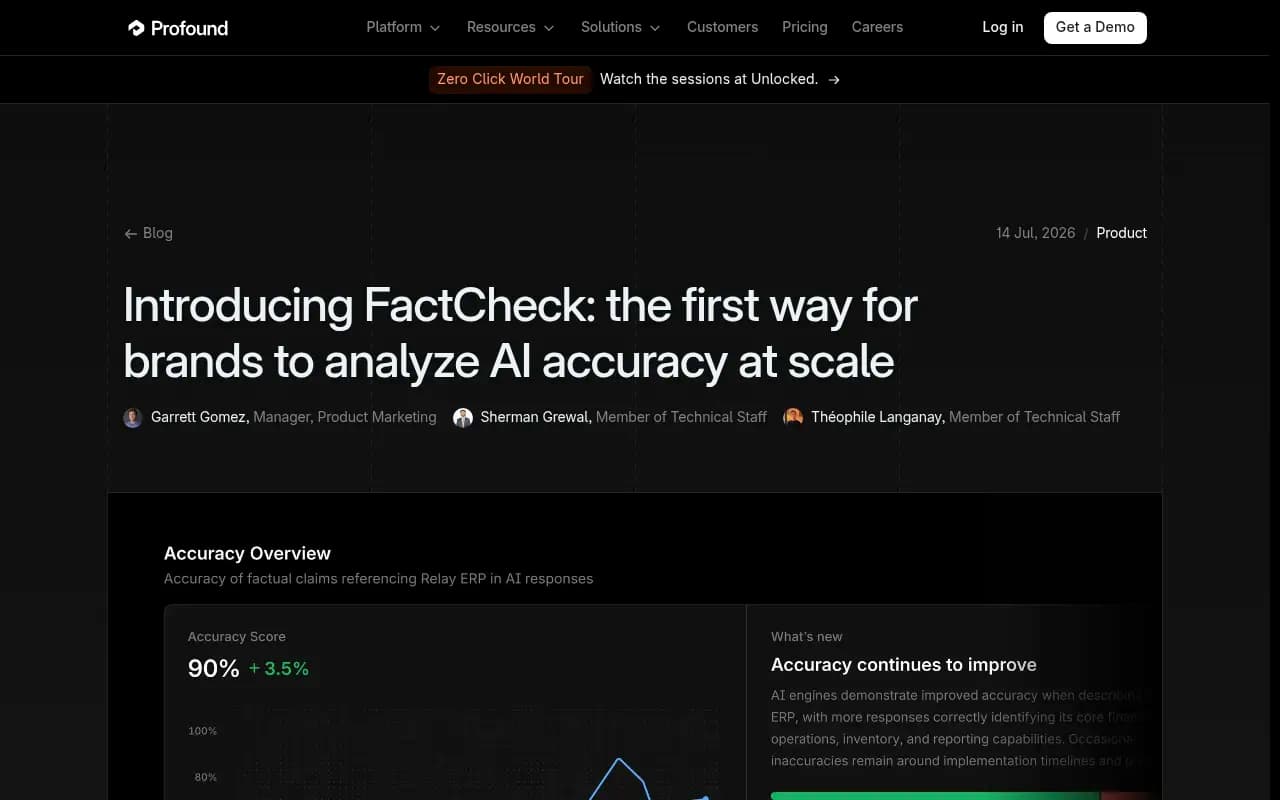
The approach is the same across tools: define what is true, then compare. Profound's FactCheck, for instance, has you tag prompts with a deterministic answer (pricing, specs, features, availability, policies), build a Knowledge Base by crawling your domain or uploading files, and then uses its own claim-detection model to compare each sentence against that base. Results show an overall accuracy score, inaccurate claims grouped by theme, and the AI claim side by side with your ground truth.
Promptwatch's version works from the claims Brand Narrative already extracted. You mark a claim Accurate or Inaccurate, and Fact Check then reads the pages crawled from your own site to find the ones that state the claim or its opposite, with quotes and a recommended next step. That answers the question that actually matters: which of my pages is AI learning the wrong thing from? Fact Check is available on Business, Agency Scale, and Enterprise, and uses Agent Credits.
Two cautions, whichever tool you use:
- A fact check is only as good as the ground truth. If your Knowledge Base is stale, your accuracy score is fiction. Assign an owner and a review date.
- Deterministic facts check well. Subjective claims like "best for startups" are a reputation question, not an accuracy one. Handle them under sentiment and positioning instead.
The manual version
No budget yet? Build a simple sheet. One row per claim, with columns for the prompt, the model, the date, the exact sentence, the true value, the page that states the true value, and a verdict. Fifty prompts across three models is a very reasonable first pass. The University of Maryland's guide on lateral reading is a handy habit for the verification step: open a new tab and check the claim against independent sources rather than trusting the answer's own framing.
Step 3: Trace each wrong claim to its source
Knowing something is wrong is easy. Knowing why is the hard part, and it determines the fix.
Omnibound's worked example is a good mental model. A starter price appears in nine places: the pricing page says $45, a 2024 PDF says $39, an archived page says $49, a partner page says $39, and an AI-written summary says $29. Four of the nine copies disagree, and an answer engine can't tell which is current. Invented, as they note, but most B2B brands would find something similar.
A wrong claim usually comes from one of these:
| Where the copy lives | Who controls it | Typical way it drifts |
|---|---|---|
| Your live page | You | Rarely wrong, but not always the clearest statement |
| Old pages, PDFs, help articles | You | Never updated or archived |
| Claimed directory profiles | You | Updated once and forgotten |
| Unclaimed listings | You can ask | Copied from an old source |
| Partner and reseller pages | You can ask | Lag behind your changes |
| AI-written summary pages | Nobody you can reach | Repeat whichever copy the writer used |
To find every copy of one fact, search your own site for the old value and old names, then check directories, partner pages, review sites, press, and forums, using both current and former wording. Log each copy with where it lives, the value it states, and when it was last updated (Omnibound's footprint audit lays this out well).
Citation data shortens the search. If your tool shows which URLs fed a given response, start there. Promptwatch's citation reports and Page Tracker show which pages and third-party sources AI cites for a prompt, and its crawler logs show whether AI bots can even read the corrected page. Promptwatch's own data on source counts is a reminder of how wide the net is: Google AI Overviews cite about 10 sources per answer and ChatGPT about 5 on web-search responses (average sources per response). With that many inputs, one stale page can easily be outvoted or, worse, win.
It's worth looking at your own site first. One company running its first FactCheck found its own untouched pages were the single biggest source of inaccurate claims. That is the cheapest fix there is.
Why wrong claims stick around
Don't expect them to vanish in a week. Promptwatch Data tracked every page ChatGPT cited on July 6, 2026 for 90 days. After 60 days, ChatGPT still cited 69% of landing pages and 67% of docs, and product pages, reviews, and how-tos sat at about 55%. News faded fastest, with half its pages gone after 36 days (content half-life in ChatGPT). Pricing pages count as landing or product pages, so an outdated pricing claim can be cited for months. The flip side is useful: keep those pages accurate and they keep working for you.
Step 4: Prioritize by harm
You will find more errors than you can fix this month. Rank them.
Omnibound suggests scoring harm from 1 to 3 (1 for a minor detail, 2 for something that changes a buying decision like price or an integration, 3 for legal, safety, compliance, or reputational exposure) and multiplying by how directly the copy answers a buyer question. CDP.com says the same thing in plainer terms: rank by prompt frequency, commercial stage, and potential harm, and fix pricing, security, and compliance claims first.
Two rules I'd add. Anything touching legal or safety goes to the right owner immediately, whatever its score. And one person on the marketing or comms side should own the correction queue, with product or support confirming feature and plan facts. Corrections stall when nobody owns them.
Step 5: Fix the source
The correct action depends on where the error lives. Soar Agency's routing table is a clean way to think about it:
| What you find | Next action | What to check afterward |
|---|---|---|
| Your own page is outdated | Correct the fact and every repeated passage | The public page shows the current rule |
| A third-party page is wrong | Send the exact passage and the current source | The publisher updates it |
| The source is right but the answer is wrong | Report the specific answer through the platform's feedback channel | Later answers read the source correctly |
| No source, or a similarly named company | Report the claim or mix-up and keep your public identity clear | Later answers identify the right company |
Your own pages
Keep one current page per fact and state it plainly near the top. Remove or redirect archived copies, and update PDFs and help articles. If you publish a lot of content, a content workflow that pulls from a single approved fact sheet beats chasing drift by hand. Promptwatch's Content Agent and Content Refresh are built for this, and the Content Agent can publish updates to WordPress, Webflow, or Framer, then follow the live page through crawls, citations, and AI traffic.
Third-party pages
Make the publisher's edit trivial. Send the page address, the exact wrong passage, the right value, and a link to your source of truth. Something like: "Your comparison says our Starter plan includes single sign-on. It does not; see the plan table at this URL." Log the request and the date. Claim every directory profile you can. Profound's agents can draft this outreach automatically, and Promptwatch's Offsite Mentions report finds third-party pages naming your brand, including ones that don't link to you, so you know where to send it.
Answers that misread a correct source
I could not find official, documented correction channels for ChatGPT, Gemini, or Perplexity, so treat in-product feedback buttons as best-effort rather than a guaranteed route. Record the question, the answer, and the date, report it, and keep your own page as the clearest statement of the fact.
Things you can't fix
Some copies, like AI-written summary pages, are out of your hands. Make your own page the clearest copy, keep tracking the prompt, and mark these as known unfixable so nobody burns a week on them.
Step 6: Recheck the same prompt
After fixes, ask the same prompt again with the same wording and compare the answer and its sources. A change is encouraging. No change usually means you haven't found the copy the engine is reading, or an identity mismatch exists. Source edits have no fixed timeline for changing generated answers, so keep the check on a schedule rather than expecting an instant flip.
Report two outcomes separately: the page correction and the improved AI answer. They happen at different times, and clients or executives will ask about both.
Tool comparison for claim accuracy
Prices below come from vendor pages and third-party roundups checked in October 2026. Confirm current pricing directly before buying.
| Tool | How it checks claims | Pricing notes | Best for |
|---|---|---|---|
| Promptwatch | Brand Narrative extracts claims; Fact Check matches them to crawled pages on your site, then the Content Agent and Action Board handle fixes | Brand Narrative on every plan from $95/mo; Fact Check on Business ($579/mo), Agency Scale, Enterprise | Teams that want detection, source tracing, and content fixes in one loop |
| Profound FactCheck | Own claim-detection model against a Knowledge Base; agents draft fixes and outreach | Custom Enterprise; free trial | Enterprise and regulated teams wanting audit trails |
| Peec AI | You write a fact list and it checks prompts against it | Starter $95/mo (5 prompts, 5 facts); Pro $245/mo (10 prompts, 20 facts) | Small, fixed fact sets |
| Waikay | Extracts claims and tags the model; you mark each correct or flag it by hand | From $24.95/mo | Budget manual review |
| AthenaHQ | Knowledge Base and claim review on Enterprise | Custom | Larger teams already on the platform |
A few notes from the Stride and Rework roundups. Stride is a vendor in its own comparison, so weigh it accordingly. Peec's lower tiers check very few facts, which can be thin for a real product catalog. And Rework says AthenaHQ and Peec AI stop at detection, while Profound's agent traces the claim and drafts a correction.



Suites like seoClarity sell accuracy monitoring as an add-on too.

If you want to compare more options, the GEO software directory at bestgeosoftware.com lists a wide set of visibility platforms.
A 30-day starter plan
- Week 1: List 20 to 30 fact-based prompts (pricing, plans, integrations, policies) and your approved answer for each, with the page that states it.
- Week 2: Run them across the major engines, extract the claims, and mark each Accurate or Inaccurate. Promptwatch's free AI visibility report is a no-login way to see a first reading before you commit.
- Week 3: Trace every wrong claim to its source, score by harm, and fix your own pages first.
- Week 4: Send publisher requests, then rerun the same prompts and log what changed.
If you'd rather hand the whole workflow to specialists, an agency like 1001 SEO Media runs GEO programs that include this kind of claim audit. Either way, the loop is the same: find the claim, find the source, fix it, check again.
What to remember
AI accuracy is a content-hygiene problem more than an AI problem. The model is repeating something it found, so the leverage is in the copies of your facts that you can control. Start with pricing, make one page the clear authority for each fact, and keep rechecking, because the answers will keep moving.