Key takeaways
- Both GetMint.ai and Meteoria.ai are AI visibility monitoring tools, but both have meaningful gaps that limit their usefulness for teams who need to act on data, not just read it.
- Meteoria.ai is a French-built platform focused on LLM brand monitoring; GetMint.ai covers a similar space with a broader feature set on paper.
- Neither platform offers the full action loop: find gaps, create content, track results. They're primarily monitoring dashboards.
- If your goal is to actually improve your AI search visibility rather than just observe it, you'll need a platform that goes beyond tracking.
- Tools like Promptwatch close the gap with built-in content generation, answer gap analysis, and crawler logs -- features neither GetMint nor Meteoria offer.
The AI search visibility space has exploded in 2026. Brands are realizing that showing up in ChatGPT, Perplexity, and Gemini responses matters just as much as ranking on Google -- maybe more, depending on your audience. So naturally, a wave of monitoring tools has followed.
GetMint.ai and Meteoria.ai are two of the names that come up in this category. Both pitch themselves as solutions for tracking how your brand appears in AI-generated responses. Both have real users. And both have real problems.
This guide is an honest look at what each platform does well, where each one falls short, and how they compare to each other and to more capable alternatives.
What GetMint.ai actually does
GetMint.ai positions itself as an AI search visibility and brand monitoring platform. It tracks how your brand appears across major LLMs -- ChatGPT, Perplexity, Claude, and others -- and gives you visibility scores, mention tracking, and some competitive comparison features.
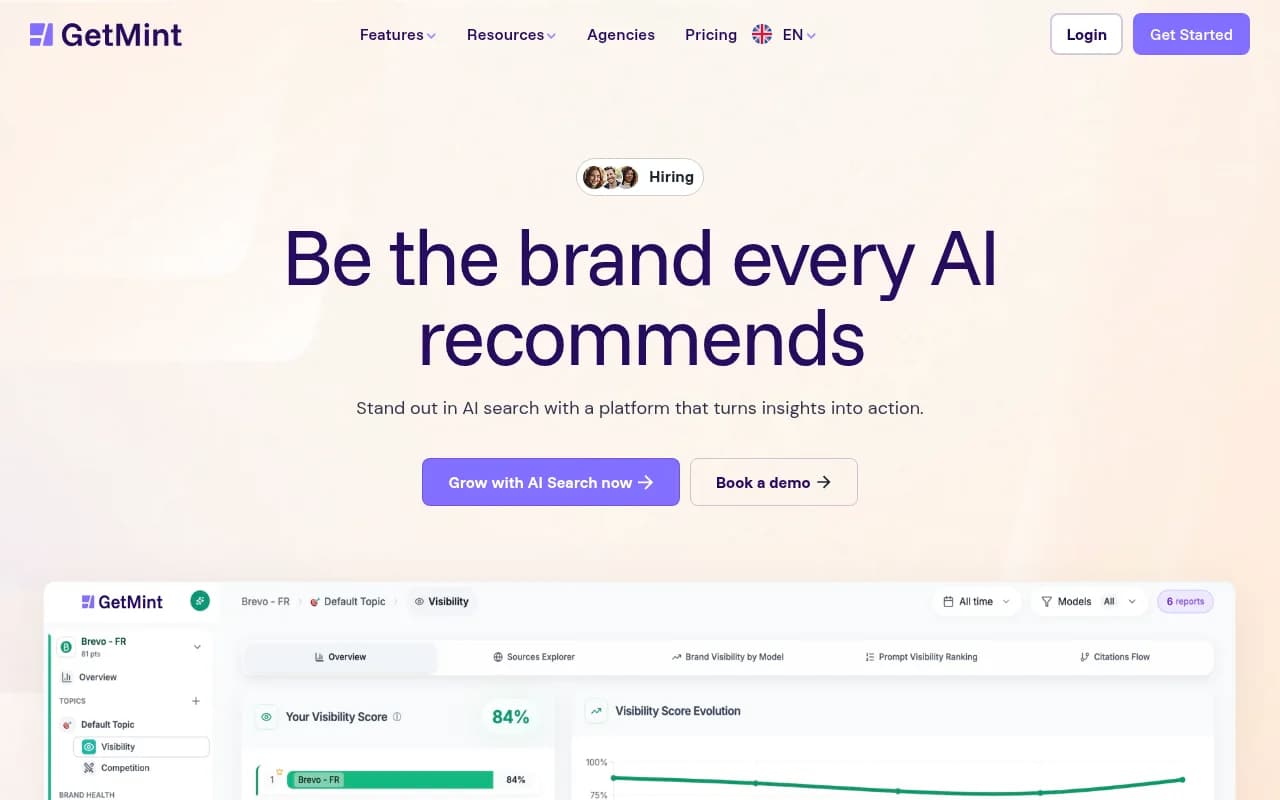
On paper, the feature list looks reasonable. You can set up prompts, monitor brand mentions, and get a sense of which AI models are citing you and how often. For teams just starting to think about AI search, that's a useful starting point.
The problems start when you try to do something with that data.
GetMint's core limitation is that it's a monitoring dashboard. It shows you where you're visible and where you're not, but it doesn't tell you why you're missing from certain responses, and it doesn't give you tools to fix it. You get a score. You don't get a path to improving it.
There's also the question of data depth. Prompt volume estimates, difficulty scoring, and query fan-outs -- the kind of intelligence that helps you prioritize which gaps to close first -- aren't prominently featured. If you're managing a large brand with hundreds of relevant prompts, that makes prioritization a guessing game.
What Meteoria.ai actually does
Meteoria.ai is a French platform that focuses on brand visibility in AI-generated responses. According to a roundup by Vydera, it queries major LLMs including ChatGPT and Perplexity, analyzes how your brand appears in those responses, and gives you monitoring data across models.
It's a clean, focused product. The French-language support is a genuine differentiator for European brands, and the interface reportedly makes it easy to set up basic monitoring quickly.
But "basic monitoring" is also the ceiling. Meteoria.ai is, by most accounts, a visibility tracker. It doesn't generate content, it doesn't analyze which specific topics your competitors are winning that you're not, and it doesn't connect your AI visibility data to actual traffic or revenue. You can see that you're invisible in certain responses. You can't easily figure out what to do about it.
The platform also has limited coverage compared to some competitors. If you need to monitor AI responses in multiple languages, across regional variants, or with persona-specific prompting, Meteoria's feature set gets thin quickly.
Head-to-head comparison
Here's how the two platforms stack up across the dimensions that matter most for teams trying to improve their AI search presence:
| Feature | GetMint.ai | Meteoria.ai |
|---|---|---|
| LLM monitoring | Yes (multiple models) | Yes (ChatGPT, Perplexity, others) |
| Brand mention tracking | Yes | Yes |
| Competitor comparison | Yes | Limited |
| Answer gap analysis | No | No |
| Content generation | No | No |
| AI crawler logs | No | No |
| Prompt volume/difficulty scoring | Limited | No |
| Reddit/YouTube citation tracking | No | No |
| Traffic attribution | No | No |
| Multi-language support | Limited | Better (French market focus) |
| ChatGPT Shopping tracking | No | No |
| Free trial | Yes | Yes |
| Pricing transparency | Moderate | Limited |
The table tells a clear story: both platforms cover the basics of monitoring, but neither has built the infrastructure for optimization. They show you a problem. They don't help you solve it.
The core problem with both platforms
The fundamental issue isn't specific to GetMint or Meteoria -- it's a category-wide pattern. Most AI visibility tools were built as dashboards first, with optimization as an afterthought (or not at all).
That made sense in 2024, when brands were just waking up to the fact that AI models were recommending products and services without necessarily citing their websites. The first question was "are we visible?" Monitoring tools answered that.
In 2026, the question has shifted. Brands now know they have visibility gaps. The question is "how do we close them?" And that's where single-purpose monitoring tools hit a wall.
If you're using GetMint or Meteoria and you discover that a competitor is showing up in ChatGPT responses for 40 prompts that you're not, what do you do next? You'd need to:
- Figure out which specific content gaps are causing the problem
- Create content that addresses those gaps in a way AI models will actually cite
- Track whether that content improves your visibility over time
- Connect visibility improvements to actual traffic and revenue
Neither platform helps with steps 1 through 4. They help you identify that the problem exists.
What to look for in a more complete platform
If you're evaluating AI visibility tools in 2026, here are the capabilities that separate monitoring-only tools from platforms that can actually move the needle:
Answer gap analysis. You need to see exactly which prompts competitors are winning that you're not -- not just that a gap exists, but the specific questions and topics your content isn't addressing. This is the starting point for any real optimization work.
Content generation grounded in citation data. Generic AI writing tools won't help here. You need content built around what AI models actually cite -- which sources, which formats, which angles. That requires real citation data at scale, not just keyword research.
AI crawler logs. Knowing which pages AI crawlers are visiting (and which they're ignoring or hitting errors on) is fundamental to understanding why your content isn't getting cited. Most monitoring tools skip this entirely.
Traffic attribution. Visibility scores are vanity metrics if you can't connect them to actual sessions and revenue. Look for platforms that offer GSC integration, a tracking snippet, or server log analysis.
Prompt intelligence. Volume estimates and difficulty scores for each prompt let you prioritize. Without them, you're optimizing blind.
Alternatives worth considering
If GetMint or Meteoria isn't cutting it, here are some platforms that go further:
Promptwatch is the most complete option in this space. It covers the full cycle: answer gap analysis to find what's missing, a built-in AI writing agent to create content engineered for AI citation, and page-level tracking to see results. It also includes AI crawler logs, Reddit and YouTube citation tracking, ChatGPT Shopping monitoring, and prompt volume/difficulty scoring. Used by 6,700+ brands including Booking.com and Center Parcs.

For teams that want solid monitoring with a clean interface, a few other tools are worth a look:

Otterly.AI is a good entry-level monitoring tool. It's affordable and easy to set up, though like GetMint and Meteoria, it doesn't offer content generation or gap analysis.
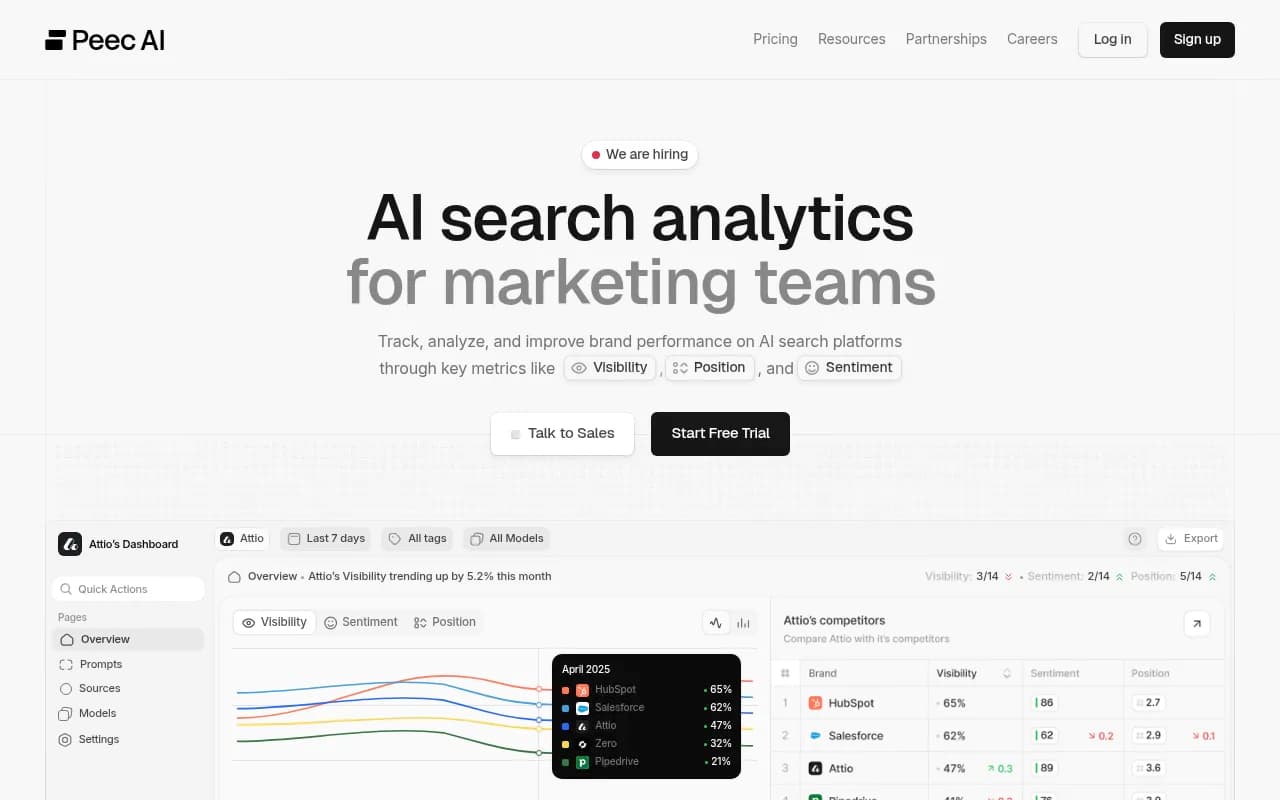
Peec AI covers AI search monitoring across major models. Similar story -- strong on tracking, limited on optimization.
Profound is a more enterprise-oriented option with stronger analytics, though it comes at a higher price point and doesn't include content generation either.
Scrunch AI sits in the mid-market range and offers decent competitive comparison features, though Reddit tracking and crawler logs are absent.
Which has more problems: GetMint or Meteoria?
Honestly, it's close -- and the answer depends on what you need.
Meteoria.ai has a narrower feature set, which means it's simpler to use but also more limited. If you're a French-market brand that needs basic LLM monitoring and doesn't need deep analytics or content tools, Meteoria might actually be the right fit. It does one thing and does it cleanly.
GetMint.ai tries to do more, which means there's more surface area for disappointment. The competitive comparison features and broader LLM coverage are genuine advantages, but the lack of optimization tools means you're still stuck after you find a gap.
For most teams in 2026, the bigger problem with both platforms is the same: they stop at observation. You can watch your competitors win in AI search. You can't use either tool to catch up.
If you're just starting out and want to understand your AI visibility baseline, either platform can get you there. But if you're at the stage where you need to actually improve your position -- create content that gets cited, fix crawler issues, attribute AI traffic to revenue -- you'll outgrow both quickly.
The AI search visibility category is still young, and the gap between monitoring tools and optimization platforms is real. Before committing to either GetMint or Meteoria, it's worth asking whether you want a dashboard that shows you the problem, or a platform that helps you fix it.