Key takeaways
- A point-solution stack (a tracker, a content tool, a crawler or analytics tool) can be cheaper on paper, but you pay the difference in integration work, and in the time between spotting a gap and fixing it.
- A full-stack platform makes sense when you want one place that connects visibility data, crawler behavior, traffic, and content production. It makes less sense if you only need a baseline.
- Most "best GEO tools" lists are written by vendors who rank themselves. Treat every ranking, including mine, as an opinion to test.
- AI engines change behavior in steps, so whatever you buy has to keep re-measuring. One-off audits mislead.
- Start small: a $29 to $95 tracker is a fine first move. Buy the bigger platform when the work, not the dashboard, becomes your bottleneck.
What the choice actually is
GEO tooling split into two camps pretty quickly. On one side you have monitors: they run a set of prompts against ChatGPT, Perplexity, Gemini and others, then report mentions, citations, sentiment and share of voice. On the other side you have platforms that also tell you why you are missing, write the content to fix it, and check whether the fix worked.
The question in the title is a real procurement decision. Do you buy one platform that covers monitoring, diagnosis and content, or do you assemble three tools yourself? Typically that looks like a cheap tracker, a content optimizer or writer, and something for crawler or traffic data (often your existing analytics plus Search Console).
Both are valid. The wrong answer is picking by price tag alone, so let's go through what you actually give up each way.
A note on bias before you read any listicle
I went through several of the current "best GEO tools" guides while writing this. Almost all of them are published by a vendor that ranks itself first. One of them, MaxAEO's, says so openly in an editorial disclosure and admits its product is not the best fit for every buyer. Credit for that. Olostep's guide makes the same observation about the category: most articles on this topic are published by the vendors they rank.
The Botric guide, similarly, frames the world as "monitoring-only vs full-stack" and puts Botric in the full-stack column. That framing is useful, and I will borrow it, but notice who wrote it. The same goes for me: this site is run by 1001 SEO Media, an agency that uses Promptwatch, and I will say where Promptwatch fits. Check my claims against pricing pages.
The four jobs a GEO stack has to do
It helps to stop thinking in product names and think in jobs. A working GEO program needs:
- Measure. Prompt tracking across engines, with mentions, citations, position, sentiment and share of voice.
- Diagnose. Why you are or are not cited. This means crawler logs (are AI bots reaching your pages, and hitting errors?), site audits, and which of your pages get cited.
- Produce. Content and page changes that close the gaps the data shows.
- Attribute. Whether any of it brings visits and conversions.
Monitoring-only tools do job one well. Content tools do job three well, but usually with no idea what AI engines are actually asking. Analytics tools do job four. Nobody gets job two for free from a tracker, and job two is where most teams get stuck.
Why continuous measurement is non-negotiable
This is the part that should shape your buying decision, because it applies to every option.
AI engines change in steps, and the steps are tied to model releases. Promptwatch Data tracked what happened when GPT-5.3 rolled out on March 4, 2026: in the week before, ChatGPT cited about 6.4 sources per search-enabled response. By late March it settled at roughly 4.7 to 4.9, about 27% fewer citation slots, and it had not recovered a month later. The drop hit GPT-5.3, GPT-5.4 and GPT-5-Mini at once. (ChatGPT citation drop after GPT-5.3)
If you had run a single audit in February and another in April, you would have concluded your content got worse. It did not. ChatGPT just cites fewer sources overall. Without continuous data, you cannot separate "we lost visibility" from "the engine changed."
Query behavior moves the same way. Promptwatch's ChatGPT query fanout data shows averages of about 2.15 distinct web searches per prompt in early December 2025, down to about 1.84 by early March 2026, and the average fanout query shrank from roughly 117 characters to the high 80s. Later, ChatGPT began using the site: operator at scale on August 8, 2026, jumping from about 0.4% to about 17% of fanout queries overnight, per Promptwatch's site: operator report.
Sources per response also differ by engine. According to Promptwatch's average sources data, ChatGPT cites about 5 sources per web-search answer, Google AI Overviews about 10, and Perplexity almost exactly 10 every day. Copilot swung from under 2 to nearly 17 within weeks. Perplexity's stability makes it a decent test bench: if your citations move there, it is probably your content, not noise.
The point for buyers: whichever route you pick, the data must be daily, from real engine interfaces, and kept over time. A cheap tool that runs weekly on a handful of prompts will give you exactly the single-snapshot problem above.
Option one: stitch three tools together
A typical stitched stack in 2026 looks like this:
- A tracker such as Otterly.AI (about $29/month for 15 prompts on four engines), Peec AI, or LLM Pulse.
- A content tool such as Clearscope, Surfer SEO, Frase or AirOps.
- Your existing analytics, Google Search Console, and maybe a log analyzer like Screaming Frog or Botify for the crawler side.



What stitching does well
- Low entry cost. You can start at $29 and learn what the category is before committing.
- Best-of-breed content. If you already love Surfer or Clearscope, keep them. Nobody says you must replace a working writing workflow.
- Swap-ability. When a tracker falls behind, you replace one piece.
- Existing stack reuse. If you pay for Semrush or Ahrefs, adding their AI tracking module means no new vendor to onboard.
Where it breaks
- The handoff gap. Your tracker says you are missing from "best X for Y" prompts. Your content tool knows keywords, not prompts. Someone has to translate between them, by hand, each time.
- No crawler data. Most pure trackers cannot tell you whether GPTBot or ClaudeBot actually visited the page you just updated, or hit a 403. You find out weeks later, when nothing changes.
- No closed loop. You publish, then wait, then guess. Did the page get crawled? Cited? Did it drive visits? Three dashboards, three definitions of "cited."
- Seats and credit sprawl. Three subscriptions mean three bills, three logins, and three sets of limits on prompts or articles.
- Reporting. Someone stitches the monthly report together in a spreadsheet. That someone is usually you.
Option two: one full-stack platform
The full-stack argument is simple, and Botric's guide puts it well: choose full-stack if you would rather the platform close the gaps itself. A workflow, not a dashboard.
There are a few real contenders. Promptwatch is the one I would point to first for end-to-end coverage: it tracks real engine interfaces (ChatGPT, Google AI Overviews, AI Mode, Gemini, Perplexity, Copilot, Meta AI and more), adds IP-verified AI crawler logs, visitor analytics for AI-referred traffic, a content gap analysis, and a Content Agent that writes and publishes to Webflow, Framer or WordPress, then tracks whether each page gets crawled, cited and clicked. Underperformers come back as actions on its Action Board.

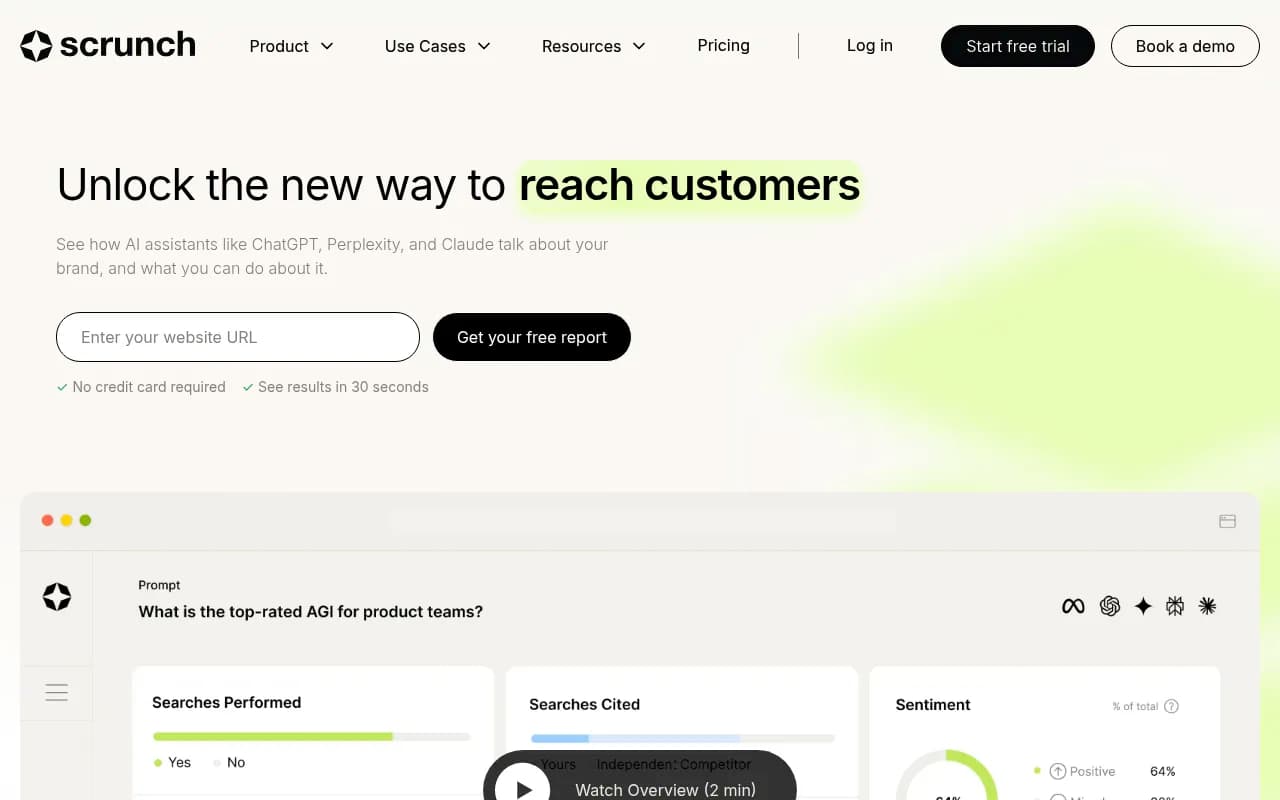
Others worth a look depending on your situation: Profound for enterprise monitoring depth, Scrunch, AthenaHQ, Botric (which has a free plan and paid tiers from $15/month), Relixir and Writesonic.


What full-stack does well
- One data model. Prompts, citations, crawler hits, traffic and content live in the same place, so you can ask "which pages rank in Google but never get cited by AI?"
- Shorter loop. The distance between finding a gap and publishing a fix is minutes or hours, not a sprint.
- Attribution. AI-referred visits and conversions sit next to citations. That is how you defend budget.
- One bill, one security review. For enterprise buyers, a single vendor with ISO 27001 or SOC 2 is far easier to approve than three.
Where it disappoints
- Higher floor. Full platforms usually start around $95 to $250 a month, not $29.
- Uneven depth. Some "all-in-one" tools are a strong tracker with a thin content editor bolted on. Test the weak half, not the strong half.
- Lock-in. Your prompt history and content live in one system. Make sure you can export (CSV, API, MCP).
- Paying for features you will not use. If you have no content team and no appetite to publish, an agent that writes articles is wasted money.
Side-by-side comparison
| Factor | Three point solutions | One full-stack platform |
|---|---|---|
| Typical monthly cost to start | $29 to $100 for tracking, plus $50 to $200 for a content tool | About $95 to $579 for one platform (Promptwatch Essential to Business) |
| Time from gap to published fix | Days to weeks (manual handoff) | Hours (gap analysis to content to publish) |
| Crawler visibility | Usually absent from trackers | Included in end-to-end platforms |
| AI traffic attribution | Via your own analytics, with effort | Built in on stronger platforms |
| Vendor reviews and security | Three | One |
| Flexibility to swap parts | High | Low to medium |
| Best for | First baseline, tight budget, strong existing content stack | Teams that need results, not reports |
A quick cost reality check
Using public list prices (confirm current numbers on each pricing page, they change fast):
- Otterly at about $29/month covers 15 prompts on four engines. A fine experiment.
- A content optimizer typically adds another $79 to $200 or more per month.
- Add a log or crawl analysis tool and the stack is easily $200 to $400, before counting the hours spent reconciling three sets of numbers.
- Promptwatch Essential is $95/month with 50 prompts, 6,000 responses, all AI models, a site audit and content gap analysis. Professional is $245 with crawler logs, 5 AEO articles and a Knowledge Base. Business is $579 and adds the automated Content Agent, local GEO targeting and Ads Radar. Agencies have separate plans starting at $199.
So the stitched route is cheaper at the very bottom and roughly equal in the middle. The difference is labor. If your time is billed or scarce, count it.
How to decide: five questions
- Do you already have a content workflow that works? If yes, keep it and buy measurement and diagnosis. If no, a platform that writes and publishes saves the most time.
- Can you see AI crawlers on your site today? If not, you cannot diagnose. Choose something with crawler logs or set up CDN log forwarding.
- Who will do the work? A solo marketer with 10 hours a week needs automation. A five-person content team can run a stitched stack.
- Do you need to show revenue? If a CFO will ask, you need AI traffic attribution, which most trackers lack.
- How many brands or clients? Agencies should look for per-client reporting, white-label output and unlimited projects, not three tools multiplied by twenty clients.
Quick recommendations by situation
| Your situation | Suggested route |
|---|---|
| Never tracked AI visibility, small budget | Start with a $29 tracker like Otterly, run it for 60 days |
| Already pay for Semrush or Ahrefs | Try their built-in AI module first, add depth later if needed |
| In-house team, wants measure plus fix plus attribution | Full-stack platform, such as Promptwatch |
| Agency with many clients | Agency-tier platform with white-label reporting; compare in the GEO software directory |
| Enterprise with procurement and compliance needs | One vendor with ISO 27001 or SOC 2, with SSO and audit logs |
How to test a platform in two weeks
Do not trust demos. Run this instead:
- Load 30 to 50 real prompts, including brand, competitor-comparison and generic category queries.
- Check that data comes from real engine interfaces, not only API calls. User-facing answers can differ from API output.
- Ask for crawler visibility. Can it show you which AI bots hit which pages, and which failed?
- Take one gap and ship a fix. Time how long it takes from "found" to "published."
- Check the date of every dip against model releases before blaming content.
- Try exporting everything. If you cannot get your data out, that tells you something.
The free end of the market is useful for step zero. Promptwatch offers a free Explore plan (ChatGPT only, 10 prompts), and its free AI Visibility Report needs no login. Amplitude AI Visibility and HubSpot's AI Search Grader give a one-time snapshot too.

What I would actually do
If I were starting from zero with a small team, I would not buy three tools. I would spend two weeks on a free or cheap baseline to learn which prompts matter, then move to one platform as soon as the bottleneck shifted from "what is happening?" to "who is going to fix it?" That shift usually comes within a quarter.
If I already had a strong SEO content process, I would keep it, buy a tracker with crawler data and attribution, and let the existing writers do the fixing. Stitching works when you have the people to be the glue. It fails when nobody owns the glue.
Either way, wherever you land, pick based on the loop, not the leaderboard. Can it measure, explain, fix and verify? If one product does all four, buy it. If you need three to do it, make sure someone has the job of connecting them. For more options by category, the directories at bestgeosoftware.com and ai-rank-tools.com are good places to keep browsing, and Promptwatch's data hub is worth bookmarking for tracking how engines change.